
I’m heading south to the urban sprawl of Manchester, to meet a very different kind of copper, one who lives at the dark end of the street. Aidan Waits was memorably brought to life (and death, I think) by Joseph Knox.
Aidan Waits inhabits a place where it never seems to be fully daylight, a world where he rubs shoulders with drug dealers and their customers, a city where violence is a common currency, and streets where broken hearts and disappointment walk hand in hand. Noir? Certainly, and probably the best British example of the genre in recent years. It’s not just Waits who is a creature of the darkness. His immediate boss, the ironically named DS Peter Sutcliffe, is a pretty awful specimen of both man and copper. They both glow with a certain righteousness only when they stand next to the repulsive Zane Carver, Waits’s sworn enemy and nemesis. If you click the image below, you will be able to read reviews of the three Aidan Waits novels, Sirens, The Smiling Man and The Sleepwalker.

Next, I am going to a different place and time altogether. Back through the centuries, and to a place that was considerably less dystopian than Joseph Knox’s Hieronymus Bosch-like Manchester. Shrewsbury in the early 12th century was, like most other towns, no stranger to dark deeds and the general venality of its inhabitants, but in the Brother Cadfael novels by Ellis Peters (Edith Pargeter) there is virtue to be found as well as kindness and redemption. There were 21 novels featuring the crime-solving Benedictine monk, beginning with A Morbid Taste for Bones (1977) and concluding with Brother Cadfael’s Penance (1994). It wouldn’t be fair to call the series ‘cosy’, but readers certainly became comfortable with the vividly authentic period settings, the intriguing crimes, and Cadfael’s own blend of worldliness – as befitted a man who was a former soldier – and Christian benevolence. So, what was Cadfael’s story?

For many people, the Cadfael stories will have been defined by the excellent TV versions, starring Derek Jacobi. That’s absolutely fine, and his portrayal must be added to the surprisingly short list of definitive adaptations that matched and enhanced the printed word. In my view, only John Thaw’s Morse, David Jason’s Jack Frost, Roy Marsden’s Adam Dalgliesh and David Suchet’s Poirot should be included, although there is – due to the number of options – a separate debate about Sherlock Holmes. For the record, it is Jeremy Brett for me, but that’s a discussion for another day. Go back to the printed word, though, for the most subtle and multi- layered portrait of Brother Cadfael – one of crime fiction’s immortals.


 n a fictional world overflowing with disfunctional detectives who happen to be rather good at their jobs, Joseph Knox has raised, or perhaps lowered, the bar considerably with his DC Aidan Waits. We first met Waits in
  Together with his grotesque partner and immediate boss, DI Peter Sutcliffe, Waits always gets the shitty end of the stick. ‘Sutty’ Sutcliffe is, you might say, a good old fashioned copper. Waits goes to meet him in a dingy rock-and-roll boozer:
 hy is Aidan Waits such a tortured character? Well, how long have you got? His childhood was loveless and chaotic, and spent largely in institutions where he rubbed shoulders with trainee failures, malcontents and killers. Echoing Nietzsche’s chilling remarks about the moral abyss, Waits has, more recently, gazed too long into a chasm inhabited by a repellent Manchester crime lord called Zane Carver. Carver has fed Waits’s drug habit, and the two have fought over women. Carver has a particular talent with women:
 s distinctive as Knox is as a stylist, and as much as he is a master of the inky black metaphor, he has a tale to tell and a plot to spin. The sepulchral calm of Martin Wick’s closely guarded hospital room is shattered by a savage attack which Waits survives, but puts him at the head of the queue as the police and the gutter press search for scapegoats. With Carver having decided to exact revenge on Waits by donning his black cap and pronounced the death sentence, Waits is on the run both from the gangster and, no less implacably, his politically motivated senior officers, but he keeps them at bay. He discovers faint-but-fatal fault lines in the original case against Martin Wicks, and finds that both Kevin Blake, the detective who brought Wicks to justice, and Frank Moore, the father of the murdered children, still have songs to sing.
 Joseph Knox writes like an angel. Possibly an Angel of Death, but he grasps the spluttering torch of English Noir once carried by such writers as Derek Raymond, and runs with such vigour that the flame burns brightly once again. He is not without humour, and there are many – if unrepeatable – gags exchanged between the cynical cops and their low-life prey. The politically correct nature of modern policing doesn’t escape his attention, either:
 nox has his grim fun with a Manchester police force that is barely honest, city down-and-outs who have lost most of the trappings of humanity, and an infestation of tattooed, Spice-addicted thugs straight from Central Casting – with Hieronymus Bosch as the agency’s head of HR. He also leaves us with a delightfully enigmatic final few pages. The Sleepwalker is published by Doubleday and will be
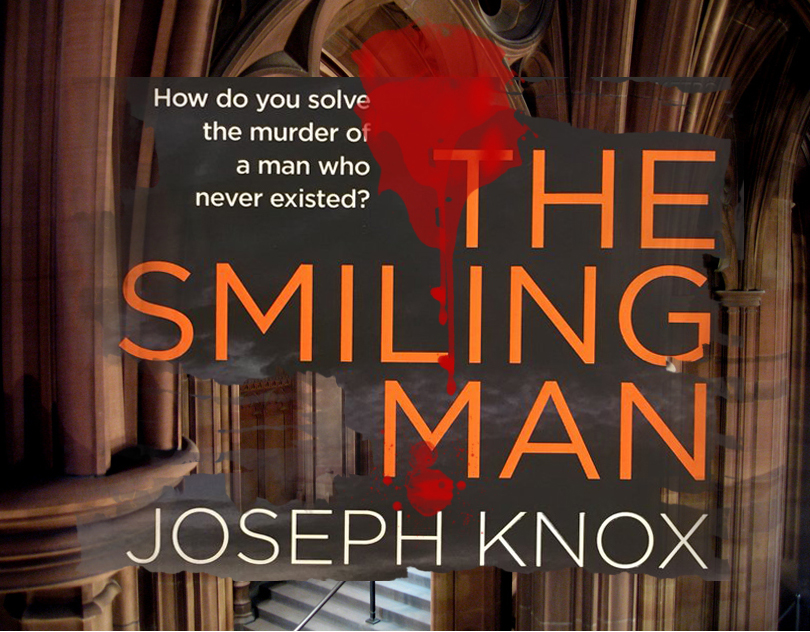

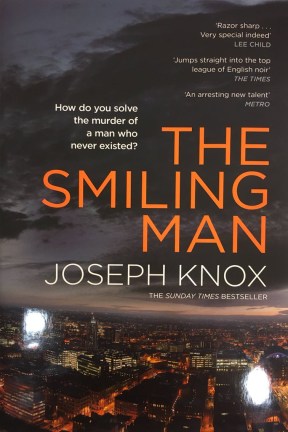 This is all too much like hard work for Sutcliffe, but despite warnings from his saturnine superior, Superintendent Parr, Waits digs deeper. He uncovers a labyrinthine series of connections between an absent solicitor doing his rich-white-man things among the bar girls of Thailand, an apparently gay businessman and his estranged wife, the corpse (now renamed The Smiling Man), and another hotel room, its floor saturated with pint after pint of human blood.
 This is little short of a modern masterpiece. You might imagine Joseph Knox (right) to be a weathered, life-weary cynical misanthrope, hunched in a corner of the pub, savouring a roll-up, rather like a latter day Derek Raymond, but anyone who has had the privilege of meeting Joseph will know that this is far from the case. He is well versed in the art of Noir, though, as he revealed when he spoke to us around the time that his first novel, Sirens, was published.
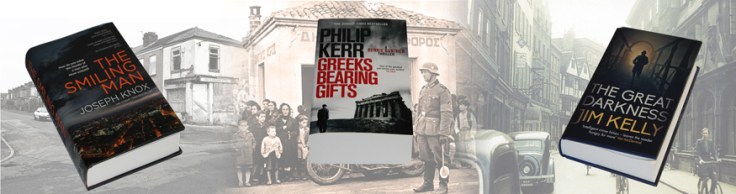
 Just as George MacDonald Fraser had his magnificent bounder Harry Flashman working his way through all the major political and military events of the the second half of the 19th century, so Philip Kerr (right) has positioned his wearily honest – but cynical – German cop Bernie Gunther in the 20th. We know Gunther fought in The Great War, but his service there is only, thus far, alluded to. We have seen him interact with most of the significant players in the decades spanning the rise of the Nazis through to their defeat and escape into post-war boltholes such as Argentina and Cuba. In the 13th book of this brilliant series, Gunther, joints creaking with advancing old age, is now working for an insurance company who want him to investigate a possible scam involving a sunken ship. His work takes him to Athens, where he discovers an unpleasantly familiar link to evil deeds committed under the baleful gaze of Adolf Hitler and his henchmen. Some of Bernie Gunther’s earlier exploits are covered


 So, Waits plays a dangerous double game which involves being undercover yet in full view. This paradox is essential. Obviously drug lord Zain Carver will know that Waits is a suspended copper; the deception will only work if Waits can convince the gangster that he is prepared to damage his former employers with leaked information. It requires no acting ability whatsoever for Waits to appear dissolute, addicted and troubled – that is his normal persona. However, a big problem looms. A rich and influential Member of Parliament has “lost” his teenage daughter. Isabelle Rossitter is one of the satellites fizzing around the planet Carver. Daddy is desperate to get her back, and Waits is given the task.


 fullybooked2017