

Bologna, northern Italy, November 1944. The introduction to this excellent novel explains the political situation in more detail but, in a nutshell, Italy is divided. The provisional ‘free’ government has surrendered to the Allies who are, painfully, fighting their way north up the spine of the country. Most of Italy – including Bologna – is still under German control. The city, with its ancient churches, porticos and squares, now resembles a giant farmyard. Rural villages around the city have now moved in, bringing livestock and farm carts full of straw and root vegetables.
Bolognese copper Comandante De Luca has three murders to investigate. The three dead men giving De Luca a headache are: Francesco Tagliaferri, in life an engineer, in death just a corpse with a shattered head, slumped against the column of a portico in Via Senzanome; Professor Franco Maria Brullo, of the city’s Faculty of Medicine, shot dead through the eye; most problematic, given the Germans’ penchant for violent retribution, is the corrupted body of a minor SS functionary, Rottenführer Weber, found floating in a flooded cellar. The latter is key, as if De Luca doesn’t solve the killing of the SS corporal the Nazi authorities will execute ten random Italian prisoners pour encourager les autres {or its equivalent in Italian.
As Caliban said, “The isle is full of noises,” and among the ‘noises’ to disrupt the lives of Bologna’s citizens are The Black Brigades (ultra violent fascist volunteers), the Bodogliani (left wing partisans loyal to the the King) and activists with all manners of allegiances in between. Rather like Philip Kerr’s immortal Bernie Gunther, De Luca tries to be a decent copper with his left hand tied behind his back and the fingers of his right holding his nose against the stench of corruption.
Parts of Bologna resemble a nightmare visualised in a Bosch painting. A young man in a derelict theatre – where shattered families are trying to rebuild their lives in the boxes once patronised by wealthy theatre-goers, faces Deluca. When challenged for his identity, he says,
“What do you want to see? My military rank? My exemption from labor?” He beat his hand on his shoulder and grimaced because he must have hurt himself. “Here are my documents. This,” he shook the empty sleeve, “I left in Russia. And what I am wearing,” he held the flap of his coat, “is all I have left.”
The Bologna winter is certainly dark, but Lucarelli’s prose renders the shattered city with the inky blackness of a genuine Noir novel.
“There was in the air the scent of old smoke, ashes and wet filth which Bologna always had during that year and a half of war. Damp and sticky in summer, dry and biting in winter. The stench of boiled cabbage and burnt oil, of urine and excrement, sweat and dust, cold and coarse like rusted iron.”
While reading this, my mind strayed to Joseph Heller’s Catch 22. Not only was Bologna the target for Yossarian’s squadron but, towards the end of the book, a cold wind blows away the buffoonery, and we are left with the blacked out streets, and the grim murder of the maid Michaela, by the psychopathic navigator, ‘Aarfy’ Aardvark.
Lucarelli gives us a labyrinthine plot and a reassuringly fallible central character, who makes many mistakes and wrong calls as he searches for the truth. Reassuringly, there is also a full glossary explaining the multitude of different factions and splinter groups which made up the Italian political landscape in 1944. Bizarre though it sounds given their brutality, the Wehrmacht and the SS give a sense of relative unity to what was, otherwise, chaos.
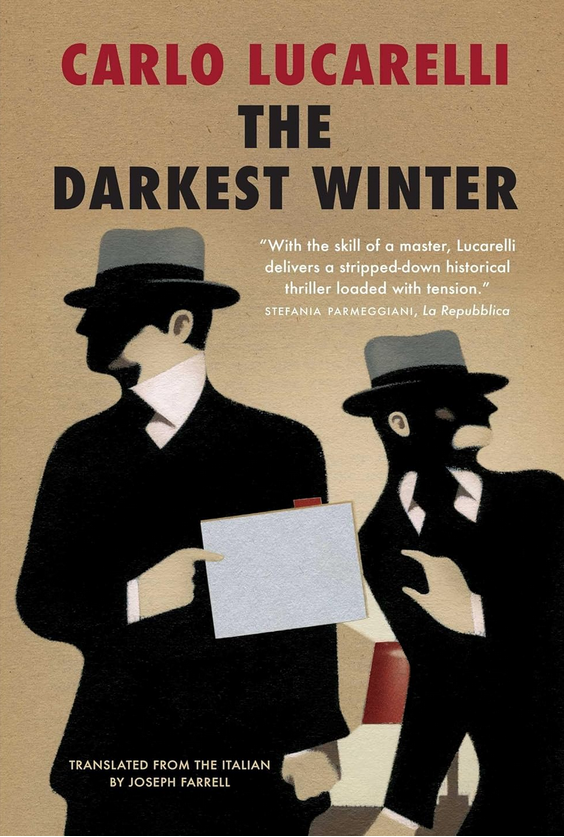
This novel follows on from three earlier books, known as the De Luca trilogy, consistg of Carte Blanche (it: Carta bianca, 1990), The Damned Season (it: L’estate torbida, 1991), and Goose Street (it: Via Delle Oche, 1996). The Darkest Winter, translated by Joseph Farrell, is published by Open Borders Press/Orenda Books, and will be available on 22nd May. For an Englishman’s view of a very different Italy, a few months earlier than Lucarelli’s story, you should read There’s No Home by Alexander Baron, where we join a British unit in the south of the peninsula, not long after the Germans had retreated to their defence lines further north.




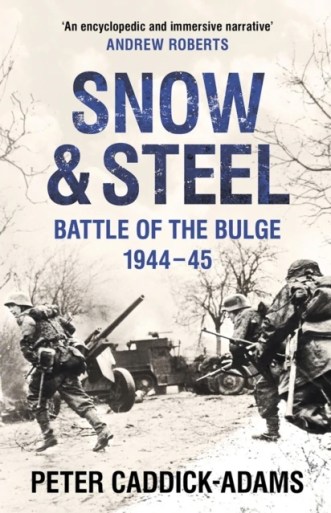 By the autumn of 1944, German forces had been pushed out of France and were being systematically overwhelmed by the Red Army in the east. The allies had control of the Channel coast, but the Germans had effectively wrecked the French ports. Antwerp, however, had been taken more or less intact, and when the Germans had been removed from their strong-points controlling the estuary of the River Scheldt, the Belgian port became a massive conduit for the arrival of men, machines and supplies for the Allies.
 It is one of the great paradoxes of WW2 that on the ground, at least, the Germans had the best guns, the best artillery and the best tanks. The problem was that although the formidable Panzers were easily able to overcome the relatively underpowered Sherman tanks used by the allies, the German vehicles were high maintenance and, some would say, over-engineered. The ubiquitous Shermans were rolling off the production lines in their thousands, while the formidable Tigers and Panthers – when they developed a fault – were fiendishly difficult to repair or cannibalise. Caddick-Adams (right) also reminds us how well-fed and supplied the American GIs were compared with their German foes. In one particularly eloquent passage, he tells us of the utter joy felt by a unit of Volksgrenadiers when they seized a supply of American rations. When their own kitchen unit eventually reached their position, the cooks and their containers of watery stew were given very short shrift.


 fullybooked2017