

I had been aware of this book for ages – it was first published in 1978 – but had never read it until now. My initial reaction was to be intrigued by Deighton’s premise. It is November 1941, the Germans have invaded and the pastiche document, headed Geheime Kommandosache at the beginning of the book tells us that Britain surrendered on 19th February. So, my first thought was “What happened?” Was there no Dunkirk, no Battle of Britain? What became of The Royal Navy? Presumably Rudolf Hess never made his bizarre flight to Scotland and the Molotov-Ribbentrop Pact is still unbreached. What of Reinhard Heydrich? Is he just a couple of months into his new job as Reich Protector of Bohemia and Moravia? I read on, hoping that Deighton’s rather audacious re-write of history would be plausible.
We open with what appears to be a relatively mundane murder mystery. A prominent – and successful black marketeer is found shot dead in his flat-cum-warehouse in London’s Shepherd Market, and Detective Superintendent Douglas Archer (whose boss now is Gruppenführer Fritz Kellerman) is sent to investigate. It rapidly becomes obvious that the corpse identified as one Peter Thomas is no such person, and that his death has triggered a dramatic response from Berlin, in that Standartenführer Huth, a senior SS investigator, has been sent to London to take over the case.
In fairness, a few chapters in we disciver that Churchill has been shot by a firing squad in Germany and King George VI, like the long lost princes, is imprisoned in The Tower of London. Deighton also teases us with furtive appearances from the British resistance movement, and hints that the death of ‘not Peter Thomas’ may be connected with something deeply dangerous, perhaps connected to the search to make a nuclear weapon. Huth establishes himself, at least superficially, as the very worst kind of SS officer, but around half way through the book Deighton pulls a couple of very clever rabbits out of the hat, in terms of the plot. Regarding Oskar Huth, wise readers will reserve their judgment. Archer becomes involved with Barbara Barger, an influential American war reporter and, because of his apparently willing co-operation with the German authorities, he reaches number one on the assassination hit list of the resistance movement.
We learn the answer to the Molotov-Ribbentrop conundrum when, with a wonderfully Baroque flourish, Deighton turns the story on its head by describing a heavily orchestrated ceremony to disinter the remains of Karl Marx from Highgate and move them to Moscow. It all goes spectacularly wrong, and Archer is swept along on the tide of events. The focus of the story soon becomes clear, and it is the possession of vital information that will allow those who own it to make a nuclear bomb.
Deighton’s meticulous historical research allows him to put to good use the dichotomy between the regular German army and the ‘upstart’ SS, and the deep distrust which Hitler’s inner circle felt for the Abwehr, the intelligence agency for the army. He also describes the German unease about royalty. Remember that ‘Kaiser Bill’, the last German royal ruler was, in the autumn of 1941, only a few months in his grave. Our reluctant monarch, King George VI plays a part in the denouement of this story. Already a sick man, he is used as merely a piece on the international chess board, and not a very potent one.
Going back to my initial reservations, Deighton doesn’t explain how Hitler’s forces managed to invade Britain in spite of what we know as the serious military impediments in his path. We do learn that Hitler and Stalin, at least on paper, are still best pals, but my overwhelming response to what is a fiendishly clever reworking of history is simple: thank God for Dunkirk, the RAF – and America. This edition is from Penguin Modern Classics and is available now
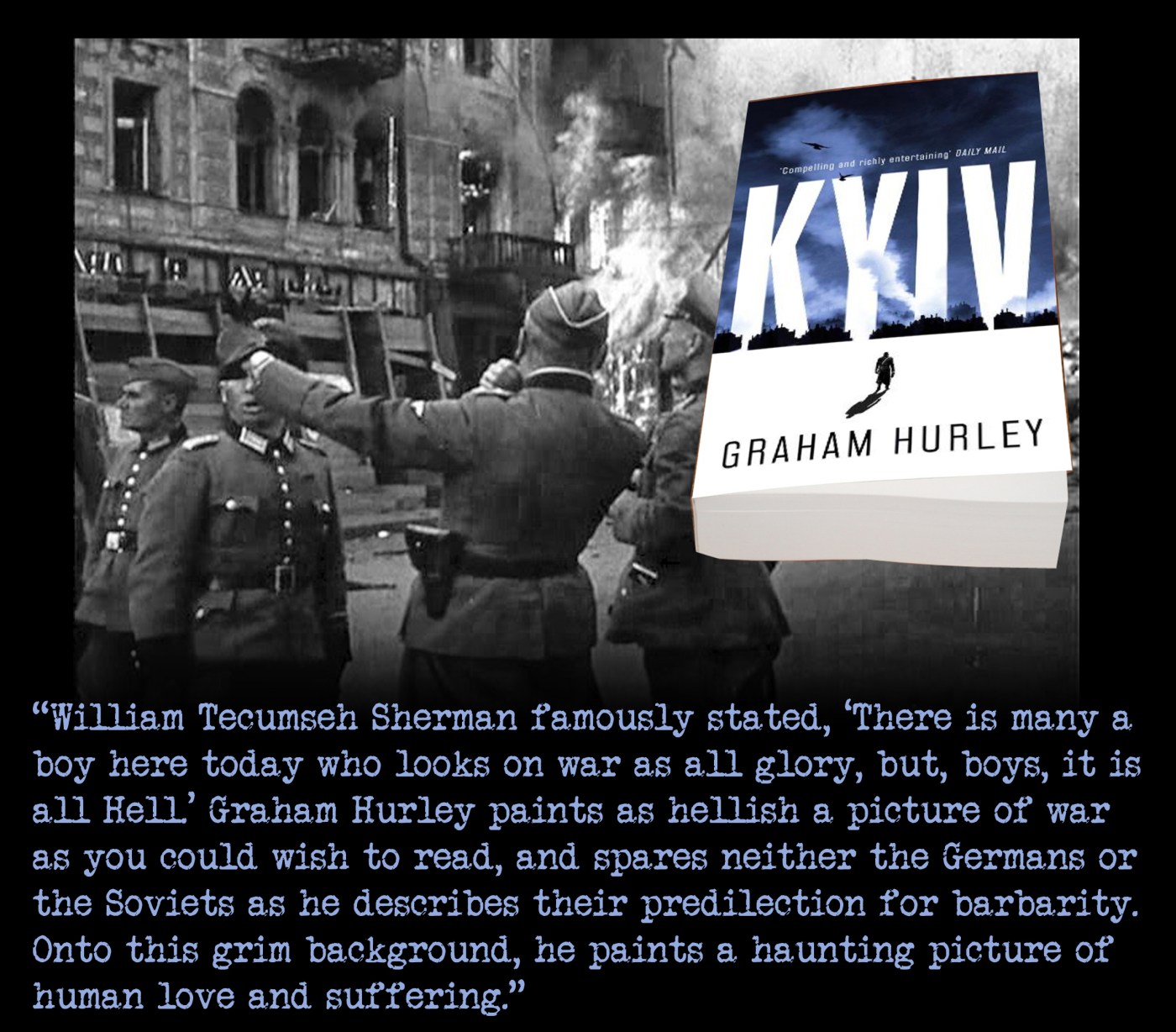
 Graham Hurley is, for me, one of the outstanding crime writers of this generation. His Joe Faraday series was simply wonderful, and the Jimmy Suttle spin-off books were just as good. His
  Knowing, as we do now, that the invasion of Russia was a disastrous strategic mistake which eventually brought the downfall of the Third Reich, shouldn’t diminish our appreciation of this book. In some ways, we are in


 fullybooked2017