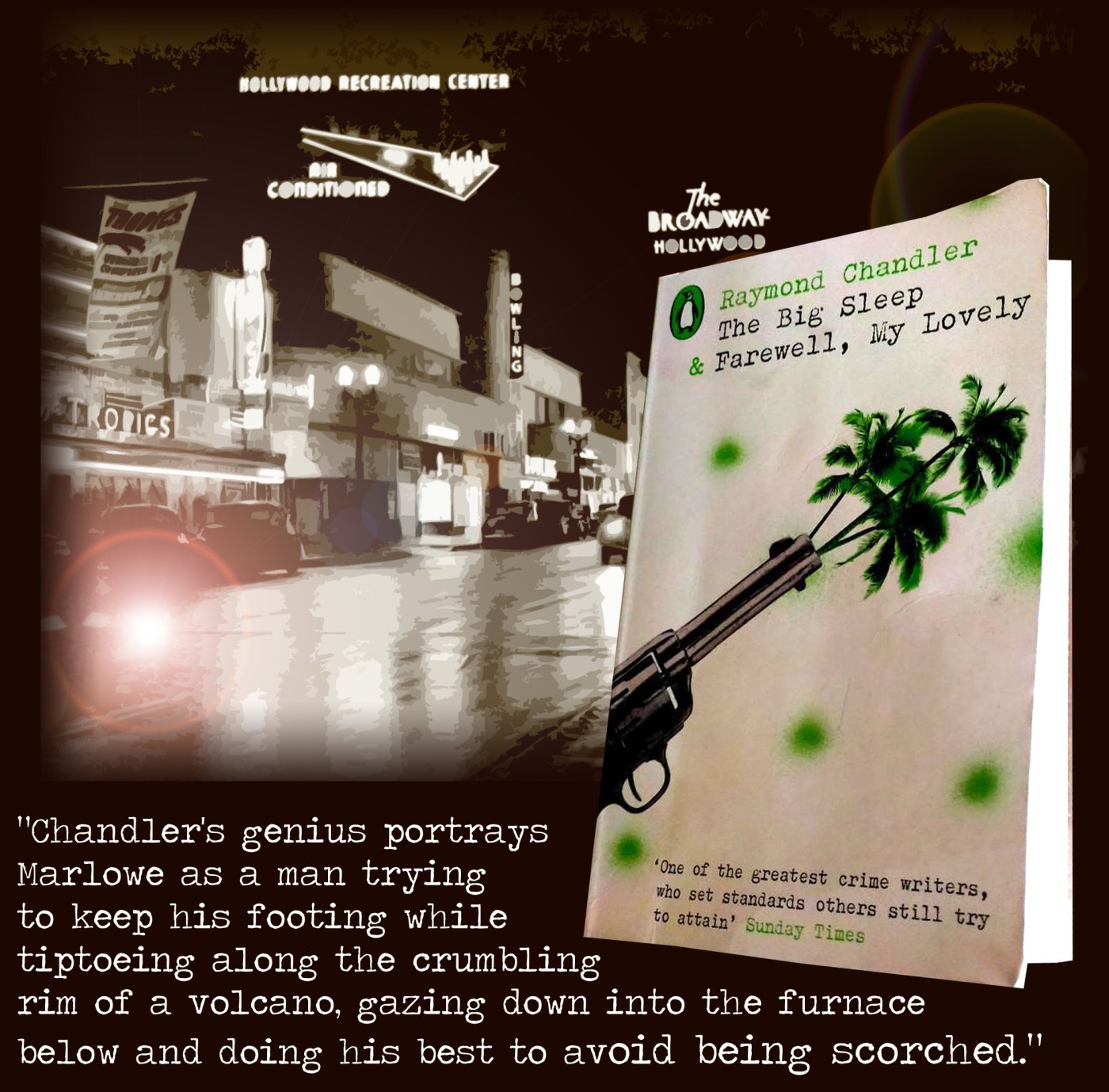

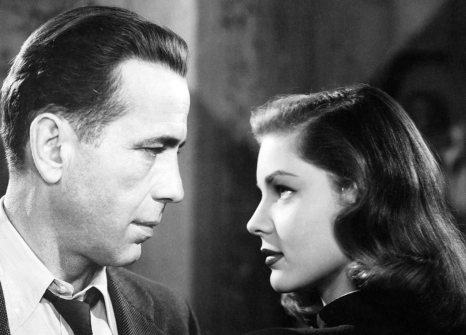
 The Big Sleep was published in 1939, but the iconic film version, directed by Howard Hawks, wasn’t released until 1946. Are the dates significant? There is an obvious conclusion, in terms of what took place in between, but I am not sure if it is the correct one. The novel introduced Philip Marlowe to the reading public and, my goodness, what an introduction. The second chapter, where Los Angeles PI Marlowe goes to meet the ailing General Sternwood who is worried about his errant daughters, contains astonishing prose. Sternwood sits, wheelchair-bound, in what we Brits call a greenhouse. Marlowe sweats as Sternwood tells him:
“I seem to exist largely on heat like a newborn spider, and the orchids are an excuse for the heat. Do you like orchids?”
“Not particularly.”
“They are nasty things. Their flesh is too much like the flesh of men. And their perfume has the rotten sweetness of a prostitute.”
The General can no longer drink alcohol, but he enjoys watching men who can:
“The old man licked his lips watching me, over and over again, drawing one lips slowly across the other with a funereal absorption, like an undertaker dry-washing his hands.”
“I used to like mine with champagne. The champagne as cold as Valley Forge and about a third of a glass of brandy beneath it.”
Sternwood has two daughters. The elder, Vivian, was married to a an ex-IRA bigshot called Rusty Reagan, a man much admired by his father-in-law, but he has disappeared. The younger girl, Carmen, has gone off the rails completely, and has been sucked into a world of drugs, vice and pornography.
Initially, Marlowe’s brief from the General is to find out what is going in with Carmen. He soon discovers that she is involved with a pornographer called Geiger. He goes to Geiger’s house, and sits in his car outside, the rain teeming down.
“As the darkness folded back on it and ate it up a thin tinkling scream cried out and lost itself among the rain drenched trees. I was out of the car and on my way before the echoes died. There was no fear in the scream. It had a sound of half pleasurable shock, an accent of drunkenness, overtone of pure idiocy. It was a nasty sound. It made me think of men in white and barred windows and hard narrow courts with leather wrist and ankle straps fastened to them.”
Forcing his way into the house, Marlowe finds an interrupted photoshoot:
“Neither of the two people in the room paid any attention to the way I came in, although only one of them was dead. She was wearing a pair of long Jade earrings. They were nice earrings and had probably cost couple of hundred dollars. She wasn’t wearing anything else.”
The drugged Carmen Sternwood had clearly been in the middle of a pornographic photo shoot and beside her is Geiger – shot dead. After taking Carmen back to the Sternwood mansion Marlowe returns to Geiger’s house, where he has left his car. He finds that Geiger’s body has gone and the crime scene has been interfered with. Wondering who has taken the corpse, he makes the celebrated comment:
“Dead men are heavier than broken hearts.”
The plot then becomes something of a whirling dervish pirouetting in the California dust, sometimes moving so fast and in such unexpected directions that it is not easy to keep track of what is going on. We meet Joe Brody, a small-time spiv who is trying to muscle in on Geiger’s pornography racket. He is shot dead by Geiger’s homosexual lover, and then Marlowe becomes aware of a much more sinister figure – gangster Eddie Mars, who is connected to Vivian Sternwood. This mad dance however is subsidiary to the poetry of Marlowe’s view of the dark world he inhabits. Chandler’s genius portrays Marlowe as a man trying to keep his footing while tiptoeing along the crumbling rim of a volcano, gazing down into the furnace below and doing his best to avoid being scorched.
In the end, as in all great novels it comes down to who we as readers care about. We don’t care too much for Carmen. We don’t care at all for the scattering of underworld figures who populate the book. We care about Vivian, who is damaged but perhaps redeemable. We care about the dying general still trying to protect his daughters and his legacy. Another cruel irony for the old man is the fate of Rusty Reagan, his corpse long since dumped in one of oil wells that have brought the family their immense wealth Above all, however, we care about Marlow and the bruises – mental and physical – he sustains while trying to do his job.
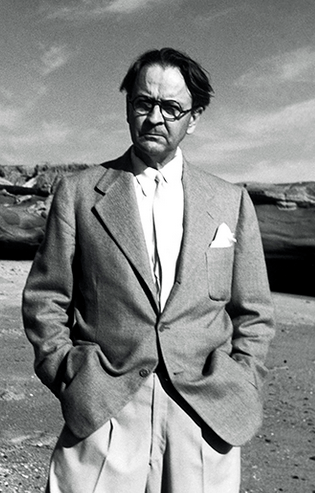 The book began with an optimistic Marlowe:
“I was wearing my powder blue suit, with dark blue shirt, tie, and display handkerchief, black brogues, black wool socks with dark blue clocks on them. I was neat, clean, shaved and sober, and I didn’t care who knew it.”
It ends with him making a bitter deal with Vivian, that she will take Carmen as far away as possible from the moral cesspit she has been bathing in, and that the fate of Rusty Reagan will be kept from her father.
“Me, I was part of the nastiness now. Far more a part of it than Rusty Reagan was. But the old man didn’t have to be. He could lie quiet in his canopied bed, with his bloodless hands folded on the sheet, waiting. His heart was a brief, uncertain murmur. His thoughts were as grey as ashes. And in a little while he too, like Rusty Reagan, would be sleeping the big sleep.”
The edition I read for this review was published by Penguin, and is part of their recent series of ‘Green Penguin’ crime classics. It is paired with Farewell My Lovely, and is available now.


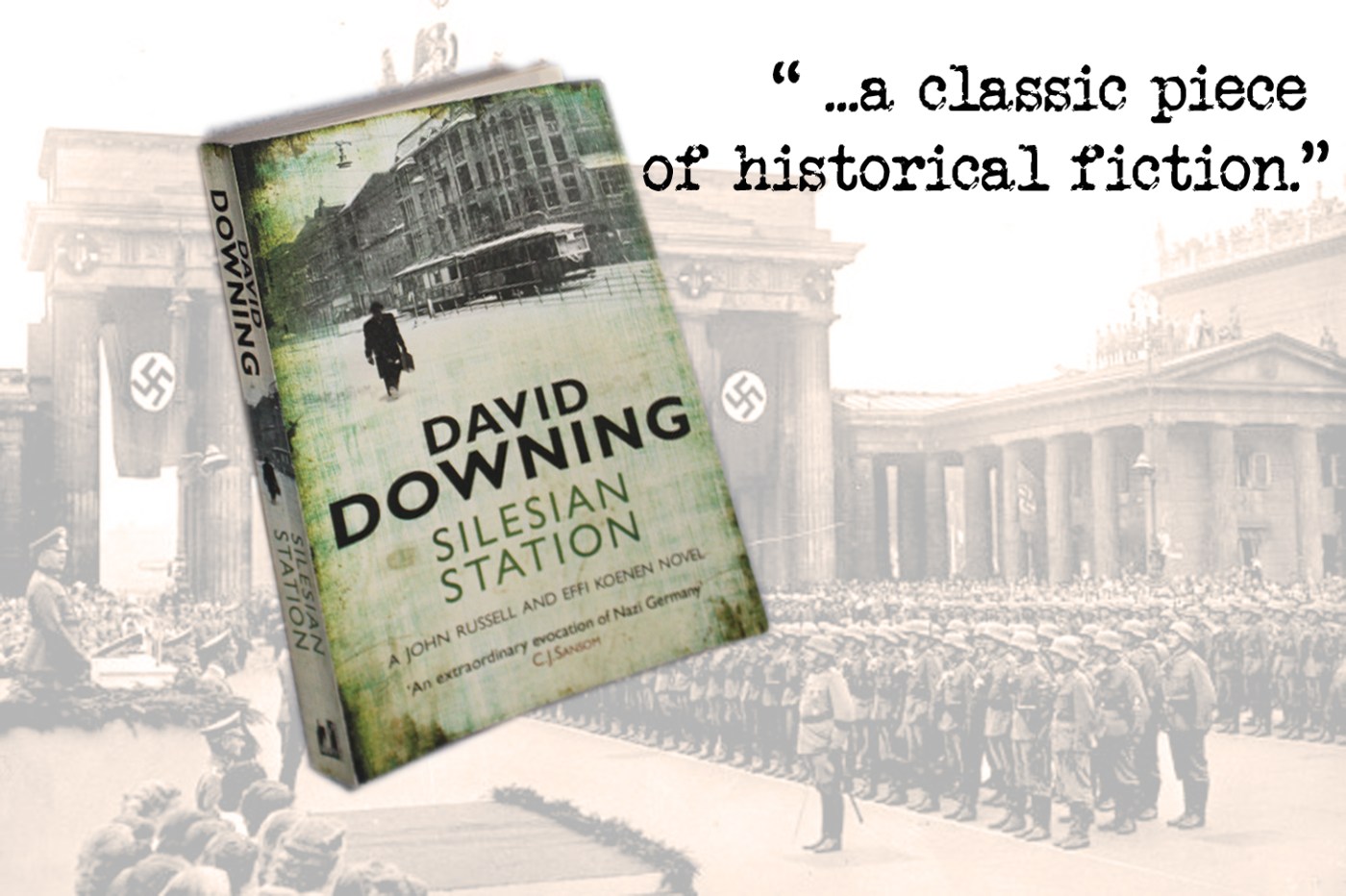

 Russell is a survivor, a man who can usually talk his way out of trouble. Multilingual, and with that all-important American passport, he keeps a wary eye on the features he wires back to his newspaper in the states, but has – more or less – managed to stay out of trouble with the various arms of the Nazi state – principally the Gestapo, the SS and their nasty little brother the Sicherheitsdienst. Russell fought in the British Army in The Great War, but in its wake became a committed Communist. Although he has now ‘left the faith’ he still maintains discreet contacts with the remaining ‘comrades’ in Berlin. With that in mind, it is unsurprising, perhaps, that he has been manoeuvred into the sticky position where both the German and Russian intelligence services believe that he is working uniquely for them, and he is being used to pass on false information from one to the other.
 In this febrile atmosphere are many men and women who have memories of “the last lot”. One such is the latest creation from Jim Kelly, (left) Detective Inspector Eden Brooke. He saw service in The Great War, but were someone to wonder if his war had been ‘a good war’, they would soon discover that he had suffered dreadful privations and abuse as a prisoner of the Turks, and that the most physical legacy of his experiences is that his eyesight has been permanently damaged. He wears a selection of spectacles with lenses tinted to block out different kinds of light which cause him excruciating pain. For him, therefore, the nightly blackout is more of a blessing than a hindrance.


 When it comes to creating a sense of place in their novels, there are two living British writers who tower above their contemporaries. Phil Rickman, (left) in his Merrily Watkins books, has recreated an English – Welsh borderland which is, by turn, magical, mysterious – and menacing. The past – usually the darker aspects of recent history – seeps like a pervasive damp from every beam of the region’s black and white cottages, and from every weathered stone of its derelict Methodist chapels. Jim Kelly’s world is different altogether. Kelly was born in what we used to call The Home Counties, north of London, and after studying in Sheffield and spending his working life between London and York, he settled in the Cambridgeshire cathedral city of Ely.
 It is there that we became acquainted with Philip Dryden, a newspaperman like his creator but someone who frequently finds murder on his doorstep (except he lives on a houseboat, which may not have doorsteps). While modern Ely has made the most of its wonderful architecture (and relative proximity to London) and is now a very chic place to live, visit, or work in, very little of the Dryden novels takes place in Ely itself. Instead, Kelly, has shone his torch on the bleak and vast former fens surrounding the city. Visitors will be well aware that much of Ely sits on a rare hill overlooking fenland in every direction. Those who like a metaphor might well say that, as well as in terms of height and space, Ely looks down on the fens in a haughty fashion, probably accompanying its haughty glance with a disdainful sniff. Kelly (above) is much more interested in the hard-scrabble fenland settlements, sometimes – literally – dust blown, and its reclusive, suspicious criminal types with hearts as black as the soil they used to work on. Dryden usually finds that the murder cases he becomes involved with are usually the result of old grievances gone bad, but as a resident in the area I can reassure you that in the fens, grudges and family feuds very rarely last more than ninety years
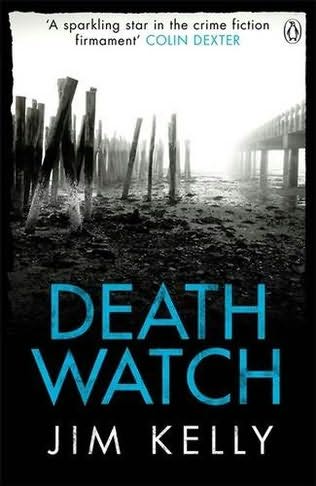 In the Peter Shaw novels, Kelly moved north. Very often in non-literal speech, going north can mean a move to darker, colder and less forgiving climates of both the spiritual and geographical kind, but the reverse is true here. Shaw is a police officer in King’s Lynn, but he lives up the coast near the resort town of Hunstanton. Either by accident or design, Kelly turns the Philip Dryden template on its head. King’s Lynn is a hard town, full of tough men, some of whom are descendants of the old fishing families. There is a smattering of gentility in the town centre, but the rough-as-boots housing estates that surround the town to the west and the south provide plenty of work for Shaw and his gruff sergeant George Valentine. By contrast, it is in the rural areas to the north-east of Lynn where Shaw’s patch includes expensive retirement homes, holiday-rental flint cottages, bird reserves for the twitchers to twitch in, and second homes bought by Londoners which have earned places like Brancaster the epithet “Chelsea-on-Sea.”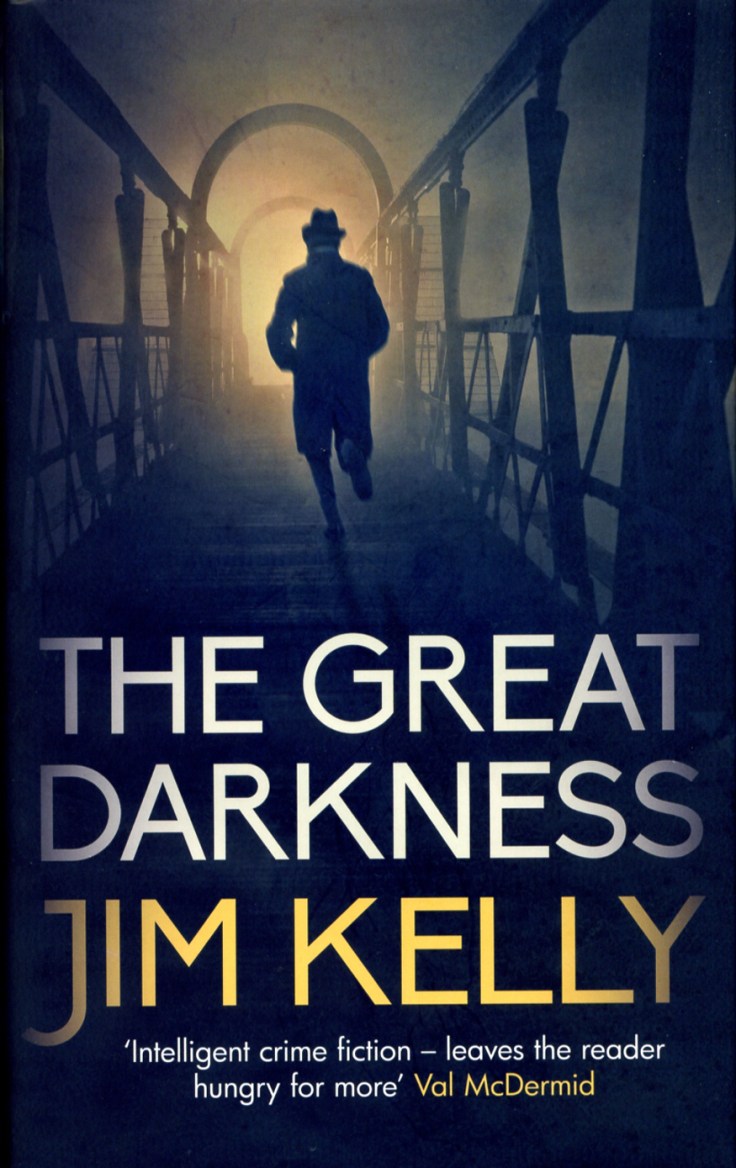


 It is the summer of 1939. In Germany, the bitter ashes which have been smouldering for two decades since the punitive reparations after Versailles have been fanned into flames, and the fire is set to spread across Europe. As Hitler prepares to march into Poland, in Britain the world carries on as normal, although few would know that this would be the last summer of peace for more than six years.
 Rachel Rhys (right) is nothing if not a skilled storyteller, but we should not be surprised as Dangerous Crossing is no debut novel. Under her real name, Tamar Cohen, she has written a string of best selling psychological thrillers. So, as the Orontes proceeds on its stately voyage to Australia, we share Lily Shepherd’s mixture of discomfort and amazement as she goes onshore to visit such exotic places as Pompeii, Cairo and Colombo. Rather after the fashion of a modern day Patricia Highsmith, Rhys has the main players gradually revealing their secrets to one another. The rack turns, one ratchet at a time, but so elegantly and cleverly are things concealed that the crime, when it does happen, is completely shocking and unexpected.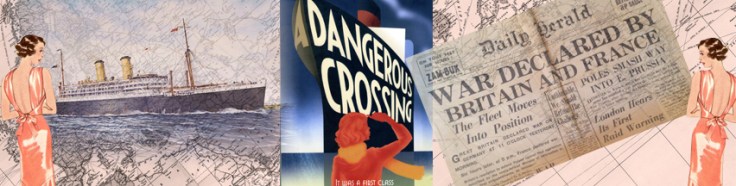


 fullybooked2017