Search

fullybooked2017

Tag

1919

THE PARIS PEACEMAKERS . . . Between the covers

TPP SPINE041 copy

The guns that began their incessant thunder in August 1914 are, at last, silent. The German field army has surrendered, the Kaiser’s High Seas Fleet lies at anchor in Scapa Flow, and Wilhelm himself has abdicated. In Paris, the great, the good – but more importantly, the victorious –  are assembling to pick the bones out of five years of carnage. Meanwhile, we meet the Rutherford family. Their home is in Thurso, on the stormy north eastern coast of Scotland. Jack is just one of nearly 900,000 British men to have paid what was poetically called ‘the supreme sacrifice’. His sisters are both now in France: Corran is with a charity in Dieppe, bringing some sort of education to young soldiers who have had academic opportunities denied them for the last five years. Stella is in Paris, having been engaged as one of the hundreds of typists needed to record the decisions and arguments in the drama shortly to be played out at Versailles. Alex is still on Royal Navy duties, with his ship keeping a watchful eye on a war that is still being fought between Russian Bolsheviks and the Tsarists they overthrew.The novel follows the lives and loves of the Rutherford girls.

Flora Johnston handles the historical background well. It is now widely acknowledged that the Treaty of Versailles did not end the war between Germany and her enemies. It merely put it in on hold for twenty years. There was not to be a new world, or anything remotely like the ‘land fit for heroes’ that optimists imagined, either in Britain or France,and certainly not in Germany. In vain did US President Wilson strive for some kind of settlement that would be for all time. Who can blame France – with 1.4 million dead, thousands of villages reduced to rubble, its industry shattered and a priceless architectural heritage destroyed – for wanting to make Germany pay?

We see 1919 through many different eyes, and this is a story skillfully told. Arthur, Corran’s teacher colleague is embittered by the sacrifices his own parents made to educate him, and white-knuckled with anger that, back home, his own family, protesting against the lack of jobs, are faced with baton charges by police. Rob Campbell, once Corran’s intended fiancée, is worn down and traumatised by his work as a battlefield surgeon. His fondest hope is purely escapist, and it is that one day he might be able to relive his glory days on the rugby pitch. But with so many of his fellow players rotting under the French and Belgian soil, what hope does he have?

The game of rugby is a powerful motif in this story. in an England-Scotland game in March 1914 the thirty young men are at the peak of fitness, chests bursting with pride. Too many of those chests would, in the coming turmoil, simply become targets for German bullets and shell fragments. On New Year’s Day 1920, the first game of any consequence to follow the war was played, between France and Scotland. It is a small and hesitant step forward, but there are too many missing names of the teamsheets.

The story is a remarkable blend of history, romance and social observation. Flora Johnston is a fly on the wall at a bitter ceremony in a young man’s bedroom that must have been repeated countless times across Britain and, indeed, France, and Germany:

She felt again the overwhelming sadness of sorting through Jack’s possessions yesterday. All over the country there were houses like this, filled with the ephemera of hundreds of thousands of lives that had unexpectedly ceased to exist. Clothes and footballs, bicycles and egg collections, razors and comics and diaries and gramophone records. So much of it: surely far too much for the nations attics or rubbish heaps or junk shops to absorb.”

The Peacemakers of Paris reaches out to so many different readers. WW1 buffs who appreciated Birdsong and Pat Barker’s trilogy will find something here. Those who like romance, a hint of heartbreak, but an optimistic ending will also be happy. Most importantly, anyone who enjoys a novel which is well researched with convincing characters will not be disappointed. Published by Allison & Busby, the book is available now.

Screen Shot 2024-04-17 at 17.30.01

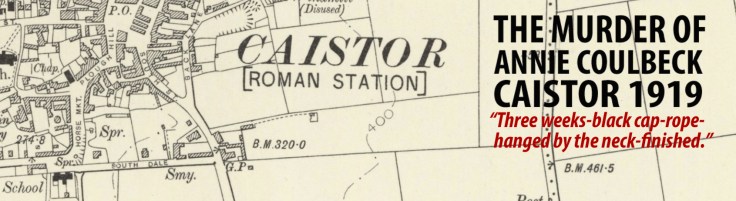
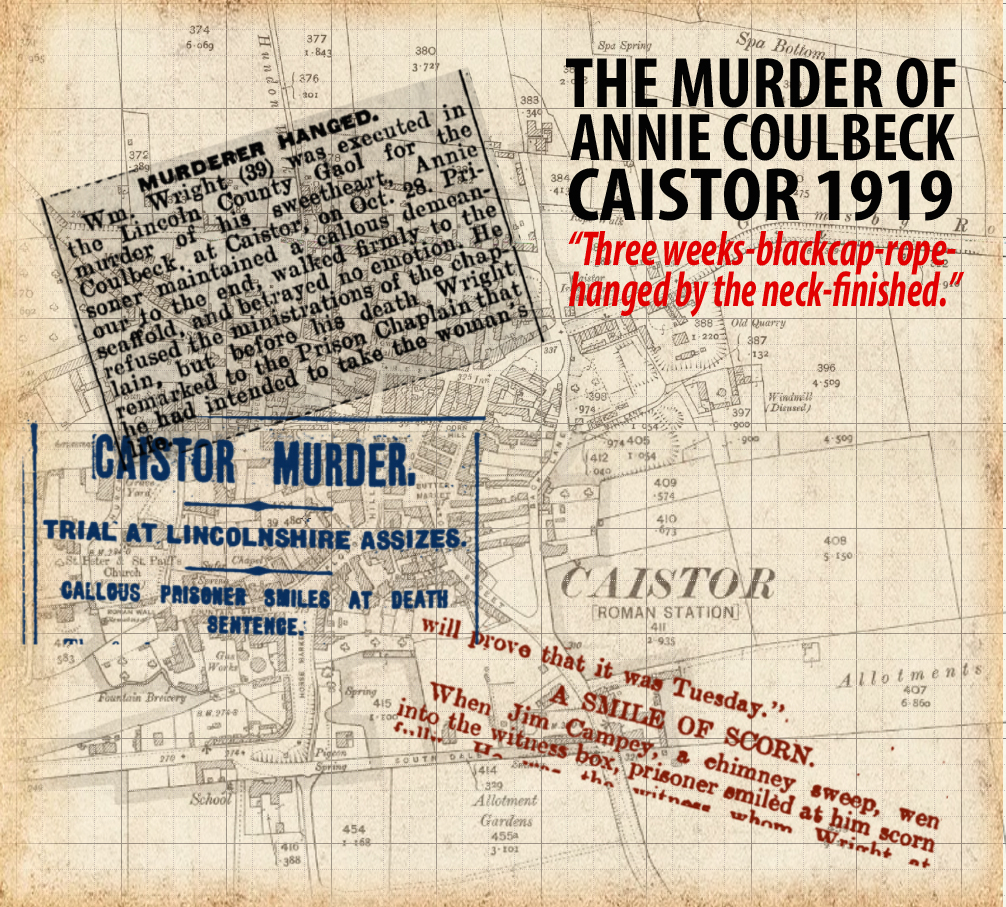
THREE WEEKS-BLACK CAP-ROPE-HANGED BY THE NECK-FINISHED . . . The murder of Annie Coulbeck, Caistor 1919 (2)

Annie Header

SO FAR: Caistor, North Lincolnshire, October 1919. William Wright (39), a former soldier, is now working in a sawmill in nearby Moortown. He has a reputation as a ne’er-do-well and sometime vagrant, with a long criminal record. He has been in a relationship with Annie Coulbeck, (34). She is carrying his child.

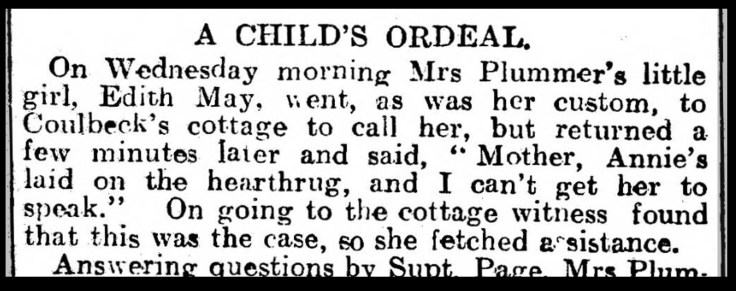
Annie, who lives in a cottage at Pigeon Spring on Horsemarket. has been working as a nanny, looking after the children of Mrs Plummer.  On the morning of Wednesday 29th October, Annie has not turned up for work, so Mrs Plummer sends one of her children to Annie’s cottage to see if she was unwell.

Child's ordeal

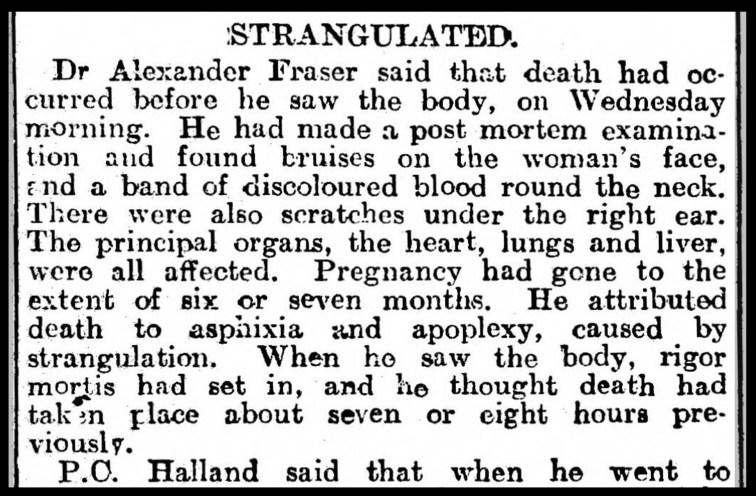
Annie Coulbeck had been strangled, and had been dead for some hours, and it goes without saying that her unborn child – some seven months in her womb – had shared its mother’s fate. At the coroner’s inquest, the doctor gave his report:

Strangulated

It was no secret that Annie Coulbeck and William Wright were lovers, and when police visited him at his home in South Dale, Caistor, his admission was astonishingly matter-of-fact:

“Last night, a little after 10 o’clock, I left the Talbot public house. I had a lot of drink and went down to Annie Coulbecks house. I asked her where she had got the brooch from which she was wearing. She said it was her mothers. I told her I did not think it was. I told her I thought it was one of her fancy men’s. She said, “I’m sure it is not, Bill.” I told her I would finish her if she did not tell me whose it was. I strangled her with my hands and left her dead. I put the lamp out and went home.”

Talbot

The Talbot in Caistor (above) is no longer a pub, but if its walls could talk, they might bear witness to a chilling conversation William Wright had with a fellow drinker, a local chimney sweep.

Strange Statement

The umbilical cord is often used as a metaphor for two things being inextricably joined, but it also has a presence in the British legal system, particularly in the case of murdered babies. Criminal history, particularly back in the day, is full of young women being tried for murder after they have killed an unwanted new-born baby. For it to be murder, it has to be established that the  infant had an independent existence, and it is clear that the child Annie Coulbeck was carrying had no such thing. However, in my book, William Wright was as guilty of murdering that child – his child –  as he was of killing its mother.

Screen Shot 2023-11-22 at 19.02.01

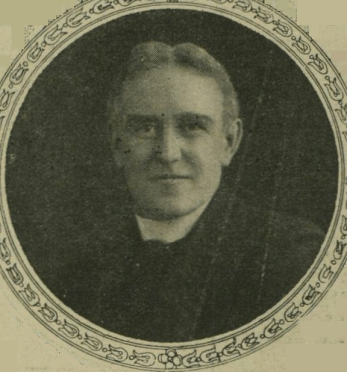
Wright, in his drunken estimation that it would take just three weeks from the death of Annie Coulbeck to his appointment on the gallows, was as ignorant of the legal system as he was of the way decent human beings should behave. The law took its rather ponderous course, and after the Coroner’s Inquest and then Magistrate Court, William Wright finally appeared at Lincoln Assizes, before Mr Justice Horridge (left) on Monday 2nd February 1920. It was a perfunctory affair. Wright’s defence lawyers, as they were bound to do, came up with the only possible plea – that Wright was insane. They cited his war experience, and the fact that members of his family had been committed to institutions. Neither judge nor jury were impressed and, as Wright had predicted, hunched over his beer in The Talbot, the judge donned the Black Cap. An appeal was lodged, but failed.

Appeal

Throughout the legal process, Wright had shown not one iota of remorse, nor did he betray any concern about what awaited him.

Black Cap
Screen Shot 2023-11-22 at 19.17.49

Wright was executed at Lincoln Castle on 10th March 1920. He had refused the ministrations of the prison chaplain, and the last face he would have focused on before the hood was placed over his head and he dropped to his death was the grim visage of executioner Thomas Pierrepoint (right), uncle of the more celebrated hangman Albert Pierrepoint, subject of the excellent film (2005) featuring Timothy Spall as the man who hanged, among others, Ruth Ellis and dozens of Nazi war criminals. The corpses of executed criminals at Lincoln Castle were interred in a little graveyard situated on the Lucy Tower. If ever a soul deserved to rot in hell, it is that of William Wright.

FOR MORE HISTORIC MURDERS IN LINCOLNSHIRE
CLICK THE IMAGE BELOW

Screen Shot 2023-11-25 at 20.25.19

THREE WEEKS-BLACK CAP-ROPE-HANGED BY THE NECK-FINISHED . . . The murder of Annie Coulbeck, Caistor 1919 (1)

Annie Header

There is an aphorism attributed to George Orwell which goes:

“We sleep safe in our beds because rough men stand ready in the night to visit violence on those who would do us harm.

It echoes Rudyard Kipling’s famous poem, ‘Tommy”, where he says:

“For it’s Tommy this, an’ Tommy that, an` Chuck him out, the brute! ”
But it’s ” Saviour of ‘is country ” when the guns begin to shoot”

In a nutshell, we want our soldiers to be savages when they face the enemy, but except them to revert to civilised and urbane when they walk our peaceful streets, far away from conflict.

This prelude is in no way an excuse for the  murder of a woman in the Lincolnshire village of Caistor in the autumn of 1919, but it points to the problems that some former soldiers have when they leave the world of government-endorsed killing, and walk again down peacetime streets.

William Wright was certainly not from an impoverished or brutal background. He was born in 1880, and the 1881 census shows that he was the youngest of three children to Charles Wright, a tailor, and his wife Jamima. He worked for his father for a while in his teens but it is recorded that he joined the army in 1898, and fought in the Boer War. Peacetime clearly didn’t suit him, as between 1907 to 1914 he received 32 convictions, mostly for theft, vagrancy and drunkenness.

Convictions

1914 came, and with it the chance to turn whatever demons plagued him in the direction of the Boche. His military record was to be no better than his civilian one, however, as In 1916 he was sentenced to death for striking his superior officer. The sentence was commuted to one of five years penal servitude and then further reduced to two years hard labour.

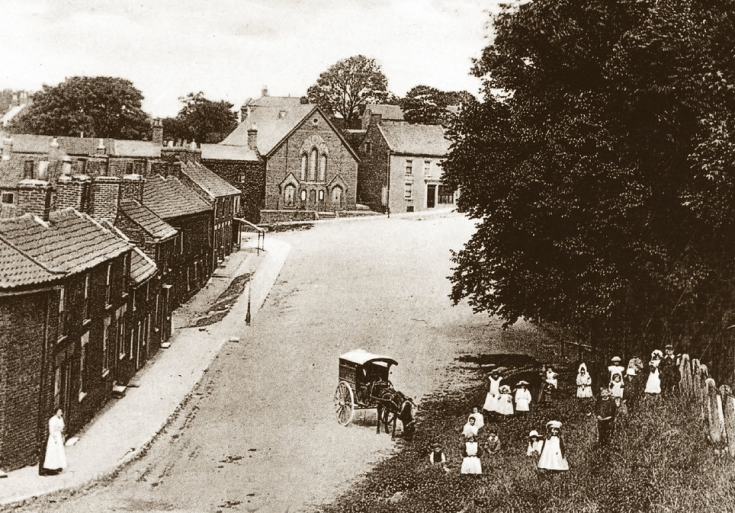
The army was clearly glad to be rid of Wright, and when he returned to Caistor in 1918, he struck up a relationship with Annie Coulbeck. We know relatively little of Annie. We know that she was 34 at the time of her death, was probably born in the nearby village of Stallingborough, and some sources suggest that she was simple minded. More pertinent to this story is that she had the misfortune to meet William Wright, and was pregnant with his child. In October 1919, her daily employment was to look after the children of a Mrs Plummer at her cottage near Pigeon Spring on Caistor’s Horsemarket. The picture below dates from 1908.

Horsemarket

This is an extract from a short video about the Horsemarket, and  is well worth watching, as it places Pigeon Spring on the photograph.

On the afternoon of 28th October 1919, William Wright came to visit Annie Coulbeck at Pigeon Spring. On the morning of the 29th, Annie Coulbeck had not arrived to look after the children, so Mrs Plumer sent one of her daughters to see if Annie had slept in. What the child found sent shock waves through the peaceful rural community.

TO FOLLOW
A DREADFUL DISCOVERY
AN INNOCENT BROOCH
A SMILING PRISONER
MORE WORK FOR MR PIERREPOINT

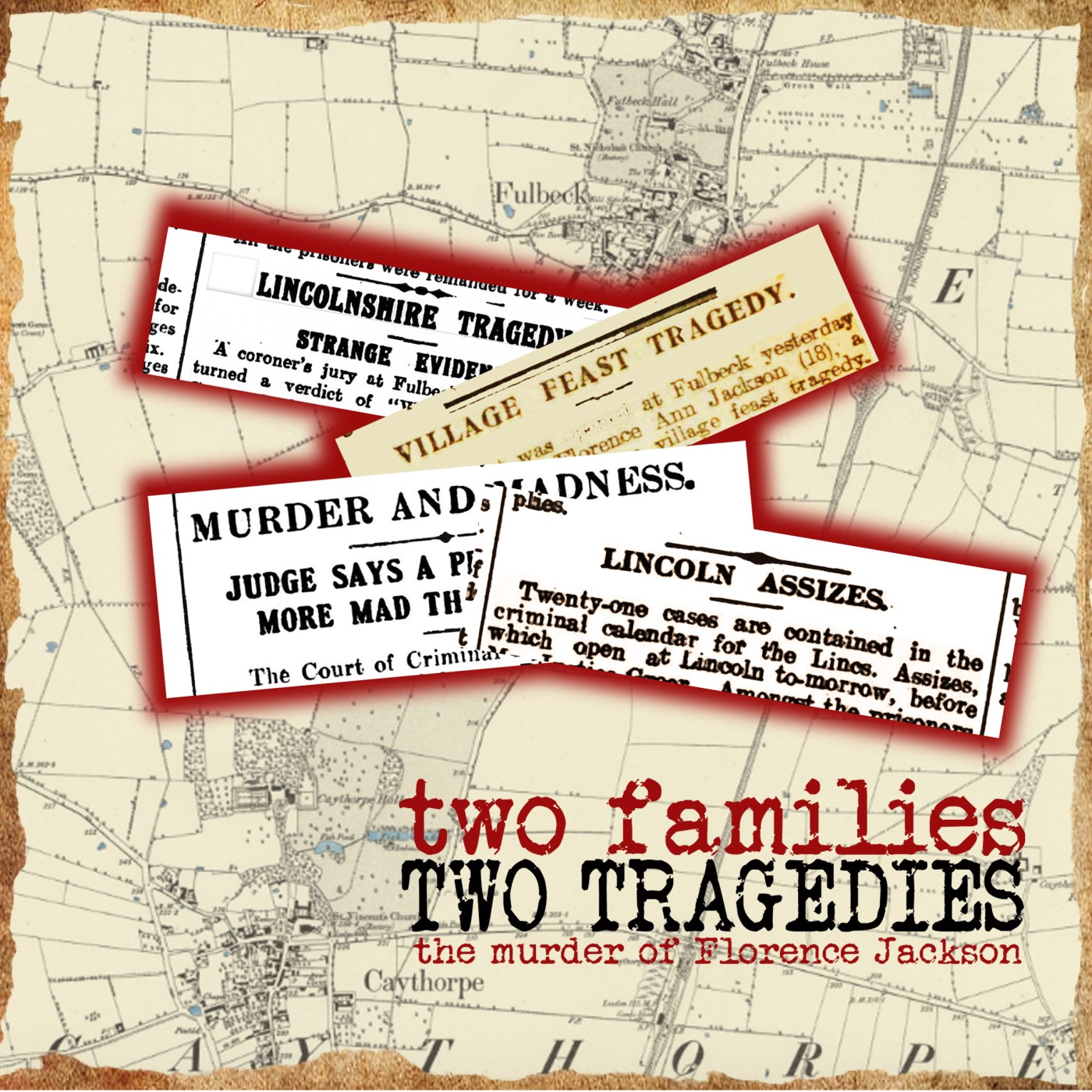
TWO FAMILIES, TWO TRAGEDIES. . . The murder of Florence Jackson (part two)

GRR header

SO FAR: Grantham man Dick Rowland had seen action in the trenches from 1915 until 1918. Unlike his two brothers, he survived, but was wounded and gassed. Spring 1919 found him back in Grantham, aged 29, just another ex-soldier. He had, however, met and fallen for a Fulbeck girl, Florence Jackson. She was ten years his junior and there, I think, lay the problem. She was pretty, fun-loving and with no shortage of local suitors, not to mention dashing officer types from what was to become Royal Air Force College Cranwell. Florence’s mother thought Dick Rowland too old for her daughter, but she could never have envisaged the events of 31st May 1919. It was the day of Caythorpe Feast, an annual event always held on the last Sunday in May. Dick and Florence were there, with hundreds of other local people both young and old. Dick Rowland had become insanely jealous, and every smile or wave Florence gave to some other young man cut him to the quick. He was particularly vexed when Florence decided to share a fairground ride – the wooden swing-boats with some other chaps.

On the swing-boats

Sometime around 10.00pm, Dick and Florence decided to walk home to Fulbeck. That road, now the A607, was known as the Lincoln Road. Many other people were on that road, but they would have been spread out and it was very dark. I have no idea if there was a moon that night, but one man heard something in the darkness as he rode his bicycle up to Fulbeck. He was later to give evidence at a Coroner’s inquest. This a verbatim report from a local newspaper:

Richard James Nelson, dairyman, Welbourn, spoke of visiting Caythorpe feast on Saturday night last. He saw the deceased girl in the swing boats with a man called Edward Knights. He left the feast about 1045. When he had reached Gascoigne’s gate in the parish of Fulbeck a man called out to him:
“Chummy, stop!”
He stopped, and man who was a stranger asked him to fetch a motorcar from the top as there had been a nasty accident. Witness asked him what it was, and he said:
“A girl has tried to cut my throat and now she has cut her own.”
He noticed the man’s throat was cut and bleeding and he also saw the body of the girl lying on the ground just inside the gateway. Witness attempted to go through the gateway towards the girl. but the man pushed him away and told him to get on his bicycle and fetch a motor car. He then rode off for the police.

There is a horrible irony in that the next people to arrive at the scene were none other than Florence’s older sister and her young man.

Laura Emma Jackson, the deceased’s sister, a land worker employed at Fulbeck Heath, said on Saturday night she was at Caythorpe feast where she saw deceased with Dick Rowland who was courting her. They seemed alright together. Witness left the feast at 10:15 and walked towards home with Percy Graves, a friend. When they got to Gascoigne’s gate she saw a man standing there. He said,
“Mr, Mr, come and look what I have done.”
She told Graves not to go as the man was drunk, but the man came towards them holding out his hands and said,
“Is that Laura?”
Witness replied,
“Yes.”
And he then said,
“I am Dick – I have killed your Flo. Another man wanted her. I have tried to kill myself but could not. Go and tell them at home.”
Witness noticed that Roland had blood down the front of his clothing and was bleeding from the throat. She did not notice her sister. She went home and reported the matter to Mr Palethorpe. Rowland was not drunk but seemed to be rather excited. Witness was at the Grantham statute fair on 17th May  with her sister and Rowland. Flo went to speak to some soldiers and Roland asked her to keep an eye on her and watch that she did not go with the soldiers. She told him not to be so silly and that she would not go. Rowland shook his head and remarked,
“Flo’s alright. If I don’t have her I will see no one else does.”
Flo was with the soldiers three or four minutes and then she rejoined Rowland and witness.

The Fulbeck Doctor also gave evidence at the inquest:

Doctors Evidence
Mr Justice Greer

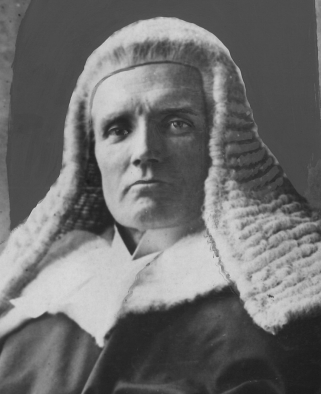
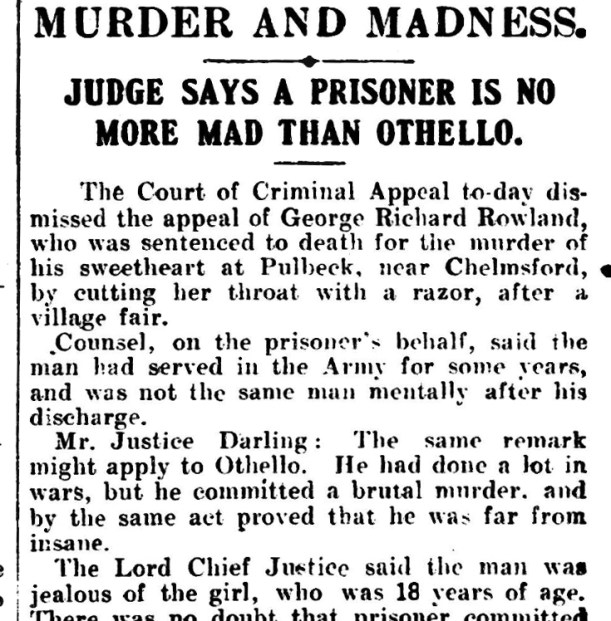
Dick Rowland was arrested for the murder of Florence Ann Jackson. The Coroner recommended that he be charged with murder and the case was sent to the Sleaford Magistrates who agreed, and arranged for Rowland to appear at the Summer Assizes in Lincoln. Rowland’s bizarre defence that somehow Florence had received her fatal wounds in some kind of struggle for the razor was abandoned, and his legal team asked for a postponement of the trial so that further investigations could be carried out into the man’s mental health. This delay was granted, and so it was that Dick Rowland appeared before the Lincoln jurors and judge Mr Justice Greer (left) in November 1919. He was found guilty and sentenced to death despite the jury recommending a merciful punishment. There was an immediate appeal against the death penalty, but that was thrown out, with the appeal judge famously opining that Rowland was no more mad than Othello,(the newspaper managing to mis-spell the village name, and relocate it to Essex}

Othello

So, Dick Rowland sat in his condemned cell awaiting his fate, probably unaware that he had been compared to one of Shakespeare’s greatest tragic characters. Othello, of course, racked with guilt, stabs himself, which is precisely what Rowland claimed he had tried to do on that fateful evening back in May, but he was to have better luck than the Moor.

Reprieve

In the event, it appears that Dick Rowland was released in April 1935. He married, and the records tell us that he died in Cleethorpes in 1954. Had he become unhinged by his wartime service, a victim of what we now call PTSD? Or had his own chilling words – ” If I don’t have her I will see no one else does.” become a dreadful deed? You must make up your own minds. Incidentally, the fatal spot where Florence died is still there for anyone wishing to stand and contemplate.

GG watercolour

Incidentally, a local man, Jonathan Wilkinson has written a novel based on the events I have described. It is very well written, and focuses on what the author believes happened in the months and weeks leading up to Florence’s death. It is available from the Fulbeck Craft Centre (07410 968333)

Jealous

I have been researching and writing about historic Lincolnshire murders for some years,and those wishing to find out more about our county’s macabre past should click this link

TWO FAMILIES, TWO TRAGEDIES . . . The murder of Florence Jackson (part one)

GRR header

Fulbeck sits amid the hills and hollows of what is known as The Southern Lincolnshire Edge whose most obvious geological feature is the cliff-like ridge which is easy to see when driving along the A17 from Newark. Nearby Leadenham seems to perch on the very edge of this cliff. Fulbeck could almost be mistaken for a Cotswold village, with its abundance of limestone buildings, but most of that stone came from the quarries around Ancaster, just a few miles away. In 1919 the railway ran nearby and there was a station at Caythorpe. These days, the village is bisected by a very busy main road, the A607, which links Leicester and Lincoln. It was just beside this road that the tragedy of the title took place, but our story starts a few years earlier in Grantham, just over ten miles to the south.

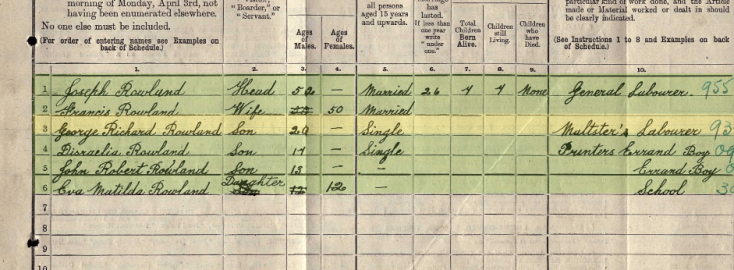
The 1911 census shows that at 50 New Street, a tiny terraced house which still stands, lived the Rowland family.

1911 census

There was another brother, Joseph William Rowland, but he had left to join the army, and in 1911 was overseas with 1st Battalion Lincolnshire Regiment. By the time war broke out, he had married and was living in Portsmouth. The Rowland family was to pay a heavy price during that war. Both George Richard – known always as Dick – and brother John answered the call of King and Country. Dick joined the Lincolnshire Regiment but John, although he enlisted in Grantham, would go on to serve with The Seaforth Highlanders.

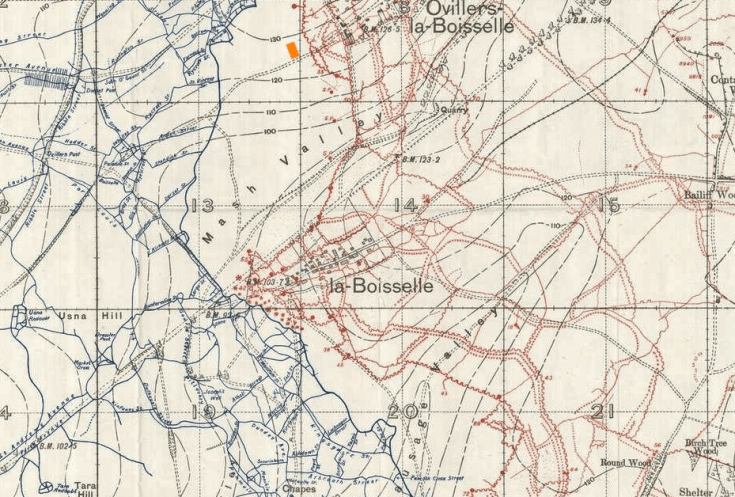
On 1st July 1916, Joseph Rowland was with the 2nd Battalion Lincolnshire Regiment facing the German front lines at Ovillers.

Screen Shot 2023-08-31 at 18.43.38

The story of that dreadful day is well known, and not strictly relevant to this story, but suffice it say that Joseph Rowland was one of the 20000 British men killed on that day. A letter would have been delivered to 50 New Street, Grantham, initially saying that Joseph was ‘missing’. Another letter would have followed saying that he was ‘missing, presumed dead’. His body was never found, and his name is one of the 72000 engraved on the Thiepval Memorial to the Missing.

Joseph William CWGC

Worse was to follow. Ever anxious to deliver the final crushing blow to the enemy, the British High Command devised yet another huge offensive to punch a hole in German lines. This was to be east of the city of Arras, 20 miles or so north of the Somme killing grounds. The offensive, more properly known as The First Battle of The Scarpe,  began at Easter 1917, in a snow storm. Once again, a death notice would find its way to Grantham. This time, although it would have been of little consolation, a body was found and given a decent burial.

JR Rowland

Dick returned to Grantham in late 1918, apparently unscathed, at least physically, but we know he had been in action since 1915, and had been both gassed and wounded. Once the euphoria at ‘beating the Hun’ had died away, there was little awaiting men like Dick Rowland in a country that should have been – but wasn’t – grateful. He managed to get work at Rustons in Grantham. On a side note, it is worth remembering that it was at the Ruston works in Lincoln that the first tanks were developed, as well as the iconic aircraft known as the Sopworth Camel.

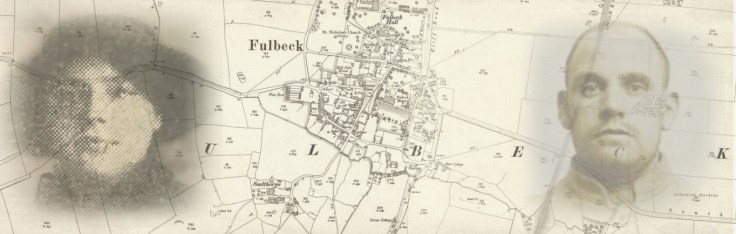
FlorenceNow, though, we must return to Fulbeck. Only a grainy newspaper image of Florence Jackson remains, but it doesn’t take a great leap of imagination to picture a pretty, round-faced girl with a confident gaze for the camera. Once again, the 1911 census is of service. She lived in Fulbeck with her family. Florence would not live to be noted in the 1921 survey. Opportunities for young women of humble birth  in rural communities in those days were limited to farm work, or domestic service. There are suggestions that Florence has been in service at Barkston, or had returned to Fulstow in anticipation of a similar post. At some point she met Dick Rowland, and he was smitten, considering himself deeply in love. He was now 29, with a lifetime of horrors condensed into four years of hell on the Western Front, Florence was just 19, pretty, vibrant and untouched by the death and misery of The Great War.

Florence 1911


IN PART TWO
A courtship
A fatal ride on the swing-boats
Gascoigne’s Gate
The Lincoln Assizes

Blog at WordPress.com.

Up ↑