

SO FAR: On the afternoon of October 8th 1907, a strange weekday drinks party had been held in a tied cottage belonging to Guy’s Head Farm near Sutton Bridge. Some of the drinkers went home for tea, the tenant of the cottage, William Gear, departed in fetch more beer, leaving his wife, Kate, alone in the house with their lodger, William Duddles. When her returned, he found that his neighbours had found Mrs Gear lying on the floor of the cottage, mortally wounded, a bloodstained hammer by her side. Of Duddles, there was no sign.
The police went in search of Duddles, and he was soon found. A newspaper reported:
“Sergeant Taylor, of Long Sutton, went in search of him. and he was discovered in the Marsh, near to the sea bank. He was then charged with attempted murder, the deceased at that time not being dead. His hands and clothing bore marks of blood, and in answer to the charge he said, “A still tongue makes a wise head,” and made no definite statement.”
The same newspaper went on to say:
“At Long Sutton, on Wednesday, William Duddles, aged forty-seven, was charged with the wilful murder of Catherine Gear, aged thirty-six, at Lutton Marsh, on October 8th. Supt. Osborn, of Spalding, gave evidence similar what is stated above. Sergt. Taylor, stationed Long Sutton, said he charged the prisoner with the attempted murder of Mrs. Gear, in Lutton Marsh, that afternoon. Prisoner replied : ” I have never done anything wrong before ; I am a bad ‘un, I know. I have been put on.” A short time afterwards he said: “A still tongue makes a wise head ; I shan’t say nowt.”
“That morning, from further information, and after cautioning him again, witness charged him with the wilful murder of Catherine Gear, and he made no reply. The prisoner was remanded until Wednesday, the l6th. He appeared in court with a black eye and cuts on the left temple and over the left eye, which, it was suggested, indicated that the woman had tried to defend herself. The inquest was held on Wednesday evening, before Dr. Barritt the Spalding District Coroner, at Lutton Marsh. William Gear, the husband, said that he and his wife got on very well together. A lodger named Duddles had been with them about two years, he occasionally had some words with them when was in drink, and sometimes made imputations against deceased.”
“They had some words recently. Duddles called his wife some some abusive names, and witness, taking her part, struck him. On Tuesday, witness went out at four o’clock to fetch some beer, and upon returning found his wife lying on the floor with her head in a pool of blood, a coal hammer lying few yards away. She was not dead, but was unconscious. Evidence was also given by Edwin Hocking, living next door, and a neighbour named Towson. The inquiry was adjourned until Monday next, and a post-mortem examination was ordered. The hammer, with which the tragedy alleged was alleged to have been enacted was produced in Court; it is an engineer’s hammer, fifteen inches long, with a heavy head of iron.”

The funeral of Kate Gear was a lonely and bleak affair:

Justice moved swiftly in the case of William Duddles. He was swiftly indicted for murder, and sent for trial at the November Assizes in Lincoln. This was not before the national press had a few things to say about him.

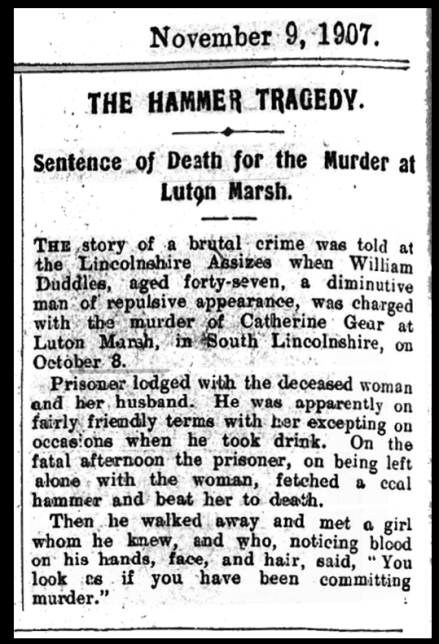 The “diminutive man of repulsive appearance” was found guilty of murder, and sentenced to death by the judge, despite the jury recommending mercy due to the prisoner’s mental state. One of the strange things about this case is that newspapers at the time normally reported verbatim anything said in court, either by the accused or his legal representatives. In this case, I have been able to find absolutely nothing. Defence barristers are known to this day for concocted elaborate excuses when pleading clemency for their clients, but here they either had nothing to say, or it was never reported. The obligatory plea for mercy was sent to the Home Secretary, Herbert Gladstone (son of the great former Prime Minister) but it fell on deaf ears, and William Duddles was executed on 20th November in Lincoln Prison. In charge of proceedings were the Pierrepoint brothers, Henry and Tom – father and uncle to the more celebrated Albert.
The classic mantra of solving murders – both real and fictional – is ‘Means, Motive and Opportunity’. In the case of William Duddles, the means and opportunity are obvious, but the big question remains “why”? From the limited evidence that remains available through old newspapers, it is hard not to conclude that there was a sexual element in this murder. Out of consideration for the dead woman and her family, the newspapers would have remained silent, but it seems to me that Kate Gear was, in some way, tormenting Duddles over a period of time, perhaps promising much but delivering little, and the teasing became too much for a man of limited intelligence made dangerous by drink.
Does this excuse what he did? Never in a million years. He battered a woman to death and, depending on your views on capital punishment, was punished accordingly. There is a strange undercurrent to this case – the mid-week drinking binge being the strangest – that will remain a mystery. Kate Gear lies in the peaceful churchyard of St Nicholas, Lutton, while her killer is buried in the poignant little plot reserved for hanged men within the grounds of Lincoln Castle.


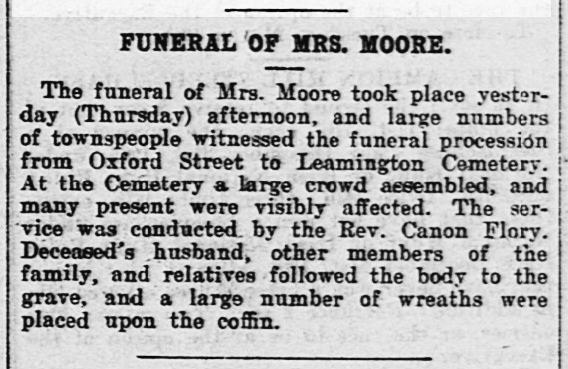


 Number 13 Oxford Street is a narrow three-story terraced house used these days, I believe, for student accommodation. It was advertised recently as a six bedroom let, a snip (!) at £3,360 pcm. The Bank of England inflation calculator tells me that in 1891, Edward Moore and his family would have been paying just under £26 a month. He had a large family comprising his wife Fanny Adelaide (36) and children Edwin James Moore (16), Fanny A Moore (14), William A Moore (13), Joseph C Moore (11), Rose Hannah Moore (10), Percy E Moore (8), Leonard J Moore (7) and Ernest F Moore (4).


 fullybooked2017