Search

fullybooked2017

Tag

1896

FOUR MORE ANGELS IN HEAVEN TONIGHT . . . The Wimblington Tragedy (2)

Header4A

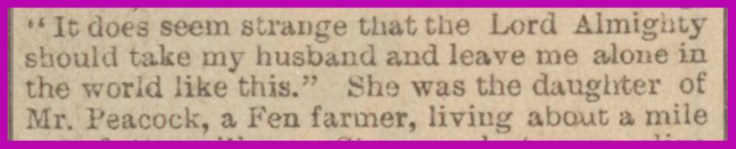
SO FAR – It is February 1896, and Mary Jane Farnham has moved back to Wimblington following the death of her husband, Henry, a former Stationmaster in Essex. She has five children, but is  comfortably provided for, thanks to savings, insurance and a pension from the Railway Benevolent Fund. She and the children have rented a roomy cottage, not far from Wimblington railway station. The children are universally liked, and she is regarded as a quiet and respectable woman. She and the four younger children – Lucilla, aged 12, is in service with a family in nearby March – are regular church-goers. But something is very wrong. She has mentioned to her parents that the strain of being alone troubles her. Her words were later quoted in the press:
Quote

It can have been no comfort to Mary Jane Farnham to be living within sight and sound of Wimblington railway station, and it must have been a daily reminder of better days, when she and her husband lived in a similar building, were pillars of the community, and with their whole lives ahead of them.

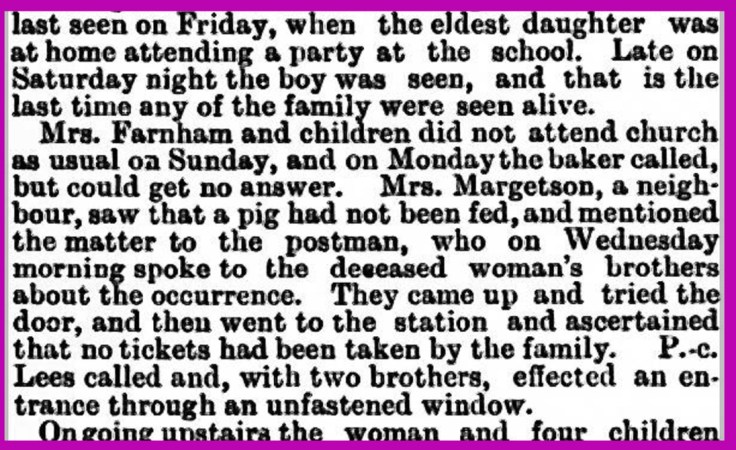
I have been researching and writing these true crime stories for many years, and I can truthfully say that none of the human tragedies I have investigated comes close to this one in terms of loss and despair. The Farnhams were last seen alive at some time on Saturday 15th February. It needs to be remembered that communities were much smaller and ‘in-each-other’s-pockets’ in those days, and the comings and goings of villagers in a place like Wimblington were very public. Bit by bit, villagers suspected that something was wrong.
Unease

What the Peacock brothers and the village policeman found in the upstairs bedrooms would probably haunt them for the rest of their lives. Marjorie May, 11, Sidney Harold, 8, Henrietta Mary, 6, and Dorothy Esther, 4, were dead in their beds, killed while they slept, and their throats cut so deeply that their heads were nearly severed. Beside them was the body of their mother, a white handled knife, savagely sharp, in her dead hand. The bedsheets around the bodies were saturated with blood. It was.literally, a bloodbath.

This was no spur of the moment act of desperation by Mary Jane Farnham. On a table in the house was an envelope containing the outstanding rent on the cottage. Even more chilling, It was later revealed that she had sent a letter to the Railway Benevolent Fund requesting that her widow’s pension be terminated. This mixture of propriety and savagery is hard to comprehend, even though a century and more has passed.

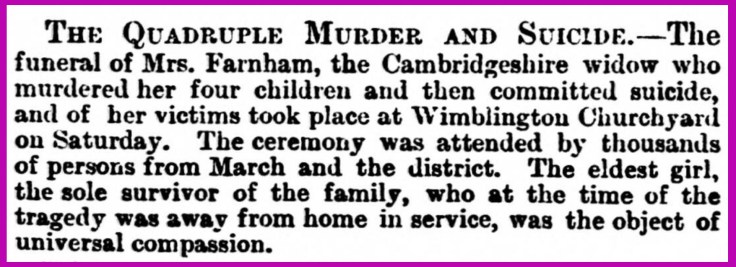
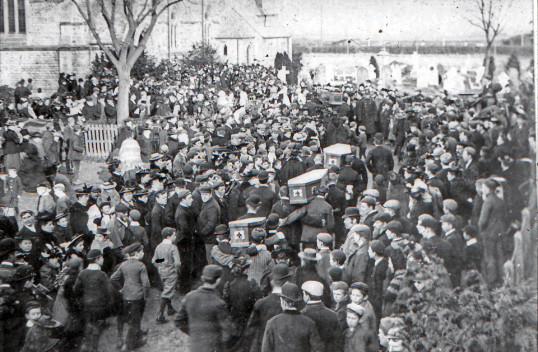
The inquest verdict on the five dead was a formality – murder and suicide while temporarily insane. To the eternal credit of the community, Mary Jane Farnham was not separated from her children even in death, and their joint funeral, just seven days after their deaths, attracted widespread attention. 
Funeral

This remarkable photograph of the funeral is used with permission of its owners, the Fisher Parkinson Trust, a local heritage archive.
Funeral

These accounts of man’s inhumanity to man are not intended as judgments, or condemnations, but it is difficult to balance out sympathy for Mary Jane Farnham’s grief and the sheer inhumanity she showed when she cut the throats of her four younger children. They all had lives to lead, as we can see by following the progress of Lucilla, the daughter who was lucky enough to be elsewhere on that fateful Saturday night in February 1896. By 1901, she was living in Leeds with her aunt, working as a draper’s assistant, by 1911 she had moved to Bournemouth, and  in 1917 the records tell us that she married Daniel Meaney in Exeter. She died in 1968 at the age 0f 86.

Judgement is for God alone, so I conclude this sad tale with a picture taken in the churchyard at Wimblington. (NB – the ages of the two younger children are incorrectly inscribed)
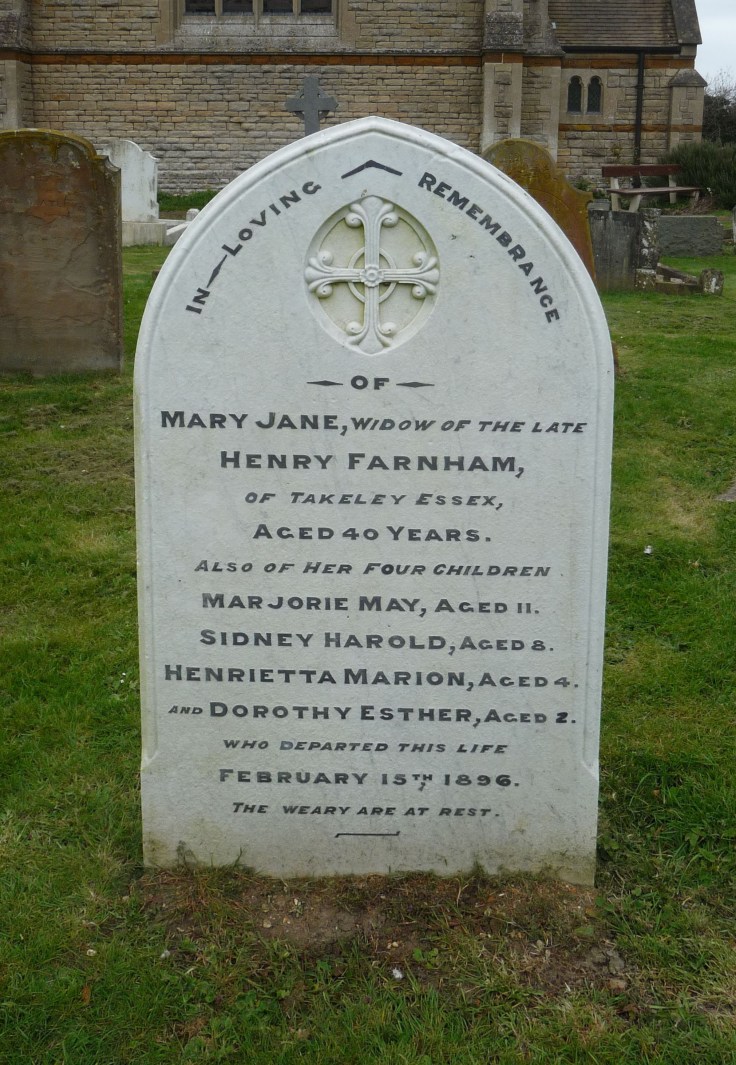

Gravestone

FOUR MORE ANGELS IN HEAVEN TONIGHT . . . The Wimblington Tragedy (1)

Header4A

Mary Jane Peacock was born, some registers say, in Upwell in 1855, but the 1861 census says that she was born in Wimblington, and shows her living there with her parents.

The Cock

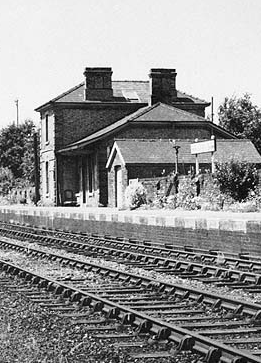
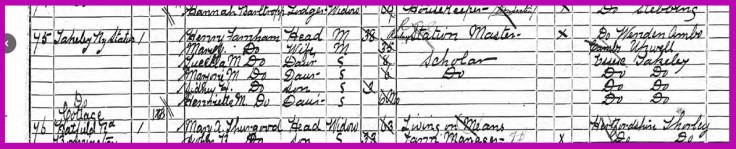
Screen Shot 2022-01-04 at 20.28.32Her father was John Peacock, who kept The Cock Inn on Eastwood End. In the autumn of 1877, she married Henry Farnham, who worked for The Great Eastern Railway. He became the Stationmaster at Takeley, (left) a station on the Bishops Stortford – Braintree line. The Stationmaster’s house was substantial, and survives to this day, (although the line it once served has long since disappeared. The 1891 census seems to show the Farnhams – still living at Takeley – as a happy and prosperous family which included Lucella (8), Marjorie (6), Sidney (3) and Henrietta (3 months).

Takeley

Then, in 1893, the family welcomed another child – Dorothy – but within months tragedy struck. Henry Farnham died of “congestion of the lungs’ which sounds like pneumonia. The family were immensely well thought-of in the area. A newspaper reported:

“The family, were always held the very highest respect, and had the sympathy of all classes in the neighbourhood ou the death of the father, which led to their removal from the village. The late Mr. Farnham came to Takeley station-master from his native fen country about years ago, bringing with him his newly wedded bride. He had formerly held similar position on the G.E.R. at Wilburton. Mr. and Mrs. Farnham made many friends and were regarded as exemplary couple. He was a man that nobody could help liking— the most amiable and obliging man ever met with the railway service. He was held much esteem the Earl and Countess Warwick, who used the station frequently while residing at Easton, and H.R.H. the Prince of Wales, when making visits to Easton Lodge, always had cheery word to say to Farnham, and when, after the station master’s death, subscription was set on foot for the widow and family, his Royal Highness gave handsomely towards it, as also did the Earl and Countess of Warwick, Sir Walter Gilbey, and other residents of the neighbourhood.

Mr. and Mrs. Farnham were thrifty people, and despite the expense of bringing up young family they had put away for future use a nice little sum, which with £100 that the widow received from an insurance company upon the death of her husband, and about £80 which was subscribed for them locally, and various benefit club payments, amounted something like £400. The Great Eastern Railway Company allowed her £10 a year for life.”

No-one who attended Henry Farnham’s funeral could have possibly predicted an even greater tragedy which was to follow

In the autumn of 1895, Mary Jane Farnham moved back to Wimblington with her children, and settled in what was described as a comfortable four roomed cottage situated near the station, rented from a Mr Fisher. February 1896 was to witness an event which sent shockwaves, not just across Fenland, but throughout Britain

IN PART TWO – A HEARTBREAKING DISCOVERY

MURDER AT MADAME TUSSAUDS . . . Between the covers

Murder header

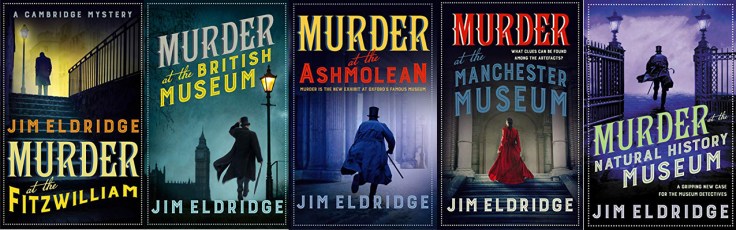
This is the sixth book in the delightful series from Jim Eldridge set in the last years of Queen Victoria’s reign, and featuring a private investigator partnership between Daniel Wilson and Abigail Fenton. The pair are so mismatched that they make a delightful fit, if that makes any sense. Former policeman Daniel is short, stocky and of solid working class London stock, while Abigail is of more ‘noble birth’,  tall, elegant, and an expert in archaeology, particularly that of the classical world. As you can see from the banner above, they have worked their way around the major museums of England, but now they are called to a slightly less academic venue – Madame Tussaud’s waxworks on Baker Street.

One of the night watchmen is found decapitated, his body (and head) posed next to the instrument of death that caused Anna Maria “Marie” Tussaud née Grosholtz to fear for her own life during the French Revolution – the guillotine. Wilson and Fenton immediately smell a rather large and malodorous rodent. The dead man – Eric Dudgeon – and his fellow watchman, Walter Bagshot, were lifelong friends, and former army colleagues. Now Dudgeon is dead and Bagshot is missing. Even stranger is the fact that some months earlier the previous watchmen, Donald Bruin and Steven Patterson, both left at the same time and, within days, Dudgeon and Bagshot arrived at the exhibition asking if there were any vacancies for security staff.

BigWigs

Meanwhile, Eldridge has introduced some real life characters (pictured above) – Prime Minister the Marquess of Salisbury, Sir Matthew White Ridley the Home Secretary, and William Melville head of the Special Branch. The men are concerned about a series of successful bank robberies, each of which has been carried out by the robbers tunneling into the bank vault from the cellar of an adjoining building. The sums taken have been eye-wateringly huge – so much so that the government is concerned about a run on the banks. Dedicated Sherlockians, when hearing about the robbers’ method, will raise an eyebrow and say, “A-hah – The Red Headed League!*

The murder plot becomes more twisted, when a young man, working on the basis that if he can scare his girlfriend she will succumb to his advances, hides with her in a Tussaud’s broom cupboard at closing time, and then sneaks out into The Chamber of Horrors. What they find is a genuine horror rather than a wax version, and all thoughts of dalliance go out of the window. Abigail, meanwhile, is courted (in a gentlemanly way) by none other than Arthur Conan Doyle, who wants her to lead an expedition to excavate an obscure group pf pyramids in Egypt. Both she and Daniel have their lives threatened, however; Abigail by an obsessed young woman who lusts after Daniel, and Daniel himself by a powerful and seemingly untouchable crime boss, Gerald Carr. But is Carr the real spider at the centre of this web, or is it someone much more closely connected to high society?

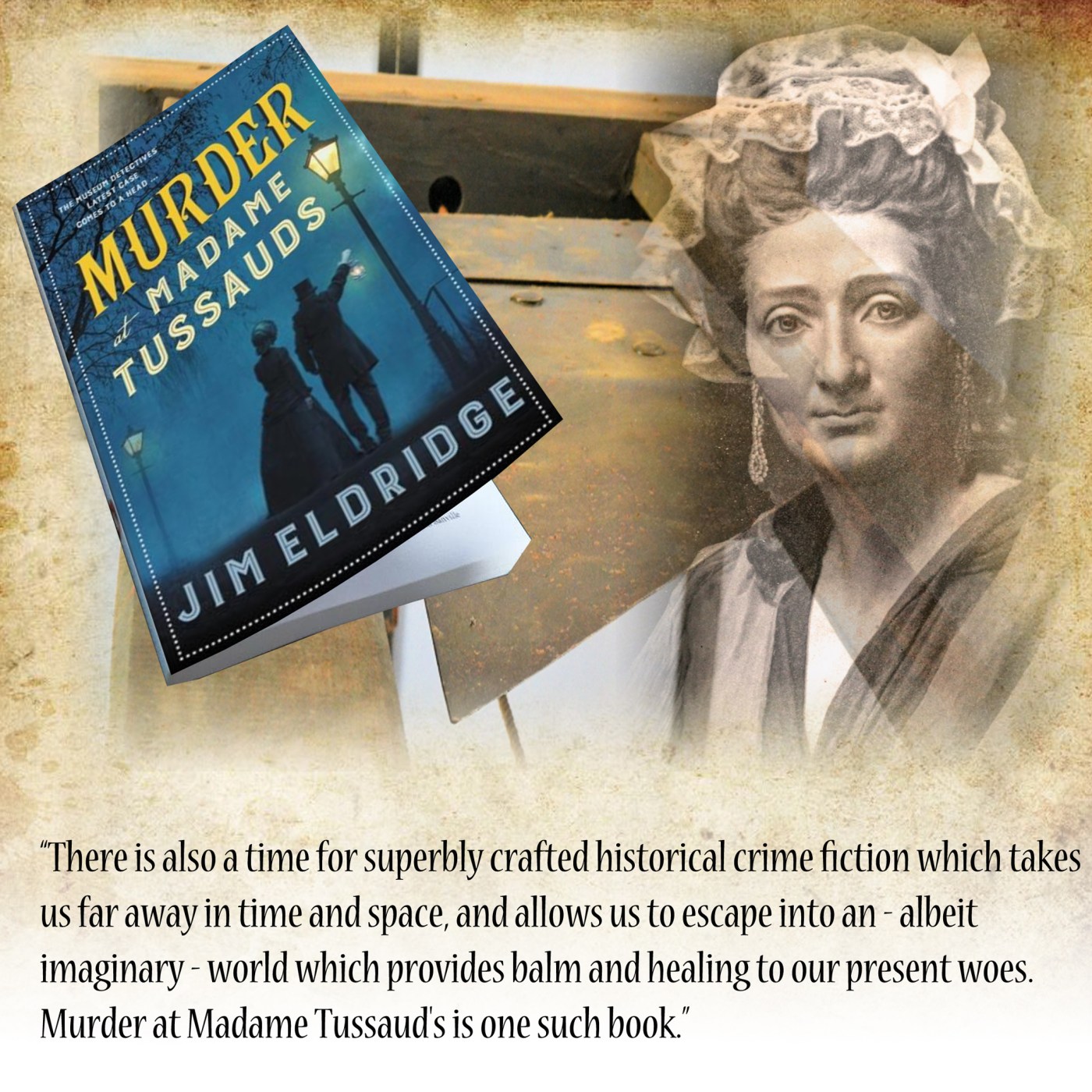
Screen Shot 2021-06-20 at 19.30.31This shouldn’t be dismissed as ‘comfort reading’. Yes, we know what we are going to get – the atmospheric late Victorian setting, the warm human chemistry between Daniel and Abigail, the absence of moral ambiguity and the certainty that good will prevail. Any genuine reader of fiction – and in particular, crime fiction – will know that, rather in the manner of Ecclesiastes chapter III , there is a time for everything; there is a time for the dark despair of Derek Raymond, there is a time for the intense psychological dramas of Lisa Jewell, and a time for workaday police procedurals by writers like Peter James and Mark Billingham. There is also a time for superbly crafted historical crime fiction which takes us far away in time and space, and allows us to escape into an – albeit imaginary – world which provides balm and healing to our present woes. Murder at Madame Tussaud’s is one such book. It is published by Allison & Busby and is available now.

*The Red-Headed League” is a short story by Sir Arthur Conan Doyle in which Sherlock Holmes takes the case of a businessman who feels that he’s been duped. A small business owner named Wilson tells Holmes how a man named Spaulding convinced him to take a job with The Red-Headed League. The League pays Wilson to copy out the Encyclopedia Britannica in longhand. Wilson does this for seven weeks, until the League is disbanded. Holmes realizes that Spaulding just wanted Wilson out of the shop so that he could dig a tunnel into the nearby bank.

Blog at WordPress.com.

Up ↑