Search

fullybooked2017

Tag

1895

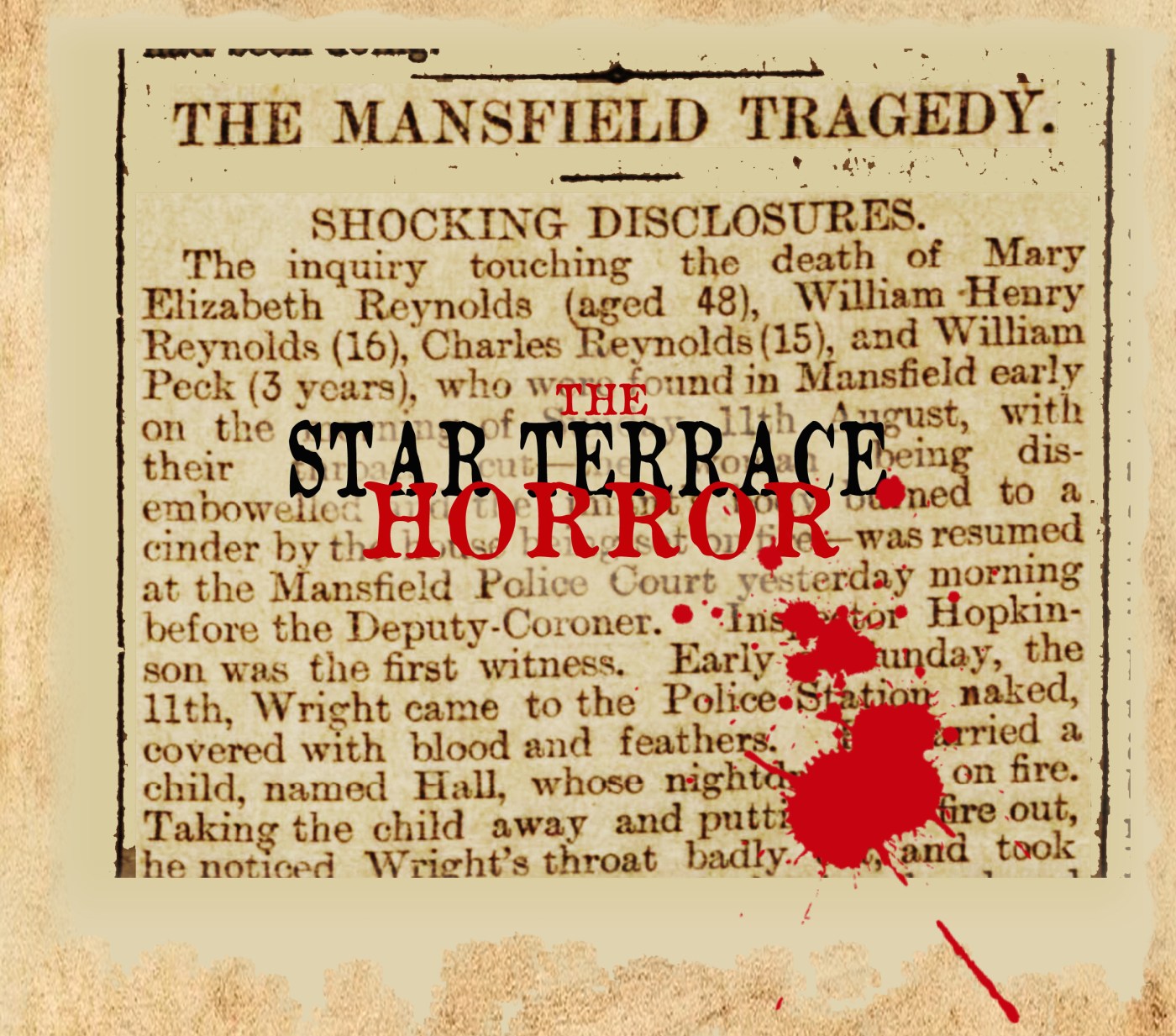
THE STAR TERRACE HORROR . . . Slaughter in Mansfield, 1895 (2)

Mansfield header

SO FAR: Mansfield, August 1895. Henry Wright, a foundry labourer, has been lodging at 1 Star Terrace, with Mary Elizabeth Reynolds and her step children. In the early hours of Sunday 11th August, Inspector Hopkinson, who lives at Commercial Street Police Station, is woken up by a commotion, and  woken up outside his window. He finds Henry Wright, nearly naked, holding a small boy in a burning nightdress. Both Wright and the boy are covered in blood. Hopkinson leaves the pair  with his wife and hurries to Wright’s lodging, just fifty yards down the street. The upstairs of the house is on fire, and George Reynolds is at his bedroom window shouting for help, but the fire brigade soon arrive, rescue George with a ladder, and then force an entry to the house.

Downstairs is a scene from hell. Most subsequent newspaper reports rather glossed over the horror, merely saying that Mrs Reynolds was found dead, but one or two papers thought that their readers were made of sterner stuff.

Gore

Upstairs there was more horror. Charlie and William Reynolds were both dead, their throats cut and  lying in pools of their own blood. In another bedroom was the charred remains of little William Peck, the grandchild.

Meanwhile, Inspector Hopkins’s wife had taken Wright and the child to the nearby workhouse. Wright’s wounds – to the neck, and self inflicted – were bandaged, and the Hall child had been taken to hospital. Wright, known as ‘Nenty’ had spoken to Mrs Hopkinson:
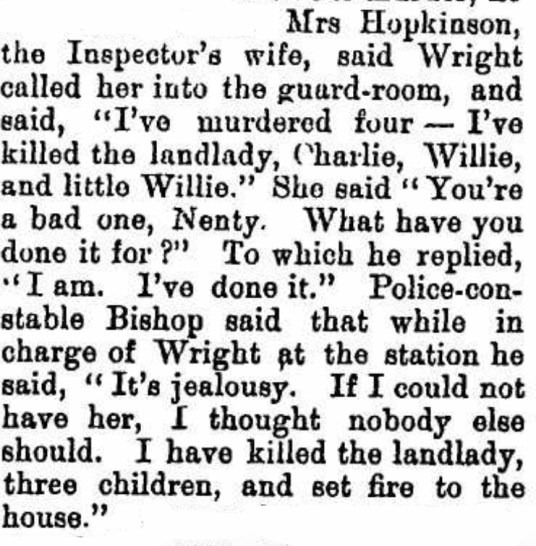
Nenty

Hopkinson immediately charged Wright with the four murders (it could easily have been five, as he had secured George’s bedroom door tight shut with rope), and he was taken away to recover from his wounds, and await the magistrates’ court.

Screen Shot 2023-11-01 at 18.20.24

What do we know of Henry Wright? Very little, in truth. He was born in the town in 1862, and the family had lived for many years in the central thoroughfare of Leeming Street (above, in the early 1900s). They were still there in 1881, and Wright’s father, William was described as a nurseryman. His mother, Jane, had died the previous year. There is no record of him being involved in any kind of criminality, let alone terrifying violence. My first reaction to reading about the horrific mutilation of Mary Reynolds was to think of the scene of butchery that greeted those who discovered the remains of Mary Jane Kelly – Jack The Ripper’s last victim – in Millers Court Spitalfields, just seven years earlier. What possessed Wright – and I use that word advisedly – to commit his butchery of Mary Reynolds? We know that he had ‘romantic’ designs on the woman, and that he had been rejected, but this was not the work of an enraged and jealous spurned lover. This was the work of a madman.

As Wright lay under close guard at the workhouse, awaiting trial, there were bodies to be buried.
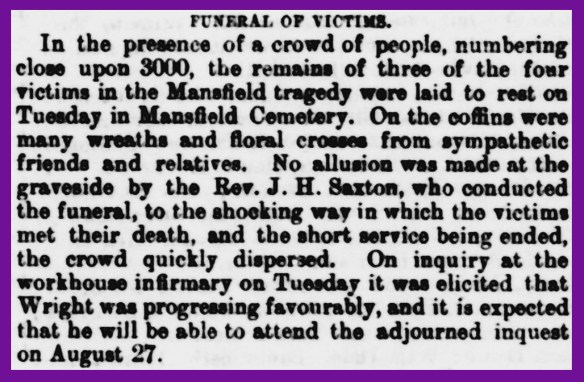
Funeral

Screen Shot 2023-11-01 at 18.35.39

Inevitably, the Mansfield magistrates found Wright guilty of the four murders, and passed the case on to the Nottingham Assizes. There, in November, and equally inevitably, he was found guilty and sentenced to death. There seems to have been a fairly desultory attempt to suggest that he was insane, but medical reports suggested otherwise, and Mr Justice Day duly donned the Black Cap. The ritual appeal against the sentence was duly lodged, but the Home Secretary Matthew White Ridley (left), like the Nottingham jury and the judge before him, was having none of it, and the appeal was rejected. I am certain that the dire American import of ‘counting the sleeps until Christmas’ had not penetrated the British consciousness in December 1895, but I am sure youngsters across Nottinghamshire woke on the morning of Christmas Eve with a sense of anticipation.
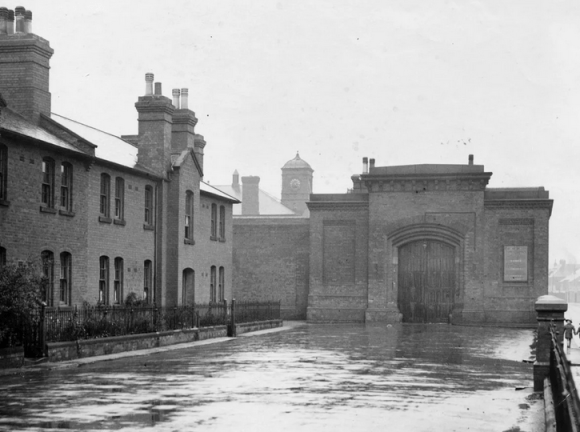
Screen Shot 2023-10-30 at 18.12.25

In Bagthorpe Gaol, Nottingham (above) Henry Wright was experiencing an altogether different kind of anticipation.
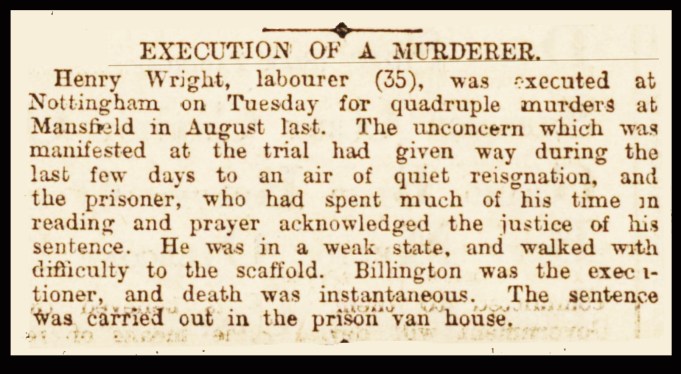
Execution

There are more questions than answers with this case. I have been researching and writing about real-life historical murders for many years, and this is the worst murder I have ever encountered. The circumstances of most of the killings I have researched are similar and familiar. They include these elements:

Heat of the moment’ murders, unplanned but the result of rage.
Planned killings, usually involving stealth and often using poison.
Fatal violence as a result of ‘temporary insanity’, often fueled by drink.

Henry Wright mutilated Mary Reynolds’ body. He disemboweled her, cut off her breasts and destroyed her face with his razor, and then kept her gaping stomach parted open with a curtain rod, so that his work could be seen by those who discovered the carnage. All this was not done in an instant. It is not a ‘one punch’ death. It is not the fatal result of a skillfully placed knife thrust or a well aimed bullet.

There is something dark, disturbing and dreadful about the Star Terrace murders which will never be solved by writers like myself who rely on on old newspaper reports. Whatever the answer, it is buried in Henry Wright’s unmarked prison grave, dug as Christmas Eve 1895 gave way to the most joyful day in the Christian Calendar.

FOR MORE HISTORICAL MURDER CASES CLICK THIS LINK


THE STAR TERRACE HORROR – Slaughter in Mansfield, 1895 (1)

Mansfield header

Do you believe in ghosts? Part of me would like to think that there are such things. The phantoms of the dead have been a significant part of cultures across the world since written records began. I have no personal experience one way or the other but, like many people, I know folks who know other folks who have had paranormal encounters. It’s always third hand, though, isn’t it? But I digress. There is a line from the poem ‘Raglan Road’ by Patrick Kavanagh, which goes:

“On a quiet street, where old ghosts meet..”

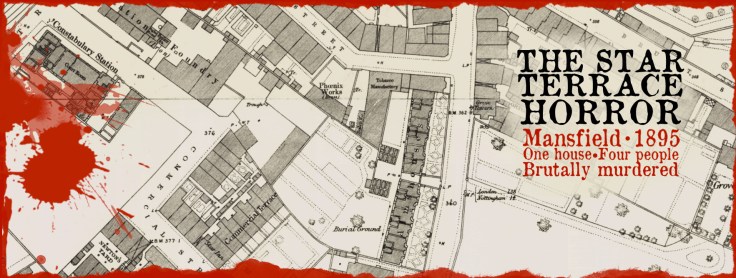
Star Terrace, Mansfield, no longer exists. The houses once sat on Commercial Street, now Commercial Gate, but the road layout is much altered today. There was a pub called The Star Inn, but it – like the terrace named after it – has long since gone. If “old ghosts” could meet, they would certainly be reunited on a bloodstained patch of ground in the middle of Mansfield. On the night of 10th August 1895 Mary Elizabeth Reynolds, her step-children George, William and Charles, grandson William Peck, a two year-old boy named Hall (a relative) went to bed peaceably, unaware that horror was about to be perpetrated before dawn broke the next day. Absent that night was the lodger, a man called Henry Wright. They all lived under the same roof, but only George Reynolds and the boy Hall would live to celebrate Christmas.

Mary Reynolds had lived with William Reynolds, head brewer at the nearby Mansfield Brewery. Although they had never married, she took his name, and when he died on 29th October 1890, although there was a newspaper appeal for claimants on his estate – implying he had died intestate – it seems that he had left her comfortably off, with enough money to rent a house. The bulk of his estate, hoever – nearly £164,000 in today’s money –  was left to his daughter, a Mrs Quible. The 1891 census tells us that  1 Star Terrace was occupied as follows:

Screen Shot 2023-10-31 at 18.25.55

At the top of Commercial Street, where it joined Station Street, was a police station. Inspector Hopkinson lived there with his wife, and  in the early hours of Sunday 11th August, 1895, he was woken up by a commotion outside. Throwing open his bedroom window he looked out and saw a sight which was a bizarre mixture of comedy and horror. Down in the courtyard stood a man, naked except for his socks. He was carrying a child whose nightshirt was on fire. Both the man and the child were covered in blood. Hopkinson knew the man – it was Henry Wright. Sensing that something awful had happened, the police officer put Wright under temporary arrest, applied first aid to man and child, then left them in the charge of his wife. He then ran the fifty yards to  Star Terrace where he knew Wright was lodging. He saw fire and smoke billowing from the upper windows of the terraced house. He sent for the fire brigade, but what they discovered when they broke into the house would haunt them for the rest of their days.

IN PART TWO

A SHOCKING DISCOVERY
ARREST AND TRIAL
RETRIBUTION

‘A PALE FACE AMONG THE RUSHES’ . . . The death of Alfie Wright (part two)

Alfie header2

SO FAR: August 1895. Hannah Elizabeth Wright, 23, gave birth to a little boy, Alfred Edward, in November 1893. The boy’s father has disappeared, leaving Hannah to deal with the situation. Alfie has been in the care of a Miss Flear, who lives near Newark, but Hannah can no longer afford to give Miss Flear the money she requires, and has collected the little boy, and returned to Lincoln on the evening of 26th August. The following day, having not returned to their home in Alexandra Terrace the previous evening, she tells her brother and his wife that the boy is still in Newark, and is being put up for adoption.

Screen Shot 2023-09-14 at 13.36.13

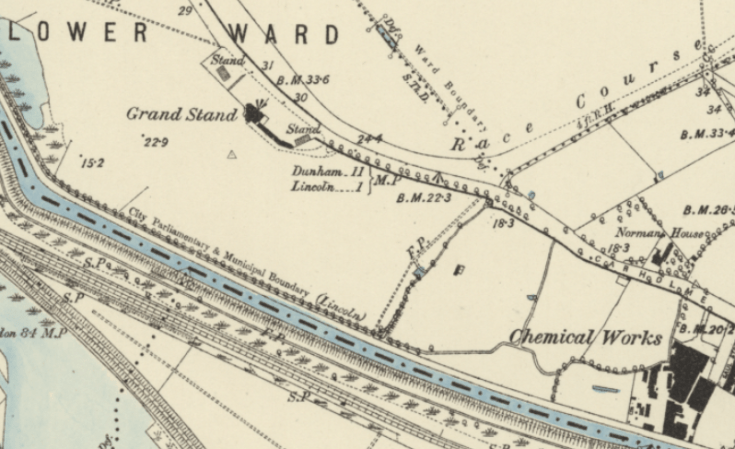
Foss Dyke is a canal that links Lincoln with the River Trent at Torksey. Some historians insist that it was built by the Romans, while others believe that it dates back to the 12th century. It was along the bank of this ancient waterway, between Jekyll’s Chemical chemical works and the back of the racecourse grandstand, that on the evening of Monday 26th August our story continues. A young man called James Fenton was sitting on a bench with a lady friend, when a woman passed them, walking in the direction of Pyewipe. She was carrying a bundle, but they heard a whimpering sound, and they realised that she was holding a child. It was, by this time almost dark, but when the woman passed them again, this time heading back towards the city, she was empty handed. Thinking this strange, Fenton followed the woman at a distance, but lost her somewhere in the vicinity of Alexandra Terrace. The following morning, Tuesday, a man on his way to work had an unpleasant surprise. He was later to tell the court:

Pale face

RecoveryJames Fenton had contacted the police with his suspicions, and the discovery of the body confirmed the police’s worst fears. It is not entirely clear how the police knew exactly where to find the mystery woman, but on the Tuesday, they paid several visits to the house at 25 Alexandra Terrace. Hannah Wright, however, was nowhere to be found. She had left that morning, telling her sister-in-law that she was going to visit friends. She did not return until the Wednesday morning, by which time the police had instituted a full scale murder investigation. Hannah confessed to Jane Wright, and a neighbour, Mrs Sarah Close. It was Mrs Close who accompanied Hannah to the police station, but the girl seemed to be under the bizarre misapprehension that if she told the truth she would get away with a ‘telling off’ or, at worst, a fine. She was not to be so fortunate:
Confession

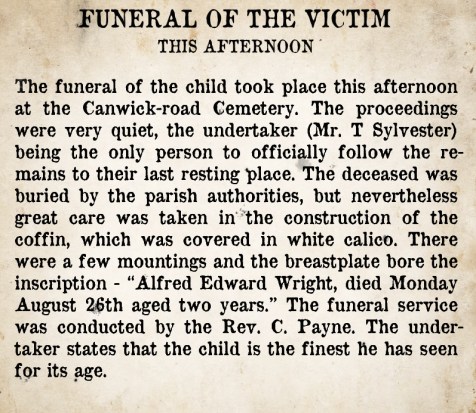
FuneralThe law took its inevitable course. There was a coroner’s inquest, then a magistrate’s hearing, both of which judged that Hannah Wright had murdered her little boy. As was customary, the magistrate passed the case on to be heard at next Assizes. Meanwhile Alfie’s body was laid to rest in a lonely ceremony at Canwick Road cemetery. It is pointless speculating about Hannah’s state of mind, but it is worth reminding ourselves that Alfie had known no father and  had seen very little of his mother during his brief sojourn – fewer than 300 days – on earth. If ever there were a case of ‘Suffer the little children’ this must be it.

Whatever the state of Hannah Wright’s mind when she drowned her son, and during her  long months before she came to trial, when she finally appeared before Mr Justice Day at the end of November she must have had a cold awakening as to what possibly lay ahead of her. Since September, there had been various intimations in the press that Hannah was, to use the vernacular, “not quite all there” but there was no medical evidence that she was weak minded or mentally deficient. Her defence barrister made a rather odd case, as was reported in The Lincolnshire Echo on Tuesday 26th November 1895:

“The Judge pointed out that the defence was rather an unusual one, namely of a two-fold character, one contention being that the prisoner never committed the crime all, and it she did do so that her mind was unhinged at the time. As to the plea of insanity he did not see that there was the slightest evidence to show that her mind was diseased. The jury retired to consider their verdict at 5.20, and returned into Court after an absence of twenty-seven minutes. They found the prisoner guilty, with a strong recommendation mercy. Prisoner made no reply to the question put to her by the Clerk whether she wished to say anything before sentence was passed. The Judge, who appeared be deeply affected, said the jury had simply discharged their duty, painful though undoubtedly was. With regard to the recommendation to mercy his Lordship said he would wish and beg her not to place undue reliance upon that recommendation. His Lordship then passed sentence of death in the usual manner. Prisoner fainted as she was being led down the dock steps.”

The general public in Lincoln and round about had become very involved in this tragic case, and even before Hannah collapsed on the steps of the dock, a petition was created and with thousands of names on it, presented to the Home Secretary, Sir Matthew White Ridley KCB. Within days, the threat of the hangman’s noose was lifted.

reprieve

Peter Spence, a distant relative of Hannah, and to whom I am indebted for sharing his research, suggests that this story has something of Thomas Hardy about it, but we would do well to remember that poor Tess (of the D’Urbervilles) is hanged for her crime. Not only did Hannah survive, but she was released from prison in Aylsbury, apparently going straight to London to work as a servant.

Screen Shot 2023-09-14 at 19.01.38

Strangely, that is where the story ends. Peter Spence, and that eminent compiler of Lincolnshire crime stories Mick Lake, like me, have found no trace of what became of Hannah. This is unusual, given the amount of information available on modern genealogy websites, but it it is what it is. There are a couple of inconclusive mentions in the 1939 register, but no evidence that these people are ‘our’ Hannah. There is this, but is it feasible that a servant girl could have eventually returned to Lincolnshire and died at the age of 89, leaving the sum of £2552 10s – nearly £47,000 in today’s money? Perhaps that is a mystery for another day.

Hannah will

I have been researching and writing about historic Lincolnshire murders for some years,and those wishing to find out more about our county’s macabre past should click this link

‘A PALE FACE AMONG THE RUSHES’ . . . The death of Alfie Wright (part one)

Alfie header1

Hannah Elizabeth Wright was born on 25 August 1872 to John Wright, an agricultural labourer, and Mary Anne Key in 
Kirkby la Thorpe,  a tiny village a few miles east of Sleaford. The 1881 census recorded 256 souls.

1881 KLT

ewerby

Hannah was the youngest of five 
children, two boys and three girls. Sadly, her mother died when she was four. Her father remarried so she 
was brought up by her stepmother. There were few options for young women ‘of humble birth’ in rural communities in those days. It was either work on the land, or go into service – meaning a live-in position with some wealthy family, either as a cook or a general maid. The census in 1891 shows us that Hannah was working in The Manor House at Ewerby, less than two miles from Kirkby. Her employer was Mr William Andrews, a farmer. The Manor House (left) still stands.

By 1893, she had moved further away to the village of Weston, near Newark. It was here that she began a relationship with a local lad and became pregnant. Alfred Edward Wright was born on 3rd November 1893. He was, by all accounts, a healthy child, but his father quickly disappeared from the scene, and became engaged to another woman. This left Hannah in a dire situation. With no other means of support other than her own work, how was she going to bring up Alfie? A solution – of a kind – was found when a Weston woman called Jane Flear offered to take the boy in – for a price.

We know that by 1895 Hannah was working for a family in Branston, south of Lincoln, and had begun another relationship, with a young man called William Spurr, but she kept Alfie’s existence from him. Hannah had already fallen into arrears with her payments for Alfie, but her problems became worse when she received word from Miss Flear that the price for looking after the little boy was to be raised to three shillings and sixpence each week. Using the Bank of England inflation calculator, that would be nearly £38 In modern money, probably more than Hannah earned each week, given that her food and housing would come with the job.

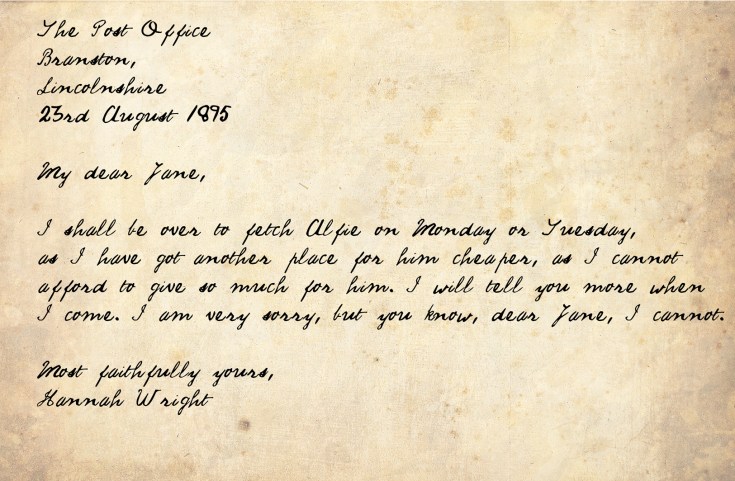
Jane Flear received this letter (facsimile) from Hannah:

Letter

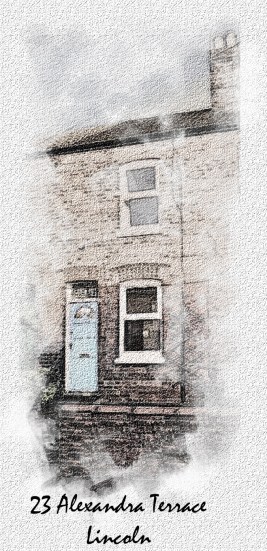
23AlexHaving traveled to Lincoln on the afternoon of 23rd August, Hannah visited her brother and his wife at their house, 23 Alexandra Terrace. All appeared to well, and on the Sunday evening Hannah even brought her young man, William Spurr, round for tea.
Hannah Wright arrived in Weston on the afternoon of Monday 26th August to collect Alfie. Miss Flear had misgivings about handing over the little boy, and thought that Hannah was in something of a disturbed state. When she went to collect the rest of Alfie’s clothes, Hannah said she didn’t want to take them. The three of them, Jane Flear wheeling Alfie in his pram, set off to walk the two miles to Crow Park station, just outside Sutton on Trent. Hannah and Alfie caught the 6.15 train to Retford. Jane Flear never saw Alfie alive again. Hannah eventually returned to the little terraced house in Alexandra Terrace late on the Monday evening,and explained to Jane and William Wright that her little boy was still in Weston, but she had arranged for someone to adopt him permanently. Jane Wright asked her sister in law if she had discussed the situation with William Spurr, but despite Jane telling her that it was wrong to keep back something so important, Hannah was adamant that he was not to be told. They all retired to bed at 11.30 pm. The next morning, at about 9.30 am, Hannah announced that she was going to visit some friends, and would return later.

IN PART TWO

A CONFESSION
A TRIAL
THE BLACK CAP

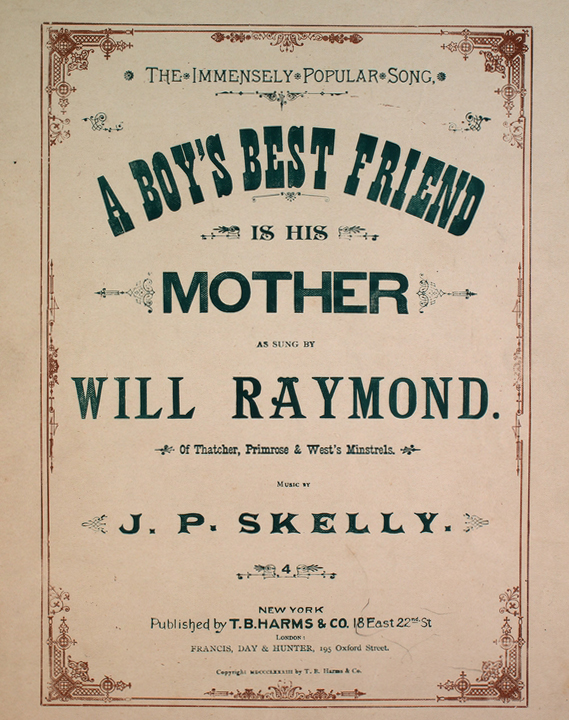
A BOY’S BEST FRIEND IS HIS MOTHER

for-blog

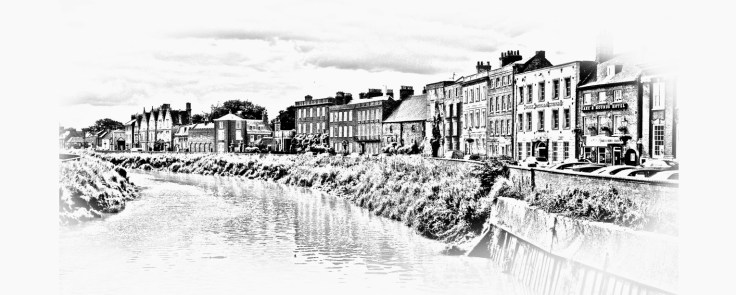
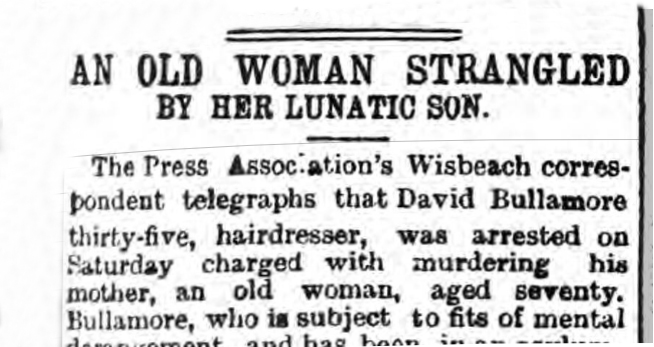
After a brief visit to Bermondsey, the podcast is this week back on home territory in Wisbech, to tell the sad saga of a man with a debilitating mental condition who was left to roam the streets, with dire consequences for the person who loved him the most.

headline

A BOY’S BEST FRIEND IS HIS MOTHER

a-boys-best-friend

Blog at WordPress.com.

Up ↑