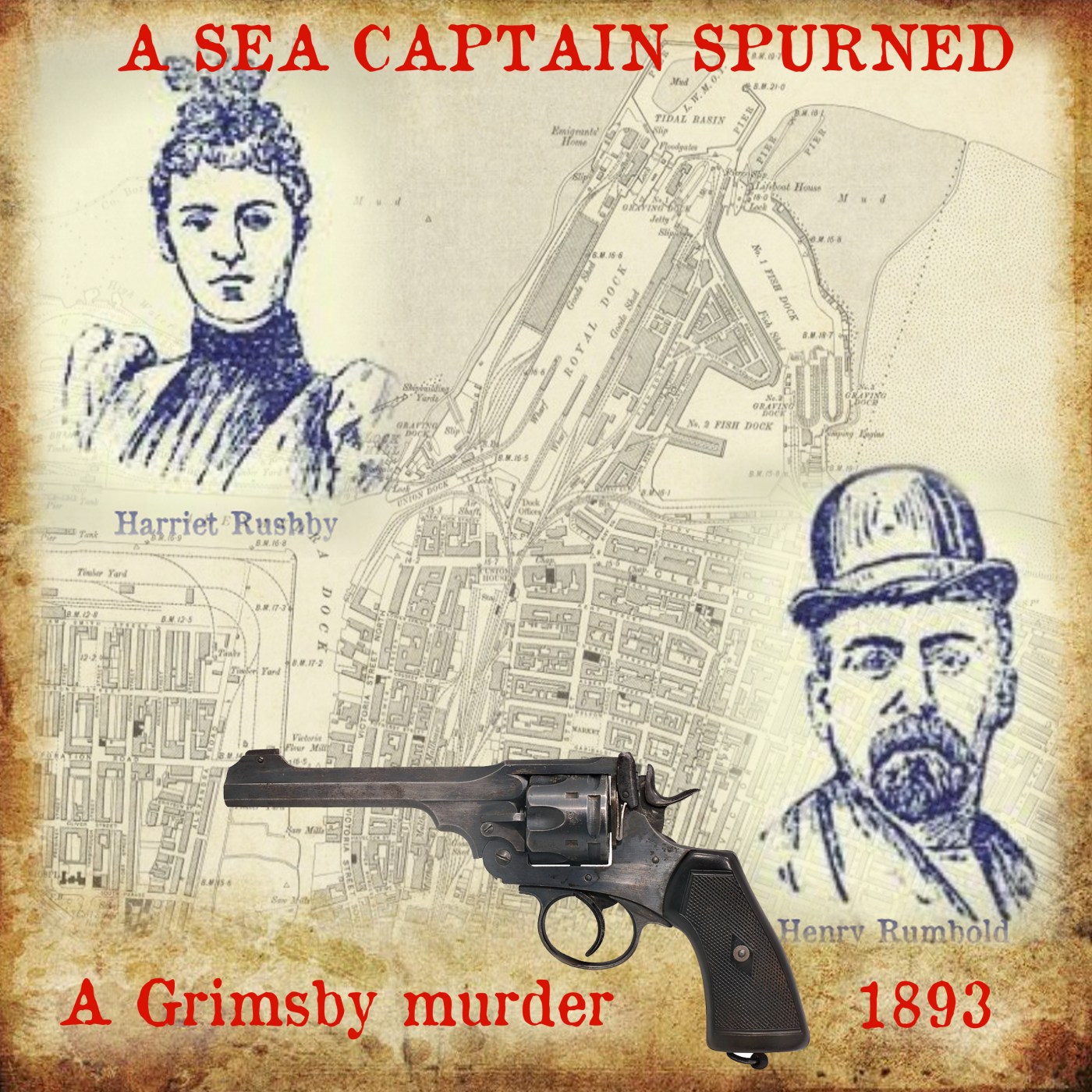

SO FAR – It is November 1893. 39 year-old Grimsby fishing smack captain Henry Rumbell (widely called Rumbold in press reports) has been having an affair with a young Grimsby girl, Harriet Rushby. Rumbell, fearing that Rushby was ‘playing the field’ had arranged for her to stay under the watchful eye of one of her relatives while he and his ship set to sea for a long trip.
Rumbell’s fishing trips normally lasted eight weeks, but Harriet Rushby was clearly playing on his mind, and after just two weeks at sea, he turned Nightingale round and headed back to Grimsby. On reaching port on the afternoon of Tuesday 7th November, Rumbell made straight for the house in Ayscough Street where he had hoped that that Harriet had been staying under the watchful eye of her cousin Charles. The news that he had seen neither hide nor hair of the young woman sent Rumbell into a barely controlled rage. He set off for Victoria Street where he purchased a revolver and a box of cartridges from a gunsmith’s shop.
He visited a woman called Ann Widall in Emmerson’s Terrace, and she told him that Harriet had been seen heading for what the press called The Empire Music Hall. This is another of the mysteries in this story. Where it was, I don’t know, as what became known as the Empire Theatre in Cleethorpes wasn’t built until 1895. Eventually Rumbell caught up with Harriet on the Cleethorpes Road. She was in the company of a woman called Mrs Bowdidge and a man called William Burns, who lodged with her at 124 Tunnard Street. The four of them continued an evening’s drinking, ending up at a long-since-closed pub, The Barrel in Lock Hill. At about eleven o’clock, Rumbell and Rushby went to the house in Tunnard Street, where Rumbell demanded to know what the girl had been doing behind his back. When Bowdidge and Burns arrived at the house a short time after, what they heard was reported in a local newspaper:

From here, the path from Grimsby police station to the gallows at Lincoln Gaol was straight and smooth. This, once again from a contemporary newspaper:
“Rumbold was tried at Lincoln Assizes on Wednesday, November 29th, before Mr. Justice Charles. There was practically no defence, the only efforts of counsel on behalf of the prisoner being directed to obtain a verdict on the less serious charge of manslaughter. The summing up of the judge was distinctly unfavourable to this view of the case. His Lordship said he did not suppose anyone could have any doubt of the sort of life led at the woman Bowdidge’s house, and there it was that the girl took up her abode whilst the prisoner was away at sea, but in point of law nothing took place that would justify them in reducing the criminality of the charge After nine or ten minutes consideration the jury returned a verdict of guilty, and then it was that the prisoner, who had presented a calm demeanour throughout the four hours’ trial, made most extraordinary statement. He expressed his satisfaction with the verdict, and asked his Lordship to grant him, as he was a great smoker, as many cigars and cigarettes as he wished for between then and the day of his death. ” I want to die an English hero,” said the wretched culprit, ” though,” he added, ” I know it is a disgrace to my country and my friends and comrades.”
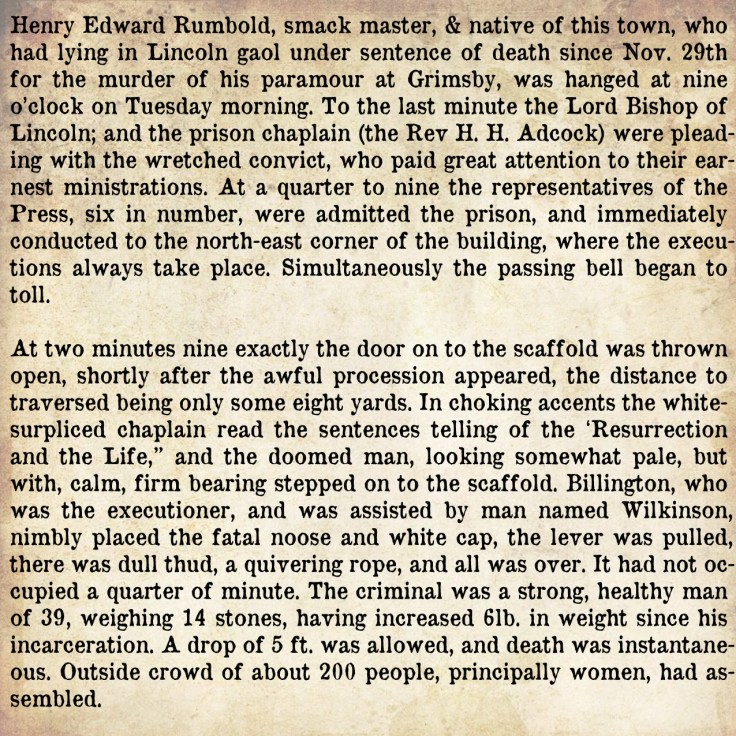
Henry Rumbell’s demise on 19th December 1893 was described graphically in a Grimsby newspaper report:
Tragically, male on female violence, whether fueled by jealous rage or not, shows no sign of abating as we supposedly become more civilised. The list of men who have murdered women is a long one, and includes such infamous names as Dr Crippen, Reginald Christie, John Haigh, Fred West, Harold Shipman, Levi Bellfield and Wayne Couzens. It remains a matter of debate whether the death penalty would have acted as any deterrent in the more recent cases.
FOR OTHER LINCOLNSHIRE MURDERS, FOLLOW THE LINKS BELOW
The strange death of Catherine Gear
 The early life *(see footnote) of Harriet Rushby has been difficult to trace. One newspaper report says that she was 24 in 1893, while another says she was 20. There is a death record for December 1893, where a Harriet Rushby was buried in Caistor, aged 22, and a census record for 1881 which gives us a Harriet Rushby living in Lower Burgess Street with her grandparents, but she is listed as being born in 1874.
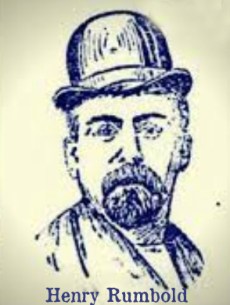 Henry Rumbold proved just as problematic, until I realised that his actual surname was Rumbell, and that his family were well known seafarers from Yarmouth. On the night of Sunday 3rd April 1881 he was listed in the census as being on board the ship Tempus Fugit, moored off the Suffolk Coast. It looks as though he was described as Master, while his younger brother Walter was Mate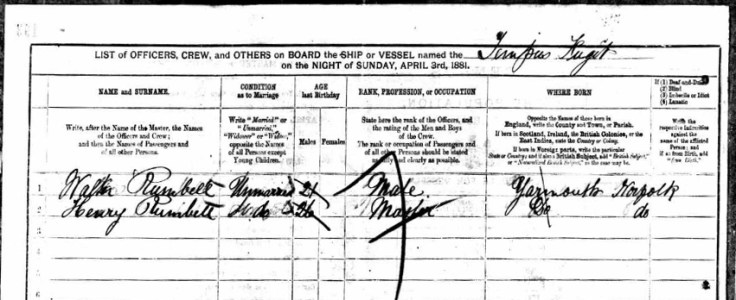


 fullybooked2017