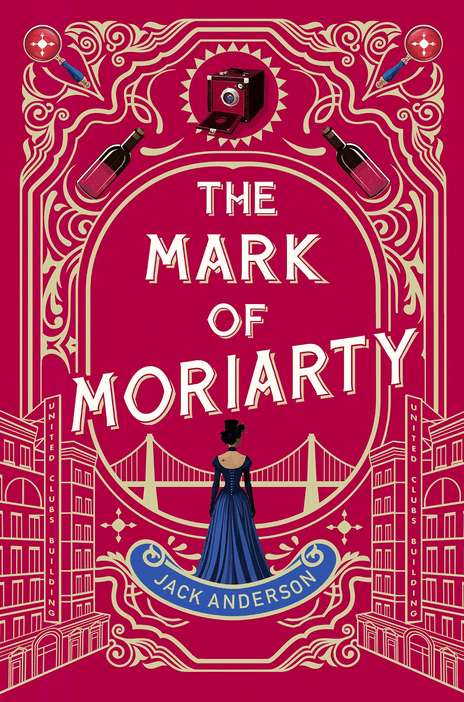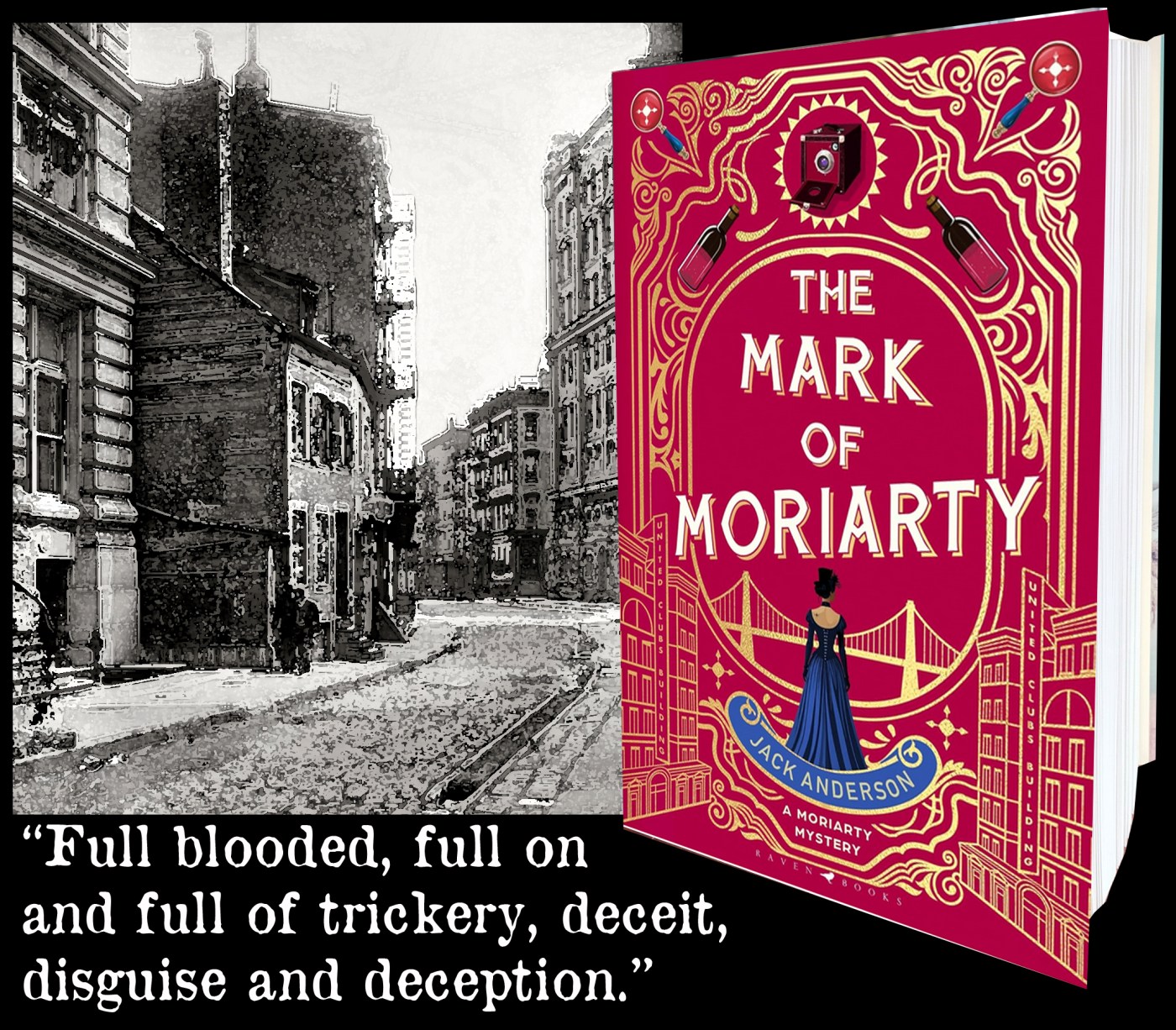

It is one of Crime Fiction’s oddities that American writers seem to be able to produce credible pastiches of our most famous detective, the best of which, by far, is Mitch Cullin’s A Slight Trick of the Mind. The series of Holmes tales written by Bonnie MacBird are also very readable.
So what do we have here? Not Holmes himself, for reasons which will become clear. After a couple of (sadly, now seemingly obligatory) prologues, we read a letter sent from New York to 221B Baker Street, asking for help. It is a bizarre tale. A well-to-do New York family has reluctantly taken into their home a distantly related orphan girl. She grows up to be clever, beautiful and entrancing. But the she falls from grace and disappears, only to mysteriously reappear some years later, in a snowy city alleyway, clad only in a chemise.
The best crime novels establish a sense of purpose early on. Readers like to learn about a crime, a perpetrator, and who is trying to solve the crime. This novel, to put it mildly, meanders at the start. We know the strange tale of Viola Bellman, and that her uncle’s letter to Sherlock Holmes has been opened and answered by Dr John Watson, because Holmes is dead. We initially observe things through the eyes of Clara Mendel, a psychiatrist who has been treating Viola. We also know that Mendel is, somehow, connected to James Moriarty. He eventually materialises, and Mendel forms an uneasy alliance with him.In the distant background is a sinister organisation called the Arcane Society.
Mendel, on returning from the Bellman home, where she has been treating Olivia, is shot and wounded just outside her apartment, but the next thing we know, we are in Amsterdam, where a young American, a professional punter on horse racing, had been imprisoned by a gang who put his knowledge of the turf to their own ends. Things become ever more mysterious. Back in New York and recovering in hospital from her gunshot wound, Mendel is visited by her friends from the Sabel Club, a group of like-minded mystics and ‘spiritual investigators’. They tell her that, in between the bullet being removed from her shoulder, the wound stitched and bandaged, and the dressing removed, a mysterious runic tattoo has appeared on her skin.
In Amsterdam, the captive American escapes by jumping from his rooftop into the flooded Keizersgracht, The Emperor’s Canal, but in Manhattan, Clara Mendel is close to being overcome by events. Members of her Sabel Club are being murdered – and her search for the Arcane Society is becoming shambolic.
I am not sure how well analogies between painting and novels work, but here goes. This book does not have the calm logic, cool sense of reality and human perception of a Constable, a Gainsborough or a Rembrandt. Instead, it is a feverish mix of Caravaggio, Richard Dadd and Goya. It is full blooded, full on and full of trickery, deceit, disguise and deception.The solutions to the Sabel Club murders are are either divinely complex – or prosperous – depending on your viewpoint, but what we do we make of Jack Anderson’s version of Moriarty? He is clearly capable of great brilliance of mind, and is clearly a mathematical genius, but he appears to lack any kind of moral compass. By most modern definitions he is, then, a psychopath, in that everything he does is controlled, calculated and manipulative. His complex relationship with Clara Mendel is best summed up in this quote:
“We shall not be travelling together, Dr Mendel”, James says.
“We infuriate each other. We deceive each other constantly. Neither of us is a desirable travelling companion.”
The deep seated reason for all the intrigue and carnage? In fiction, as in life, it’s always one of two things – lust or lucre. In this case, the lucre is particularly filthy, as it consists of a vast hoard of gold, stolen by a ruthless West Coast gang years earlier. It had been hidden, and its location protected by a complex series of ciphers and obscure clues that make Long John Silver’s treasure map about as complex as the instructions on your car’s GPS system. This entertaining recreation of late 19th century New York was published by Raven Books on 5th November.