Search

fullybooked2017

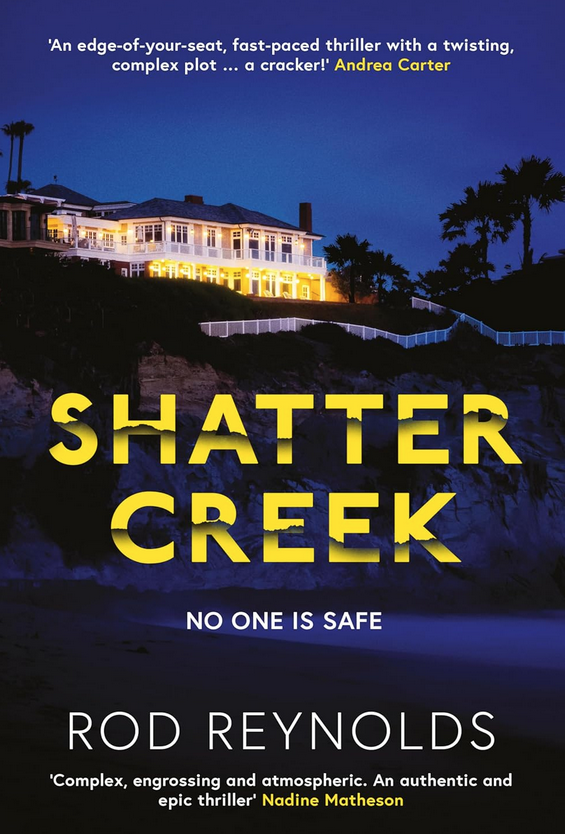
SHATTER CREEK . . . Between the covers

Cards on the table. About five minutes in, I decided I didn’t want to like this thriller. Why? Because it began with my absolute pet hate, jumbled time frames. When I see chapter headings ‘..one week earlier…..twenty four hours later …… twenty four hours earlier..’ I get irritated beyond measure. Just tell the story, please! I am pleased to say, though, that after a few pages of darting back and forth, the narrative settled down, and I was drawn into a gripping story.

We are in Long Island, and Hampstead County PD cop Casey Wray’s badge is still – just – in place after a corruption scandal that rocked the department. Her hopes of being appointed Lieutenant (to replace a casualty of the purge) have come to nothing, and her new boss Lieutenant Dunmore doesn’t exactly exude affection. Wray has no time for grudge-nursing, however, as she is knee deep in a double homicide. One of the victims – Landon Whitlock –  was a generous donor to local Democrat Party funds, and the movers and fixers at City Hall are on her back for a quick result. Next day, though, there is another murder. This being America it is, naturally, another gun crime.

I did have an irreverent thought at this point. Don’t they have knives or machetes in the States? Here in Britain we are plagued by murders committed with blades. The answer is pretty obvious, I suppose, and it is that literally anyone here – including teenagers –  can get hold of a potentially fatal blade. Likewise, anyone in America can get their hands on a gun, whether it is their own or belonging to their parents. I have a firearms permits, and controls are pretty strict, especially for rifles (as opposed to shotguns). As for handguns, they are not available – except to criminals. One of my sons lives in USA, and shoots. I asked him how he buys his ammunition and, after giving me a quizzical look, he said, “Online, of course – the postie just puts the package in the mailbox’

I digress, so back to the story, and the new murder. The victim is a woman called Lori Goff. and the immediate suspect is Adam Ryker, her boyfriend, and what we Brits would call ‘a nasty piece of work’. He is a deeply unpleasant and narcissistic womaniser. When the murder weapon is found buried in his back yard, the search for him intensifies. He is found. Beside a hiking trail near Pine Barrens. As dead as can be. A single gunshot wound to the temple, a revolver clasped in his hand. This is just over half way through the book, so any crime reader worth his or her salt will immediately suspect that this is not the remorseful suicide it appears to be.

In many ways, Casey Wray is a classic ‘outsider cop’ beloved of many a CriFi writer. She ticks most of the boxes.
Unlucky in love √
Lives alone √
Ruthlessly honest √
Has a challenging relationship with her superiors √
Privately vulnerable √
As she digs deeper into the complex lives of Landon Whitlock and his abrasive wife Darcy, Wray is innocently oblivious of the storm that is about to engulf her. The killings are the fruits of a poisonous plant that has its roots deep in Long Island politics and, although Wray – at least on paper – solves the mystery, the book ends with her clinging to a metaphorical alpine ledge, with an avalanche about to engulf her. This isn’t a typical slick American thriller, as I believe the author is British, but it has pace, complexity and a beguiling number of red herrings. Shatter Creek is published by Orenda Books and will be available on 22nd May.
RING OF FIRE . . . Between the covers

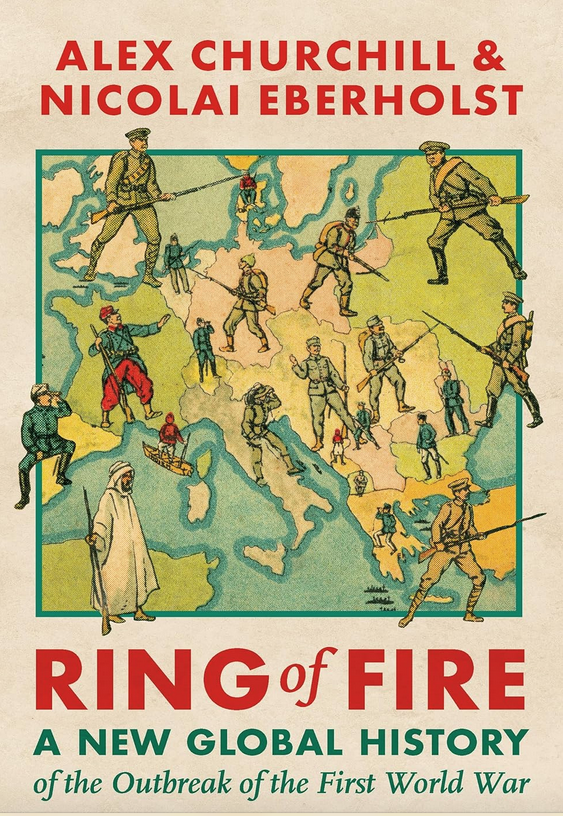
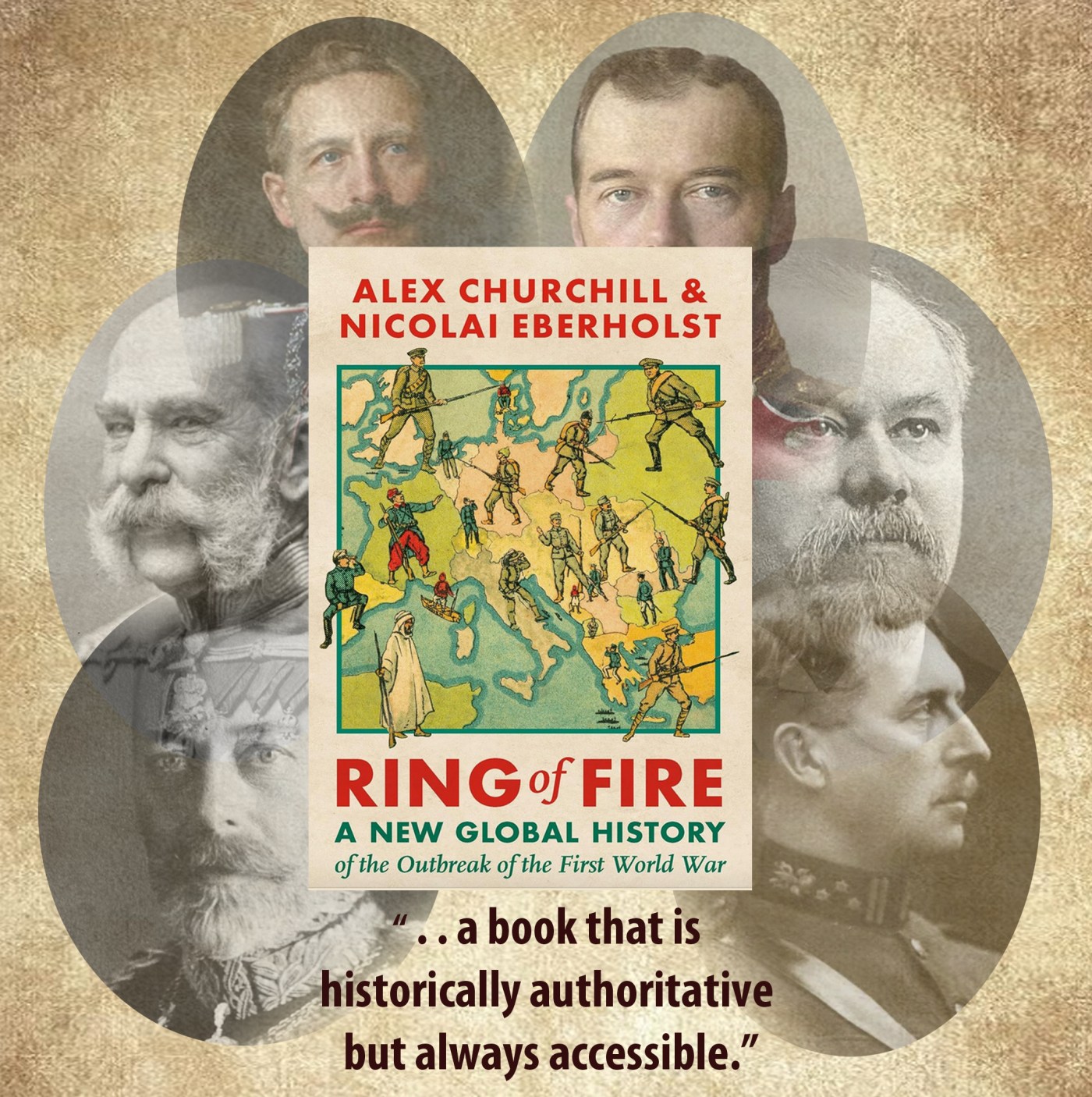
In my reading experience, the definitive account of the outbreak of The Great War remains Barbara Tuchman’s The Guns of August (1962). The author made us flies on the wall in cabinet meeting rooms across Europe, and hidden observers within General Staff offices of the armies of Germany, Britain, France and Russia. This book is very different. Its premise is that this was a truly global conflict, principally due to the vast colonial outreach of the major powers. Men and women, ordinary citizens of places in Africa that were ruled from London, Berlin, Paris and Brussels, remote settlements in the Caucuses who were subject to the rule of the Tsar, shoeless peasants in the outer reaches of the ailing Ottoman empire, and those living in the United States and South America who were part of the colossal diaspora from Europe – all felt the rough hand of destiny on their shoulder.

The celebrated (but not always admired) historian AJP Taylor famously argued that the outbreak of the war was inevitable, due to military planning relying on inflexible railway timetables. Once the trains, packed with tens of thousands of men, headed off to their destination, then conflict was inevitable. This theory is easily challenged but Churchill and Eberholst give this example:
Britain’s rail network comprised some 23,000 miles of track. On 4th August 1914, 130 companies were effectively taken over by the government. At Aldershot, from 5th August officers were being handed dossiers that revealed the plan for their departure. For instance: ‘Train No 463Y will arrive at siding B at 12.35 a.m., 10th August. You will complete loading by 3.40 a.m.’

Britain’s army in 1914 was tiny compared to those of France, Germany and Russia. It was even outnumbered by the army of Belgium, but it was superbly trained and had relatively recent battlefield experience in the Boer Wars. The key difference between Britain and the empires of France and Germany was in the existence of Britain’s white dominions. Australia, Canada, New Zealand and South Africa were, in theory at least, at one with the mother country’s foreign policy.

One of the many valid points made by the authors is the vexatious question of perceived neutrality. Long before the first shots were fired in the war, developed nations needed vast quantities of imports and, were they fortunate enough to possess natural resources, ships to export material and goods elsewhere. The ownership of cargo vessels was perhaps not as opaque then as it is now but, for example, if a Swedish ship sailed into Hamburg loaded with iron ore, did that compromise Sweden’s notional neutrality? What if an American ship loaded with wheat were headed for the Port of London? Did that make the vessel fair game for German submarines?

The authors remind us that by the time the trenches ran from Switzerland to the Belgian coast, maps were able to be made showing every dip or fold in the land and – literally – every large shell crater. In the dying days of August 1914, particularly in the rural areas of Galicia, East Prussia and Serbia, the landscape was a complete mystery to field commanders. Knowledge of the terrain was almost completely absent, resulting in disastrous tactical blunders by all sides.

Comparing different kinds of horror brought about by war is, perhaps, futile, but as an amateur historian brought up on grim tales of life in the Western Front trenches, I was struck by the descriptions of the relentless carnage of these early weeks of the war. Yes, it was a war of movement but, in particular, it was fought in intense August heat. Men on the march were driven mad by thirst; tinder-dry fields and woods caught fire quickly, cremating the dead and wounded alike. This was a new kind of war; medical services were woefully inadequate to meet carnage on this scale. I was quickly disabused of any notions I had that these early battles between the huge armies were somehow cleaner and less grisly than the trench warfare which followed them.

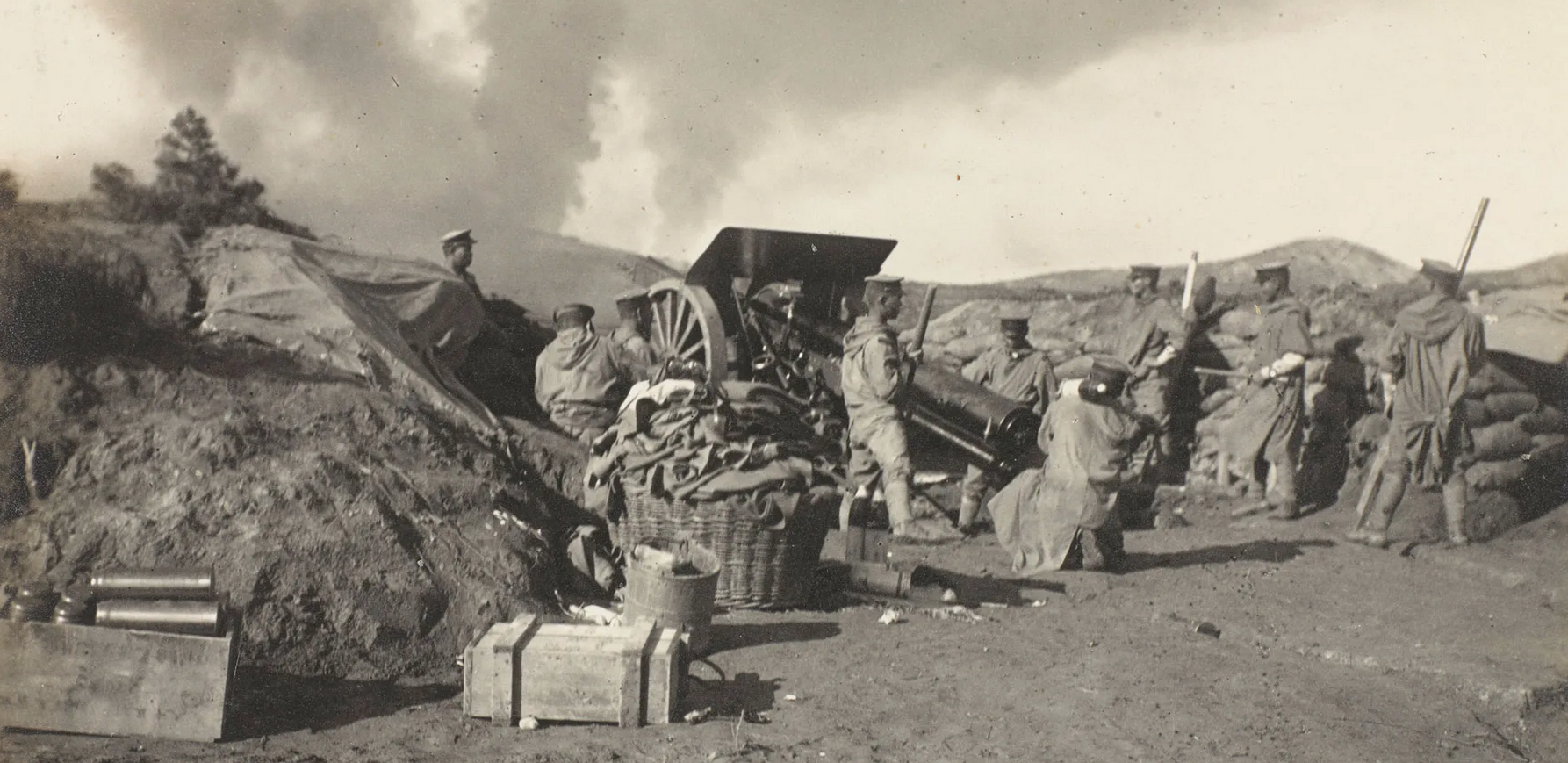
Another surprise (at least to this woefully ignorant reader) was to learn that Japan and Britain fought together to drive Germany out of Chinese city of Tsingtao (below) between August and November 1914. It is a sobering reflection on the fragile nature of national alliances to think that less than a decade earlier, Japan and Russia locked horns in a savage war. Now, they were, notionally, allies in a war against Germany.

As autumn turned into winter, the major powers were all unsteady on their feet. The French had suffered astonishing losses in the east, but had engineered a miracle on The Marne. Germany’s relentless advance through Belgium had been thwarted, and they had back-pedalled in disarray to dig in north of The Aisne. Despite the debacle at Tannenberg, Russia had inflicted a monstrous defeat on Austria Hungary in Galicia. This account, from a Hapsburg officer, is horrific :

‘Scenes from Dante’s Inferno were happening on the road. Driven by instinct, both men and horses pressed forward, regardless of the corpses and wounded lying on the ground. Horses hooves were treading over bellies and heads. Intestines, guts, brains mixed with mud covered the road with a bloody mess. The screams of the wounded, men and horses, together with the cracking rifles, grenade and shell explosions drove one to near insanity.’

I am always intrigued by writing partnerships, and ponder the (largely irrelevant) question, “Who did what?” Whatever the respective inputs were here, Churchill and Eberholst have written a book that is historically authoritative but always accessible. UK Great War literature tends, for quite laudable reasons, centred on the Western Front and the great calamities that took place there, but here we have a timely reminder of the days before the trenches were dug “from Switzerland to the sea” and the horrific slaughter that took place in places with names that have long since vanished from the map. Ring of Fire will be published by Apollo on 8th May.

DEATH ON WOLF FELL . . . Between the covers

This is the next instalment of the career of Lancashire DS Jessica Raker, to whom we were introduced in “Death at Dead Man’s Stake”. Jess resumes her head-to-head battle with gang boss Maggie Horsefield, a ruthless and vindictive woman who is at the apex of the criminal fraternity, but someone who swims in the toxic waste in terms of human decency. It complicates matters that Jess’s daughter Lily and Maggie’s offspring Caitlin are BFFs at school.

It’s fair to say that Jessica Raker has something of a turbulent past. Born and bred in the district she now polices, she gravitated to London, where her career in the Metropolitan Police concluded dramatically with her shooting dead a feckless younger member of a serious crime gang. When a retaliatory contract was taken out on her life, she was relocated to Clitheroe. She has two children, but her relationship with husband Josh is, to say the least, threadbare, although they are still together.

This story starts with Lance Drake, a petty crook somewhere near the bottom of Maggie Horsefield’s barrel of criminal employees, facing his worst nightmare. He is being released on license from HMP Preston, where he has been quite happily spending the last few months, safe from the inevitable retribution which has awaited him since he shot his mouth off to the police, thus losing his boss tens of thousands of pounds in a drug shipment.

Inevitably, given that Horsefield has her employees embedded at every level of the criminal justice system, Drake is soon grabbed, and when the hood is taken from his head, he finds himself cable-tied to a chair sitting, ominously, on a large plastic sheet spread on the floor of a disused mill, with Horsefield sitting nearby, fondling a zombie knife. Jess Raker’s team have had their eyes on this mill for some time, rightly suspecting that is part of Horsefield’s drug distribution business and, happily for Lance Drake, they choose that moment for a raid.

Most of Horsefield’s goons get away, the mill plus an industrial quantity of ‘merchandise’ go up in flames, and the stage is set for a dramatic encounter as Horsefield and her lover, London gangster Tommy Moss, plan a multi-million pound raid on Wolf Fell Hall, an ancestral home which contains scores of priceless old master paintings. Along the way, we learn more about the team of officers around Jessica Raker. There is the intelligent and resourceful PCSO Samira Patel, who yearns to become a ‘proper’ copper. CID officer Dougie Doolan is one of Jessica’s mainstays, but she suspects he is hiding a grim secret. Her boss, Inspector Price, we strongly suspect may be a wrong ‘un, but is he actually feeding information to the dreadful Maggie Horsefield?

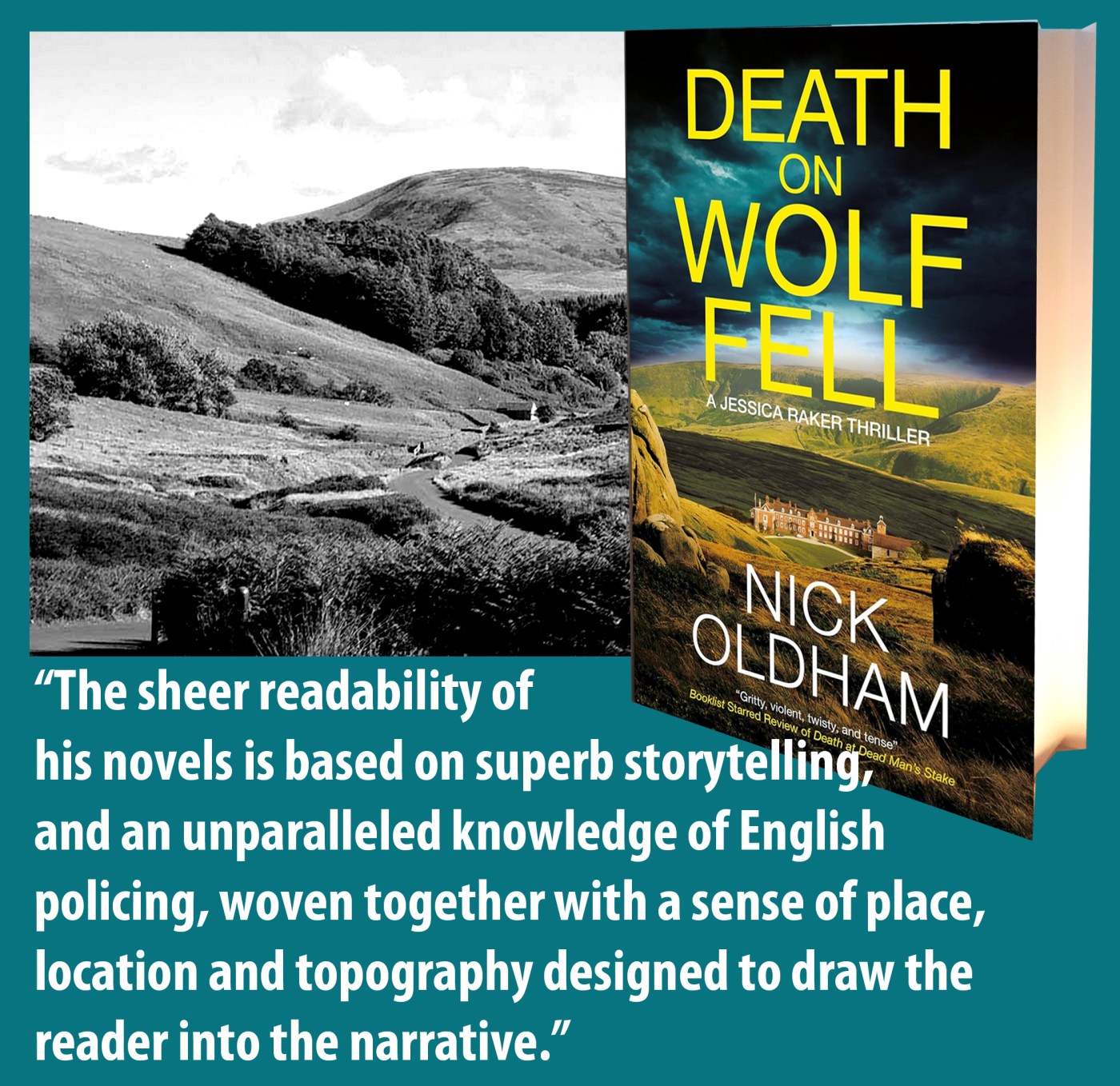
One thing you will not find in a Nick Oldham novel, thankfully, is the remotest trace of sympathetic hand-wringing for his villains. Yes they may come from awful families with dreadful parents but, like all of us, they have a choice. If they take the wrong road, then they have no-one to blame but themselves. For Oldham, once a working copper in hives of scum and villainy like Blackpool, they have made their choice and deserve everything they get. He has a direct, no-frills narrative style. The sheer readability of his novels is based on superb storytelling, and an unparalleled knowledge of English policing, woven together with a sense of place, location and topography designed to draw the reader into the narrative. Death on Wolf Fell will be published by Severn House on 6th May.

MRS HUDSON AND THE CAPRICORN INCIDENT . . . Between the covers

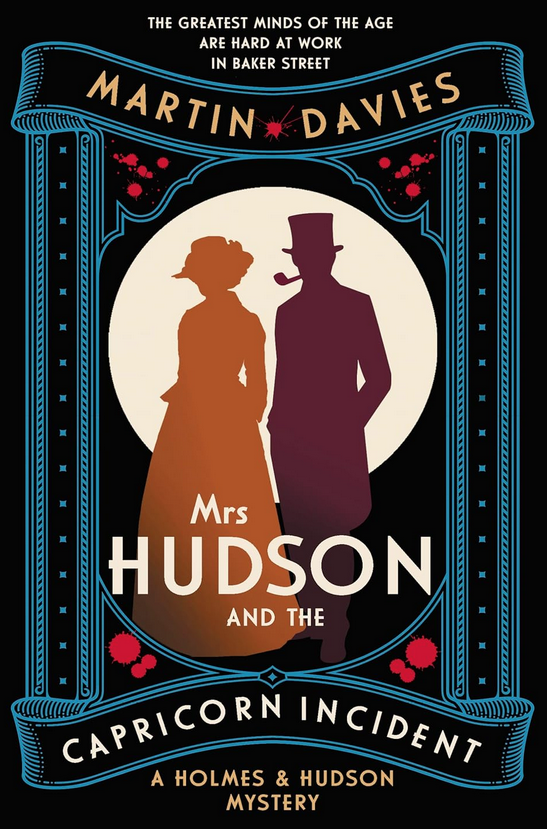
The canonical 56 short stories and four novellas featuring Sherlock Holmes have left so-called ‘continuation’ authors with plenty of subordinate characters to draw on. Dr Watson, inspector Lestrade, Moriarty and brother Mycroft have each been the central character in novels. I suppose it was only a matter of time before Mrs Hudson took centre stage. Martin Davies took up the challenge in 2002 with Mrs Hudson and the Spirit’s Curse, but here, events are narrated by a girl called Flotsam, who recalls events rather in the way that the good Doctor reminisces about the cases his old friend solved.

Flottie was an orphan girl, saved from a life of degradation by the kindness of Mrs Hudson, but is now a very bright young woman who has seeks education where and whenever she can find it. She is now highly literate and socially adept (but still working downstairs).The story unfolds through her eyes and ears. The substantive plot centres on Rosenau, a tiny Duchy in the Balkans, squeezed between the competing demands of the ailing Ottoman empire, Austria-Hungary and fervent Serbian nationalists. It’s survival depends on an impending marriage between Count Rudolph and Princess Sophie who, hopefully will provide a legitimate heir, ensuring the Duchy’s survival. Rosenau is, of course, fictional, but the Balkan powder keg was, at the turn of the century, frighteningly real. Everything goes awry when, first, the Count goes missing while on a European skiing trip and, second, when the princess is abducted from a London residence.

Reviewers and critics are perfectly entitled to question the validity of the still-vibrant Sherlock Holmes industry. Why, over a century after the last Conan Doyle tale was published, are we still seeing (and here, choose your own description) continuations, homages, pastiches and re-imaginings of crime fiction’s most celebrated character? The answer is simple – because people buy the books or borrow them from the library. Conan Doyle tired of his man, and tried to end it all, in the hope that readers would be drawn towards his other novels, like Micah Clarke or the Brigadier Gerard series. He was forced to relent. As a former prime minister said, “You can’t buck the market.” She was correct, and it must be assumed that two decades after the first novel in the series, people still buy these books and, for publishers, that is it and all about it.

Is this book any good? Yes, of course. Conan Doyle planted a seed which has grown into the mother of all beanstalks, and the Sherlock Holmes phenomenon is as busy as it ever was. Martin Davies reconnects us to a world which is endlessly appealing: chaste bachelors of independent means, a strictly ordered society, a London unsullied by antisemitic mobs, a railway system that ran with clockwork precision, handwritten letters delivered several times daily, a world that challenged the chant of Macbeth’s witches, ‘fair is foul and foul is fair’. This moral ambiguity has no place in the world of Mrs Hudson or Flottie. The tone of the book? Light of heart in some ways, with a certain amount of comedy. Here, a caricature aristocratic old gent opines on marriage:

“Wedding, for goodness sake? Weddings are ten a penny. When I was a lad, a man got married in the morning, introduced his wife to his mistress at lunchtime, and was at the races in the afternoon. And so long as he honored his debts, no one thought the worse of him.”

The humour reminded me very much the very underrated series of Inspector Lestrade novels by MJ Trow. As in those novels. this author provides some good jokes: A famous actress confides in Flottie.

“The important thing is to remember that your skirts are your enemy and speed is your friend. Which is quite the opposite of how we usually think about things, isn’t it?”

She is talking about the new enthusiasm among young women for cycling.

I have made this point before, but it is worth repeating. The canonical Holmes short stories were just that – short. Conan Doyle could take one problem, and allow his man to solve it in just a few pages. Even the four novels were brief. Short stories don’t sell these days and the concept of novels serialised in print and paper magazines is dead and buried, therefore modern Holmes emulators have to spin out the narrative to the regulation 300-400 pages. So, there has to be subplots and other investigations going on, and this almost always means that the narrative tends to drift. So it is here, with the Rosenau crisis sharing the pages with the search for someone called Maltravers, a serial swindler. Martin Davies handles this dilemma as well as anyone else, and presents us with an entertaining tale that is well worth a few hours of anyone’s time. There were occasional longeurs, but the last few pages were rather wonderful. Mrs Hudson and the Capricorn Incident is published by Allison & Busby and is available now.

MARBLE HALL MURDERS . . . Between the covers

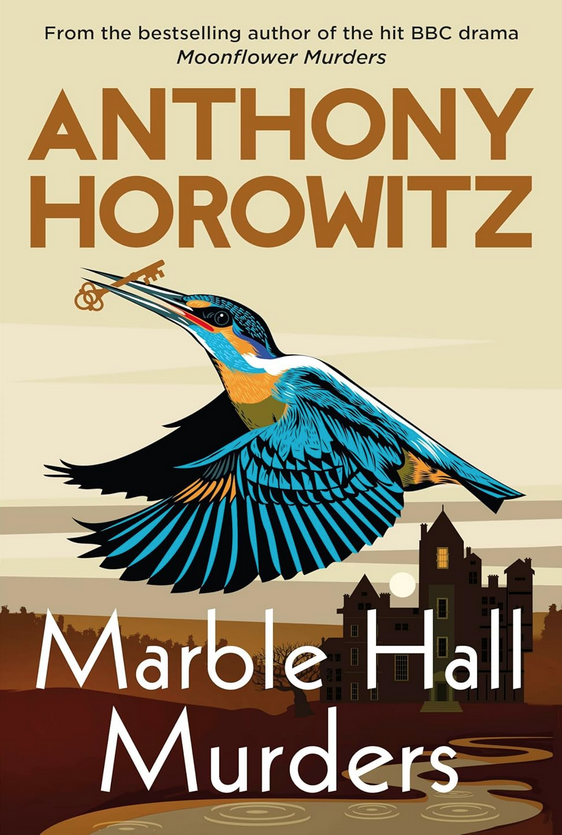
Anthony Horowitz is – deservedly – celebrated as an author and screenwriter. In the Daniel Hawthorne novels he plays himself, and there are frequent allusions to the world of publishing and TV production. In this novel the central character is Susan Ryeland, a freelance literary editor. She has just returned from a spell living in Crete with her hotelier boyfriend, but the charms of the sun, blue sea, olives and tsikoudia lifestyle have worn thin and she is back in London.

Her first commission on returning to England is to read through a manuscript of what is politely known as a continuation novel. Atticus Pünd was the central character in a highly successful series written by Alan Conway, and Susan had edited the books, despite having a fractious relationship with the author. Conway died in dramatic circumstances, but now a writer called Eliot Crace – himself the grandson of widely venerated author of children’s fiction – has resurrected Pünd. Susan is no fan of continuation novels, but this is Mr H having a little joke at his own expense, as among his own novels are ‘continuations’ of Sherlock Holmes and James Bond.

Make no mistake, the structure of this book is more complex than any of Horowitz’s books that I have read previously, but perhaps it is similar in the two books – Magpie Murders and Moonflower Murders  – which preceded this title. I do not watch much mainstream television, and I was unaware that these novels had also been filmed for the small screen.

Not long after Susan has offered to read through the first part of Eliot Crace’s reimagining of Atticus Pünd, we get to read it with her, and it tells of Pūnd, aware that he is terminally ill, investigating the death by poison of an English aristocrat in her villa in the south of France. We have, then, a novel within a novel. it must be one of the greatest challenges for a writer to make readers of a sequential novel aware of what has happened in previous books without labouring the point. Horowitz doers it well here, so I won’t waste paragraphs explaining what happened to Susan in the previous two books. Here, she learns from Eliot Crace that his grandmother, far from being the sainted creator of million-selling children’s books, adored by countless fans, was actually a vindictive, intolerant and spiteful old woman. Anthony Horowitz has set up a delightful conceit – and I use the term in its positive sense.

There is added piquancy in the fact that Susan Ryeland, the narrator of the ‘outer’ novel, is being paid to edit/criticise the content of the ‘inner’ novel, penned by Eliot Crace who, at first glance, appears to be mad, bad and dangerous to know. Anthony Horowitz is, like it or not, deeply embedded in the world of TV drama. There are many of us who think that Foyle’s War was the best show we ever watched. AH retains a keen eye for the best and worst of prime time TV drama and, using the voice of Susan Ryeland, he sneaks in a mention of ‘one that got away’, a thoughtful and intelligent series called Boon, starring Michael Elphick.

This is a complex novel containing layers within layers, but the nub is that Eliot Crace, although just a child, witnessed (or believed he had) his grandmother’s murder. Having lived with this secret for decades, he now decides to reveal the identity of the killer in his Atticus Pünd pastiche. When he himself dies in suspicious circumstances, we must assume that his killer is not someone from a novel, but a real person, still living, and someone who cannot afford the truth behind the death of Miriam Crace to become public knowledge. I hope this is not a spoiler, but astute readers will be alerted by the  beautiful cover image of Alcedo Atthis.

A long read, this, not far short of 600 pages, and Anthony Horowitz has cooked up an intriguing blend of elements. We have Golden Age Crime, complete with incriminating anagrams, arcane use of poison, the glittering world of wealthy people and, naturally, the ‘in the library’ denouement where the killer’s identity is revealed. Throw into the mix a candid view of the rather bitchy world of publishing, a rather engaging police officer, and  we have something for everyone. The television version of this novel, with Lesley Manville playing Susan. will be on your screens soon. Meanwhile, the book comes out in hardback, published by Century, on 10th April.

NO PRECIOUS TRUTH . . . Between the covers

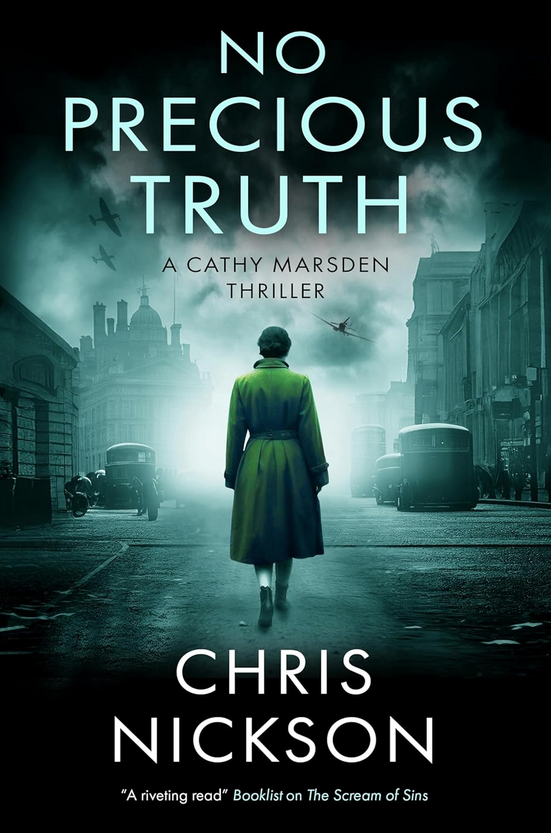
In my reading experience, there is no living writer so closely associated with one place than Chris Nickson. Phil Rickson had his Welsh Marches, Robert B Parker had his Boston, Colin Dexter had his Oxford and Christopher Fowler had his (peculiar) London. Sadly, Time has borne those four sons away, but Nickson’s Leeds is now rediscovered in the first of a new series.

It is February 1941. Cathy Marsden is a Sergeant in the Leeds police, but has been seconded to the Special Investigations Bureau, a unit recently set up to investigate black marketeers and other criminals looking to make money out of the war. She is astonished when her older brother, Daniel, turns up at the office. As far as she was aware he was humdrum civil servant in London, pushing pens and folders of documents from one desk to another. Like her, however, he has been seconded, but to another top secret intelligence service, and he is in Leeds to track down a dangerous Dutch double agent called Jan Minuit.

Although I have read and enjoyed them all, Nickson’s Leeds novels tend to have a similar plot, which is basically a manhunt. This enables the author’s creations from Simon Westow to Tom Harper (who gets a brief mention here) to pound the streets of the city in search of a villain. The technical aspect of this is not complicated, as it enables Nickson to put his unparalleled knowledge of the topography to good use. He is clearly in tune with a kind of of geopsychology, which enables readers to follow the footsteps of his characters across the decades, so that thoroughfares like Briggate, The Headrow and Kirkgate become as familiar as our own back yards.

If Minuit is bent on sabotage, Leeds has two prime targets for an agent of The Third Reich. One is pretty much in the open. The Kirkstall iron foundry has been producing components for military vehicles since WW1 and is hard to disguise. The Avro factory at Yeadon, however has been covered in camouflage and disguised – from the air – as open country. This ‘shadow factory’ is working day and night to produce Lancaster bombers, as well as the less celebrated (but equally vital) Anson.

Nickson has a well-established style. It is propulsive. Short sentences. A sense of urgency. Genuine narrative drive.

“Cathy turned off the ring road and started up Wheatwood Lane.The daylight was lasting longer, barely a stretch of dusk on the horizon. Ahead of her, the hill rose steeply, fields on either side, farmland.No chance to go more than a few yards.The road was filled with police cars, a pair of ambulances and the black coroner’s van.,”

“Monday dawned sour with threatening clouds, the colour of old bruises. The air was thick and damp. Yesterday’s promise of spring had vanished like a magician’s illusion. Instead, the rain felt that it like might begin at any time. At least it would deter the Luftwaffe.”

There is a thrilling conclusion to the team’s pursuit of Jan Minuit, and it is Cathy’s resilience and strength which eventually brings the spy/saboteur to his knees. Chris Nickson’s skill lies in his ability to convince us that we are standing beside his characters and sharing their world. In this case, it is Cathy Marsden’s wartime Leeds, with its rationing and privation, its fear that clear nighttime skies will be a gift to the Luftwaffe, and the ever present fear in the hearts of local women that their father, husband, brother, son or boyfriend will be the next name on the mounting list of casualties.

Nickson also reminds us that the horrors of WW1 cast a long shadow. Cathy’s father, once a strapping Yorkshire lad, was gassed in the trenches, and over thirty years later is a wreckage of a man, struggling with the essentials of existence – such as breathing. No Precious Truth will be published by Severn House on 1st April.

THE CAMBRIDGE SIREN . . . Between the covers

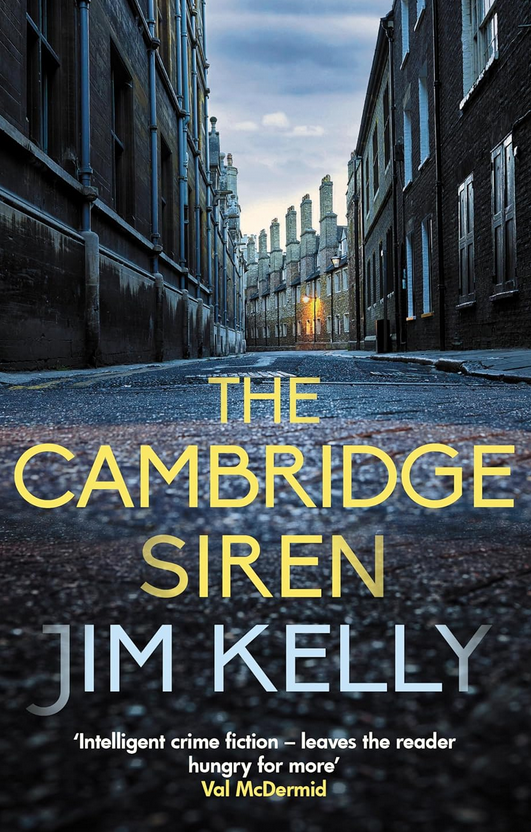
This is the fourth in Jim Kelly’s excellent series set in Cambridge during WW2, featuring senior police detective Eden Brooke. If you click the images below, you will be able to read my reviews of the previous three novels in the sequence.

Brooke served in The Great War, but had the misfortune to fall prisoner to the Turks. The Ottomans, rather like their Japanese brethren twenty years later, were brutal – not to say sadistic – captors, and Brooke’s eyes were permanently damaged. He and his wife Claire are certainly ‘a family at war’, however. Their daughter Joy’s husband is a submariner, while son Luke is away training in Scotland for some ‘hush hush’ activity.

Brooke has plenty on his hands. A dead man is discovered in a city air raid shelter. Cause of death? Wrists neatly slit. Too neatly, according the medical officer; suicides rarely if ever manage to slit the second wrist properly after self-inflicting the first wound. And why does the unidentified man have Brooke’s telephone number inked on his hand? Hundreds of miles away, on board his submarine, Lieutenant Ben Ridding has to examine a faulty periscope, which recently caused two torpedoes to miss their target by a considerable margin. He finds that one of the lenses has been purposely set askew. It was manufactured at the Vulcan works in Cambridge. A coded message to the Admiralty is passed on to Brooke, who begins an investigation.

Kelly has a magnificent eye (and ear) for period detail. Here, Brooke takes a witness to the morgue to investigate a corpse.

“Brooke led Mrs. Brodie to the table: twenty strides, the metal Blakey’s* on his shoes striking the quarry tiles. It was a ceremony with all the subtle horror and indecent haste of an execution.”

*Blakey’s were little metal plates nailed onto the leather soles and  of shoes to preserve them

Another two dead men are discovered, each in the vicinity of a shelter. The dead men found in the shelters have two things in common. Each has minor disability, thus eliminating them from service in the forces, and each had stayed at The Laurels, a rather strange guest house outside the city. Despite posting a police ‘spy’ inside the Vulcan works, the latest batch of periscopes reaches its destination in Barrow-in-Furness. From a shipment of twelve, two have been sabotaged.

Jim Kelly’s other two crime fiction series – The Philip Dryden Ely novels and the Peter Shaw books, set a little to the north in Kings Lynn, are dominated by the pull of the the landscape. Eden Brooke’s world is more intimate, centred on the college gateways and narrow city byways of Cambridge, but he is ever aware that just beyond the city lights (now dimmed by wartime regulations) is the primeval vastness of The Fens, now largely drained, but still desolate and sparsely populated.

“The Fens, as Brooke had been taught by his father in a lecture illustrated by a map which still hung in his old bedroom at Newnham Croft, lay in three levels: North, Middle and South. The north stretched to Lincoln across the silty fields south-west of the Wash.”

Despite the apparent failure to  solve the mystery of the periscopes, Brooke turns his attention to The Mystery of The Laurels. If that sounds like a story from a Sherlock Homes collection, it is appropriate because, using an attention to detail worthy of the great man, Brooke discovers a complex and lucrative conspiracy whereby wealthy young men can pay to avoid being called up into the armed forces. In WW1, it took Britain over two years to resort to conscription, but it was re-introduced  in 1939, almost immediately after war was declared. In solving the murders, however, Brooke has inadvertently trodden on some very important toes. Involved, although rather at a tangent to the call-up conspiracy, is a notable British scientist connected to a major defence project. As in aside, it is worth noting that while Hitler was obsessed with what have been called ‘wonder weapons’ (at the expense of solid and reliable military kit) Churchill was fascinated by rather weird developments. One such features in this novel. If you Google Project Habbakuk you will discover more.

Once again using a potent blend of observation and intuition, Brooke solves the periscope problem, and the book ends with a joyful family reunion, but one tinged with uncertainty. Brooke is an endearing character, a deeply thoughtful and ascetic man in some ways, but with unlimited courage and a steely sense of duty. The Cambridge Siren is published by Allison & Busby, and available now.

NOBODY’S FOOL . . . Between the covers

In the last Harlan Coben book I read, Think Twice, the DNA of a man who died decades ago turns up at a recent murder scene. Coben loves these ‘impossible’ scenarios, and here, he sets us another one. When he was on a gap year trip to Europe twenty-two years earlier, Sami Kierce had a passionate fling in a Spanish resort with a young fellow American called Anna. It all ended grimly when, after yet another evening fueled by booze, drugs and sex, Sami wakes, as usual, in Anna’s arms. Problem. He is covered in Anna’s blood and clutching a knife.

Now, Sami, thrown off the police force for various indiscretions, scratches a living as a PI in New York, also turning a more-or-less honest buck giving evening classes in criminology to a bunch of weirdos. When one of his classes is joined by a woman who, if not Anna is, surely, a clone, Sami does a classic double-take. So many questions, already. First up is how Sami managed to get back Stateside after the Costa del Sol incident with Anna. We do find out, eventually. Second is how ‘Anna’ appears to be living in a Connecticut mansion, deep in a forest and protected by armed heavies and belligerent dogs.

As if having one dramatic backstory weren’t enough, Sami has two. Before he had to throw in his badge, Sami was engaged to a fellow officer, Nicole Brett. Then she was murdered by a nasty piece of work called Tad Grayson, who was arrested, tried, and given a life term. But now, thanks to nifty footwork by his legal team, Grayson is out, and determined to prove that he did not kill Nicole. All of which, naturally enough, does not improve Sami’s sunny demeanour. ‘Anna’ is actually Victoria Belmond who, back in the day featured in the mother-and-father of all ‘missing heiress’ stories. Victoria disappeared on New Years Eve after a party, and what happened in the next eleven years – until she turned up sitting in a corner booth of a Maine diner – remains a mystery. Victoria was – literally – mute for many months thereafter and even, when speech returned, remembered nothing of where she had been and with whom.

After his abortive attempt to follow ‘Anna‘ on the night she came to his class, Sami has become a person of interest to the Belmond family and, much to his surprise, he is offered a small fortune to do what the police and FBI failed to do – discover the truth about Victoria’s disappearance. He even uses the Belmond’s largesse to take a quick trip to Spain along with wife Molly and their baby son, and here he finds the police officer who dealt with the case back in the day. He learns that he was the victim of a very clever scam involving ‘Anna’ and her drug hustling boyfriend.

Just when this particular reader was reflecting that this was just one more engaging – but slick and formulaic – American thriller, something truly awful happens and, 308 pages out of 414, everything I thought I understood about the plot is turned on its head. Reviewers are forever trying to think up new metaphors and catchy phrases to explain astonishing plot twists, so all I can say is that this one is up there with the best. I can also say that in the hands of a lesser writer that Harlan Coben, it would probably be a disaster, but he pulls it off with his customary flair. Nobody’s Fool was published by Penguin on 27th March.

A FATAL ASSUMPTION . . . Between the covers

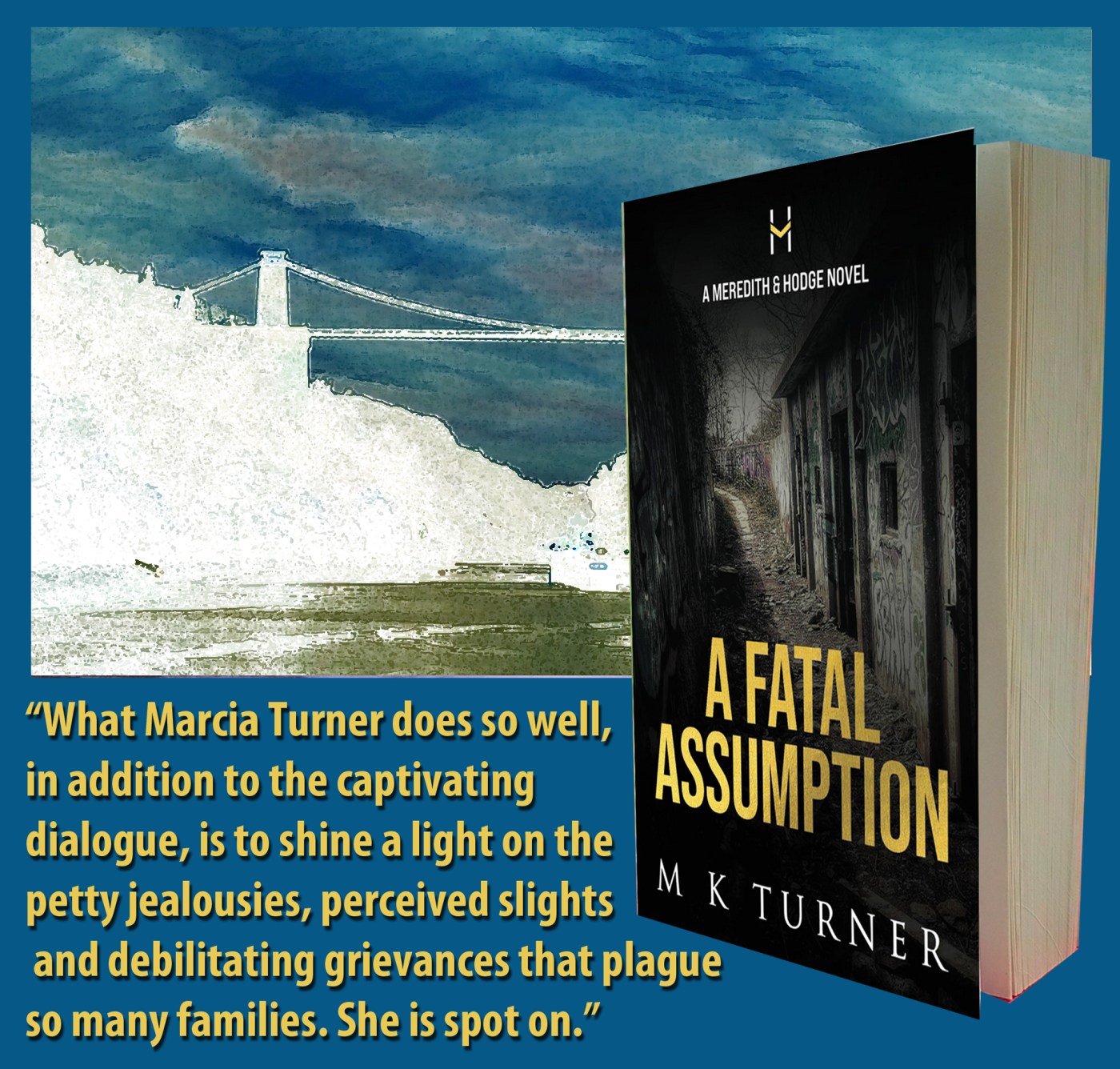
These Bristol based Meredith & Hodge cold-case-crime novels are rather special. Their latest case seems unsolvable. For starters it’s over a decade old. Christine Hawker was making breakfast for the children with husband Mike was upstairs getting them ready for school. The smoke alarm goes off. Mike discovered it has been triggered by a pan of burned porridge. But where was Christine? Puzzled, he took the kids to school, but then he disappears, too. The case baffled everyone, and gradually slid further and further back down the “To Do” list.

Now, the case has been reopened, because Mike Hawker’s remains have been inadvertently exposed by the bucket of a digger preparing the ground for a new supermarket. Meredith & Hodge? DCI Meredith and his wife, fellow officer Patsy Hodge are the ideal husband and wife team. Except – at the moment – they’re not. Patsy is on extended sick leave after a case went horrifically awry and has fled to relatives in New Zealand. Meredith? He’s getting over jetlag in a budget Auckland hotel having flown in to try to save his marriage.

By any standard, this is a terrific police procedural novel. Yes, all the operational details are convincing and the plotting is cleverly done. For me, however, it is the dialogue that sparkles. Marcia Turner enlivens her characters by what they say, and the idioms they use. For example, an elderly man says that he is a bit ‘mutton’. Younger readers might be baffled, but Turner knows that people of this character’s generation would recognise the rhyming slang. Mutt ‘n’ Jeff were comic book characters back in the day. Mutt ‘n’ Jeff became rhyming slang for ‘deaf’ and this later evolved into ‘mutton’ – a double play on words.

Meredith’s peacemaking overture in New Zealand is favourably received, and the pair return to the UK and face the mysteries of the Hawker case. The extended family dynamic is complex, and throws up a number of grievances. In no particular order. Christine’s father died of cancer when she was in her early teens, and she had become embittered that her mother remarried so quickly, suspecting that the relationship may have been blossoming while her father was on his bed of death. Mike’s father is cantankerous and an awkward customer, and his peace of mind was not improved a few months before his son’s disappearance when a young man met him and introduced himself as his long-lost son, conceived in a youthful fling decades earlier.

Meredith’s team clutch at what seem to be increasingly flimsy straws of evidence and imperfect recollections. What about the mysterious white van seen near the Hawker’s house on the day of the abduction? It is of no help at all that several of the potential suspects worked in trades where the proverbial ‘white van’ was ubiquitous. As is probably the case in real life criminal investigations, forensic questioning unearths all manner of ill-concealed grievances and grudges within the extended family of Mike and Christine Hawker.

Despite the proverbial quote suggesting the opposite, it is inspiration rather than perspiration which finally lifts the veil for Meredith, and it comes by way of a pleasant couple of hours the detective spends with his baby grandchildren. The next day, he calls the investigative team together, and on the whiteboard writes one simple word. The culprit returns to the interview suite, confesses, and the cold case team can chalk up another success. What Marcia Turner does so well, in addition to the captivating dialogue, is to shine a light on the petty jealousies, perceived slights and debilitating grievances that plague so many families. She is spot on. We all know what she is writing about. Thankfully, it doesn’t make us all murderers, but – as they say – we have all been there. From 127 Publishing, this excellent police thriller is available now.

Blog at WordPress.com.

Up ↑