Search

fullybooked2017

Category

True Crime

THE MURDER OF ROSA ARMSTRONG . . . Sutton in Ashfield 1924 (1)

ROSA HEADER

Rosa Armstrong was born in 1915, the daughter of Frederick Armstrong and his wife Maria. Her father died just three years later, but her mother remarried – to Edward Buttery – in 1920. June 1924 saw them living at 78 Alfreton Road, Sutton in Ashfield. Nine year-old Rosa attended the Huthwaite Road Council School, just ten minutes’ walk away along Douglas Road. Rosa’s older sister, Ethel (31), had not been lucky in her marriages. She had married William Parnham in August 1912, but on 18th June 1916, he died of wounds in France. Ethel married again, to Edward Mordan, a year later. An Edward Mordan is recorded as being killed in September 1918. At some point after the war, Ethel married again, to Arthur Simms, a miner, and in 1924 they were living in Phoenix Street, Sutton in Ashfield.

At this point, it is worth mentioning that Arthur Simms was reported as having served in the army – in both India and France – during the Great War, and that he had been taken prisoner by the Germans. He was born in 1899, so – unless he had lied about his age – the earliest he could have entered the war was 1917. Keep this in the back of your mind, because I will return to it later.

I am fairly ancient, and when I was at school, lunchtimes were long enough to allow children to go home for lunch. In the 1950s and 1960s, with just a few exceptions, I always walked or cycled home for lunch. Rosa Armstrong’s journey was less than a mile, and on Friday 27th June, she came home for lunch as usual, and as she prepared to go back to school, she asked her mother for sixpence to pay for her school photograph. Her mother, Maria, said that she would come to the school herself and pay for the photograph. Rosa never made it back to school for the afternoon’s lessons.

Fulwood no longer exists as a separate place, but back in the day it had its own identity as a small community south-west of Sutton and south of what is now the A38. In 1924, there was a sweet shop. Its owner was later to testify.
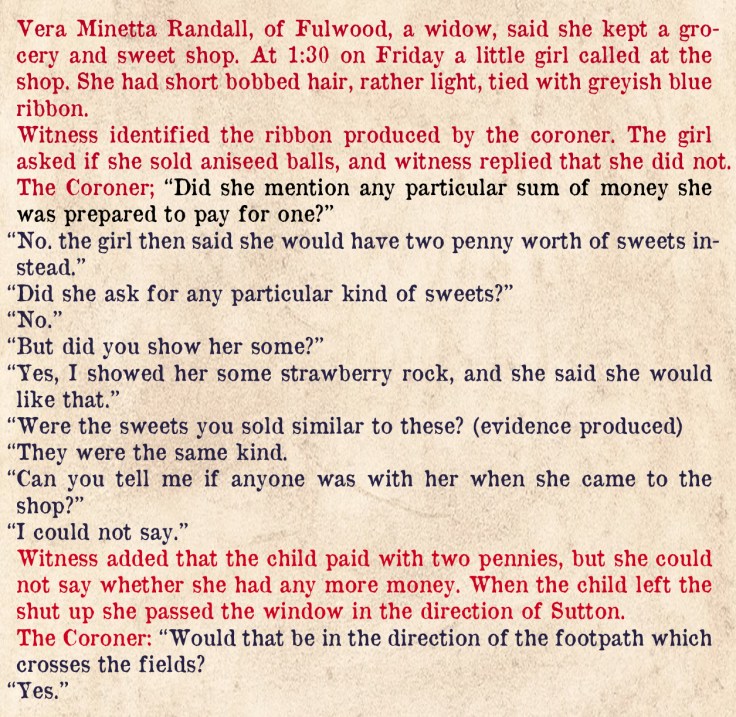
Sweets

When Rosa didn’t return home at the end of the afternoon, her mother was horrified to learn that Rosa hadn’t said “Yes, Sir” at afternoon registration. Deeply worried, she tried asking everywhere, even making it to the home of her daughter Ethel, but she drew blanks everywhere.

Police Constable Cheeseman was bored, tired and foot-sore, as he did his nocturnal rounds in Mansfield, four miles or so up the road from Rosa’s home. At 2.00 am, the early hours of 29th June, he was leaning against a wall in the Market Place, thinking about bed, supper, and sleep, when he was  startled to see a young man, apparently sober, making his way towards him. The newspapers later carried this report:

PC Cheeseman recounted the story of how Simms gave himself up to him in Mansfield Market Place in the early hours of the morning. As he was standing at the bottom of Stockwell Gate, he said he saw the prisoner approaching from the direction of Sutton The man came up to him and said,
“Policeman, I want to give myself up.” He asked what for and Simms replied,
“For murder. It’s my wife’s little sister at Sutton. I have done it at Sutton this afternoon.”
The constable took him to the police station and there said,
“Do you realise the seriousness of your statement?” Simms replied,
“Yes, I do.”
“When I next cautioned him that anything he said would be used as evidence against him,” continued PC Cheeseman. Simms said,
“You will find her under the hedge in the second field of mowing grass near Saint Marks Church Fulwood. I strangled her with my hands. I will put it on paper if you like.”

IN PART TWO

A HORRIFYING DISCOVERY
A FUNERAL
RETRIBUTION
AN UNSOLVED MYSTERY
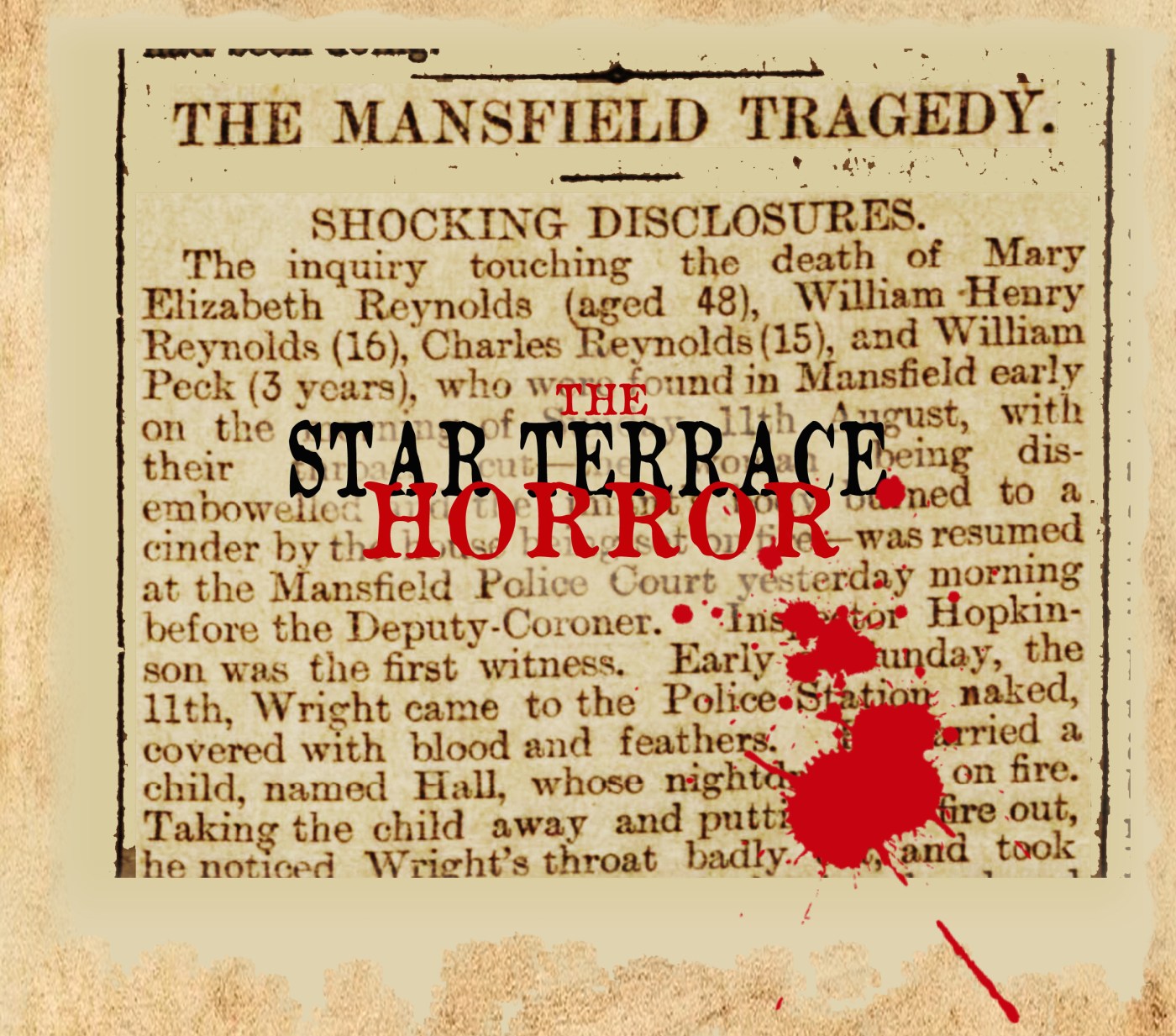
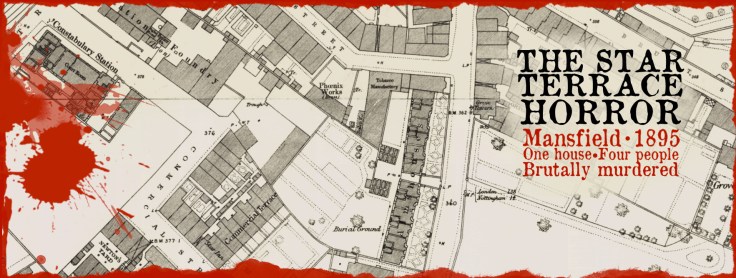
THE STAR TERRACE HORROR . . . Slaughter in Mansfield, 1895 (2)

Mansfield header

SO FAR: Mansfield, August 1895. Henry Wright, a foundry labourer, has been lodging at 1 Star Terrace, with Mary Elizabeth Reynolds and her step children. In the early hours of Sunday 11th August, Inspector Hopkinson, who lives at Commercial Street Police Station, is woken up by a commotion, and  woken up outside his window. He finds Henry Wright, nearly naked, holding a small boy in a burning nightdress. Both Wright and the boy are covered in blood. Hopkinson leaves the pair  with his wife and hurries to Wright’s lodging, just fifty yards down the street. The upstairs of the house is on fire, and George Reynolds is at his bedroom window shouting for help, but the fire brigade soon arrive, rescue George with a ladder, and then force an entry to the house.

Downstairs is a scene from hell. Most subsequent newspaper reports rather glossed over the horror, merely saying that Mrs Reynolds was found dead, but one or two papers thought that their readers were made of sterner stuff.

Gore

Upstairs there was more horror. Charlie and William Reynolds were both dead, their throats cut and  lying in pools of their own blood. In another bedroom was the charred remains of little William Peck, the grandchild.

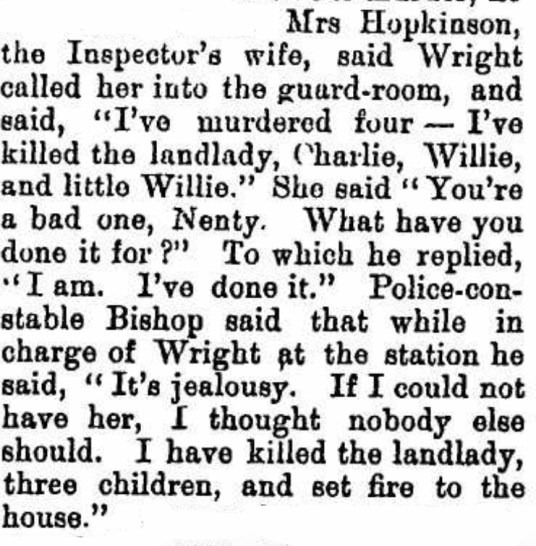
Meanwhile, Inspector Hopkins’s wife had taken Wright and the child to the nearby workhouse. Wright’s wounds – to the neck, and self inflicted – were bandaged, and the Hall child had been taken to hospital. Wright, known as ‘Nenty’ had spoken to Mrs Hopkinson:

Nenty

Hopkinson immediately charged Wright with the four murders (it could easily have been five, as he had secured George’s bedroom door tight shut with rope), and he was taken away to recover from his wounds, and await the magistrates’ court.

Screen Shot 2023-11-01 at 18.20.24

What do we know of Henry Wright? Very little, in truth. He was born in the town in 1862, and the family had lived for many years in the central thoroughfare of Leeming Street (above, in the early 1900s). They were still there in 1881, and Wright’s father, William was described as a nurseryman. His mother, Jane, had died the previous year. There is no record of him being involved in any kind of criminality, let alone terrifying violence. My first reaction to reading about the horrific mutilation of Mary Reynolds was to think of the scene of butchery that greeted those who discovered the remains of Mary Jane Kelly – Jack The Ripper’s last victim – in Millers Court Spitalfields, just seven years earlier. What possessed Wright – and I use that word advisedly – to commit his butchery of Mary Reynolds? We know that he had ‘romantic’ designs on the woman, and that he had been rejected, but this was not the work of an enraged and jealous spurned lover. This was the work of a madman.

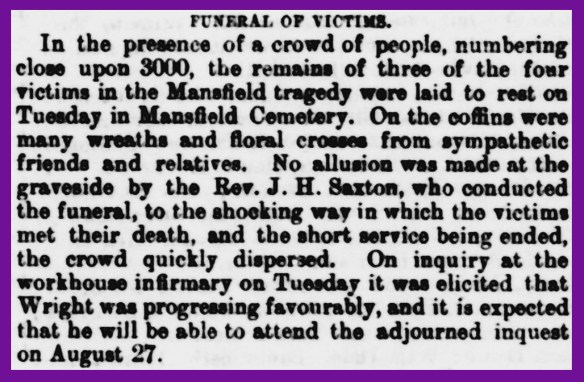
As Wright lay under close guard at the workhouse, awaiting trial, there were bodies to be buried.

Funeral

Screen Shot 2023-11-01 at 18.35.39

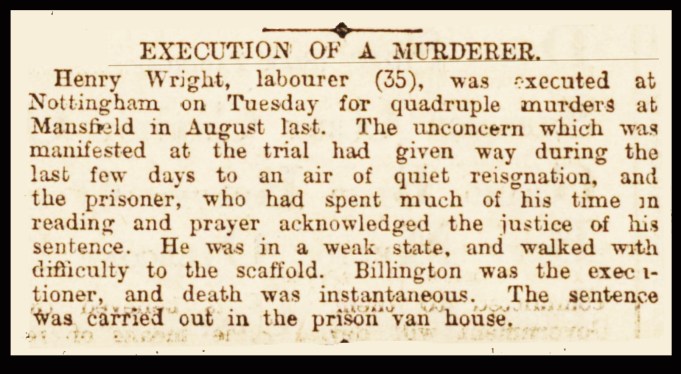
Inevitably, the Mansfield magistrates found Wright guilty of the four murders, and passed the case on to the Nottingham Assizes. There, in November, and equally inevitably, he was found guilty and sentenced to death. There seems to have been a fairly desultory attempt to suggest that he was insane, but medical reports suggested otherwise, and Mr Justice Day duly donned the Black Cap. The ritual appeal against the sentence was duly lodged, but the Home Secretary Matthew White Ridley (left), like the Nottingham jury and the judge before him, was having none of it, and the appeal was rejected. I am certain that the dire American import of ‘counting the sleeps until Christmas’ had not penetrated the British consciousness in December 1895, but I am sure youngsters across Nottinghamshire woke on the morning of Christmas Eve with a sense of anticipation.

Screen Shot 2023-10-30 at 18.12.25

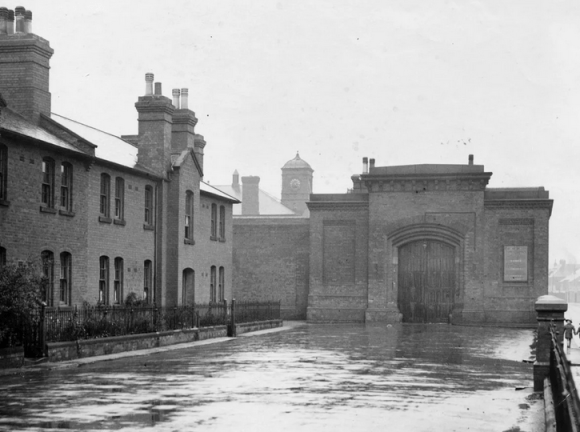
In Bagthorpe Gaol, Nottingham (above) Henry Wright was experiencing an altogether different kind of anticipation.
Execution

There are more questions than answers with this case. I have been researching and writing about real-life historical murders for many years, and this is the worst murder I have ever encountered. The circumstances of most of the killings I have researched are similar and familiar. They include these elements:

Heat of the moment’ murders, unplanned but the result of rage.
Planned killings, usually involving stealth and often using poison.
Fatal violence as a result of ‘temporary insanity’, often fueled by drink.

Henry Wright mutilated Mary Reynolds’ body. He disemboweled her, cut off her breasts and destroyed her face with his razor, and then kept her gaping stomach parted open with a curtain rod, so that his work could be seen by those who discovered the carnage. All this was not done in an instant. It is not a ‘one punch’ death. It is not the fatal result of a skillfully placed knife thrust or a well aimed bullet.

There is something dark, disturbing and dreadful about the Star Terrace murders which will never be solved by writers like myself who rely on on old newspaper reports. Whatever the answer, it is buried in Henry Wright’s unmarked prison grave, dug as Christmas Eve 1895 gave way to the most joyful day in the Christian Calendar.

FOR MORE HISTORICAL MURDER CASES CLICK THIS LINK


THE STAR TERRACE HORROR – Slaughter in Mansfield, 1895 (1)

Mansfield header

Do you believe in ghosts? Part of me would like to think that there are such things. The phantoms of the dead have been a significant part of cultures across the world since written records began. I have no personal experience one way or the other but, like many people, I know folks who know other folks who have had paranormal encounters. It’s always third hand, though, isn’t it? But I digress. There is a line from the poem ‘Raglan Road’ by Patrick Kavanagh, which goes:

“On a quiet street, where old ghosts meet..”

Star Terrace, Mansfield, no longer exists. The houses once sat on Commercial Street, now Commercial Gate, but the road layout is much altered today. There was a pub called The Star Inn, but it – like the terrace named after it – has long since gone. If “old ghosts” could meet, they would certainly be reunited on a bloodstained patch of ground in the middle of Mansfield. On the night of 10th August 1895 Mary Elizabeth Reynolds, her step-children George, William and Charles, grandson William Peck, a two year-old boy named Hall (a relative) went to bed peaceably, unaware that horror was about to be perpetrated before dawn broke the next day. Absent that night was the lodger, a man called Henry Wright. They all lived under the same roof, but only George Reynolds and the boy Hall would live to celebrate Christmas.

Mary Reynolds had lived with William Reynolds, head brewer at the nearby Mansfield Brewery. Although they had never married, she took his name, and when he died on 29th October 1890, although there was a newspaper appeal for claimants on his estate – implying he had died intestate – it seems that he had left her comfortably off, with enough money to rent a house. The bulk of his estate, hoever – nearly £164,000 in today’s money –  was left to his daughter, a Mrs Quible. The 1891 census tells us that  1 Star Terrace was occupied as follows:

Screen Shot 2023-10-31 at 18.25.55

At the top of Commercial Street, where it joined Station Street, was a police station. Inspector Hopkinson lived there with his wife, and  in the early hours of Sunday 11th August, 1895, he was woken up by a commotion outside. Throwing open his bedroom window he looked out and saw a sight which was a bizarre mixture of comedy and horror. Down in the courtyard stood a man, naked except for his socks. He was carrying a child whose nightshirt was on fire. Both the man and the child were covered in blood. Hopkinson knew the man – it was Henry Wright. Sensing that something awful had happened, the police officer put Wright under temporary arrest, applied first aid to man and child, then left them in the charge of his wife. He then ran the fifty yards to  Star Terrace where he knew Wright was lodging. He saw fire and smoke billowing from the upper windows of the terraced house. He sent for the fire brigade, but what they discovered when they broke into the house would haunt them for the rest of their days.

IN PART TWO

A SHOCKING DISCOVERY
ARREST AND TRIAL
RETRIBUTION

DEATH AT HOLMES FARM . . . A double murder in 1931 (2)

Jackling Header

Annie

SO FAR: On the morning of 3rd October 1931, in their isolated farmhouse near Waddingham, Annie Priscilla Jackling (left) is found dead in her bed, while on the floor nearby is her husband Robert, grievously wounded. Both have been shot at close range with a twelve bore shotgun. Their child Maurice is unharmed, but standing in in his cot, crying for his mother. The couple’s nephew, sixteen year-old Harold Smith, who lived and worked on the farm, is missing.

Harold Smith’s escape from the scene was hardly a thing of drama. Taking Robert Jackling’s bicycle, he had made it as far as Wrawby, just north of Brigg, when he was arrested, just hours after the  grim discovery at Holmes Farm. Superintendent Dolby from Brigg knew that the case, which became a double murder when Robert Jackling died in Lincoln Hospital, offered only three sensible scenarios. First, that this was a murder suicide, Jackling having shot his wife and then turned the gun on himself. Second, that the pair had been shot by an unknown assailant and, third, that the killer was Harold Smith.

Smith made a detailed statement quite soon after his arrest. It implied that he had been brooding for some time over his treatment by Robert Jackling, and had been contemplating taking action. At Smith’s trial at Lincoln Assizes in November, this was reported:

Confession

Screen Shot 2023-10-20 at 19.56.02

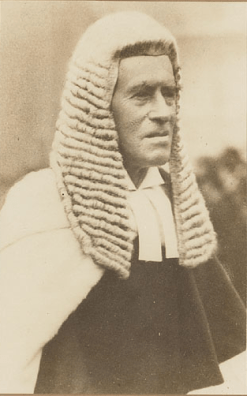
At his trial, Smith resolutely denied having anything at all to do with the murders, and only admitted to hearing gunshots in the night, and subsequently removing the shotgun from the bedroom, and placing it downstairs. He said that he fled the scene, fearing that he would be blamed. Neither Mr Justice Mackinnon (right) nor the jury were having any of this, and he was found guilty and sentenced to death, although the jury made a recommendation that mercy be shown. Invariably, judges had little option but to don the black cap when the charge remained as murder, with no suggestion of the defendant being insane. As there had been no-one hanged at the age of sixteen for decades, it was almost inevitable that the Home Secretary would order a reprieve, and Harold Smith was spared the attentions of the hangman. To me, from a distance of over ninety years, it seems that Harold Smith was guilty of cold blooded murder. The words in his original statement are chilling:

“I stood by the doorway of the bedroom for some minutes, deciding whether to do it or not. At last I touched the trigger.”

There was a long feature article in Thompson’s Weekly News after the reprieve, purportedly written by Smith’s mother. Thompson’s Weekly news was published in Dundee, and the parent company were also proud parents of The Beano. There is little to choose between Mrs Smith’s reported outpourings some of the more unlikely adventures of the Bash Street Kids and Dennis the Menace.

subheading

I don’t apportion any blame to Mrs Smith. She clearly was delighted that her son would not be hanged, and being a poor woman,the newspaper’s money would have been welcome, but the article is clearly the work of one of the newspaper’s more inventive hacks and, under the sub-heading reproduced above, contains such comments as:

“Harold was looking exceptionally well, but I noticed that the tears were not far from his eyes. Indeed, l am sure he would have broken down if we had not had our friend with us, Even then, if we had not turned the conversation round to the happy days he had spent on the farm after leaving school, he would not have managed to keep a stiff upper lip.”

“I could not take in what was happening. My poor boy sentenced to die by the hangman’s rope! Oh no! Surely there was some mistake.”

The 1939 register shows that Harold Smith was in Maidstone Prison. We also know that he was released on licence in June 1941, slightly less than ten years since the brutal killing for which was adjudged responsible. He was still younger than either of his victims. He died at the age of 78 in January 1998, in Crewe. The last surviving witness to the tragedy was the child who stood in his cot as the dreadful event took place. Maurice Jackling died in 2003, also at the age of 78.

We know that Holmes Farm was still occupied in 1939, because Harry Dickinson, who farmed there, was the victim of pig-rustling by a couple of his workers. The property was advertised as a vacant possession in April 1945, but I believe it was derelict and had been pulled down by 1950, as in 1952 a property known as New Holmes Farm, built just down the lane, was advertised as “an excellent modern farmhouse and range of buildings, both erected since the war.”

I would like to thank Mick Lake for help with researching this case.

I have been researching and writing about historic Lincolnshire murders for some years,and those wishing to find out more about our county’s macabre past should click this link.

DEATH AT HOLMES FARM . . . A double murder in 1931 (1)

Jackling Header

Lincolnshire is England’s second largest county, and its landscape reflects that in its diversity. In the ‘Deep South’, fen and marsh prevail. Drive north from Boston on the A16, though, and as you near East Keal, the southern edge of the Wolds makes a dramatic appearance. From then on, until you reach Louth, the steep valleys and chalk hills provide some of the most dramatic scenery in England. Our story here, though, takes us to the north-west of the county where, in a pleasing symmetry, the land flattens out around Brigg and Gainsborough, and it is among these sometimes bleak fields that the story begins, near the village of Waddingham.

Annie and baby

Nothing is visible of Holmes Farm today to anyone other than an archaeologist with ground penetrating radar. Holmes Farm is marked as Waddingham Holmes on old maps, and a visitor in 1931 would have found a lonely 19th century farmhouse. In October of that year, the residents were Robert James Jackling – a tenant farmer – his wife Annie (left), their infant son Maurice, and a sixteen year-old boy called Harold Smith, whose mother was Robert Jackling’s half-brother. Harold was born in 1915,  in Scawby, just a couple of miles from Brigg. He was described as a big lad, perhaps not overly bright, and destined for the most laborious kind of farm work. It was later alleged that the relationship between Harold and Robert were strained due to Harold’s inability to  complete jobs to his uncle’s satisfaction.

Families in the neighbourhood were very close-knit. William Jackling, Robert’s father, was another farmer, and on the morning of 3rd October he paid a visit to his son and daughter in law. The events of that day were to become national news. The Aberdeen Press and Journal reported:

“Mr Jacklin, senior, who lives at Waddingham, visited the farm early in the morning, and found the place locked up. Forcing an entrance to the kitchen, he saw apparent evidence of an attempt to set the house on fire. The room was full of smoke, and a rug and some straw were burning and smouldering on the floor. He rushed upstairs to his son’s bedroom, and found his daughter-in-law lying in bed shot through the mouth. His son had received a charge of shot in the side of the face, but was still alive.  .Besides the bed was a cot containing the couple’s eighteen-month-old baby son, who was crying and calling for ‘Mamma’.”

Annie was beyond help, but Robert was still alive, and it looked as if he had perhaps crawled to the window to shout for help. William Jackling raised the alarm, but with the farm being in such an isolated position, the emergency services took some time to arrive. While Robert was taken to Lincoln County hospital, Superintendent Dolby of Brigg took charge of the scene, and the first question raised by the distraught William Jackling was, “Where is Harold Smith?”

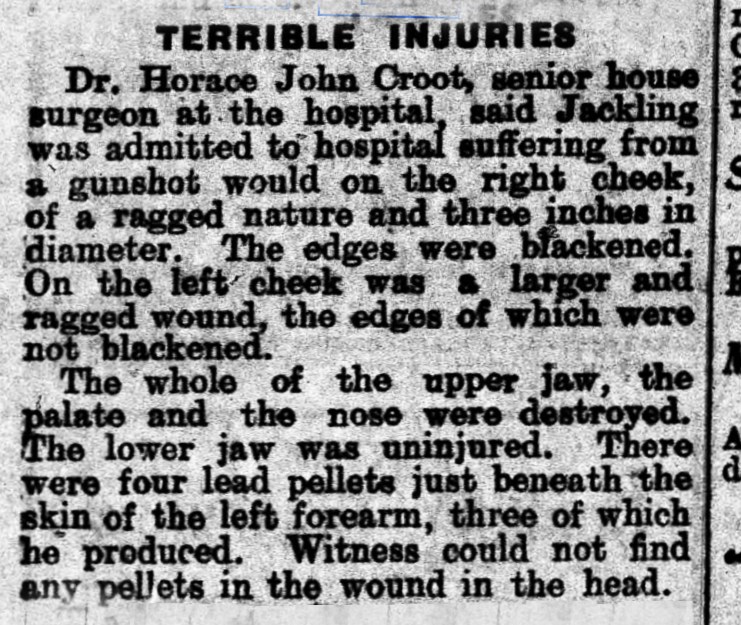
It can have been little comfort to anyone involved, but Annie had obviously died instantly, most likely without even waking up. Robert – who was to die two days later – had suffered grievously. The inquest reported:

Terrible injuries

TO FOLLOW
The search for Harold Smith
Trial
Was justice done?
Aftermath

‘A PALE FACE AMONG THE RUSHES’ . . . The death of Alfie Wright (part two)

Alfie header2

SO FAR: August 1895. Hannah Elizabeth Wright, 23, gave birth to a little boy, Alfred Edward, in November 1893. The boy’s father has disappeared, leaving Hannah to deal with the situation. Alfie has been in the care of a Miss Flear, who lives near Newark, but Hannah can no longer afford to give Miss Flear the money she requires, and has collected the little boy, and returned to Lincoln on the evening of 26th August. The following day, having not returned to their home in Alexandra Terrace the previous evening, she tells her brother and his wife that the boy is still in Newark, and is being put up for adoption.

Screen Shot 2023-09-14 at 13.36.13

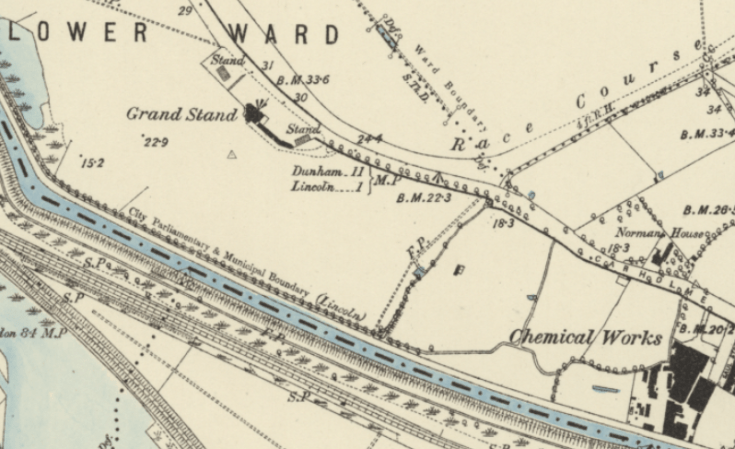
Foss Dyke is a canal that links Lincoln with the River Trent at Torksey. Some historians insist that it was built by the Romans, while others believe that it dates back to the 12th century. It was along the bank of this ancient waterway, between Jekyll’s Chemical chemical works and the back of the racecourse grandstand, that on the evening of Monday 26th August our story continues. A young man called James Fenton was sitting on a bench with a lady friend, when a woman passed them, walking in the direction of Pyewipe. She was carrying a bundle, but they heard a whimpering sound, and they realised that she was holding a child. It was, by this time almost dark, but when the woman passed them again, this time heading back towards the city, she was empty handed. Thinking this strange, Fenton followed the woman at a distance, but lost her somewhere in the vicinity of Alexandra Terrace. The following morning, Tuesday, a man on his way to work had an unpleasant surprise. He was later to tell the court:

Pale face

RecoveryJames Fenton had contacted the police with his suspicions, and the discovery of the body confirmed the police’s worst fears. It is not entirely clear how the police knew exactly where to find the mystery woman, but on the Tuesday, they paid several visits to the house at 25 Alexandra Terrace. Hannah Wright, however, was nowhere to be found. She had left that morning, telling her sister-in-law that she was going to visit friends. She did not return until the Wednesday morning, by which time the police had instituted a full scale murder investigation. Hannah confessed to Jane Wright, and a neighbour, Mrs Sarah Close. It was Mrs Close who accompanied Hannah to the police station, but the girl seemed to be under the bizarre misapprehension that if she told the truth she would get away with a ‘telling off’ or, at worst, a fine. She was not to be so fortunate:
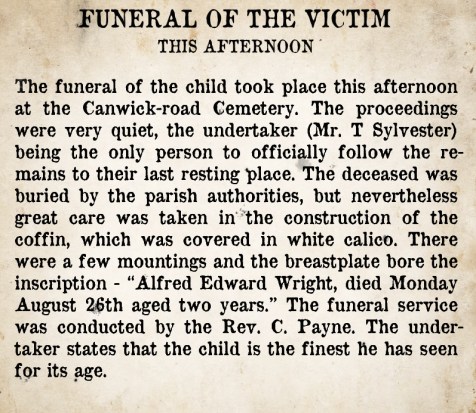
Confession

FuneralThe law took its inevitable course. There was a coroner’s inquest, then a magistrate’s hearing, both of which judged that Hannah Wright had murdered her little boy. As was customary, the magistrate passed the case on to be heard at next Assizes. Meanwhile Alfie’s body was laid to rest in a lonely ceremony at Canwick Road cemetery. It is pointless speculating about Hannah’s state of mind, but it is worth reminding ourselves that Alfie had known no father and  had seen very little of his mother during his brief sojourn – fewer than 300 days – on earth. If ever there were a case of ‘Suffer the little children’ this must be it.

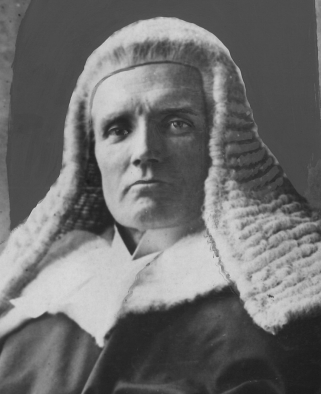
Whatever the state of Hannah Wright’s mind when she drowned her son, and during her  long months before she came to trial, when she finally appeared before Mr Justice Day at the end of November she must have had a cold awakening as to what possibly lay ahead of her. Since September, there had been various intimations in the press that Hannah was, to use the vernacular, “not quite all there” but there was no medical evidence that she was weak minded or mentally deficient. Her defence barrister made a rather odd case, as was reported in The Lincolnshire Echo on Tuesday 26th November 1895:

“The Judge pointed out that the defence was rather an unusual one, namely of a two-fold character, one contention being that the prisoner never committed the crime all, and it she did do so that her mind was unhinged at the time. As to the plea of insanity he did not see that there was the slightest evidence to show that her mind was diseased. The jury retired to consider their verdict at 5.20, and returned into Court after an absence of twenty-seven minutes. They found the prisoner guilty, with a strong recommendation mercy. Prisoner made no reply to the question put to her by the Clerk whether she wished to say anything before sentence was passed. The Judge, who appeared be deeply affected, said the jury had simply discharged their duty, painful though undoubtedly was. With regard to the recommendation to mercy his Lordship said he would wish and beg her not to place undue reliance upon that recommendation. His Lordship then passed sentence of death in the usual manner. Prisoner fainted as she was being led down the dock steps.”

The general public in Lincoln and round about had become very involved in this tragic case, and even before Hannah collapsed on the steps of the dock, a petition was created and with thousands of names on it, presented to the Home Secretary, Sir Matthew White Ridley KCB. Within days, the threat of the hangman’s noose was lifted.

reprieve

Peter Spence, a distant relative of Hannah, and to whom I am indebted for sharing his research, suggests that this story has something of Thomas Hardy about it, but we would do well to remember that poor Tess (of the D’Urbervilles) is hanged for her crime. Not only did Hannah survive, but she was released from prison in Aylsbury, apparently going straight to London to work as a servant.

Screen Shot 2023-09-14 at 19.01.38

Strangely, that is where the story ends. Peter Spence, and that eminent compiler of Lincolnshire crime stories Mick Lake, like me, have found no trace of what became of Hannah. This is unusual, given the amount of information available on modern genealogy websites, but it it is what it is. There are a couple of inconclusive mentions in the 1939 register, but no evidence that these people are ‘our’ Hannah. There is this, but is it feasible that a servant girl could have eventually returned to Lincolnshire and died at the age of 89, leaving the sum of £2552 10s – nearly £47,000 in today’s money? Perhaps that is a mystery for another day.

Hannah will

I have been researching and writing about historic Lincolnshire murders for some years,and those wishing to find out more about our county’s macabre past should click this link

‘A PALE FACE AMONG THE RUSHES’ . . . The death of Alfie Wright (part one)

Alfie header1

Hannah Elizabeth Wright was born on 25 August 1872 to John Wright, an agricultural labourer, and Mary Anne Key in 
Kirkby la Thorpe,  a tiny village a few miles east of Sleaford. The 1881 census recorded 256 souls.

1881 KLT

ewerby

Hannah was the youngest of five 
children, two boys and three girls. Sadly, her mother died when she was four. Her father remarried so she 
was brought up by her stepmother. There were few options for young women ‘of humble birth’ in rural communities in those days. It was either work on the land, or go into service – meaning a live-in position with some wealthy family, either as a cook or a general maid. The census in 1891 shows us that Hannah was working in The Manor House at Ewerby, less than two miles from Kirkby. Her employer was Mr William Andrews, a farmer. The Manor House (left) still stands.

By 1893, she had moved further away to the village of Weston, near Newark. It was here that she began a relationship with a local lad and became pregnant. Alfred Edward Wright was born on 3rd November 1893. He was, by all accounts, a healthy child, but his father quickly disappeared from the scene, and became engaged to another woman. This left Hannah in a dire situation. With no other means of support other than her own work, how was she going to bring up Alfie? A solution – of a kind – was found when a Weston woman called Jane Flear offered to take the boy in – for a price.

We know that by 1895 Hannah was working for a family in Branston, south of Lincoln, and had begun another relationship, with a young man called William Spurr, but she kept Alfie’s existence from him. Hannah had already fallen into arrears with her payments for Alfie, but her problems became worse when she received word from Miss Flear that the price for looking after the little boy was to be raised to three shillings and sixpence each week. Using the Bank of England inflation calculator, that would be nearly £38 In modern money, probably more than Hannah earned each week, given that her food and housing would come with the job.

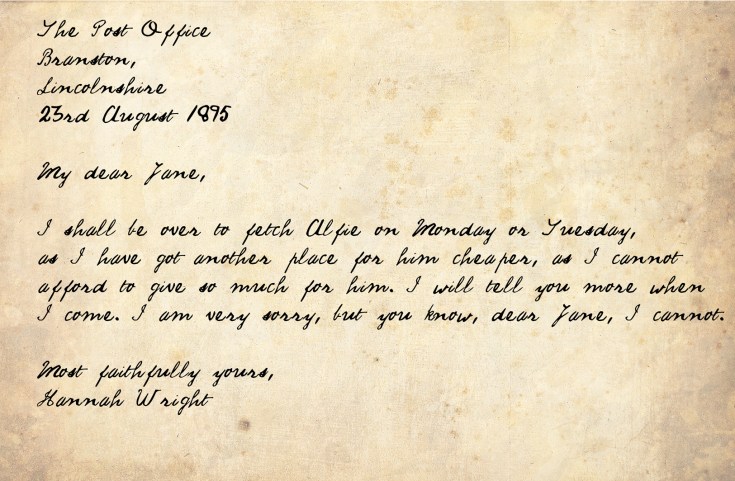
Jane Flear received this letter (facsimile) from Hannah:

Letter

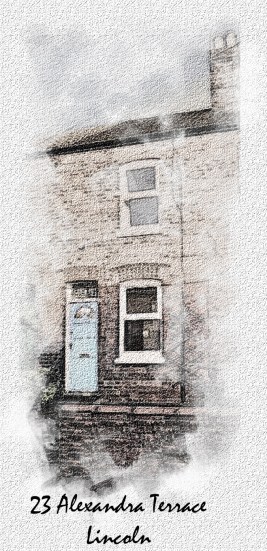
23AlexHaving traveled to Lincoln on the afternoon of 23rd August, Hannah visited her brother and his wife at their house, 23 Alexandra Terrace. All appeared to well, and on the Sunday evening Hannah even brought her young man, William Spurr, round for tea.
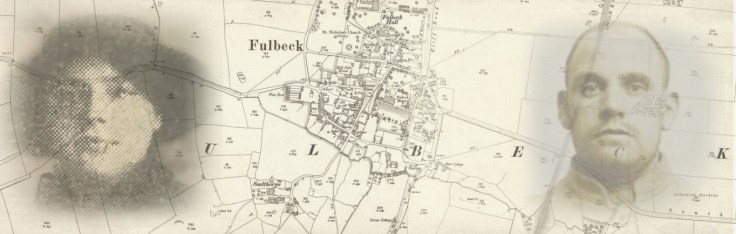
Hannah Wright arrived in Weston on the afternoon of Monday 26th August to collect Alfie. Miss Flear had misgivings about handing over the little boy, and thought that Hannah was in something of a disturbed state. When she went to collect the rest of Alfie’s clothes, Hannah said she didn’t want to take them. The three of them, Jane Flear wheeling Alfie in his pram, set off to walk the two miles to Crow Park station, just outside Sutton on Trent. Hannah and Alfie caught the 6.15 train to Retford. Jane Flear never saw Alfie alive again. Hannah eventually returned to the little terraced house in Alexandra Terrace late on the Monday evening,and explained to Jane and William Wright that her little boy was still in Weston, but she had arranged for someone to adopt him permanently. Jane Wright asked her sister in law if she had discussed the situation with William Spurr, but despite Jane telling her that it was wrong to keep back something so important, Hannah was adamant that he was not to be told. They all retired to bed at 11.30 pm. The next morning, at about 9.30 am, Hannah announced that she was going to visit some friends, and would return later.

IN PART TWO

A CONFESSION
A TRIAL
THE BLACK CAP

TWO FAMILIES, TWO TRAGEDIES. . . The murder of Florence Jackson (part two)

GRR header

SO FAR: Grantham man Dick Rowland had seen action in the trenches from 1915 until 1918. Unlike his two brothers, he survived, but was wounded and gassed. Spring 1919 found him back in Grantham, aged 29, just another ex-soldier. He had, however, met and fallen for a Fulbeck girl, Florence Jackson. She was ten years his junior and there, I think, lay the problem. She was pretty, fun-loving and with no shortage of local suitors, not to mention dashing officer types from what was to become Royal Air Force College Cranwell. Florence’s mother thought Dick Rowland too old for her daughter, but she could never have envisaged the events of 31st May 1919. It was the day of Caythorpe Feast, an annual event always held on the last Sunday in May. Dick and Florence were there, with hundreds of other local people both young and old. Dick Rowland had become insanely jealous, and every smile or wave Florence gave to some other young man cut him to the quick. He was particularly vexed when Florence decided to share a fairground ride – the wooden swing-boats with some other chaps.

On the swing-boats

Sometime around 10.00pm, Dick and Florence decided to walk home to Fulbeck. That road, now the A607, was known as the Lincoln Road. Many other people were on that road, but they would have been spread out and it was very dark. I have no idea if there was a moon that night, but one man heard something in the darkness as he rode his bicycle up to Fulbeck. He was later to give evidence at a Coroner’s inquest. This a verbatim report from a local newspaper:

Richard James Nelson, dairyman, Welbourn, spoke of visiting Caythorpe feast on Saturday night last. He saw the deceased girl in the swing boats with a man called Edward Knights. He left the feast about 1045. When he had reached Gascoigne’s gate in the parish of Fulbeck a man called out to him:
“Chummy, stop!”
He stopped, and man who was a stranger asked him to fetch a motorcar from the top as there had been a nasty accident. Witness asked him what it was, and he said:
“A girl has tried to cut my throat and now she has cut her own.”
He noticed the man’s throat was cut and bleeding and he also saw the body of the girl lying on the ground just inside the gateway. Witness attempted to go through the gateway towards the girl. but the man pushed him away and told him to get on his bicycle and fetch a motor car. He then rode off for the police.

There is a horrible irony in that the next people to arrive at the scene were none other than Florence’s older sister and her young man.

Laura Emma Jackson, the deceased’s sister, a land worker employed at Fulbeck Heath, said on Saturday night she was at Caythorpe feast where she saw deceased with Dick Rowland who was courting her. They seemed alright together. Witness left the feast at 10:15 and walked towards home with Percy Graves, a friend. When they got to Gascoigne’s gate she saw a man standing there. He said,
“Mr, Mr, come and look what I have done.”
She told Graves not to go as the man was drunk, but the man came towards them holding out his hands and said,
“Is that Laura?”
Witness replied,
“Yes.”
And he then said,
“I am Dick – I have killed your Flo. Another man wanted her. I have tried to kill myself but could not. Go and tell them at home.”
Witness noticed that Roland had blood down the front of his clothing and was bleeding from the throat. She did not notice her sister. She went home and reported the matter to Mr Palethorpe. Rowland was not drunk but seemed to be rather excited. Witness was at the Grantham statute fair on 17th May  with her sister and Rowland. Flo went to speak to some soldiers and Roland asked her to keep an eye on her and watch that she did not go with the soldiers. She told him not to be so silly and that she would not go. Rowland shook his head and remarked,
“Flo’s alright. If I don’t have her I will see no one else does.”
Flo was with the soldiers three or four minutes and then she rejoined Rowland and witness.

The Fulbeck Doctor also gave evidence at the inquest:

Doctors Evidence
Mr Justice Greer

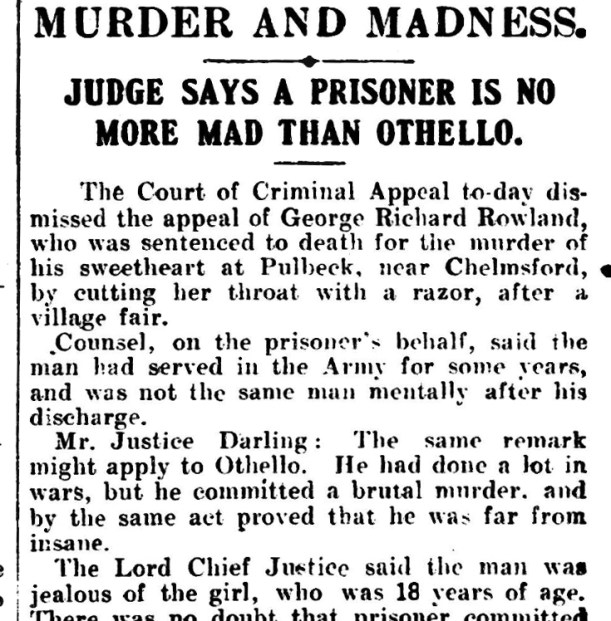
Dick Rowland was arrested for the murder of Florence Ann Jackson. The Coroner recommended that he be charged with murder and the case was sent to the Sleaford Magistrates who agreed, and arranged for Rowland to appear at the Summer Assizes in Lincoln. Rowland’s bizarre defence that somehow Florence had received her fatal wounds in some kind of struggle for the razor was abandoned, and his legal team asked for a postponement of the trial so that further investigations could be carried out into the man’s mental health. This delay was granted, and so it was that Dick Rowland appeared before the Lincoln jurors and judge Mr Justice Greer (left) in November 1919. He was found guilty and sentenced to death despite the jury recommending a merciful punishment. There was an immediate appeal against the death penalty, but that was thrown out, with the appeal judge famously opining that Rowland was no more mad than Othello,(the newspaper managing to mis-spell the village name, and relocate it to Essex}

Othello

So, Dick Rowland sat in his condemned cell awaiting his fate, probably unaware that he had been compared to one of Shakespeare’s greatest tragic characters. Othello, of course, racked with guilt, stabs himself, which is precisely what Rowland claimed he had tried to do on that fateful evening back in May, but he was to have better luck than the Moor.

Reprieve

In the event, it appears that Dick Rowland was released in April 1935. He married, and the records tell us that he died in Cleethorpes in 1954. Had he become unhinged by his wartime service, a victim of what we now call PTSD? Or had his own chilling words – ” If I don’t have her I will see no one else does.” become a dreadful deed? You must make up your own minds. Incidentally, the fatal spot where Florence died is still there for anyone wishing to stand and contemplate.

GG watercolour

Incidentally, a local man, Jonathan Wilkinson has written a novel based on the events I have described. It is very well written, and focuses on what the author believes happened in the months and weeks leading up to Florence’s death. It is available from the Fulbeck Craft Centre (07410 968333)

Jealous

I have been researching and writing about historic Lincolnshire murders for some years,and those wishing to find out more about our county’s macabre past should click this link

TWO FAMILIES, TWO TRAGEDIES . . . The murder of Florence Jackson (part one)

GRR header

Fulbeck sits amid the hills and hollows of what is known as The Southern Lincolnshire Edge whose most obvious geological feature is the cliff-like ridge which is easy to see when driving along the A17 from Newark. Nearby Leadenham seems to perch on the very edge of this cliff. Fulbeck could almost be mistaken for a Cotswold village, with its abundance of limestone buildings, but most of that stone came from the quarries around Ancaster, just a few miles away. In 1919 the railway ran nearby and there was a station at Caythorpe. These days, the village is bisected by a very busy main road, the A607, which links Leicester and Lincoln. It was just beside this road that the tragedy of the title took place, but our story starts a few years earlier in Grantham, just over ten miles to the south.

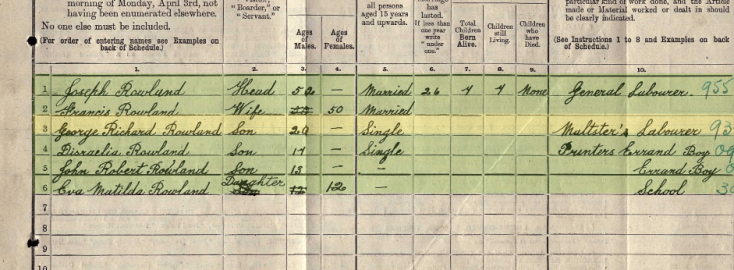
The 1911 census shows that at 50 New Street, a tiny terraced house which still stands, lived the Rowland family.

1911 census

There was another brother, Joseph William Rowland, but he had left to join the army, and in 1911 was overseas with 1st Battalion Lincolnshire Regiment. By the time war broke out, he had married and was living in Portsmouth. The Rowland family was to pay a heavy price during that war. Both George Richard – known always as Dick – and brother John answered the call of King and Country. Dick joined the Lincolnshire Regiment but John, although he enlisted in Grantham, would go on to serve with The Seaforth Highlanders.

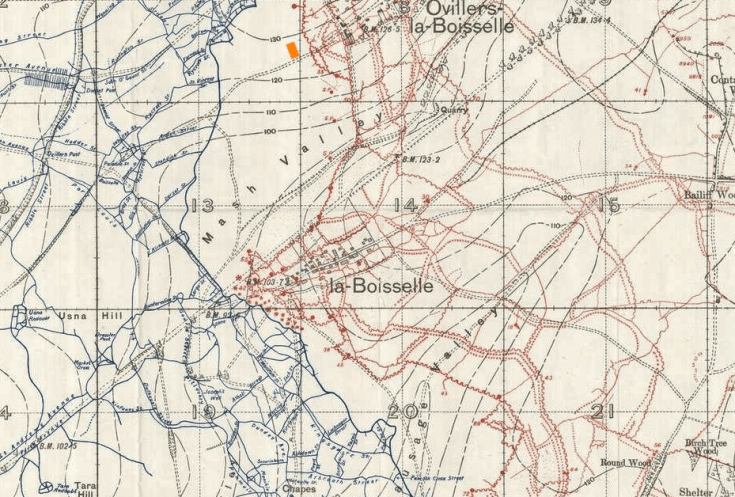
On 1st July 1916, Joseph Rowland was with the 2nd Battalion Lincolnshire Regiment facing the German front lines at Ovillers.

Screen Shot 2023-08-31 at 18.43.38

The story of that dreadful day is well known, and not strictly relevant to this story, but suffice it say that Joseph Rowland was one of the 20000 British men killed on that day. A letter would have been delivered to 50 New Street, Grantham, initially saying that Joseph was ‘missing’. Another letter would have followed saying that he was ‘missing, presumed dead’. His body was never found, and his name is one of the 72000 engraved on the Thiepval Memorial to the Missing.

Joseph William CWGC

Worse was to follow. Ever anxious to deliver the final crushing blow to the enemy, the British High Command devised yet another huge offensive to punch a hole in German lines. This was to be east of the city of Arras, 20 miles or so north of the Somme killing grounds. The offensive, more properly known as The First Battle of The Scarpe,  began at Easter 1917, in a snow storm. Once again, a death notice would find its way to Grantham. This time, although it would have been of little consolation, a body was found and given a decent burial.

JR Rowland

Dick returned to Grantham in late 1918, apparently unscathed, at least physically, but we know he had been in action since 1915, and had been both gassed and wounded. Once the euphoria at ‘beating the Hun’ had died away, there was little awaiting men like Dick Rowland in a country that should have been – but wasn’t – grateful. He managed to get work at Rustons in Grantham. On a side note, it is worth remembering that it was at the Ruston works in Lincoln that the first tanks were developed, as well as the iconic aircraft known as the Sopworth Camel.

FlorenceNow, though, we must return to Fulbeck. Only a grainy newspaper image of Florence Jackson remains, but it doesn’t take a great leap of imagination to picture a pretty, round-faced girl with a confident gaze for the camera. Once again, the 1911 census is of service. She lived in Fulbeck with her family. Florence would not live to be noted in the 1921 survey. Opportunities for young women of humble birth  in rural communities in those days were limited to farm work, or domestic service. There are suggestions that Florence has been in service at Barkston, or had returned to Fulstow in anticipation of a similar post. At some point she met Dick Rowland, and he was smitten, considering himself deeply in love. He was now 29, with a lifetime of horrors condensed into four years of hell on the Western Front, Florence was just 19, pretty, vibrant and untouched by the death and misery of The Great War.

Florence 1911


IN PART TWO
A courtship
A fatal ride on the swing-boats
Gascoigne’s Gate
The Lincoln Assizes

Blog at WordPress.com.

Up ↑