Search

fullybooked2017

Category

REVIEWS

MAILED FIST . . . Between the covers

MF header

The superb Wartime Classics series from the Imperial War Museum includes stories from the home front, such as Plenty Under The Counter, To All The Living, and Mr Bunting at War. Eight Hours From England took us to the undercover war in Albania, Patrol was set in the North Africa campaign, and in Trial by Battle, we sweated along with the men fighting in the Malayan jungle. The battle in the air was covered by Pathfinders and Squadron Airborne. Now, in the twelfth of the series, Mailed Fist joins Warriors For The Working Day and Sword of Bone with an account of the fighting in mainland Europe.

Cedric John Foley MBE (7 March 1917 – 8 November 1974) was a British Army officer, author, broadcaster, and public relations specialist. A regular soldier between 1936 and 1954, he was made MBE for his services to the Royal Armoured Corps during WW2. A man of wide interests, he was also known as a broadcaster and scriptwriter, and was military advisor to the popular ITV comedy show, The Army Game.

Cover

This is perhaps the least fictionalised of all the books in the series. Foley faithfully records his own experience after being commissioned into the Royal Armoured Corps in 1943. He was to command Five Troop – a trio of Churchill tanks named Avenger, Alert, and Angler. Foley follows the progress of the Allied forces through Normandy, the Ardennes and eventually – after bitter and brutal fighting against German forces – across the Rhine into Germany itself.

Earlier editions of the book had a very gung-ho blurb on the front but it is worth  pointing out that although Foley is, as one might expect, intensely loyal to the Churchill tank, it was widely regarded as being something of a lame duck in the tank world. The massed-produced American Shermans, the devastating Panthers and Tigers of the Panzerkorps, and the Russian T34s were all probably superior in overall performance.

MF previous

The book is markedly different from Warriors For The Working Day, another account which included a description of  a tank regiment advancing through Normandy. Peter Elstob’s writing is much more, for want of a better word, poetic, while Foley’s words have more the feel of a diary. He also concentrates more on the mechanics of the war, rather than the emotions of the men fighting it. That isn’t to say that Mailed Fist isn’t well written, and there are some memorable passages, such as this description of a column of German prisoners:

“One cheerful imp-faced man – obviously the platoon jester –  gave a Nazi salute grinned broadly as he turned it into a mime of pulling a lavatory chain. At the end of the column came a boy, he looked about thirteen years old and as he stumbled past he used the sleeve of his greatcoat to wipe the tears from his eyes.”

If you hadn’t worked it out from the featured illustration, the book’s title refers to the cap badge of the Royal Armoured Corps. Mailed Fist is a highly readable and authentic account of a crucial stage during WW2. It is published by the Imperial War Museum, and will be available on 21st April.

GLOSSARY OF SOME MILITARY TERMS USED IN THE BOOK

BESA British version of a Czech machine gun, frequently mounted in WW2 British tanks. Fired 7.92 Mauser rounds.
BOCAGE Countryside in Normandy typified by small fields, dense hedgerows and sunken roads. Difficult country for offensive warfare but ideal for defenders.
CHURCHILL British tank, well armoured, but lacking the firepower of its German adversaries. Still in use in the 1950s.
ENSA Entertainments National Service Organisation – dedicated to bringing light entertainment to serving military units.
LST Landing Ship, Tank. American boat used to transport tankson D-Day
PANTHER German tank considered one of the best of the war in terms of fire power, protection and mobility.
SHERMAN The ubiquitous Allied tank of WW2. American designed and built, easy to run and maintain, produced in huge numbers.
SPANDAU German machine gun, firing up to 1200 rounds a minute/Known to the Allies as ‘Hitler’s Buzzsaw’.
TELLERMINE Literally ‘Plate Mine’ – German anti-tank mine.
TIGER Probably the supreme tank of WW2, at least in theory. Fast, manoeuvrable, with a powerful gun and formidable armour, it was, difficult to repair and too highly engineered to be produced in sufficient numbers.

MR BUNTING AT WAR . . . Between the covers

Bunting header

This is another in the superb series of republished novels set in the Second World War. As author Wiliiam Boyd remarked:

“If poetry was the supreme literary form of the First World War the, as if in riposte, in the Second World War, the English novel comes of age. This wonderful series is an exemplary reminder of that fact.”

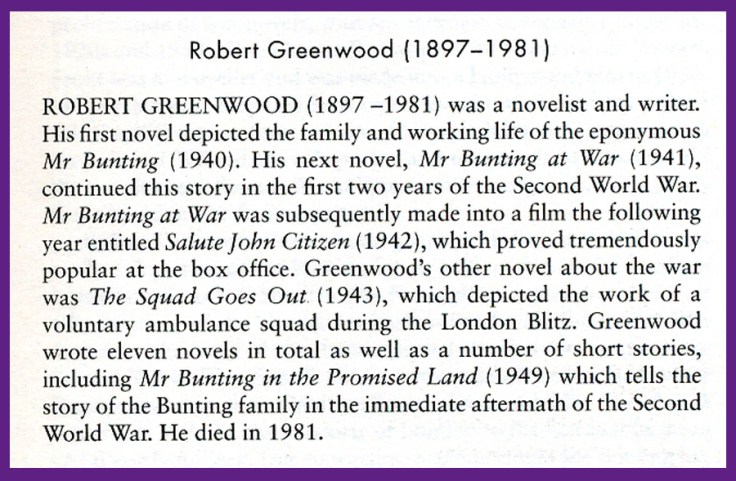
Robert Greenwood introduced Mr Bunting to the world in the book of the same title, published in 1940. He is something of a ‘stuffed shirt’, but entirely without malice, and he lives with his family in Essex, but within commuting distance of his work at an ironmongers in London. This is set in 1941, with London under siege from the skies, but by the end of the book the strategically unimportant district where the Buntings live is feeling the full wrath of the Luftwaffe.

George Bunting and his wife Mary have three grown up children, Chris, Ernest and Julie. Chris is, it could be said, George’s favourite son. He is practical, endlessly optimistic and cheerful, while Ernest is more introspective – and a gifted pianist. Both young men are trying hard to make a go of their respective careers, while Julie is something of a dreamer, and looking for suitable work.

The day to day world that Robert Greenwood describes would have been completely familiar to thousands of readers in 1941. So many elements of life then, however, are almost unimaginable to us now: the sheer terror of being under regular attack from the skies, the dread of receiving a telegram from the armed forces, the privations and shortages of food and the heavy hand of a wartime government laid on every aspect of normal life.

I was initially tempted to compare Mr Bunting with another  gentleman from an earlier generation, Charles Pooter. Mr Pooter (the creation of George and Weedon Grossmith in Diary of A Nobody) lived closer to ‘town’,  in Holloway. His house was called The Laurels, while Mr Bunting lives at Laburnum Villa. While the Grossmiths wanted us to laugh at Mr Pooter, Robert Greenwood takes a very different approach. He invites us, perhaps, to smile and raise an eyebrow at Mr Bunting’s rigid view of the world and his own place in it, but he never mocks. Bunting is a man of simple pleasures:

“There was nothing Mr Bunting liked better than to escape from the war and listen to his wife and daughter-in-law discuss the technicality of ‘turning the heel’ or report on experiments with recipes recommended by the Ministry of Food. To sit placidly smoking and listening to these discussions was to realise one had a home and a wife who was a jewel. If there was anything better in life, Mr Bunting wanted to know what it was.”

Through Mr Bunting, as he travels into London each day on his morning train, we see the carnage being wrought on the city. As he walks from the station to Brockleys, things almost become too much for him:

“Through the devastation he walked, stepping over hoses, skirting the edge of craters, threading his way past grimed and bloodshot firemen, single-mindedly pursuing his own particular business. There were gruesome sights, too, sensed rather than seen, tarpaulins stretched over what he knew were human forms. Once, a lock of a girl’s hair fluttered brightly as the wind ruffled her crude shroud. He bit his lip, and looked away.”

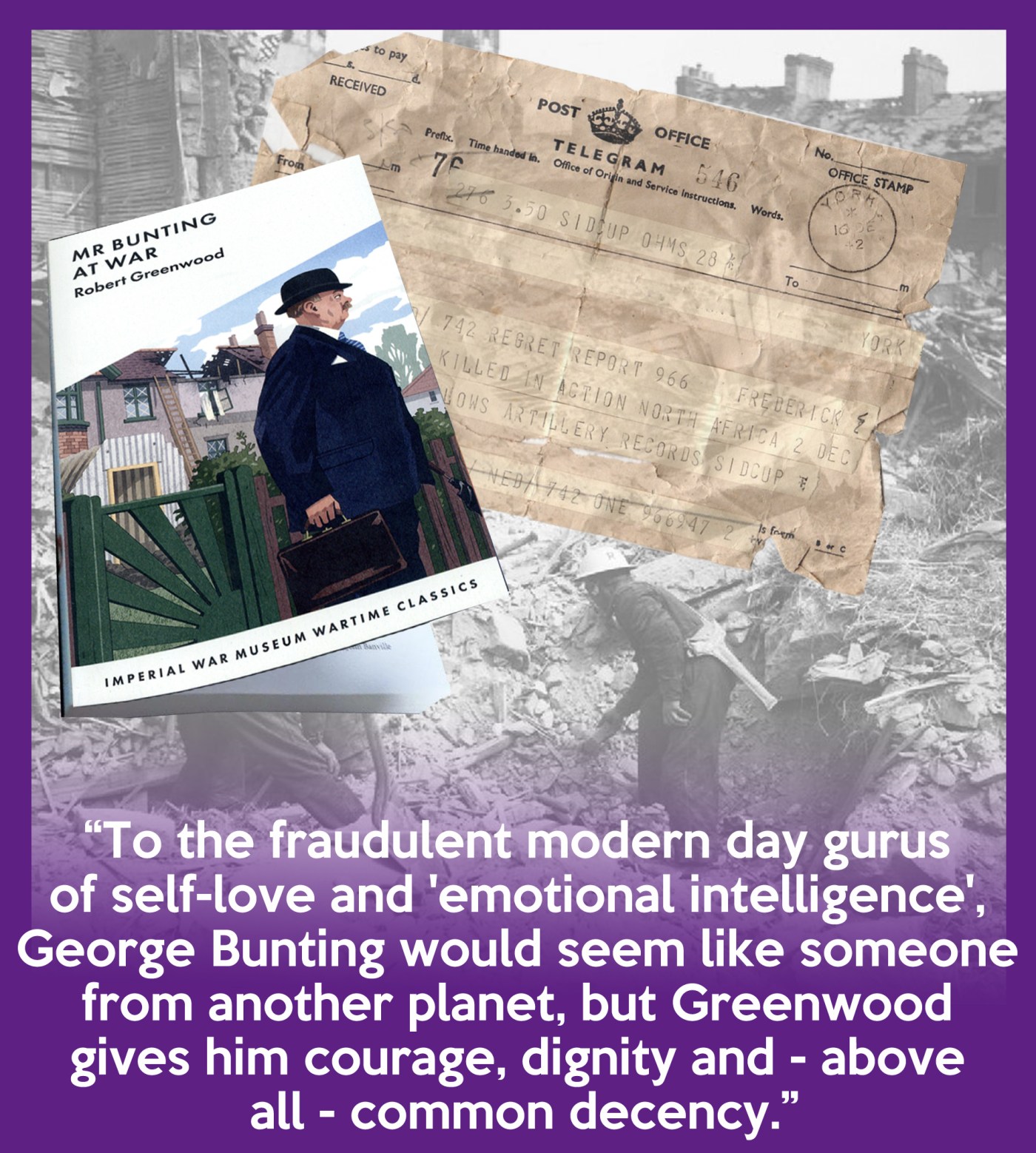
In George Bunting, Robert Greenwood created a character who is ordinary in the extreme, socially gauche, but from a generation of people who simply ‘got on with things’ when the darker side of life – in this case, a world war – threatened to overwhelm them. When tragedy strikes the family, he is devastated, but breaking down is simply something that was ‘not on’ in those days. To the fraudulent modern day gurus of self-love and ’emotional intelligence’, George Bunting would seem like someone from another planet, but Greenwood gives him courage, dignity and – above all – common decency. Mr Bunting at War is an Imperial War Museum Classic, and will be out on 21st April.

Greenwood

For reviews of other IWM Classics, click the link below.

IMPERIAL WAR MUSEUM CLASSICS

BLIND JUSTICE . . . Between the covers

BJ header

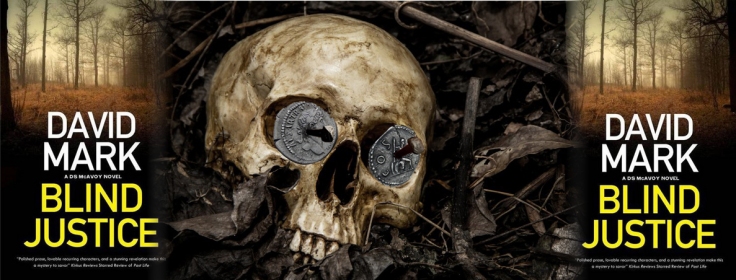
In the thirteenth episode of what is a genuinely impressive series, David Mark’s Hull copper Aector McAvoy returns, along with the established cast – his wife Roisin and their two children, and his boss, Detective Superintendent Trish Pharoah. McAvoy is, as the name suggests, a Scottish exile, and he is built like the proverbial brick you-know-what. Despite his forbidding appearance, McAvoy is a peaceable and studious man, shy with other people, but perceptive and with an attention to detail that matches his formidable appearance.

Screen Shot 2022-03-15 at 19.07.34The book begins with a flashback to an attempt by young men to carry out what seems to be a robbery in an isolated rural property. It ends in horrific violence, matched only by the destructive storm that rages over the heads of the ill-advised and ill-prepared group. Cut to the present day, and another storm has lashed Humberside, bringing down power lines, flooding homes, and uprooting trees. One such tree, an ancient ash, reveals something truly awful – a human body, mostly decayed, entwined within its roots in a macabre embrace.

McAvoy is called to the scene, and it doesn’t take too much evidence – in this case a pair of fashionable trainers – for McAvoy to deduce that this body has been put into the ground in living memory. What is astonishing, however, is that two Roman coins have been nailed into the victim’s eyes. The gentle policeman can only hope and pray that this act was not done while the victim was still alive. To make matters more disturbing, the fragile bones of two babies are also found.

The body is soon identified as that of a university student who went missing in the 1990s, but what on earth was he doing in this remote spot, and who had cause to kill and maim him in such a fashion? The owners of the adjacent property are interviewed, but add nothing to the investigation. Pharoah and McAvoy discover that the case may be linked to the trade in ancient artifacts discovered by illegal metal detectorists – nighthawks – and there is disturbing evidence that a notorious Manchester gangster – convicted of horrific torture just a few years earlier – may be involved on the fringes of the case.

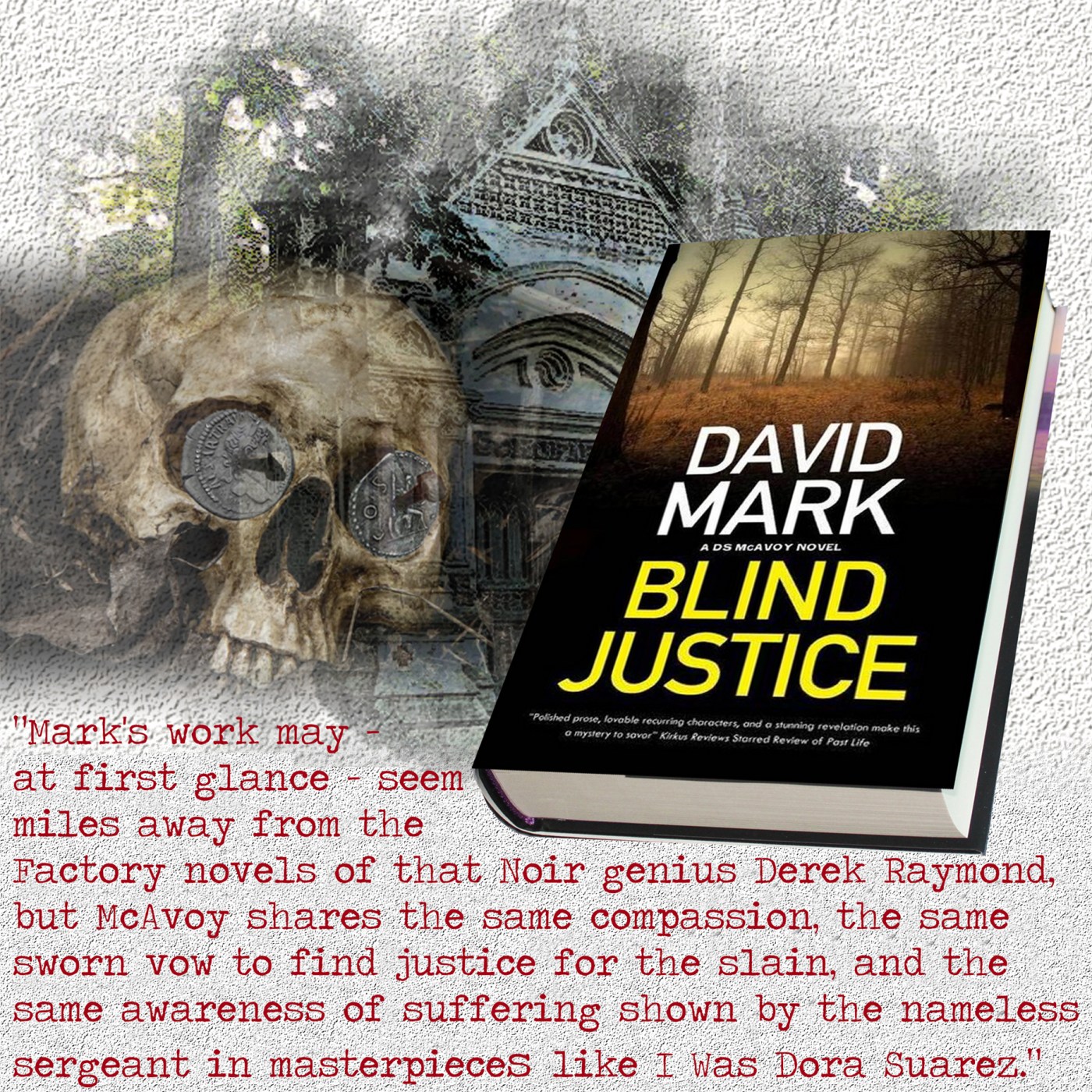
Screen Shot 2022-03-20 at 19.29.57David Mark (right) writes with a sometimes frightening intensity as dark events swirl around Aector McAvoy. The big man, gentle and hesitant though he may seem, is, however, like a rock. He is one of the most original creations in a very crowded field of fictional British coppers, and his capacity to bear pain for others – particularly in this episode his son Fin and Trish Pharoah – is movingly described. Mark’s work may – at first glance – seem miles away from the Factory novels of that Noir genius Derek Raymond, but McAvoy shares the same compassion, the same sworn vow to find justice for the slain, and the same awareness of suffering shown by the nameless sergeant in masterpieces like I Was Dora Suarez.


The terrifying climax to Blind Justice is also straight out of the Derek Raymond playbook and is not for the squeamish, but vivid and visceral. Where David Mark does differ from his illustrious predecessor is that he allows McAvoy the redemption and respite denied to Raymond’s sergeant with his dead child and mad wife, and it comes in the shape of his intriguing part-gypsy wife and their children.

If I read a better book all year, be sure that I will let you know. Blind Justice is published by Severn House and will be out on 31st March.

MURDER AT CLARIDGES . . . Between the covers

MAC header

Screen Shot 2022-03-14 at 19.49.22Jim Eldridge (left) and his aristocratic Detective Chief Inspector Edgar Saxe-Coburg are working their way around the best hotels in 1940s London, investigating murder We have had The Ritz  (click for my review), The Savoy, and now Claridges. Setting a murder against a grand backdrop is a simple but agreeable  formula which Eldridge has employed in his ‘museum series’, which are set in late Victorian England. The action takes place in October 1940, with Londoners under the hammer from Hitler’s bombers each and every night.

The concept which underpins the plot is similar to the one used in Murder at The Ritz. In the late 1930s, there were still countries in Europe ruled by what we might dismiss as ‘minor monarchies’. Albania, Yugoslavia and Romania all had ruling families, and some of them decamped to London, along with their coffers of gold. Also in London, which adds spice to the plot, were less fortunate people, some of them with a political agenda. One such, a Romanian kitchen hand at Claridges, is found garotted outside on the pavement. Saxe-Coburg’s boss calls hands him the murder investigation. The reason he wants Edgar on the case is touchingly naive. He thinks that when peace returns, and the ruling families of the Balkans resume their thrones, they will remember fondly the  discretion and tact used by an English detective. The garotter then finds another victim, but what possible connection does a young woman working for the Free French headquarters in London have the unfortunate Romanian?

murder-at-claridge-sLurking in the background of this tale is a man who is less than noble, but with more power than all the kings and queens sheltering in London’s best hotel suites. Henry ‘Hooky’ Morton is a London gangster who is building his empire on black market scams, the most profitable of which is his manipulation of the petrol market. We think of fuel supply – or lack of it – as a very modern problem, but in 1940, having fuel to put in your car was crucial to many organisations. Hooky Morton has a problem, though. Someone has infiltrated his gang, and is making him look stupid. Then, Hooky does something really, really stupid and, no nearer identifying the garotte killer or their motives, Saxe-Coburg becomes involved in investigating what is, for any copper, the worst crime of all.

Saxe-Coburg’s wife Rosa, a popular pianist and singer does her bit for morale in concert halls and hotels in the evening, but her day job is more exacting and brings her face to face with the havoc raining down on London from the sky – she drives an ambulance. Her assistant is killed when a bombed building collapses on him, and a little while later, when Rosa goes to visit his widow. she is horrified to find the woman dead on the kitchen floor, killed with the same method used to despatch the Romanian kitchen hand and the young Frenchwoman.

I suppose Murder at Claridges is, if genres mean anything, on the fringe of cosy crime, but is a genuine page-turner. Despite the grimly authentic background of London being battered by the Luftwaffe, it gives us larger-than-life characters and, of course, it allows us to peep into a world which only the truly rich inhabit. The suave Saxe-Coburg is a timely antidote to the damaged, troubled and – frankly – disturbing world of so many fictional Detective Inspectors who inhabit our contemporary world. Eldridge is a fine writer and never has escapism been so elegantly penned. This book is published by Allison & Busby, and will be out in Kindle and hardback on 21st April, with a paperback edition due in the autumn. To read my reviews of two of Jim Eldridge’s ‘museum series’, click the links below.

Murder at Madame Tussaud’s

Murder at the British Museum

SHAKING HANDS WITH THE DEVIL . . . Between the covers

shwtd header014

There is an interesting debate which raises its head periodically, and it involves the tricky subject of what can – or should not – become the subject of comedy. Jimmy Carr was in the news only the other day, because he made a joke about the deaths of Roma people in The Holocaust. There are numerous TV sitcoms from back in the day which are fondly remembered by us older folks, but would not survive the heightened sensibilities of modern publicists and producers. This preamble is by way of a warning that Bryan J Mason’s novel, Shaking Hands With The Devil, will not be for everyone. There are jokes and themes in here which, as they say, push boundaries, so if you are someone who takes offence at words on a page, then I think it’s probably ‘Goodnight Vienna‘. For those made of sterner stuff, here’s the story.

We are in late 1980s London – the autumnal years of Thatcher’s Britain – beset by strikes and endless assaults by the IRA. A predatory killer called Clifton Gentle – think Denis Nilsen – is enticing young homosexuals to come back to his home, where they have sex, but the post coital routine is that he kills them and chops them up into pieces. Sometimes the pieces stay in his flat, but when they become too noxious, he leaves them spread about the capital, in skips, under bushes or in Biffa bins.

SHWTD coverOn his trail is a grotesque cartoon of a copper – DCI Dave Hicks. He lives at home with his dear old mum, has a prodigious appetite for her home-cooked food, is something of a media whore (he does love his press conferences) and has a shaky grasp of English usage, mangling idioms  like a 1980s version of Mrs Malaprop.

The other gags come thick and fast. We have three new police cadets – Oldfield, Abberline and Slipper –  working on the case (Google if you’re not sure}, while the editor of The Herald Review (one of the newspapers covering the case) is a certain Mr Charles Manson.

Mason’s final audacious name-check is when he reveals that there is a second killer on the loose, a young man who has won all the glittering prizes, but has been diagnosed with terminal cancer. Peter Kurten is determined to make the most of his final six months by a bit of casual ‘triple D’ – Date, Death, Dismember. A confession. Suspecting that this was another joke, I Googled the name (so you don’t have to) and found that Peter Kurten a.k.a The Vampire of Düsseldorf was a notorious German serial killer who went to the guillotine on 2nd July 1931.

When he learns that he has a rival, Clifton Gentle is most aggrieved. That is not his only problem, however, because a young rent boy called Jimmy is Clifton’s only failure. Not only did Jimmy escape before fulfilling his date with the cleaver and hacksaw, he has now located his would-be assassin and is blackmailing him.

Hackney’s finest, Dave Hicks or, as he prefers to be known, ‘The Dick from The Sticks’ is also up against it. As clueless as ever, he unwisely announces in a news conference that he had set himself just fourteen days to bring the killer to justice. The days and hours tick by, without Hicks having any genuine leads. Then, on the eve of the expiry of his deadline, he decides to save his reputation. In a a bizarre attempt to blend in with the crowds in London’s gay clubs, Hicks sets out to attract the killer (he is unaware that there are two) and is dressed to kill, decked out in:

BJM“A fuchsia -pink shirt with outsize wing collar, over-tight lime green denim jeans, a brand new squeaky-clean leather jacket and, just for good measure, a black beret with white trim.”

The finale of Dave Hicks’s  quest to catch his man is set in an old fashioned Soho of seedy clubs, touts and pimps that would be unrecognisable to the trendsetters who frequent it today. Bryan Mason (right) has written a dystopian novel which is, in turn, ghastly, eyebrow-raising and hilarious, but is also a must for those who like their satire as black as night.

Shaking Hands With The Devil is published by Vanguard Press/Pegasus Publishing, and is available now.

MURDER MOST VILE . . . Between the covers

MMV header

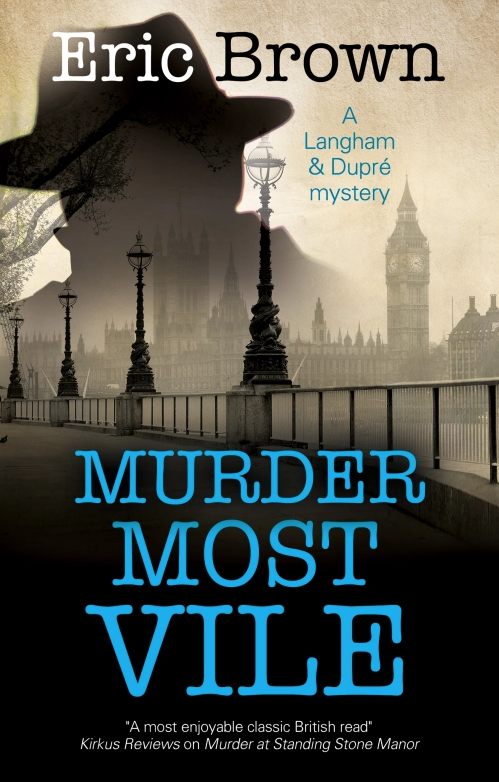
Having not come across author Eric Brown before, I did a quick search, and Wiki told me that he was a prolific science fiction writer, and I immediately thought I must have got the wrong chap, but he is one and the same. His versatility in writing Golden Age-ish mysteries set in the 1950s as well as futuristic fantasies is to be commended, but after all, he was born and raised in Haworth which, if you are looking for literary connections, is as good a place as any, and better than most.

MMV coverWhat is happening then, in Murder Most Vile? All too often these days, I am a late arrival at the ball and this is the ninth in a series centred on a pair of investigators in 1950s England. Donald Langham is a London novelist, who runs an investigation agency with business partner Ralph Ryland. Langham’s wife, Maria Dupré,  is a literary agent. Here, Langham is engaged by a rather unpleasant and misanthropic – but very rich – old man named Vernon Lombard. Lombard has a daughter and two sons, and the favourite one of the two boys, a feckless artist called Christopher, is missing.

Old Lombard has history, and not a particularly salubrious one in terms of British politics in the 1930s. He was a fervent supporter of Oswald Mosley and his fascists, and while this years ago, it is to rake up uncomfortable memories for  Ralph Ryland when it emerges that the boss of a London brewery is also a pervert, a gangster – and, like Vernon Lombard – someone who longs for the glory days of the British Union of Fascists.

Langham and Ryland are an interesting team, with Langham the more urbane and middle class of the two, while Ryland’s father was a London docker who was on what we now consider to be the wrong side of things during the infamous Battle of Cable Street in 1936, when Mosley’s fascists went head to head with an opposing force of trade unionists, Jewish groups and communists, with the police trying to keep the sides apart. Out of loyalty to and, perhaps, fear of his father, Ryland was there that day, and what he saw – and did – has continued to haunt him, especially since he was among the Allied troops who liberated Belsen in April 1945 – a month that has special significance for some of the characters in this novel.

Screen Shot 2022-03-02 at 19.24.36

What the pair uncover is that most poisonous of situations – bitter family jealousy. It transpires that Christopher Lombard’s apparent success as an artist is due to his father buying up most of his canvases, and the other two siblings are not happy. There are abductions, murders and mysteries – and Eric Brown provides a clever plot twist which I never saw coming.

It’s not always helpful to shepherd crime novels into genres, but I know that many readers are not comfortably retired like me, and the time they have for settling down with a good book is limited, and that is why they sometimes welcome a ‘heads-up’ as to what kind of book to pick up next. I would say that Murder Most Vile is cosy crime, but with a hard edge. It is also, I suppose, historical crime fiction, because, for some, 1957 is as far away as 1757 in terms of social attitudes and the trappings of technology. It might also be doffing its trilby to the world of bygone investigators – Paul Temple, certainly, with maybe just a hint of Bulldog Drummond. We have dead bodies, escapes from dungeons, powerful embittered and influential old men and  – essential to all private investigators – friends in the police force. The bottom line, however, is that this is cleverly written by Eric Brown, and is well worth a few hours of anyone’s time. Murder Most Vile is published by Severn House and is out now.

ERIC BROWN’S WEBSITE IS HERE

HUNGRY DEATH . . . Between the covers

HD header

I have become a huge fan of the Cragg and Fidelis books written by Preston-born Robin Blake. They are set in the 1740s in Lancashire, Titus Cragg is the county coroner, and his friend Luke Fidelis is an enterprising  and innovative young physician. Hungry Death is the eighth in this excellent series, and to read my reviews of three of the previous books Skin and Bone, Rough Music, and Secret Mischief, click the links.

HD coverCragg is instructed to ride out to a lonely moorland farmhouse, and what he finds surpasses any of the previous horrors his calling requires him to confront. He finds an entire family slaughtered, by whose hand he knows not, unless it was the husband of the house, himself hanging by a strap hooked over a beam. To add even more mystery to the grisly tableau, Cragg learns that the KIdd family were members of a bizarre dissenting cult which encourages its members into acts of brazen sexuality. Then, in a seemingly unconnected incident, the gardener at a nearby mansion, trying to improve the drainage under his hothouse, discovers another body. This corpse may have been in the ground for centuries, as it has been partly preserved by the peat in which it was buried. When Fidelis conducts an autopsy, however, he concludes that the body is that of a young woman, and was probably put in the ground within the last decade or so.

Bodies – dead ones – are central to Titus Cragg’s world. A coroner, then and now,  must try to be led, hand in hand, by the dead until the circumstances of their demise is revealed. Sometimes, through his investigations and observations, Cragg (helped by the medical eye of Fidelis) can make the dead talk, but the peat-blackened young woman seems to have little to say. Painstaking and shrewd deduction leads Cragg to believe that she was a servant girl once employed at one of the large households in the area. But who? The girls came and went, changed their names through marriage, and the passing years have cast a shroud of fog over the matter.

insert2

Regarding the slaughter at the farmhouse, Cragg discovers that the answer lies in the peculiar – and vengeful – nature of the Eatanswillian sect. I believe Robin Blake has used a little historical license here, as the only mention of the word  online  that I could find is that of the election in the fictional town of Eatanswill (described so satirically in The Pickwick Papers). The resolution of the case hinges on a note pinned to the door of the farmhouse, apparently written in some kind of code. Cragg hopes that  deciphering the code will lead him to the perpetrator of the slaughter.

All is resolved, of course, in the final pages, which are framed around the coroner’s inquest into both cases, and Robin Blake gives us a courtroom drama worthy of anything in the distinguished career of Perry Mason or, more recently Micky Haller. This is a cracking piece of historical crime fiction from the first word to the last, but I have to say the opening chapter was one of the most horrific passages I have read for a long time. Hungry Death is published by Severn House and is available now.

DEAD END STREET . . . Between the covers

DES header

Screen Shot 2022-02-17 at 19.21.12Jimmy Mullen is a former Royal Navy man, but he has fallen on hard times. He served in The Falklands and has recurrent PTSD. He has served a  jail term for manslaughter after intervening to stop a girl being slapped around and, until recently, lived out on the streets of Newcastle, among the city’s many homeless. Now, for the first time in years, he has a job – working for a charity – and a proper roof over his head. Author Trevor Wood (left)  introduced us to Mullen in The Man On The Street (2019), and the follow-up novel One Way Street (2020) Thanks to his Navy training, Mullen has skills in investigation, and his closeness to the dark end of Newcastle street life has enabled him to put himself in places and among people where access is denied to conventional detectives.

Mullen frequents The Pit Stop, a refuge for the homeless and one of his closest mates is a man known as Gadge, who is cranky, abrasive, drinks for England, but highly intelligent. For the first time, we learn about Gadge’s back story. In the late 1980s, he was married, had a thriving tech start-up business – hence ‘Gadge’ for gadget – and had the world at his feet. His downfall makes for grim reading, but now he is in even more trouble. There has been an outbreak of assaults on homeless men, some receiving cruel beatings. Can these be linked to the campaign of a city pub owner, who is convinced that most of the homeless are working a clever scam, begging during the day, and then secretly returning to homes in the suburbs at night with a pockets full of untraceable cash?

DES coverGadge becomes the victim of one of these assaults, but when he is woken up from his drunken stupor by the police, he is covered in blood – most of it not his – and in an adjacent alley lies the corpse of man battered to death with something like a baseball bat. And what is Gadge clutching in his hands when the police shake him into consciousness? No prizes for working that one out!

Keith Kane aka Gadge is arrested on suspicion of murder. All the forensic evidence suggests he is the killer, and he basically has only one chance of redemption, and that is if Mullen can get to the bottom of a complex criminal conspiracy involving a bent taxi firm, a former drug dealer and pimp mysteriously knocked down and killed by a bus and  – just possibly – a family who may still be seeking revenge for a death, years ago, which brought about Gadge’s metamorphosis from wealthy tech wizard to alcoholic tramp.

As Mullen bobs and weaves between some of the nastier inhabitants of Newcastle’s gangland, the case becomes ever more complicated and, just as when a rock is turned over, all kinds of nasty things scuttle away from the unwelcome light. There are embittered folk determined to avenge family members, ghosts from the past, and increasing pressure on Mullen to make some pretty momentous moral choices.

Trevor Wood’s  novel – apparently the final one in this series – is compassionate and compelling but,  above all, a bloody good crime story. It is published by Quercus and is available in all formats now.

TRUE CRIME STORY . . . Between the covers

tcs012 copy

If crime writers could win bravery awards, then Joseph Knox would certainly awarded the Military Medal, if not DSO or higher. Having written three well-received novel featuring flawed Manchester copper Aidan Waits (click for reviews), he killed him off, albeit ambiguously, and has now written a novel called True Crime Story. First up, a kind of spoiler, but it has to be done. The key is in the third word of the title. The people who are central to this book never existed. The victim, a university student called Zoe Nolan exists only in Joseph Knox’s head. Such is the authentic tone of the writing, I had to do a quick internet search, but Zoe Nolan never lived. She never disappeared, and those who make up the narrative – her family and friends – are equally imaginary.

Screen Shot 2022-02-15 at 19.29.28If you can get your head around the idea, Knox (left) plays himself here and the book is a series of statements, made to a fellow author by a cast of characters who were part of Zoe’s life. Initially, we have her parents, her twin sister, and an array of other young people who were part of her life prior to her disappearance after a night clubbing in Manchester, but as Zoe Nolan is gradually transformed into someone with a huge bag of secrets slung over her shoulder, more voices are added to the account.

The beauty of this narrative device is that we have no idea who is telling the truth, or whose words are reliable. We may even be reading a clever defensive account from the person responsible for her demise. The skill, of course, is making each statement equally plausible, even though some of the statements are contradictory. Knox sets us a challenge. We are judge and jury. Who is credible? Who has invented a tale to cover up their own complicity in events? Or, even more extreme, is there someone talking who isn’t the person they claim to be?

As clever as this is, Knox has to make the most of it, as it will only work once. It makes the reader do the work in a way that a standard crime mystery does not. In a regulation police procedural, the investigating officer takes in information, and he or she makes judgments on our behalf. We follow their reasoning and, although they sometimes make mistakes, we rarely see the error before they do.

tcs013 copyThe statements made by the ‘witnesses’ give us an overview – albeit imperfect, given that we don’t know who to trust – of the hours leading up to Zoe’s disappearance, and the months and years which led up to a promising young singer being rejected by the Royal Northern Collegee of Music and having to settle for a less prestigious place at Manchester University.

Just when you think things couldn’t become more complicated, they do. Having got used to the concept that the Joseph Knox in the book isn’t the real Joseph Knox ( a kind of Schrödinger’s Author, if you will), and there never was an Evelyn Mitchell with whom he corresponds, the flesh and blood Joseph Knox, who I have met and spoken to, has his alter ego throw more spanners into the narrative, by way of a ‘Publisher’s Note’ saying that as this (the paperback copy) is the second edition of the book, since the first edition ‘new information’ unavailable at the time the first book went to the printers, has been added ‘for clarity’.

So what happens in the end? Of course I am not going to tell you, but unless they cheat and read the book from the back, I think it will be a clever person  who predicts the outcome. This uses one of the cleverest narrative devices I have ever come across, and is an intriguing read. The problem is that anyone with an ounce of curiosity is going to Google Zoe Nolan and will, within seconds, the conjuror’s rabbit has not so much escaped from the hat, but been skinned, jointed and put in the pot for dinner.

True Crime Story came out in hardback and Kindle in June 2021 and this paperback version will be out in March. It is published by Penguin.

Blog at WordPress.com.

Up ↑