

Weston Kogi is a security guard in a London supermarket, and the most excitement in his life is when he has to chase shop-lifters across the car park. When he hears that the woman who brought him up, his Auntie Blossom, has died at her home – the city of Ede in the West African republic of Alcacia – he decides to attend the funeral. You will look in vain for Alcacia on a map, but Tade Thomson describes it thus:
“He brought out a map of Alcacia. It was shaped like a sperm whale on the West African map, tiny, squeezed between Nigeria and Cameroon, the mouth of the whale drinking from the Atlantic.”
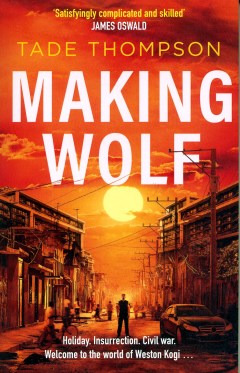 At his aunt’s funeral he meets Churchill “Church” Okuta. Church is a nightmare from Kogi’s schooldays, and the meanest person he has ever met. When asked what he does in London, Kogi, on impulse says that he is a homicide detective. Bad move. Church orchestrates the drugging and abduction of Kogi, and when he wakes up he finds that he is in the camp of the Liberation Front of Alcacia, one of two warring rebel groups trying to overthrow the government. Their leader, Enoch ‘Papa’ Olubusi has been assassinated, and the LFA, in the mistaken belief that Kogi is a crack British detective, want him to prove that the killing was the work of their bitter rivals – the People’s Christian Army.
Sucked into a deadly game of recriminations, treachery and mind-numbing brutality, Weston Kogi soon finds himself unsure of who are the good guys and who are the villains. You might think, at first sight, that the People’s Christian Army and the Liberation Front of Alcacia are comedy turns, like the rival factions in Monty Python’s The Life of Brian, but as you turn the pages of Making Wolf, you will encounter graphic and disturbing descriptions of violence in a dystopian Africa where fair is foul and foul is fair. Even everyday domestic scenes have a touch of the nightmare about them:
“Dogs howled at the full moon, took a break, and then howled some more. People came out on raffia mats, deckchairs and carved stools. Children ran around the central wood-fed fire, squealing their delight and roasting wild mushrooms on dirty sticks. Wasps, sand flies, stick insects, confused termites and other arthropods flew into the flames for one shining moment before dying.”
Amid the corruption, cheap death and commonplace brutality, Tade Thompson has a keen eye for the absurd. Kogi and Church pay a visit to a Fagin-like character who is the lord of all the many beggars in Ede.
“The King of Boys wore a crown to receive us. The crown was jewelled with marbles – children’s marbles. It was a band of tin, beaten together from old Burma-Shave containers. His head was completely bald, shining from within the rim of his crown. He had a back tailcoat on and he looked like an impoverished Fred Astaire.”
As he lifts layer after layer of lies and deception, Kogi decides to visit the widow of the assassinated politician, and she invites him to an evening at the theatre. Diane Olubusi has dressed to kill:
“She wore a low-cut white dress, designed in such a way to give the impression of a woman wrapped in a bolt of silk which was about to slip off. She smelled like a botanical garden with all the flowers in full bloom.”
Weston Kogi discovers that Alcacia is awash with money. Hundreds of thousands of dollars – in suitcases, money belts, plastic bags – are traded back and forth between sinister men in dark suits and their military friends in combat fatigues. All this while little people grind out their miserable lives in squalor and hardship. There is grim comedy, astonishing violence and a certain brutal poetry in Making Wolf. It is a book that will certainly shock you, but make no mistake, Tade Thompson is a writer to be reckoned with.
Making Wolf was first published in 2015, but is being reissued by Constable, and will be available from 7th May.











 arker is given an apology, and asked to help with the hunt for Donna Lee Kernigan’s killer. He soon learns that the Jurel Cade, a special investigator for Burden County, has been involved in the investigations – or lack thereof – into the earlier deaths. The Cade family are rich, influential and undoubtedly corrupt. They have also managed to entice Kovas, a massive defence procurement company, to build a plant in the vicinity, a deal which will put food on tables, dollars in wallets and hope in hearts for the long neglected locals. A few murdered black girls mustn’t be allowed to embarrass the PR machine that deals with the Kovas public image.
 onnolly writes like an angel, and there is never a dead sentence, nor a misplaced word. Occasionally, within the carnage, there is a wisecrack, or a sharp line which sticks in the memory:







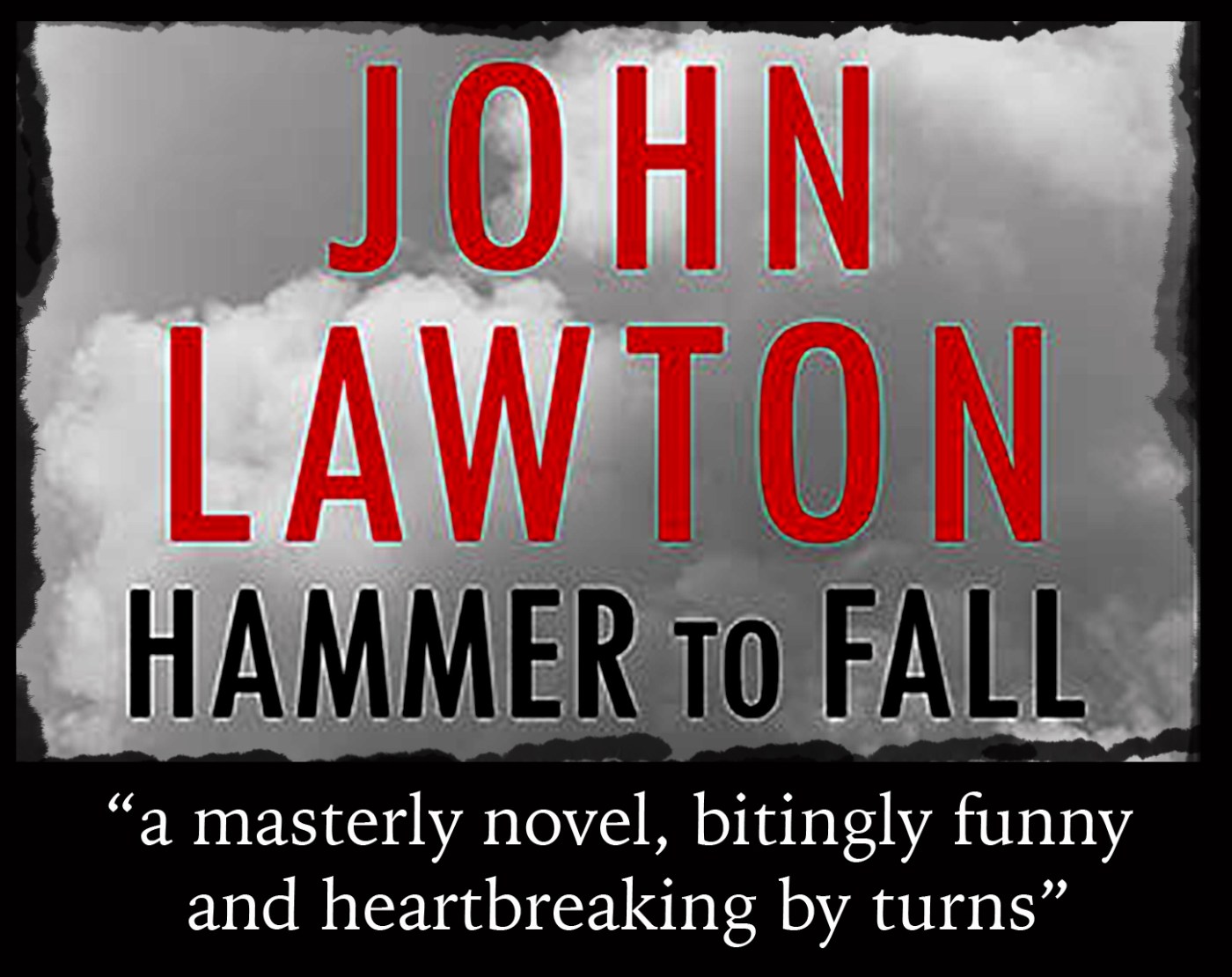

 He is no James Bond figure, however. His dark arts are practised in corners, and with as little overt violence as possible. Hammer To Fall begins with a flashback scene,establishing Joe’s credentials as someone who would have felt at home in the company of Harry Lime, but we move then to the 1960s, and Joe is in a spot of bother. He is thought to have mishandled one of those classic prisoner exchanges which are the staple of spy thrillers, and he is sent by his bosses to weather the storm as a cultural attaché in Finland. His ‘mission’ is to promote British culture by traveling around the frozen north promoting visiting artists, or showing British films. His accommodation is spartan, to say the least. In his apartment:
 So far, so funny – and Lawton (right) is in full-on Evelyn Waugh mode as he sends up pretty much everything and anyone. The final act of farce in Finland is when Joe earns his keep by sending back to London, via the diplomatic bag, several plane loads of …. well, state secrets, as one of Joe’s Russian contacts explains:


 fullybooked2017