Search

fullybooked2017

Author

fullybooked2017

A retired Assistant Head Teacher, mad keen on guitars. Four grown-up sons, two delightful grandchildren. Enjoys shooting at targets, not living things. Determined not to go gently into that good night.

THE TEMENOS REMAINS . . . Between the covers

temenos spine

A temenos (Greek: τέμενος; plural: τεμένη, temenē) is a piece of land cut off and assigned as an official domain, especially to kings and chiefs, or a piece of land marked off from common uses and dedicated to a god, such as a sanctuary, holy grove, or holy precinct.

Screen Shot 2023-02-22 at 19.19.37This is the fourth book in a series featuring Norfolk copper DCI Greg Geldard, but author Heather Peck (left) wastes no time in providing all the back-story we need. Geldard is divorced from his former wife, Isabelle, who is a professional singer. She has now remarried a celebrated orchestral conductor, with whom she has a child, while Geldard is in a relationship with one of his colleagues, DS Chris Mathews. When he gets an early morning ‘phone call from Isabelle saying she and her son have been threatened by a foreign criminal connected to one of Geldard’s previous cases, he is forced to stay at arm’s length, but is disturbed to hear from a colleague that Isabelle may be making the story up.

With this at the back of his mind, he has to focus on human remains found during an archaeological dig. Not unusual, you might think, but this skeleton has modern dental work and was buried with a 1911 silver thruppence in its mouth. After mining down into HOLMES, the national police database, Geldard’s team discover more cases that seem to be similar, and when part of the cliff near Hemsby collapses in a violent storm, another skeleton is revealed, along with its now obligatory coin. Meanwhile, in a series of short episodes which she calls ‘Entr’actes’, Peck introduces us to the man we presume is the killer, but these paragraphs are, at first, enigmatic, and only make sense towards the end of the book when the killer becomes a person of interest to the team.

Geldard’s relationship with Chris Mathews comes under a strain as she resents what she sees as his lingering affection for his former wife, and she is equally unhappy about his working relationship with DI Sarah Laurence. Do real-life coppers get into relationships with close colleagues? I don’t know, but other fictional social partnerships I recall were Tom Thorne and Helen Weeks in the Mark Billingham books, and Peter Robinson’s DCI Banks and his feisty on-off partner Annie Cabbot.

GG banner

Eventually, the killer makes a big mistake and is pulled in, Geldard’s only problem being to convince the CPS that he is fit to stand trial and plead. There is to be no celebratory night in the pub, however. Heather Peck has kept the sub-plot featuring the foreign gangster gently simmering in the background, but right at the end she turns up the heat – and leaves us with a cliffhanger worthy of Scheherazade’s tales.

I loved the Norfolk setting of this story, and as a former resident, I can vouch for its authenticity. Greg Geldard is pleasantly ‘normal’ for a fictional senior detective, and Heather Peck relies on her mastery of modern police methods to hold our interest and keep the story ticking along. The Temenos Remains is published by Ormesby Publishing and is out now.

Heather Peck is certainly a busy woman. As well as writing novels, she has been a farmer, chaired an NHS Trust, has worked on animal welfare, sailed a boat on the Broads, volunteered in Citizens Advice and the Witness Service and vaccinated humans against Covid. To find out more, go to her website.

UNNATURAL HISTORY . . . Between the covers

UH spine

Guilty pleasures? At my time of life, there should be no guilt involved. I have no intention of troubling the funeral director just yet, but I am nearly six years over my biblically allotted span and I will take every opportunity to enjoy my reading on my terms, and I do love a good series. Yes, I know the analogies – comfortable slippers, well-worn cardigan and all the rest. But why not? When time is not on one’s side, what is the point of enduring the pain of breaking in new shoes? Other metaphors are available, but here are a few of my favourite series by authors who are still with us.

Series

With that heartfelt (not) apology out of the way, here’s my take on the latest Alex Delaware novel from Jonathan Kellerman, Unnatural History. Quick bio. of Dr Alex Delaware (who first appeared in 1985, so he is one of those characters for whom time stands still). He is a Los Angeles forensic psychologist, his live-in girlfriend is a builder/restorer of high end guitars and stringed instruments, and he is involved in crime due to his friendship with Detective Milo Sturgis who is gay, very smart, and a man who, if eating were an Olympic event, would be a multiple gold medal winner.

Adonis ‘Donny’ Klement, an artist who specialises in photography, has been found shot dead in his converted warehouse studio. Three bullets to the chest, bang, bang bang – a concise equilateral triangle. Donny is a member of a very unusual family. His father Viktor is an elusive and secretive billionaire businessman, so careful to escape publicity that not a single photograph of him exists. He has a strange habit. He marries, fathers a child, and then moves on. Donny was the latest progeny, but he had several half-siblings.

By all accounts, Donny was gentle, talented, but rather naive. His most recent project was called The Wishers. He recruited several homeless down-and-outs, dressed them in exotic and fantastical costumes,and photographed them. They were well paid, but was one of them deranged enough to come back and murder the man who, if only for a brief hour, had enabled them to act out their fantasies?

Delaware and Sturgis are convinced that the murder of Klement is connected with the street people he brought into his studio, and when one of them – a deaf mute woman called Jangles – is found strangled, it begins to look as if they are right. Or are they? There is an elegant and clever plot twist which confirms that they were, but not quite in the way they were expecting.

As well as Kellerman’s taut dialogue and plotting, we should not forget that he is up there with the best writers (including his contemporary Michael Connolly and the Master himself, Raymond Chandler) in bringing to life the dramatic contrasts of the LA landscape, with its beaches, grim neon strip-malls, spectacular hills and – more recently – the horrific shanty cities full of homeless down-and-outs. Yes, of course this is ‘formula fiction’, but it is also CriFi of the highest quality. Delaware and Sturgis are perfect partners; they are a long way from being ‘two peas in a pod’, but each feeds off the other’s strengths and abilities. Unnatural History is a riveting read, and will be available from Century/Penguin Random House from 16th February. Click the image below to read more reviews of books by Jonathan Kellerman.

JK footer

THE MURDER OF P.C. WILLIAM HINE . . . A Fenny Compton Mystery (2)

Hine header

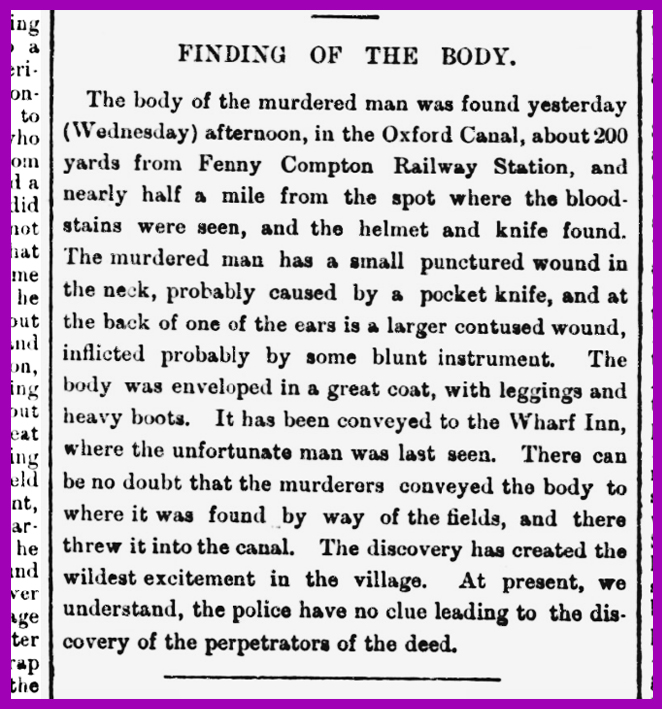
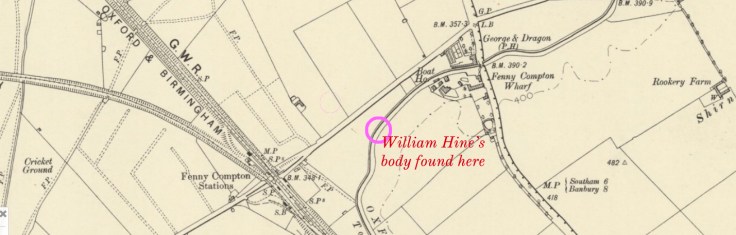
SO FAR: Fenny Compton, February 1886. Police Constable William Hine has not been seen since he left The George and Dragon inn on the evening of 15th February. Foul play is suspected, but his colleagues in the Warwickshire constabulary have found no trace of him. The Banbury Guardian, of Thursday 25th February broke this news:

Finding the body

There was a Coroner’s Inquest. Hine had been dealt a savage blow to the head, which had stunned him but the cause of death was something much more sinister – and puzzling. He had two almost surgical knife wounds in the neck, and it was speculated that he had been held down and bled out.

The medical evidence went to show that the fatal wound in the neck had been inflicted with scientific accuracy, and that probably the deceased was held down on the ground while it was indicted.”

Body found

On 6th March, The Leamington Spa Courier reported on the wintry funeral of the murdered officer:

“The remains of the murdered constable, Hine, of Fenny Compton, were interred in the Borough Cemetery, Stratford-on-Avon on Monday. More inclement weather could not possibly have been experienced. Snow had been falling for several hours, and lay upon the streets and roads to the depth of about two feet. On the outskirts of the town the snowdrifts were, in places, from three to four feet deep. Such unpropitious weather naturally militated against so large attendance of spectators as had been anticipated. Many who had intended coming from a distance were compelled to forego their intention, some of the country roads being almost impassible.”

“The hearse conveying the body of the murdered man to Stratford left the Wharf Inn, Fenny Compton, about 8 am. The journey to Stratford, nineteen miles, was accomplished with difficulty, and in the face of a blinding snowstorm. At Kineton, ten miles distant, it was found necessary to engage a third horse, the roads in places being blocked with snow. Just prior to leaving Fenny Compton a very beautiful floral wreath, composed of white camellias and maidenhair ferns, was placed upon the coffin by Mr Perry, of Burton Dasset, magistrate for that division. The hearse arrived at Stratford shortly before noon. By that time a large number of police, representing every division in the county, had assembled in the open space near Clopton Bridge.”

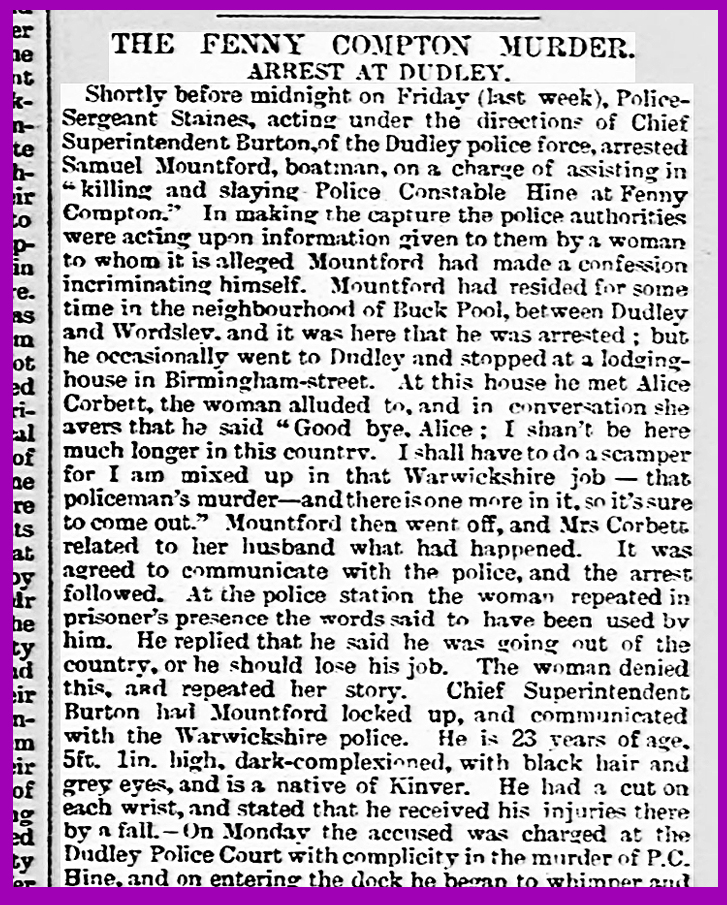
The search for those who had murdered William Hine – and opinion was that there was more than one assailant – went on until the trail grew as cold the weather on the day he was buried. There was a bizarre interlude when a bargee from the Black Country was arrested for the murder, having confessed involvement in it to a woman friend, who passed this on to the police:

Confession

In court, Mountford then vehemently denied that he had been involved, but gave no reason for his extraordinary confession. He was released without charge, and the police never explained why they discounted his confession. A year later, another “clue” emerged, as reported by the Kenilworth Advertiser:

“The police have discovered blood-stained clothes hidden in a garden at Cropredy village, adjoining Fenny Compton, and it is believed that they belong to the men who murdered Police-constable Hine in February last year. Two men in prison at Oxford are suspected. The night after the murder a woman at Cropredy noticed the blood-stains on the inspected men’s clothes, and it is said they threatened to “do” for her husband if she mentioned the circumstance. The woman is since dead, but made a statement before death.”

The death of William Hine is perhaps not the most infamous unsolved murder in Warwickshire history. That dubious accolade has to belong to the killing of Charles Walton on 14th February 1945. To read that story, click this link. There is, however, at least one similarity, and that is the location and its ambience. Lower Quinton is twenty miles away from Fenny Compton, but is in that self-same part of rural south Warwickshire, a countryside untouched by heavy industry and intense urbanisation. Both locations remain thinly populated, lightly policed, and share a population which, back in the day before mass media and the  internet, tended to keep themselves to themselves, and had a residual suspicion of strangers. There was always the suspicion that Walton’s death was somehow connected with witchcraft; there was no hint of this in the killing of William Hine, but the peculiar nature of the wounds on his throat was never explained away.

Emily HineIt is abundantly clear to me that despite the best efforts of the police, there were people who knew who had killed Charles Walton, but they took their silence to the grave. My best guess is that same applies to Fenny Compton in 1886. I believe William Hine was killed by local criminals – probably poachers and livestock thieves – who local people knew and – most importantly – feared. A charitable fund was raised for Hine’s widow and children. There was something of a scare in September 1887, when the Leamington bank of Greenway, Smith and Greenway collapsed, and it was rumoured that the Hine fund – close to £80,000 in modern money –  had been in their keeping. This rumour proved untrue and the fund paid out until Emily Hine (left) died in 1924. She never remarried, and lived in Shottery for the rest of her life. A new headstone was erected in the memory of William and Emily in more recent times.
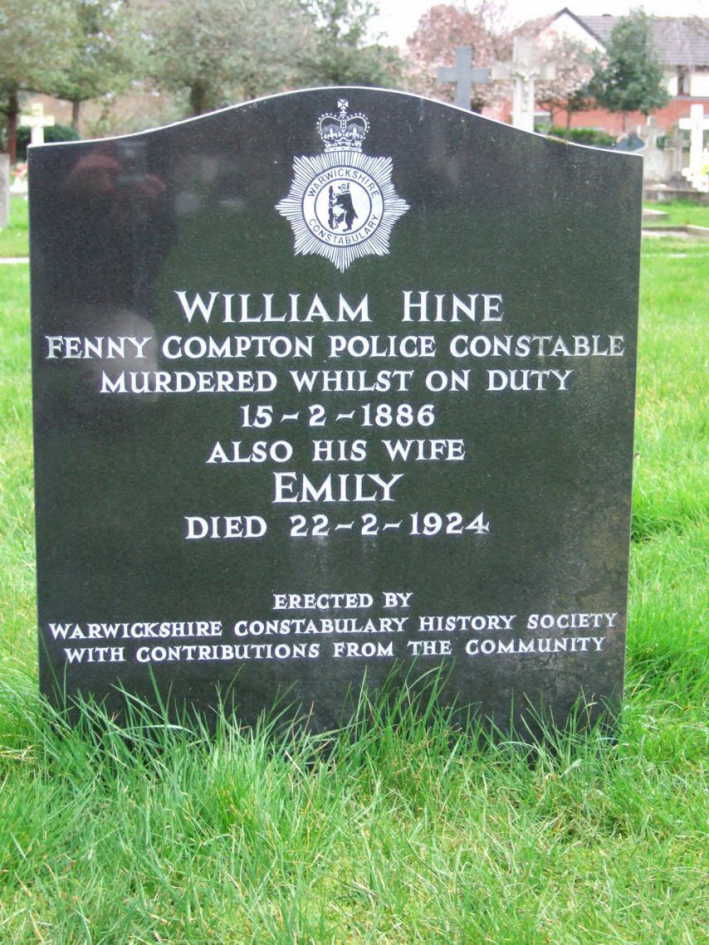
Hine gravestone

CLICK THE IMAGE BELOW
FOR MORE WARWICKSHIRE MURDERS
highest-point-in-burton


THE MURDER OF P.C. WILLIAM HINE . . . A Fenny Compton Mystery (1)

Hine header

Screen Shot 2023-02-03 at 19.14.17William Hine was born in the hamlet of Ingon, just north of Stratford on Avon, on 7th September, 1857, although his birthplace is listed on the 1861 census as nearby Hampton Lucy. He and his parents, with his brother and sister are listed as living at 2 Gospel Oak. He married Emily Edwards on 17th November 1880 in Stratford. Earlier that year, Hine had joined the police force. By February 1886 they had three children. By then, Hine was serving as Police Constable in the village of Fenny Compton.

As a native of Warwickshire myself – born and raised in Leamington Spa – I believe our county becomes more beautiful the further south one travels, and by the time one reaches Fenny Compton, just a few miles from the Oxfordshire border, the Cotswolds are within sight, particularly for the watcher who sits up on the highest spot of the Burton Dassett hills.

G and D
On the evening of Monday 15th February 1886, William Hine spent part of his evening in a pub called The George and Dragon. It sits on the bank of the Oxford Canal, is a mile and a half north-east of the village centre and is now called The Wharf. Some reports suggest there was a cattle auction being held in the pub that night, but Hine left at about 10.00pm, after ‘chucking out time’. When he did not return home, his wife was not unduly alarmed, as he was due to be on duty at Warwick Races the next day, and she assumed he had gone on ahead. When he did not turn up for duty at the racecourse, enquiries were made, and he was reported as missing. A search of the area around the George and Dragon was initially inconclusive, but then a stick which PC Hine habitually carried was found in a field, and a little further away his hat and handkerchief were found. There were bloodstains and signs of a struggle.

By the time Saturday came, the only other clue to Hine’s disappearance was the discovery of a large pocket knife in a ditch near where the hat had been found. In his six years as a Police Constable in South Warwickshire William Hine had experienced several run-ins with poachers and livestock thieves. He had remarked to a friend, “You may depend upon it they mean to do for me some time; that will be my end.”

Villagers reported the sight of a large horse and trap being driven at pace through Fenny Compton on the night of Hine’s disappearance, and rumours spread that a gang of well organised rural thieves had been at work. It is worth noting, that even today, almost 140 years on, rural theft and stock rustling is still a major crime industry in Britain.

The canal was dragged, as were nearby ponds and pools, with no result. In the absence of Hine – or his body – being found, ever crazier theories surfaced. Some said that the best way to dispose of a body was to take it to the lime kilns of the cement works at Harbury, and cremate it there. When Silvia Hine identified the pocket knife as one belonging to her husband, police wondered if Hine had tried to defend himself with the weapon, but it had been wrenched from him and used against him.

There is a saying that the sea eventually gives up its dead. The same happened with the murky waters of the Oxford canal on Wednesday 24th February, 1886.

IN PART TWO
A BODY
A FUNERAL
AN ENDURING MYSTERY

DEATH IN DORRINGTON . . . A 1922 tragedy (2)

Dorrington Header

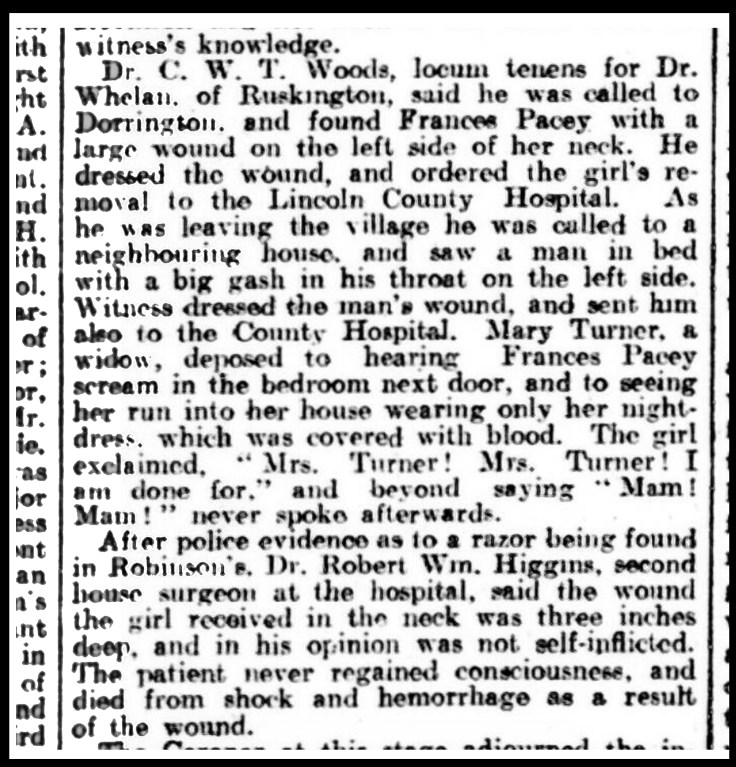
SO FAR: Dorrington, Lincolnshire, early September 1922. A young man called George Robinson, rejected by his former sweetheart, Frances Pacey, has attacked her in her bedroom in her mother’s house, slashing her throat. He has run off to his own house, and cut his throat. Both have been taken to hospital in Lincoln, fifteen miles away. Despite the best efforts of the surgeons, Frances succumbs to her wounds. The Yorkshire Post and Leeds Intelligencer carried this report in the inquest on the death of Frances Pacey:

inquest

Frances’s funeral, for whatever reason, was a lonely affair:

Funeral

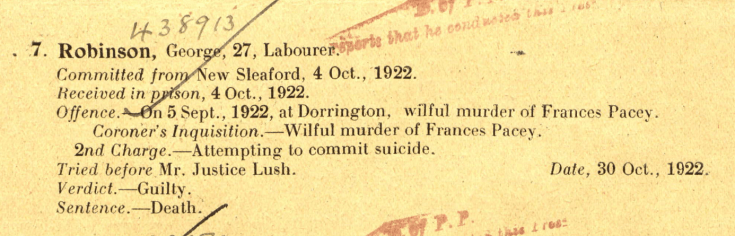
George Robinson was either lucky – or unlucky. I suppose there are arguments for both statements. He was lucky in the sense that his self-inflicted wounds were either half-hearted, or perhaps inefficient. Whatever the case, he made a full recovery. He was unlucky in the sense that had he died in his own bed on that September day. he would have been spared the subsequent court appearances throughout the autumn of 1922, and more dramatically, he would not have met his death on a chilly December morning within Lincoln prison.

Screen Shot 2023-01-31 at 20.33.02

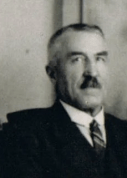
It was all quite simple. George Robinson murdered his former sweetheart. The customary route for defence barristers when faced with the clear and obvious guilt of their client, was to plead that he (very rarely ‘she’) was insane at the time. A very unscientific guess, after researching many of these cases, is that the ploy worked in scarcely two out of ten cases. George Robinson, after months in the cells, was finally brought to trial at the Autumn Assizes in Lincoln. Presiding over the court was Mr Justice Lush (left) (who was to retire from his High Court duties a few years later, due to failing hearing). George Robinson’s defence fell on deaf ears – perhaps literally – and he was sentenced to death. Later, an appeal was lodged with the Home Secretary, but it was rejected.

Screen Shot 2023-01-29 at 20.44.23

Screen Shot 2023-01-31 at 20.46.12

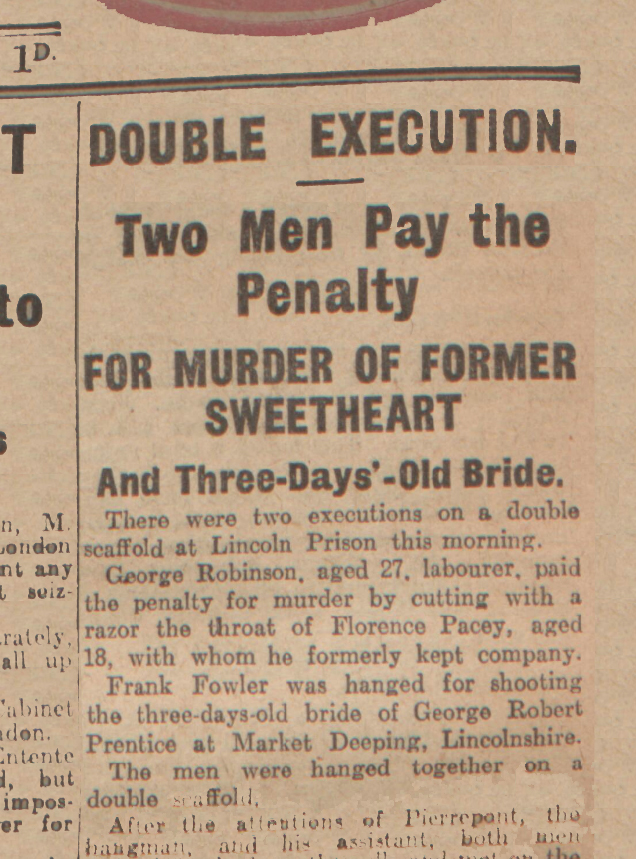
In a unique circumstance, two Lincolnshire men were sent to the gallows in the same Assizes. Robinson’s fellow murderer was none other than Frank Fowler, killer of another eighteen year-old girl, and you can read about that case by clicking this link. It was two for the price of one on the morning of 13th December 1922, when the formidable Thomas Pierrepoint (right, Uncle of Albert) carried out his morning’s work with chilling efficiency.

Headline4

FOR MORE LINCOLNSHIRE MURDERS, CLICK THIS LINK

Lincolnshire Murders

DEATH IN DORRINGTON . . . A 1922 tragedy (1)

Dorrington Header

War memorialIf ever a Lincolnshire village merited the description ‘sleepy’, it might be Dorrington. A few miles north of Sleaford, it sits between today’s B1188 and the railway line between Peterborough and Lincoln.

In the late summer of 1922, like thousands of other towns and villages across Britain, Dorrington was making its way in the uncertain world that followed the Great War. Tiny though the village was, it had still lost eleven of its sons in that conflict. There is a Percy Robinson on the memorial, but there is no evidence to suggest he was related to the families in this story. Life, like elsewhere, had resumed its natural rhythm of the seasons.

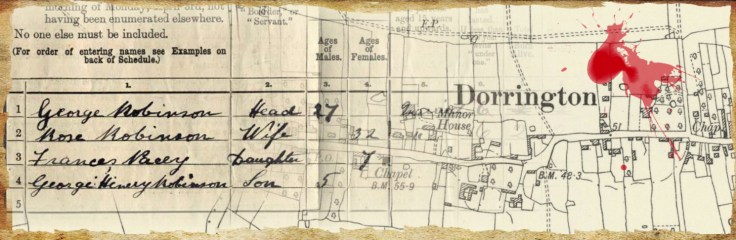
Frances Pacey lived with her mother and father, but she had retained her mother’s surname rather than taking that of her stepfather – Robinson. It is one of the ironies of this story that her father – and her younger brother – were called George Robinson, but it was another George Robinson who would intervene in her life with tragic consequences. This George Robinson was of an age to have served in the Great War but, as fellow researchers will testify, it is no easy business to track men who survived the war. He had been courting Florence Pacey for some time, but in April 1922, she had decided that she and George were, to use the modern phrase, no longer ‘an item’.

Robinson was devastated. Four months went by, and every day was a torment for Robinson, as his pleas for the relationship to be restored fell on deaf ears. On the morning of Tuesday 5th September 1922, his despair at being rejected spilled over into a brutal madness. The Boston Guardian, later that week reported what had happened:

The murder

IN PART TWO

A DEATH
A FUNERAL
ANOTHER DEATH

Dorrington Church

FINAL TERM . . . Between the covers

Final Term header

Oh, Blimey, yet another long running series to which I am a stranger. Better late than never, even if I am starting with the nineteenth of the series featuring York copper Geraldine Steel. As a former school teacher (just the forty years at the chalk-face) I can report that in modern schools, a peculiar kind of justice prevails. At the first complaint of serious misbehaviour by a member of staff, said teacher is out on his or her ear – “suspended, pending investigation”. Despite the  mealy-mouthed rider that “suspension is not an indication of wrong-doing”, it is plain for all to see that the teacher is guilty until proven innocent. And that is precisely what happens to teacher Paul Moore in Final Term when he falls foul of a rather unpleasant teenager called Cassie Jackson.  She claims he has molested her, and he is immediately shown the door, while Cassie’s claim is examined.

Final Term

Sadly, there is not much time for a thorough investigation, as Cassie’s dead body is found in nearby woodland. The post mortem reveals that she died from a severe blow to the head, she was full of alcohol. There is no sign of recent sexual trauma, but she had undergone an abortion in the last twelve months or so. DI Steel and her team swing into action, but clues are scarce. Cassie’s 18 year-old boyfriend is initially suspected, but his anger at her death seems genuine. The, with the case going nowhere, another girl from the same school is found naked and dead, and the fears deepen that a serial killer may be at large.

When both Paul Moore and his wife Laura are proved to have lied to the police about what they were doing on the night of Cassie’s murder, Geraldine’s boss senses that Moore ticks at least two of the standard boxes in a murder investigation – he had the motive and the opportunity. Geraldine is, however, uneasy about the arrest, as there is nothing forensically to link Moore to the murders. We, too, guess that he didn’t do it, as we meet the real killer about half way through the book. He is, though, rather like those anonymous TV confessions back in the day, merely a silhouette.

With Paul Moore languishing in a police cell, Laura Moore goes missing. Then, Geraldine makes that mistake which is a trope in so many novels and films – she goes off on her own, following a hunch, but telling no-one where she is going. Inevitably, she falls foul of the killer, and with her live-in partner Ian, a fellow copper, heavily involved, the search for the missing women brings Final Term to an exciting conclusion.

Screen Shot 2023-01-25 at 19.00.18Leigh Russell (right) studied literature at university, and spent four years immersed in books. After that,she became a teacher, a career that enabled her to share her enthusiasm for books with teenagers. For years, she read other people’s books with no plans to write her own, when the idea for a story popped into her mind. Intrigued by a fictitious killer who had arrived, unbidden, to lurk in her imagination, she began to write a story.  That story, Cut Short, was shortlisted for a CWA Dagger Award, and went on to become the first in a long running series. She now has three series to her name. Besides DI Geraldine Steel, her other books feature Steel’s sergeant Ian Peterson, and a civilian investigator called Lucy Hall.

Just in case anyone should get sniffy and dismiss this – and other books in the series – as “formulaic”, let me ask this. Do you complain about the repetitive structure of the Sherlock Holmes stories? Is it a turn-off that the Nero Wolfe stories always begin with Archie Goodwin presenting a problem to his boss in Wolfe’s apartment?. Are the Ed McBain’s 87th Precinct novels unreadable because of the ever present Steve Carella, Cotton Hawes, Bert Kling, Meyer Meyer and Pete Byrnes? I think we all know the answer. If the other eighteen books in this series are anywhere near as good as Final Term, then Leigh Russell has earned her place on the CriFi podium.

Final Term is published by No Exit Press and is  on sale now.


Russell books

THE GUNS OF AUGUST . . . A tragic mystery from 1889 Stratford-on-Avon (2)

Stratford header

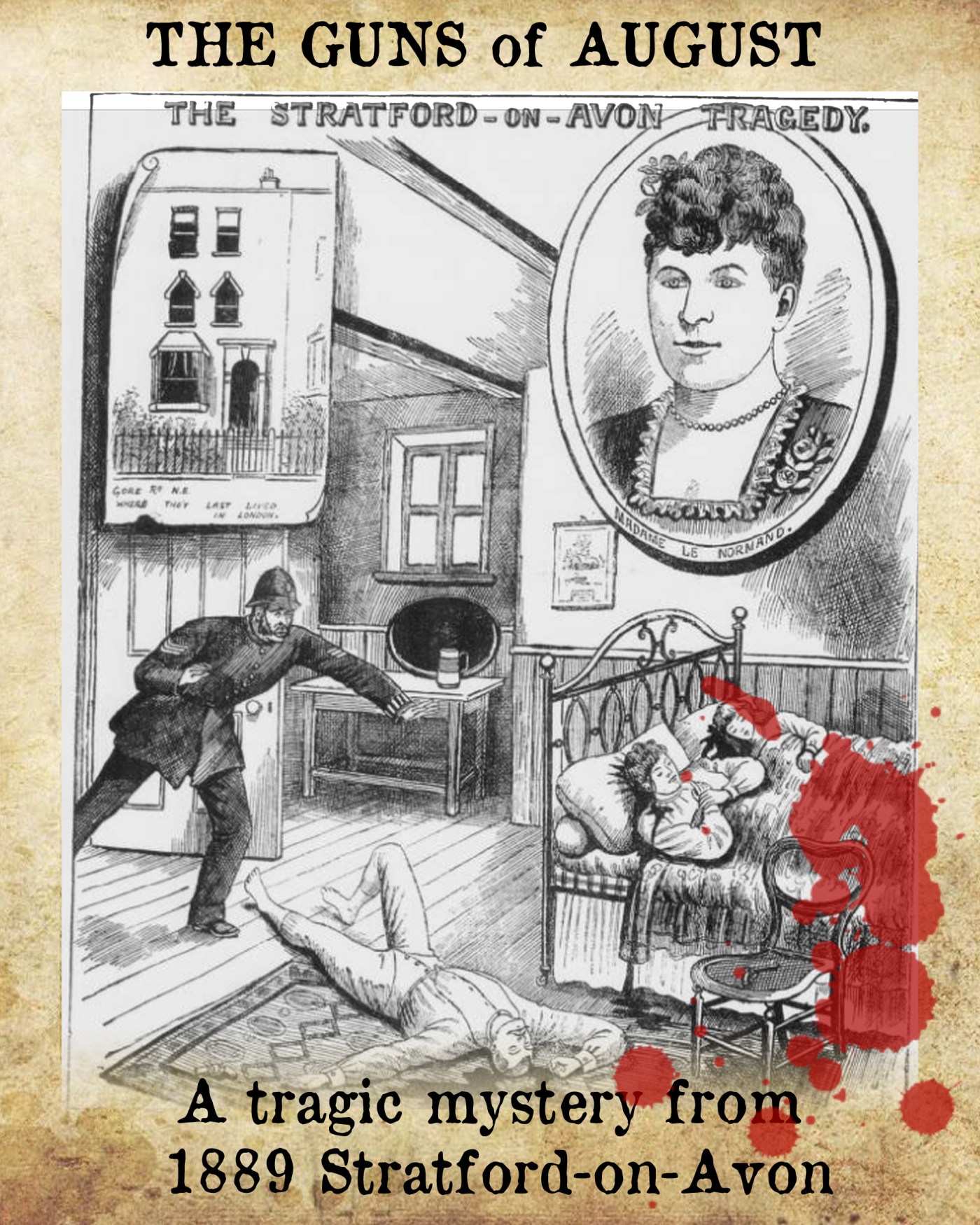
SO FAR: Stratford-on-Avon, Monday 19th August 1889. A German gentleman, J. Lachmann von Gamsenfels, with his wife and young daughter had obtained rooms in a cottage on the Tiddington Road, owned by a Mrs Freeman. At breakfast time, Mrs Freeman heard gunshots. She ran for help from her neighbour, and the police were called. When they forced an entrance into the rented room, a scene of almost unimaginable horror faced the two officers:

The discovery

Three dead bodies. A scene almost beyond the imagining of Shakespeare himself. Why would an apparently sane and reserved man murder his wife and daughter? He was also in possession of two different guns Turning one of them on himself after such an atrocity is not unheard of in the annals of crime, but the story was about to become even more baffling.

Screen Shot 2023-01-19 at 18.22.47

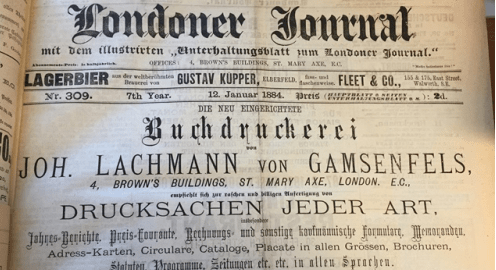
Investigations proved that Lachmann von Gamsenfels (pictured above) was who he said he was. A man, born in Prague, thus a Bohemian. The history of that area is immensely complex, and there is no time for it here. Yes, he had connections with the German language newspaper The Londoner Journal, but was he the editor,or just the printer?

Screen Shot 2023-01-20 at 19.56.31

Screen Shot 2023-01-19 at 18.23.24What threw the investigation on its head was the fact that the woman who died in that Stratford cottage was not von Gamsenfels wife, although the dead child was probably his. By examining the dead man’s possessions, the police discovered that his legal wife was a Mrs Rosanna Lachmann von Gamsenfels, and that their marriage was somewhat unusual. He was absent from the family home for months on end, but always gave his wife money for the upkeep of their son. Mrs Lachmann von Gamsenfels traveled up to Stratford to identify her husband’s body, but was either unable- or unwilling – to put names to the dead woman and girl. Try as they may, the authorities were unable to put names to the woman and girl who were shot dead on that fateful Monday morning. Artists’ impressions of ‘Mrs von Gamsenfels” were published (left) but she and her daughter left the world unknown, and if anyone mourned them, they kept silent.

A Christian burial was all that awaited the dead woman and her child. The scene was the churchyard of nearby Alveston:

“Subsequently the bodies were enclosed in three separate coffins, which were conveyed to Alveston Parish Church in the Workhouse hearse. The plate of the coffin containing Gamsenfels bore his name and the date of his death, but there were no names or inscriptions any kind on the coffins of the woman and child, as, at the time of burial, they had not been identified. Several pretty wreaths were sent by sympathising friends in the parish; and upon the coffin of the woman were placed a piece of weeping willow and a faded rose, gathered from Anne Hathaway’s cottage garden in Shottery. No burial service was read over the corpse of Gamsenfels. The coffin was carried direct to the grave and lowered into the ground without any religious ceremony whatever. The Rev. W. Barnard (vicar of Alveston) and the Rev. J. Ashton (curate) met the bodies of the woman and child the church gates, and the usual burial service was gone through. A large crowd from Stratford and the district congregated in the neighbourhood of the Tiddington Road, had witnessed the ceremony at the church.”

Alveston

The mystery of the identities of the dead woman and child remains unsolved to this day. For another Warwickshire unsolved mystery, click the link to read about the murder of Charles Walton, just ten miles away from Stratford in 1945.

FOR MORE HISTORICAL MURDERS
IN WARWICKSHIRE, CLICK THE IMAGE BELOW

Harraden, Richard Bankes, 1778-1862; Warwick Castle


THE GUNS OF AUGUST . . . A tragic mystery from 1889 Stratford-on-Avon (1)

Stratford header

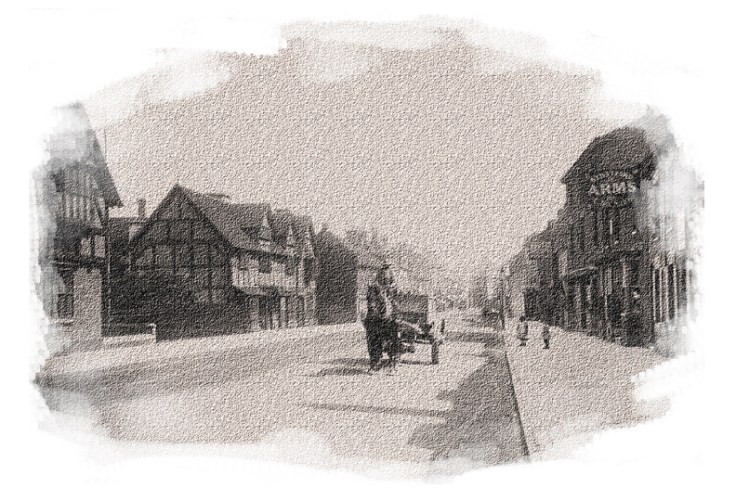
August 1889. Stratford-on-Avon was not crowded with jostling tourists from all over the world, nor was there a Midlands coach tour tick-list including Oxford, Bourton on the Water and Warwick Castle. It was altogether a much quieter town than it is today, but awareness of its greatest son had yet to draw in visitors from America, Japan and countless other countries determined to “do” Shakespeare. Elizabeth Freeman was a widow, and she offered rooms to rent in her riverside cottage on the Tiddington Road. When, on the afternoon of Thursday 15th August, an impeccably dressed foreign gentleman, accompanied by his wife and daughter, asked for rooms, she was only too pleased to oblige. A newspaper, retrospectively, described the visitors:

“It would seem that on Thursday last a German gentleman who gave his name as J. Lachmann von Gamsenfels arrived from London and engaged lodgings at a small cottage occupied by a widow named Freeman overlooking the river Avon river on the Tiddington road.
The gentleman who, it has transpired, was the editor of a German newspaper published in London as the Londoner Journal was accompanied by a lady, whom he said was his wife and by their child, a little girl of four or five years of age. Apparently he was a man in a good position and well dressed, wearing a black frock coat and a silk hat. His wife and child were also tastefully dressed, the lady being a particularly fine handsome woman
They appeared to be on the best of terms with each other and were quite cheerful in disposition.
Mrs Gamsenfels looked like an actress or professional singer and subsequently in conversation Mrs Gamsenfels herself confirmed that surmise, stating that she was connected with the stage and had last year “got up” concerts in the Isle of Man and other places.”

Old Stratford

On Friday morning, Mr Gamsenfels and his companion and child went out for a walk, but before doing so he paid Mrs Freeman’s bill, as he said he was not quite sure whether they would return. However, they did return in the evening, and Mr Gamsenfels announced that they had determined to stay in Stratford a few days longer. There were then no signs of any quarrel having taken place, and they were quite cheerful and talkative, the two conversing chiefly in German. Mrs Freeman observed that the lady was much more sociable than her husband, who appeared to be somewhat reserved.

That the party were short of money, however, had become apparent. Mrs Freeman had remarked upon the small quantity of provisions consumed, and further proof was given on Saturday night by the fact, that when Mrs Freeman fetched a loaf at the request of Mrs Gamsenfels, the latter had no money to pay for it, and they wanted nothing for tea beyond a few biscuits and some Hungarian wine, two bottles of which they had brought with them.

On Sunday again they went out, morning and afternoon, and on returning in the evening, they all had nothing for tea except some Hungarian wine, and after a light supper they retired bed, apparently in good spirits and temper. On Monday morning, however, about half-past eight o’clock, while Mrs Freeman was preparing breakfast, she was startled by hearing two gun shots fired in rapid succession in the bed room occupied by her lodgers She went to the foot the staircase and called out,

” What’s the matter ; what are you doing ?”

Receiving no reply, she became alarmed, and ran to the neighbour next door, a Mr Jones, who was sitting at breakfast with his family. It was probably while she was out that the third shot was fired. the one which killed the man himself – but Mrs Freeman only heard two. She told Mr Jones what she feared, and he immediately ran for the police, whilst his son was despatched for a doctor. Police Sergeant Northam and Police-Constable Price were quickly on the spot, and receiving no response to their inquiries at the bed room door they forced an entrance.

IN PART TWO:
‘A FEARFUL TRAGEDY PRESENTED ITSELF”
ALVESTON CHURCHYARD
AN ENDURING MYSTERY
Footer

Blog at WordPress.com.

Up ↑