
This is a tale of brutality – and total incompetence. An elderly man is battered to death, and his killers escape with a safe containing small change. Get the full story by clicking the podcast link.

This is a tale of brutality – and total incompetence. An elderly man is battered to death, and his killers escape with a safe containing small change. Get the full story by clicking the podcast link.
 Here on the coast of The Wash we can, if we wish, still measure the seasons by produce. I say “if we wish”, because supermarkets have no seasons – everything is available all the year round. But in the old fashioned world of buying food when it is fresh and local, the year has its own rhythm. Early summer gives us asparagus, followed by strawberries. In autumn and winter Brancaster mussels and native oysters are delicious, but for me, the true treasure of the summer months is samphire. This plant of the coastal marshes, Crithmum maritimum, allegedly gets its name from a corruption of the French “St Pierre”, but whatever its etymology, it is utterly delicious. Lightly boiled or steamed, it is best eaten with the fingers. Running the stems through your teeth to strip off the flesh is a completely sybaritic sensation. Local folk love it with vinegar, but with butter and coarsely ground pepper it is little short of heavenly.
But hold on, you say, this is mostly a crime fiction site. What’s with the gourmet stuff? Bear with me for a moment longer. Let’s look at the price. As you can see from the photos, it’s £5.99 for a kilo here in the market. Sadly, this will be the last until June or July next year, but no matter. A quick search on the internet reveals that an online Cornish fishmonger will provide some for £16.90 a kilo, Waitrose are selling it for £22 a kilo, and if you want to use a firm called Fine Food Specialists, a kilo will set you back a cool £34.50.
Now with that kind of a mark-up, we are almost into class ‘A’ drug territory – and this is where the crime fiction link comes in. In 2014, the estimable Jim Kelly updated his Peter  Shaw and George Valentine series with At Death’s Window. In addition to solving a series of burglaries at properties along the Norfolk coast owned by wealthy out-of-towners, Shaw and Valentine become involved in a turf war between product dealers. These are not your common-or-garden drug barons, or even owners of ice cream vans, but dealers in samphire! As I have illustrated, with a 300% mark-up available for an item that can be had for nothing, why bother with something as illegal and potentially lethal as narcotics? The problem in At Death’s Window comes when local folk are muscled off their home territory by criminal gangs using illegal immigrants as pickers. Think cockles and the Morecambe Bay tragedy, and you can see how it all might go pear-shaped.
So, as I sit down tonight and indulge myself with the last of the summer samphire, and a glass of something invigorating to wash it down, I shall drink a toast to Jim Kelly, anticipate the first sighting – and tasting – of the new season’s mussels, and dream about next summer. Oh yes, I almost forgot. Samphire pickles extremely well, and I have a few jars in the cupboard to sample in the dark depths of winter!
We have plenty of Jim Kelly on the site, for anyone whose interest has been piqued. There’s an appreciation of his writing, Jim Kelly – a landscape of secrets and a review of his latest book, Death Ship. You can also follow the link to get hold of a copy of At Death’s Window.

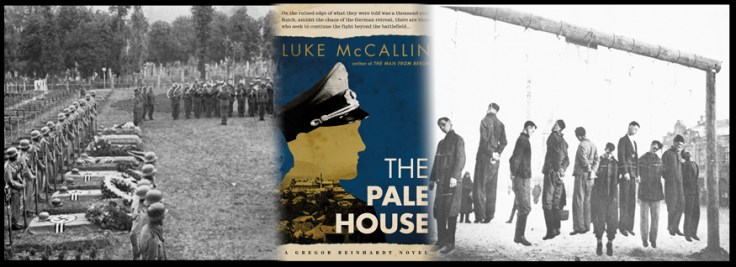
It may have been difficult for people of my parents’ generation who lived – and fought – through the grim years of WWII to distinguish one German from another. It is entirely understandable that the differences between card-carrying members of the Nationalsozialistische Deutsche Arbeiterpartei and the ordinary soldiers, sailors and airmen who carried out their wishes might be rather academic, especially if your street had just blown up around your ears, or you were sitting at a table clutching a telegram informing you that your husband, brother or son had been shot dead or drowned in battle.
The first author to write fiction from the viewpoint of the German military was the controversial Danish author known as Sven Hassel. His first novel Legion of The Damned (1953) was the first in a series describing the war through the eyes of men in the 27th (Penal) Panzer Regiment. The books were immensely successful, particularly in the UK, in spite of the fact that Hassel – real name Børge Willy Redsted Pedersen – was widely regarded as a traitor in his native land, because of his war service with the Wehrmacht.
More recently, Philip Kerr has written a series of very cleverly researched and convincing novels centred around a German policeman – Bernie Gunther – who manages to keep his self-respect more or less intact, despite working alongside such monsters as Reinhard Heydrich, Josef Goebbels and Arthur Nebe. The series has Gunther involved with all manner of military and political events, from the rise of Hitler in the 1930s right through to the days of the Peron rule in 1950s Argentina.
Gregor Reinhardt, like Gunther, is a former officer with the Berlin Kriminalpolizei, but lacks Gunther’s ability to duck and dive, bob and weave. He is forced out by the Nazis, but  finds employment as an officer in the Feldjaegerkorps. His creator, Luke McCallin, (right) introduced us to Hauptmann Reinhardt in The Man From Berlin (2014). In The Pale House (2015) Reinhardt is still at the extreme edge of what was, by 1945, the crumbling empire of The Third Reich. He is in Sarajevo, where the situation is, to put it mildly, anarchic. On one side hand are the Croation nationalists, the Ustase. They are, in theory, the allies of Germany, but only insofar as they have a common enemy, the communist Partisans, who are slowly gaining the upper hand.
This unholy Balkan Trinity is completed by a thoroughly disillusioned and war-weary German army who are aware, despite the failed von Stauffenberg plot to assassinate Hitler, that there is a savage and brutal race taking place between the Allied forces and the Red Army – the finishing line being Berlin itself. As the German military try to make their inevitable retreat from Sarajevo as orderly as possible, Reinhardt still has his job to do. In particular, he must find who is behind a series of mass killings, where the corpses are found with their faces disfigured. His investigations lead him to the Ustase headquarters on the banks of the Miljacka river.
The headquarters, known as The Pale House, is where the Ustase administer the beatings, torture and eventual murder of those they deem to be a threat. Even more disturbing to Reinhardt than the brutality of his notional allies is the fact that their excesses seem to be linked to his own countrymen – in particular, officers within the Feldgendarmerie, a more rank-and-file military police force than his own.
The Pale House is a gripping and brutal account of a war zone which tended to be overshadowed by the even more dramatic events further to the West. Reinhardt is, emphatically, a good man, and Luke McCallin’s skill is that he presents to us someone who loves his country, despite what it has become. We get a hint, in the final paragraphs, that Reinhardt will survive the political and military firestorm which is about to engulf him and his comrades, and that he will return – in another place, and with other crimes to solve.
You can find out more about the Luke McCallin and Hauptmann Reinhardt at the author’s website.

In Jim Kelly’s novels, the past is like a sunken ship that has lain undisturbed on the sea bed for decades. Then, with a freak tide, or maybe some seismic shift, the ship’s blackened timbers surface once again, breaking through the surface of the present. In this, the latest case for Detective Inspector Peter Shaw and Sergeant George Valentine, the metaphor becomes literal. In the terrible storm of January 31st 1953, a tempest that battered the East Anglian coast and claimed over 300 lives, a dilapidated Dutch coaster, the Coralia, went down, taking its captain and crew with her.
Meanwhile, the unique seaside town of Hunstanton – unique in that it is an east coast resort which faces west – has been literally rocked by an explosion on its crowded beach. Something buried deep beneath the sand is triggered by some boys determined to dig a sink-hole sized pit before the tide sweeps in. There is a brief moment when something metallic and shiny appears in the wall of their excavation, but then hell is unleashed. Miraculously, no-one is seriously hurt, but the beach is closed to holidaymakers while forensic experts and a bomb disposal team from the army do their stuff.
Shaw is faced with several possibilities. Was the explosive device recently planted by extremists from the STP – Stop The Pier – movement, who are protesting against the construction of a huge new pier which will suck trade and footfall from existing businesses? Was the explosion a result – as a teenage boffin from King’s Lynn suggests – of the very late detonation of an unexploded bomb dropped in a Zeppelin raid way back in 1915?
Shaw’s case is complicated by the discovery of a dead diver, tethered to the underwater remains of Hunstanton’s Victorian Pier, destroyed by storms in 1978. Eventually, he learns that the murdered diver is the son of one of the crew members of the ill-fated Lagan, whose remains are rotting on the seabed a couple of miles distant from the pleasure beach. And what of the apparently guileless old lady who has been caught giving arsenic-laced sweets to people in a local ‘bus queue.
Detective partnerships have become one of the enduring clichés of crime fiction. Sometimes – but not always – the pairings work, and when they do, they are a very satisfying literary device. The trope usually requires the senior partner to be yin to the junior’s yang. In this case, Peter Shaw has the imagination. George Valentine the curmudgeonly common sense; Shaw is the live wire to Valentine’s earth. The telling difference between these two and other ‘odd couples’ is that Kelly explores the psychological make up of both men, and the glimpses into their personal lives are equally perceptive and revealing. Valentine is older than Shaw by many a mile; so much so, that Valentine actually served in the force alongside Shaw’s late father, a man still revered within the Constabulary. We also learn that were it not for a faux pas which almost ended his career, Valentine would now be Shaw’s senior officer.
New readers will be pleasantly surprised at how Kelly knits together the misdeeds of the past and the murderous intent of the present. Existing fans will simply smile, and say, “He’s done it again.” You will be pushed to find a novel which so successfully welds together the police procedural, the psychological thriller, the ‘whodunnit’, and the atmospheric novel of place. If you find one, please let me know. In the meantime, I will not be holding my breath – except in waiting for the next masterpiece from one of our finest writers. Death Ship is published by Severn House, and is available here. The official launch will be – very appropriately – at the RNLI Headquarters in Hunstanton on 3rd September. For tickets and enquiries ‘phone 07840 375 984

 When I reached the grand old age of 60, I treated myself to an expensive – and very beautiful guitar. It almost played itself. The simplest chord sounded epic. This song is far from epic, but is a journey back to the years when being in love kept you awake at night, and sometimes got you up in the morning in the hope of a letter. Yes, that’s how long ago it was.
 Sir John Betjeman is so unfashionable these days that it is an utter delight to be an admirer. His directness and accessibility have been mocked, but only by those whose lack of talent and perception can only be measured in geological numbers. Here, he pokes his head round a curtain, and sees an ageing debutante, lamenting the passing years and her own decline

We were all brought up to revere the war poets such as Owen and Sassoon. Quite rightly so, for their message still has an undying resonance. If I had to choose one poem, however, to sum up the devastation and waste of The Great War, I would turn to a man who never fought in the conflict, but whose perception and vision have made this a classic. Like Betjeman’s work, it is direct, accessible and heartbreaking. Philip Larkin’s poem captures the last August of an England that had already begun to change. It would never, ever, be the same again.
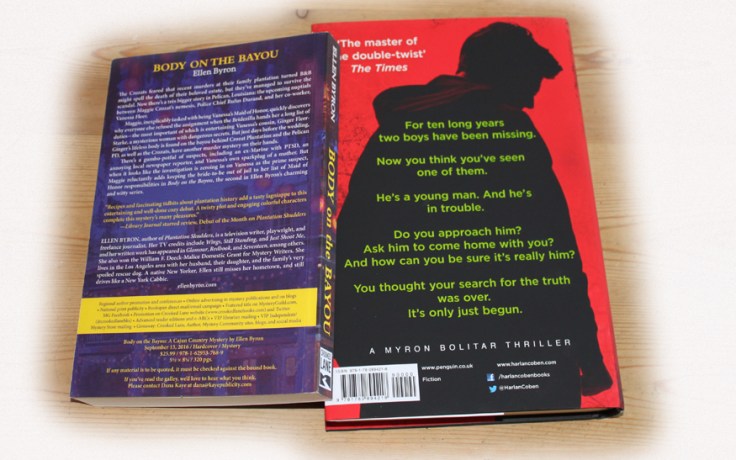
 HOME by Harlan Coben
The New Jersey based author is one of the bigger beasts in the crime fiction jungle, and he has created one of the more distinctive ‘accidental detectives’ in the genre. Myron Bolitar, the 6 feet 4 inches tall former basketball player, has already won three major awards for his creator, an Edgar (for Fade Away), a Shamus (Drop Shot) and an Anthony (Deal Breaker). In this latest adventure for the sports agent, he tackles the case of a disappeared boy who has, almost inevitably, been assumed dead. But now he shows up after a decade. Is he the real deal, or is he part of a sinister and devious scam? Home will be out in a variety of formats on 22nd September, and you can check the details here.
BODY ON THE BAYOU by Ellen Byron
Away from the city lights we go and we pay a visit to the town of Pelican, Louisiana, and as the title suggests we can expect plenty of alligators, snakes, spoonbills and other assorted fauna who make their homes in the mysterious watery glades. But this isn’t a wildlife  documentary – it’s a case of murder. Byron (right) reintroduces the characters she created in Plantation Shudders (2015) and this time the Crozat family have another murder on their hands when a woman’s body is found floating on the still waters of their plantation. The publicity tells us that the Crozats have “a gumbo potful of suspects on their hands.” Just to be clear, this isn’t Southern Noir, but more an example of Southern Cosy, and it’s out on 13th September. Find out more here.
 There’s an old expression that describes someone as “having a way with words’. There can’t be any contemporary writer who has a better “way with words” than Val McDermid. There are no dramatic flourishes, no histrionics and no scatter-gun blasts of redundant adjectives. What we have is simplicity, purity, and a command of language that is almost minimalist. She describes DCI Karen Pirie, thus:
“…a wardrobe that always looked slightly rumpled;
a haircut that never quite delivered what it had promised in the salon.
Women never felt threatened by her,
and men treated her like a wee sister or a favourite auntie.”
This is the fourth book featuring Karen Pirie, but newcomers learn just enough of Pirie’s backstory. Her lover, a fellow police officer has been killed. She is coping with her grief, but not easily. She tells civilians that she is attached to the Police Scotland Historic Cases Unit. The reality is that she – and her nice-but-dim assistant, DC Jason ‘The Mint’ Murray – are the PSHCU. An idiot boy and his mates steal a Land Rover, and decide to test it to destruction by driving over roundabouts. It works once, but the second time, the four-by-four flips, killing the hapless passengers and delivering driver Ross Garvie to the local hospital ICU. A routine DNA test links him to an unsolved rape and murder in Glasgow, years earlier. It clearly wasn’t him, but who was it?
To add to Pirie’s complicated life, a mentally troubled man is found shot through the head beside Loch Leven. He was harmless, occasionally foolish and always garrulous, but why was he a threat? Did the fact that his mother had been killed in an assumed IRA assassination mark him out for this totally unwanted attention? The trail of Ross Garvie’s DNA leads Pirie through a minefield of botched investigations, incorrect assumptions and misdeeds sheltering behind fiercely protected rights to privacy.
As you might expect, McDermid is completely at home in her geographical surroundings. We have the stark contrasts of the historic streets and alleyways of Edinburgh and the city’s brutal and depressing tower blocks clinging to its suburban coat tails. All too rarely, Karen Pirie gets to sit in her beautifully situated apartment, and we share her reverie as she looks out over the dark waters of the Firth of Forth, and across to the lights twinkling away on the Fife shore. The setting of the novel is cleverly done, but it is just one piece of the jigsaw – along with the fascinating details which make up the police procedural aspects of the story.
McDermid puts most of the pieces in place for us, but leaves us plenty to do for ourselves, and the completed picture is one that shows jealousy, human frailty, the sheer darkness of some people’s lives – but also a glittering thread of compassion and redemption. If the novel inspires you to check up on Karen Pirie’s backstory, then you will find it in The Distant Echo (2003), A Darker Domain (2008), and The Skeleton Road (2014)
It is lazy of critics to talk about “Queens” of crime, but since the deaths of PD James and Ruth Rendell, there is only one heir to the throne. McDermid just gets better and better with every book. Some writers grab us by the throat and drag us through the narrative; there are others who take us by the hand and lead us; McDermid simply has to beckon – and we follow.
You can follow the link to see your buying choices for Out of Bounds


 fullybooked2017