

V: ADAGIO
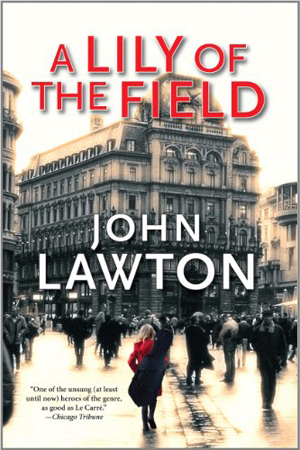 John Lawton is a master of historical fiction set in and around World War II. His central character is Fred Troy, a policeman of Russian descent. His emigré father is what used to be called a ‘Press Baron’. Fred’s brother Rod will go on to become a Labour Party MP in the 1960s, but is interned during the war. His sisters are bit players, but memorable for their sexual voracity. Neither man nor woman is safe from their advances.
Fred becomes one of London’s top coppers, but to categorise the novels as police procedurals is accurate only in as far as that there are policemen in the books, and they occasionally have procedures. All this being said, Troy is in the background during much of A Lily of the Field, where we follow the life of teenager Méret Voytek, a brilliant young Viennese cellist.
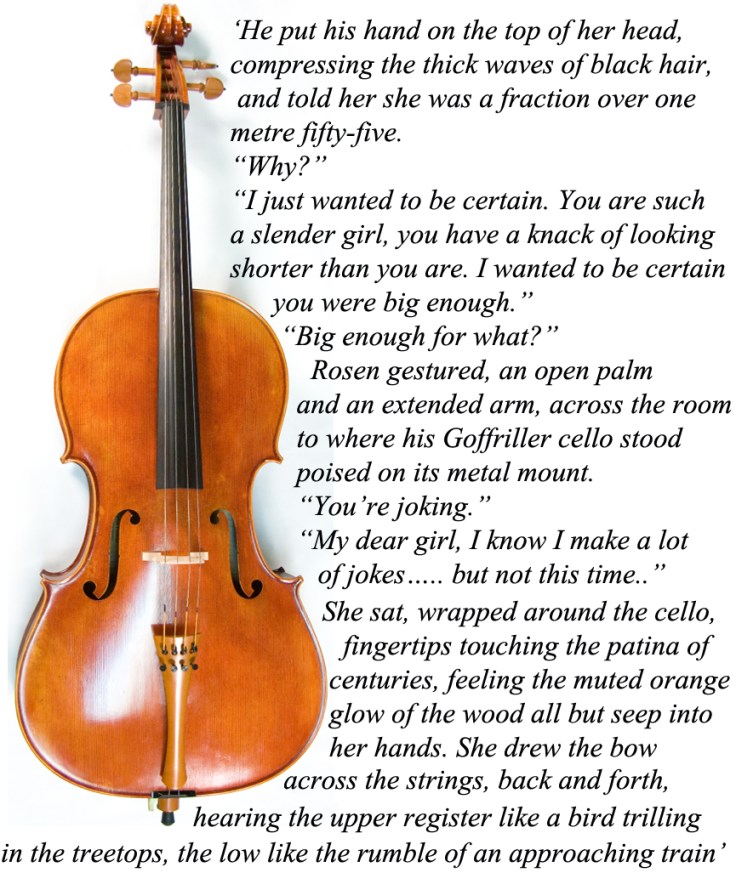
As a twelve-year-old, she begins lessons in cello and piano from an eminent musician, Viktor Rosen. He realises instantly that she is prodigiously talented, and he gives her a gift:
After the Anschluss, through her own naivete and a tragic act of fate, she is caught holding a bundle of anti-Nazi leaflets while traveling on the tram. She is taken by the SS and ends up in Auschwitz. Meanwhile, her parents have been likewise detained, and their family home ransacked. Méret’s skill as a musician has already been noted but, ever naive, she questions her friend Magda about why she has been singled out.
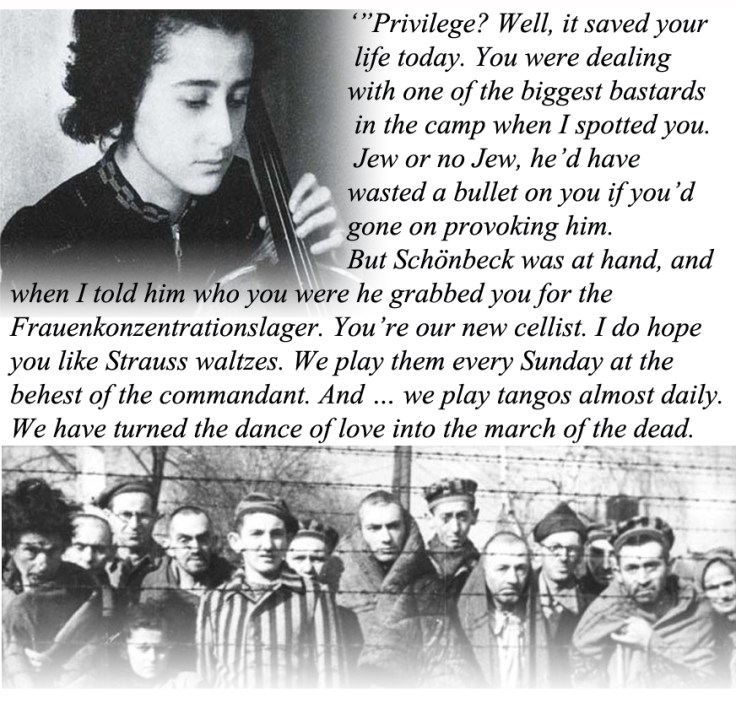 In the bitterest of paradoxes, the Auschwitz commandant, has a musical ear, and so he puts together an orchestra made up of the many skilled inmates. One of their bizarre duties is to play beautiful music as their less talented companions trudge off to work in the morning. Méret plays for her life, literally. The physical privations she undergoes are heart-breaking, but still she plays, still she clings on to what is left of her humanity.
In January 1945, with the Russians approaching from the east, and the British and Americans from the west, the Germans realise that the game is up. Auschwitz inmates who are too infirm to walk are shot, and the remainder are sent out, under guard, to start the infamous Death March. In the freezing conditions few survive, but just as Meret is about to succumb, their column is overtaken by a Russian detachment. Salvation? Hardly. The first instinct of the Russian soldiers is to rape the women. Méret is saved by a no-nonsense officer. At this point, Fred Troy aficionados will recognise Major Larissa Tosca, Fred’s one-time lover. She has, in her time, spied for both America and for Russia, but here her cap bears the Red Star.
Long-time Lawton readers will know that he leaps about between the years with a sometimes bewildering agility. True to form, the climax of this book is played out in post war London and Paris. Méret’s rescue by the Russians has come at a price, and we find her tangled up in the spy ‘games’ which characterised much of the Cold War period. Lawton is much too clever a writer just to tell this one tale, however gripping it may be. Woven into the fabric is another thread which involves an interned Hungarian physicist, Dr. Karel Szabo, who ends up as a key figure in the American efforts to build and test the first atomic bomb.
One of the key figures from the spy ring of which Méret is a part is murdered in London, and it is then that Fred Troy becomes involved. For all his many qualities, Troy is an inveterate womaniser, but he is not a sexual beast, and the late scenes where he spends time with the fragile Méret, still beautiful but old before her time, are haunting in their compassion.
‘Troy had never heard her laugh. It was like that moment in Ninotchka when Garbo laughs on-screen for the first time. It is not merely that she laughs, but that she laughs so long and so loud.
As the laughter subsided she was grasping at words and not managing to get a sentence out.
“Oh, Troy ….oh, Troy..this is….this is a farce. Don’t you see? Viktor taught us the same part.”
“We’re two left-handed women trying to dance backward. Neither of us knows the man’s part.”
She reached up her sleeve for a handkerchief to dab her tears and found none. Troy gave her his, a huge square of Irish linen with an overfancy ‘f’ in one corner.
Being drunk did not make her loquacious. In that, she was like Troy. At two in the morning Voytek was deeply asleep in front of the fire. Troy picked her up, astonished at how little she weighed, carried her upstairs and slid her into the spare bed. She did not wake. He went to his own bed.
A Lily of the Field is far from being a dry history novel where the factual details are more important than the plot and the dialogue. It is tense, funny, occasionally very violent, and written with a style and fluency which leaves lesser authors struggling in Lawton’s wake. Above all, of course, it is about music. Méret’s brilliance as a musician is both her curse and her salvation.
A final little gem, which I only noticed recently. If you look closely at the book’s cover, you can see Méret Voytek, in her red coat, moving away from us. With her cello slung over her shoulder, she walks into history.

Follow the links below to read the previous four parts in the series.

 If the South London suburb of Menham could be described as unremarkable, then we might call the down-at-heel terraced houses of Barley Street positively nondescript. Except, that is, for number 29. For a while, the home of Mary Wasson and her daughters became as notorious as 112 Ocean Avenue, Amityville. But the British tabloid press being what it is, there are always new horrors, fresh outrages and riper scandals, and so the focus moved on. The facts, however, were this. After a spell of unexplained poltergeist phenomena turned the house (almost literally) upside down, the body of nine year-old Holly Wasson was found – by her older sister Rachel – hanging from a beam in her bedroom.
 Laws (right) takes a leaf out of the book of the master of atmospheric and haunted landscapes, M R James. The drab suburban topography of Menham comes alive with all manner of dark interventions; we jump as a wayward tree branch scrapes like a dead hand across a gazebo roof; we recoil in fear as a white muslin curtain forms itself into something unspeakable; dead things scuttle and scrabble about in dark corners while, in our peripheral vision, shapes form themselves into dreadful spectres. When we turn our heads, however, there is nothing there but our own imagination.


 The Nutting Girl by Fred de Vecca
 Lights Out Summer by Rich Zahradnik
 Dadgummit by Maggie Toussaint
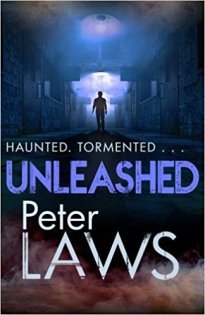 In Unleashed, his scepticism is shaken by events at an otherwise unremarkable terraced house in South London where, several years ago, a troubled nine-year-old girl committed suicide in the midst of a troubling sequence of poltergeist phenomena.

 Eddie is Eddie Newcott, the boy who used to live across the street in Chicory Lane, Limite. The boy who was just a bit different from all the other kids at school. The kid whose dad was a rough and abusive oilfield mechanic. The kid whose mom turned to the bottle to escape her violent husband and the beatings he handed out to their only child. But that was then. Now sees Eddie fallen on hard times. Times so hard that he achieved brief notoriety in the tabloid press, and has now been sentenced to death by lethal injection for murdering his pregnant girlfriend, slashing her open, dragging the foetus out and then arranging the two corpses on his front lawn, posed in an obscene mockery of a Nativity tableau. And it was Christmas Eve.
 Like Shelby Truman, Raymond Benson (right) is a highly successful writer. He has written thrillers under his own name, most notably his Black Stiletto Saga, and has also written novels based on video games. He has taken up the baton from authors who are no longer with us, like Tom Clancy, and has written several James Bond stories which have either been based on established screenplays – like Die Another Day – or standalone original stories such as The Man With The Red Tattoo.

 So, when Gabriel answers the door bell one day only to behold the wedge-shaped and granite faced personage of Farrelly – chauffeur, enforcer and general gofer for Frank Parr – he is led, like a naughty boy tweaked by his ear, to Parr’s sumptious office building. To say that Parr – now a respectable media mogul – has something of a history, is rather like saying that Vlad The Impaler was someone of interest to Amnesty International. Parr made his money – loads of it, and of the distinctly dirty variety – by publishing magazines which were not so much Top Shelf as stacked in the stratosphere miles above the earth’s surface.
 “For a while, I wandered the streets of Soho, as I had on the day I’d first visited forty years ago. Doorways whispered to me and ghosts looked down from high windows.”

 When the battered body of teenager Melanie Cooke is found amid the garbage bins in a seedy Bristol alleyway, it is obvious that she has been murdered. Only fourteen, she is dressed in the kind of clothes which would be considered provocative on a woman twice her age. Vogel goes to make the dreaded ‘death call’, but he only has to appear on the doorstep of the girl’s home for her mother and father to sense the worst. Like many rebellious teenagers before her, Melanie has told her parents that she is going round to a mate’s house to do some homework. When she failed to come home, their first ‘phone call confirmed Melanie’s lie, and thereafter, the long dark hours of the night are spent in increasing anxiety and then terror, as they realise that something awful has happened.
 The book actually starts with a prologue which at first glance appears to be nothing to do with Melanie’s death. It is only later – much later – that we learn its true significance. Bonner (right) is determined not to give us a straightforward narrative. The progress of Vogel’s attempts to find Melanie’s killer are sandwiched between accounts from three different men, each of whom is living a life where all is not as it seems.


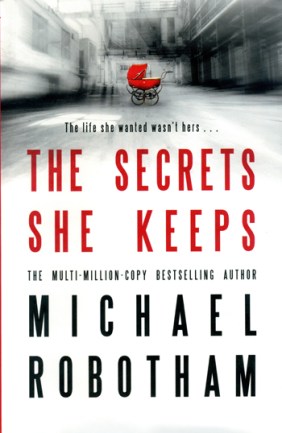 Agatha Fyfle works for peanuts in a ‘Village’ supermarket but Mr Patel, her boss, is not the kind of man to be offering generous maternity leave. He is so tight that he once docked her pay for putting the wrong price on a tin of peaches. The father of her baby is far, far away on a Royal Navy ship patrolling the Indian Ocean, chasing Somali pirates. Despite her nothing job and the desperate ordinariness of her life, Agatha has her imagination and her dreams:

 I do love Operas, though – at least those written up to the death of Giacomo Antonio Domenico Michele Secondo Maria Puccini (who would be just as wonderful even if he didn’t have six christian names.) I would add the personal caveat that for me it is sometimes better heard than seen, as stage productions can sometimes demand too much suspension of disbelief. Our chosen book, then, is Spur Of The Moment by David Linzee, and it is set around the St Louis Opera company as they prepare a performance of Bizet’s wonderful, preposterous, exhilarating four-act classic, Carmen.
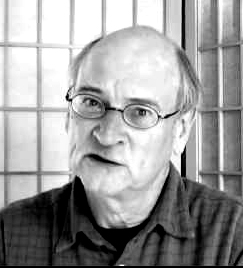 David Linzee has himself been a ‘supernumary’ – basically the opera equivalent of a spear carrier – and he enjoys several digs at the way an opera company in a mid-sized city is run. I particularly enjoyed his jibes at the ubiquitous need for sponsorship. Linzee (right) explains that the SLO has to make sure that literally every brick in the building has corporate support. Thus we have the Peter J Calvocoressi Administration Building, the Charles Macnamara III Auditorium and – best of all – the Endeavour Rent-a-Car Endowed Artist. In this case it’s Amy Song, the woman playing Carmen.



 fullybooked2017