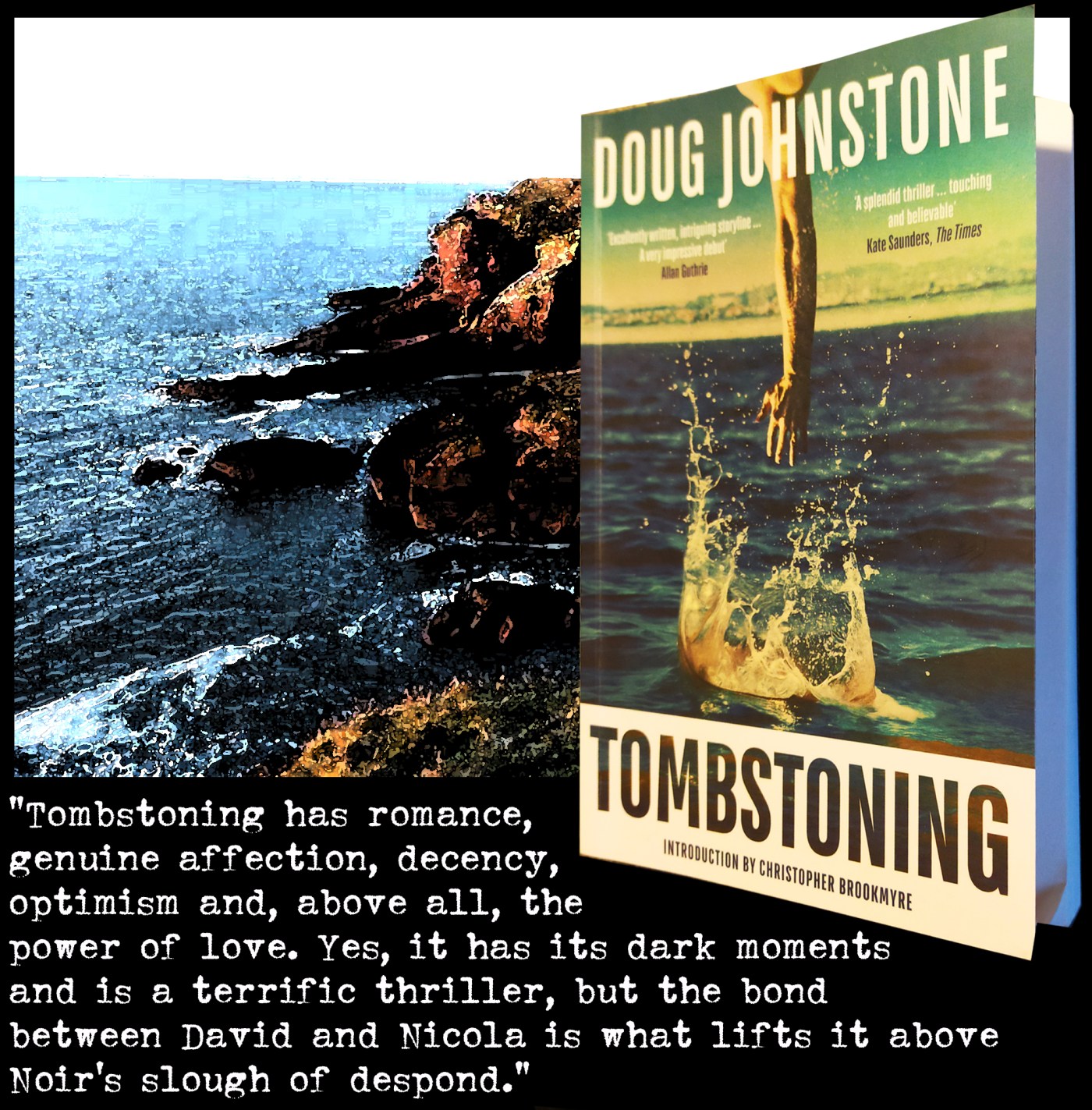

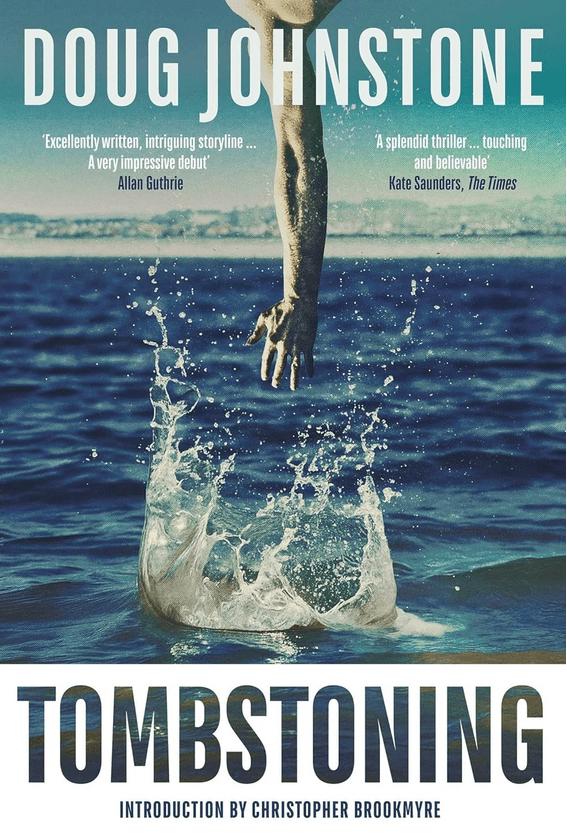
“Dazzling debut” has the tawdry connotations of tabloid alliteration, but sometimes clichés earn their keep. In 2006 we were in the high summer of New Labour but with Gordon Brown scheming away to get the top job, Arsenal moved from Highbury to The Emirates, and Doug Johnstone’s first novel ‘Tombstoning’ was published by Penguin. Successful and highly regarded at the time, it is now republished in a twentieth anniversary edition by Orenda Books.
The best books have central characters we care about, and Johnstone did this in spades. David Lindsay and Nicola Cruikshank were at school together in Arbroath, she a glacial beauty, he a skinny and rather clumsy lad too self-conscious to ask her out. Their final school days were shadowed by tragedy – a fellow school chum called Colin died after plunging from a cliff. Now, fifteen years on, Nicola has been asked by an alumni group to help organise a reunion, and she emails David, finding him on the website of his employer – a struggling web design firm in Edinburgh. Fatefully, David is persuaded by Nicola to rendezvous at the reunion in Arbroath, where he meets one of his former teachers in the pub after a dismally skill-free, but entertaining Third Division football match (Arbroath 1 – Montrose 1)
Mr Bowman reveals that far from being forgotten, Colin Anderson has been adopted by some local teenage boys as a macabre folk hero, and they have taken up the suicidal practice of jumping off the cliffs at high tide in honour of their hero. The activity is known, with bizarre irony, as Tombstoning but, thus far, no-one has died. Doug Johnstone was not the first (nor will he be the last) writer to explore the trope of the school or college reunion. The potential is for old jealousies to surface, historic slights to become even more barbed as the years have gone by, and it becomes probable that teenage rivalries can be revived by men and women now in their thirties, and much more capable of inflicting damage. So it is here.
The ghost of Colin Anderson is, like that if Banquo, the spectre at the feast, and it is not long before things begin to unravel.The mood darkens dramatically, when David receives the news that Gary Spink, an old chum with whom he had gone to the football match, has been found at the foot of the Arbroath cliffs. He and Nicola had been the last people to see him after the three of them had been thrown out of the nightclub hosting the school reunion.
About the half way mark, Johnstone introduces another figure from David’s past – Neil Corrigan. He had been the fourth member of the teenage quartet at school. Now, Colin and Gary are dead, but what became of Neil? Not as bright as his three pals, he was, however, powerfully built and aggressive. He seemed a perfect fit for the Royal Marines, but after serving in the Gulf War, he left to become a policeman. But now? Who Knows? Rumour has it that he has been seen in Arbroath.
Johnstone was brought up in Arbroath, and he describes his home town with affection, but doesn’t spare us the reality of the rather run-down former fishing port and the rusting hulks of trawlers decaying in its harbour. More potently, he describes the human tensions and sense of unease between locals who were never bright or ambitious enough to move away, and former friends like David and Nicola who have seen something of the world outside.
My only quibble with this book is a slight one, and it lies with the introduction, which seems to suggest that the novel is Tartan Noir. Noir, Tartan or otherwise suggests a bleak and monochrome vision of a society devoid of hope and optimism, where human venality tramples on love and human decency. If the writer of the intro wants genuine Noir, then I suggest he reads Derek Raymond’s I Was Dora Suarez. Ted Lewis’s GBH or Jim Thompson’s The Killer Inside Me. Instead, Tombstoning has romance, genuine affection, decency, optimism and, above all, the power of love. Yes, it has its dark moments and is a terrific thriller, but the bond between David and Nicola is what lifts it above Noir’s slough of despond. This edition will be published by Orenda Books on 26th February.


 fullybooked2017
March 4, 2026 at 3:23 pm
Thanks for the blog tour support x
LikeLike