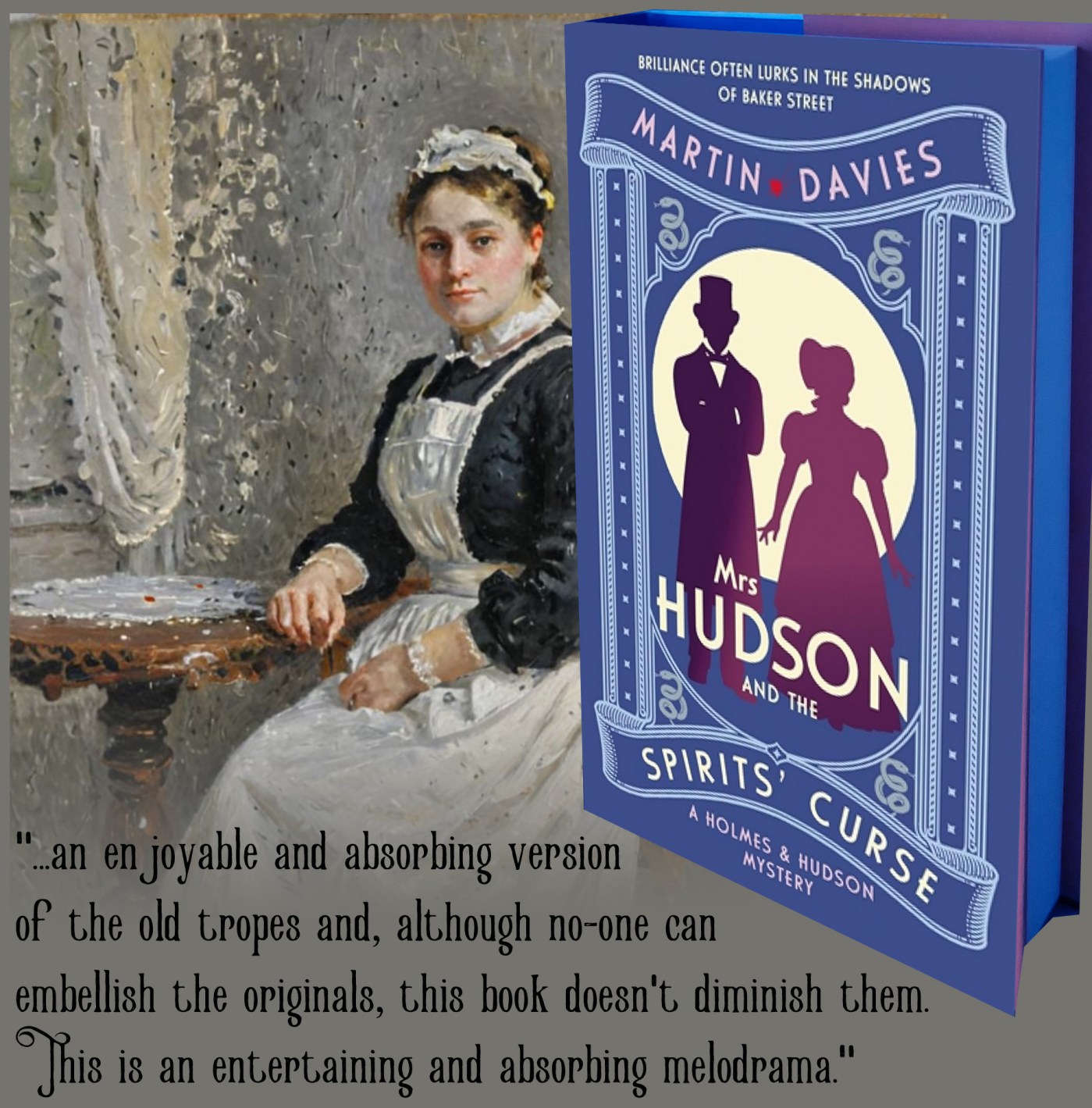

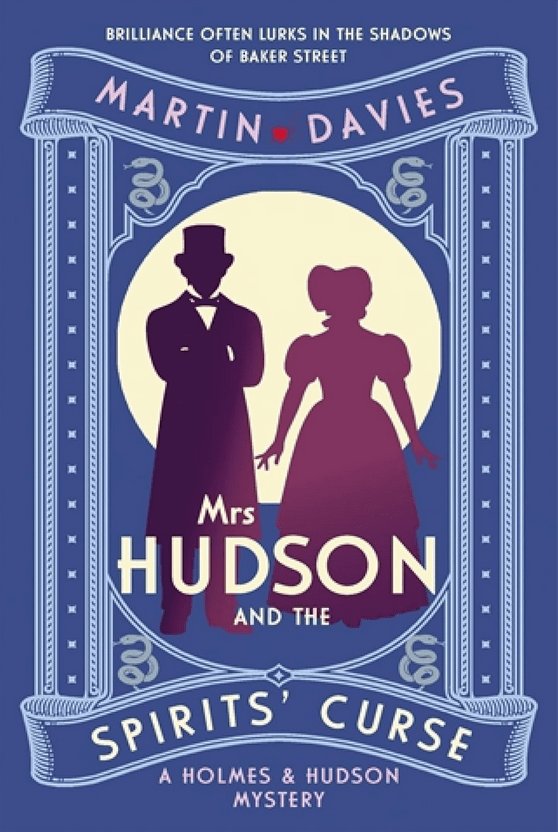
The canonical 56 short stories and four novellas featuring Sherlock Holmes have left so-called ‘continuation’ authors with plenty of subordinate characters to draw on. Dr Watson, inspector Lestrade, Moriarty and brother Mycroft have each been the central character in novels. I suppose it was only a matter of time before Mrs Hudson took centre stage. Martin Davies took up the challenge in 2002 and this book was reissued at the end of last month. It came up as available on my Netgalley account, and as I enjoyed Mrs Hudson and the Capricorn Incident, I decided to go back to the beginning of what is obviously a popular series.
The book is narrated by a young street urchin called Flottie (Flotsam) who has been taken under Mrs Hudson’s wing and, together, they take up new employment as housekeepers for two rather unusual gentlemen who have just moved into a house on Baker Street.The thrust of the main plot is this: a young man named Moran, with three colleagues, Neale, Postgate and Carruthers, was unwise enough to venture to an insanitary patch of jungle in Sumatra, in pursuit of an ambitious business scheme. As ever, the oppressive heat and rain wore them down, but their fatal error was, to paraphrase the punchline of a venerable joke, to “tell the local witch doctor to ‘fcuk off'”. Postgate never made it out alive.
Now, Neale, Moran and Carruthers have retreated in fright to England, convinced that they have been doomed by an ancient curse. Moran seeks the help of Holmes, and when Carruthers is found dead in his London hotel, his face (inevitably) contorted in an expression of terror, the game, as someone once said, “is afoot.”
At one point, another celebrated fictional character – gentleman thief Arthur Raffles – joins in the fun. Incidentally, Raffles’ creator, EW Hornung, was married to Conan Doyle’s sister Connie, although the two authors were said not to be bosom pals.
Without giving too much away, it transpires that Mr Moran has been a little economical with la vérité, but to little avail, as Mrs Hudson’s perspicacity and Flottie’s determination bring him down. Martin Davies doesn’t quite slam his four aces down on the table by introducing Moriarty, but he does the next best thing by acquainting us with a criminal mastermind called Fogarty who, while posing as a gentleman’s butler, presides over a violent and lucrative criminal empire.
Subsequent recreators of Sherlock Holmes have to get round the problem of the brevity of the 56 original short stories. Even the four novels were not long by contemporary standards. So, what is the problem? It is that in the short stories, Conan Doyle can keep a tight focus. There is one mystery, one closely linked set of characters and, usually, just two locations – Baker Street and wherever the crime was committed. In contrast, the modern homages have to fill out many more pages in order to give their readers a sense of money well spent. Whereas in the originals, Watson can feasibly go wherever Holmes does, be it Sussex, Dartmoor or Shoscombe Old Place, it stretches the readers’ credulity to have domestic servants travel far and wide with their employer, so Martin Davies get round the problem by sticking mostly to London locations.
Flottie is a plausible heroine, Holmes and Watson are faithful reproductions, and while Mrs H is nothing like the rather meek and put-upon woman in the original stories, she is perfectly credible. Canonical diehards will find the cosy fireside chats between Holmes, Watson, Hudson and Flottie, discussing the finer points of the case, utterly implausible, but we need to remember that Conan Doyle’s genius made Holmes invincible, impregnable and inviolate. No matter how many imitators take their turn, the canonical stories will always be there for us, pure and perfect. Martin Davies gives us an enjoyable and absorbing version of the old tropes and, although no-one can embellish the originals, this book doesn’t diminish them. This is an entertaining and absorbing melodrama, republished by Allison & Busby and available now.


 fullybooked2017