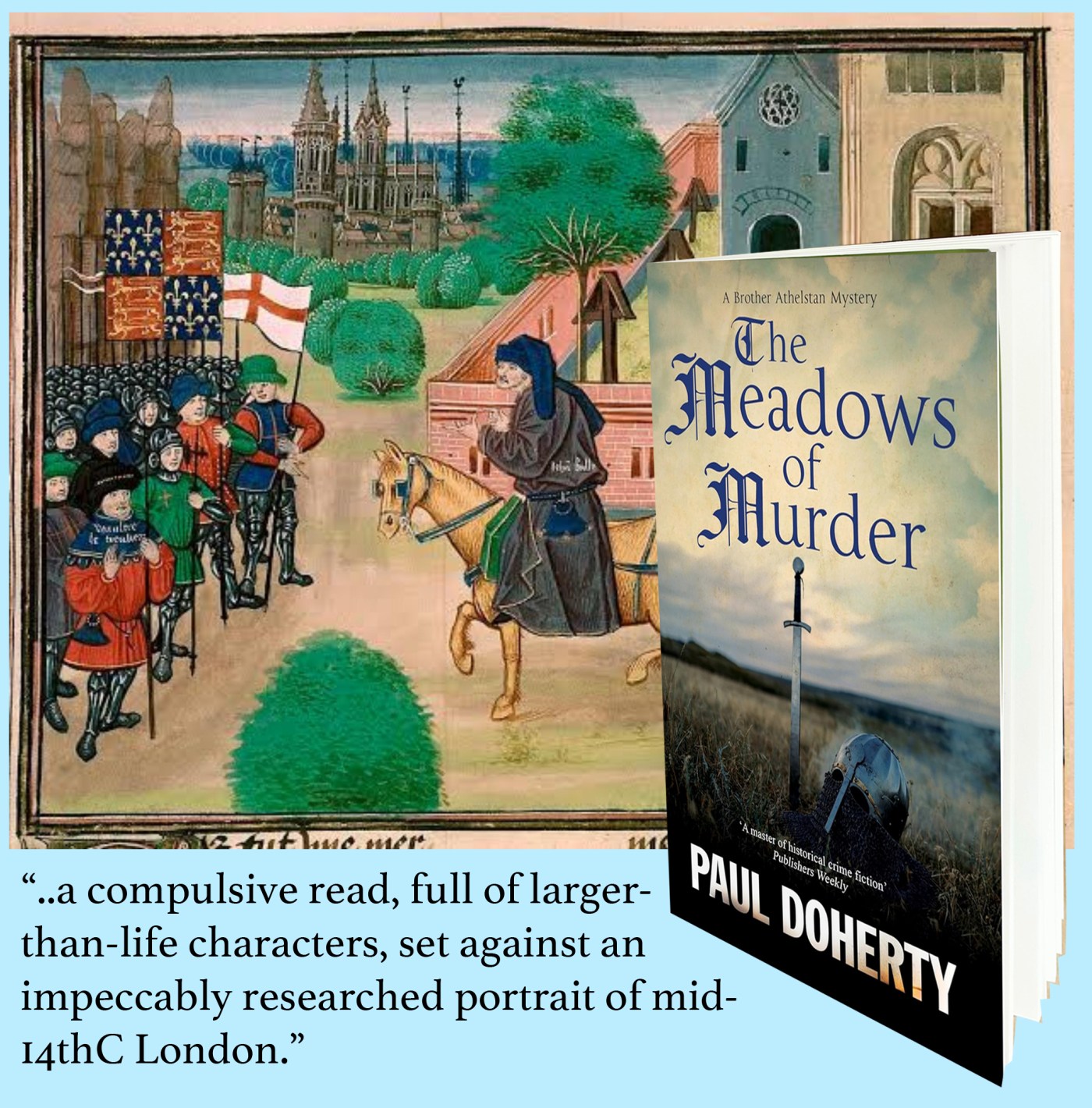

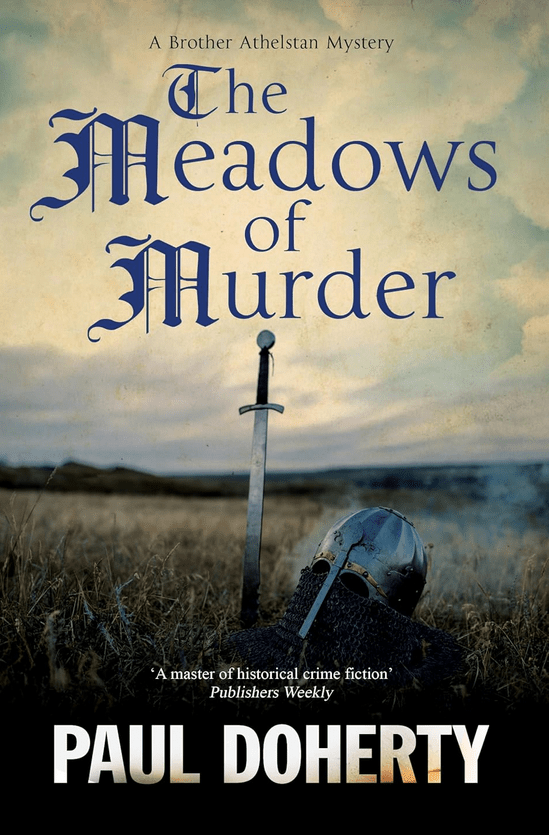
I confess to being a devoted fan of medieval mysteries. I think it started with The White Company. Though clearly not a crime novel, that book triggered my interest in the period and it’s people. Since then, we have had Ellis Peters, Umberto Eco and Sarah Hawksworth, to name but three. I am new to Paul Doherty’s Brother Athelstan books, but was not disappointed by The Meadows of Murder. We are in late 14th century London, Athelstan is priest of St Erconwald’s church, and on the north bank of the Thames, the bodies of those executed for their role in the recently crushed Peasant’s Revolt are hanging rotting from their gibbets. The prologue explains the complex political situation of the day: the King, Richard II, is little more than a boy; John of Gaunt is locked in conflict with the powerful guildsmen of London, while powerful figures like Richard’s mother Joan, conspire behind the scenes. The country is still struggling from devastating effects of The Black Death.
This is no softly tinted golden account of a fondly imagined medieval England. It is full of dark corners and harsh realities. Members of a London Guild who were guilty of what is best described as a group rape of a Spanish entertainer are being murdered, one by one. A terminally Ill craftsman has sought sanctuary in Athelstan’s church for murdering a Jewish moneylender. London’s streets are dangerous places, violent and foul with sewage. Somehow, Athelstan rides the storm, helped by a mixture of his own resolute faith and the strength of his personality.
Athelstan and his friend Sir John Cranston, the Lord Hugh Coroner of London, are drawn to St Osyth’s Priory on the north bank of the Thames. It was there, that Massimo Servini, the abused Spaniard, was taken to die. The Priory has its own mysteries. Why the previous Abbess and Prioress disappear, one with a quantity of stolen treasure? Why is Thibault, the Queen Mother’s confidante ever present? And is Adam the Anchorite actually the brain damaged fool he appears to be, or is his imbecility a cloak masking something far more sinister?
There are touches of wry humour. Athelstan’s parishioners are certainly a peculiar bunch. He has summoned them to the church.
“He glared and he stared, managing his anger, but also counting heads and remembering faces. Watkin, the Dung collector, his nephew, Michael the Minstrel, Pike the Ditcher, Ranulph, the Rat Ctcher, with his two caged ferrets, Ferox and Audax, the Hangman of Rochester, Crispin, the Carpenter, Jocelyn, the Tavern Master, and all the rest of the motley crew.”
Looming over the narrative is the immense figure of John of Gaunt. The third son of Edward III, denied the crown by primogeniture, he was still an immense political figure. Best remembered today for the memorable speech Shakespeare put into his mouth in Richard II, he nevertheless was – briefly, and by marriage – king of the ancient Spanish kingdom of Castile. His son was crowned Henry IV in 1399. The animosity between him and the London Guilds is a key part of this tale. His name? He was born in the Flemish city of Ghent, now Gand. Paul Doherty (via the perception and acuity of Athelstan) raises the concept of what were called ‘by-blow’ progeny, – children not legitimised by marriage. Men like John of Gaunt could have numerous bastard offspring, and it was seen as nothing more than a testament to their virility, but for women of noble birth it was another matter altogether.
The key to the mystery lies at St Osyth’s, both above and beneath the ground. Athelstan uncovers a fatal network of allegiances and grievances that has caused many deaths. The humble priest’s ability to move effortlessly between Court, Cloister and Commons is rather implausible, but Paul Doherty has given us a compulsive read, full of larger-than-life characters, set against an impeccably researched portrait of mid-14thC London. The Meadows of Murder will be published by Severn House on 6th January.


 fullybooked2017