Search

fullybooked2017

Month

December 2025

MYSTERY IN WHITE . . . Between the covers

Largely forgotten now, Joseph Jefferson Farjeon was a dramatist and novelist who died in 1955. His reputation has perhaps been eclipsed by that of his sister Eleanor. Coming at the tail end of The Golden Age, Mystery In White was published in 1937. Another book which begins in the snow, The Nine Tailors, came out three years earlier, but that is where the resemblance ends. Wimsey and Bunter’s misadventure in a snow-filled Fenland ditch moves on quite quickly, and covers a much longer period of time.

Here, the 11.37 train from Euston ends up stationary, the line blocked by snow. In one compartment are a variety hall dancer bound for Manchester, a middle class brother and sister named David and Lydia, a rather gauche clerk called Thomson, an old colonial hand referred to only as ‘the bore’, and an older man, Edward Maltby, who claims to be a psychic researcher. He is heading for Naseby, where he hopes to commune with the spirit of King Charles I. Not that it matters, but examining the route of the old LMS line, we might assume that the action takes place somewhere in Bedfordshire.

The beleaguered train guard can offer little hope of quick deliverance for the stranded passengers, and Maltby takes – literally – a bold step, and jumps down from the carriage, stating he will find his way to the nearest village. The others, after a while and quite implausibly, decide to follow him, and after several misadventures in the drifts, arrive at an isolated house, with an unlocked door. Inside is a puzzle, inside a mystery, inside an enigma. A kettle is merrily boiling away on the stove, as if in anticipation of a brew of tea, but the house is, as far as the group can see, unoccupied.

The escapees from the train are busy dusting themselves down and thawing out, when Edward Maltby arrives, in the company of a rough stranger, who soon leaves. Then, the bore from the train, named Hopkins, also arrives and informs the group that in the next compartment* of the carriage, a man has been found dead.

*Back in the day, railway carriages consisted of a number of separate compartments, designed to seat perhaps seven or eight people. Along the right (or left) side of the carriage ran a corridor, and each compartment had a door which opened into it.

The plot develops at pace. The loutish cockney, Smith, who first arrived with Maltby has left, returned and then left again after provoking a one-sided fight with the bore, who we now now is called Hopkins. Young Thomson was sent to bed with a high temperature, but after alarming dreams, got up in a daze, but has now been brought downstairs. The dancer, Lucie Noyes, had injured her foot in a fall, and was also packed off to bed to rest. She has disturbing thoughts about the bed, however, as it seems to have a certain ‘presence’ which is not altogether pleasant, and she took is now downstairs. Meanwhile Maltby has assumed the role of a kind of Magus, and is making enigmatic statements about the psychic dangers of the building. On a more practical note, a letter was discovered which partly explains the open door and tea being laid. A servant had been looking after the house, and was expecting visitors, but of the retainer and the guests there is no sign.

This changes when David decides to go out into the night and look around. Eventually, he finds a young woman wandering about in the snow. She tells him she is Nora Strange, and that she and her elderly father were trying to drive to Valley House. The car became stuck in a drift. David quickly surmises that they were heading for ‘the house’ itself, and the trio make their way back there.

The human story behind the seemingly inexplicable mystery is revealed in a kind of seance in the small hours of Christmas Day. It is not a seance in the accepted sense,as Maltby later explains:

“We hatch ghosts in our own minds out of the logic that is beyond us. Logic, through science, may one day recapture the sounds of the Battle of Hastings, but this will not mean that the battle is still going on. Believe me, Mr. Hopkins, there are quite enough astounding, uncanny, mind-shattering experiences within the boundaries of sheer logic to eliminate the necessity of ghosts for our explanations or our thrills. We are only touching the fringe of these things. We have only touched the fringe of them in this house.”

This is a book of huge charm. The style and dialogue are, inevitably, of their time, but they only add to the magic combination of snow, mystery, Christmas, and, dare I say it, happier times. The novel was republished as a British Library Crime Classic in October of this year.

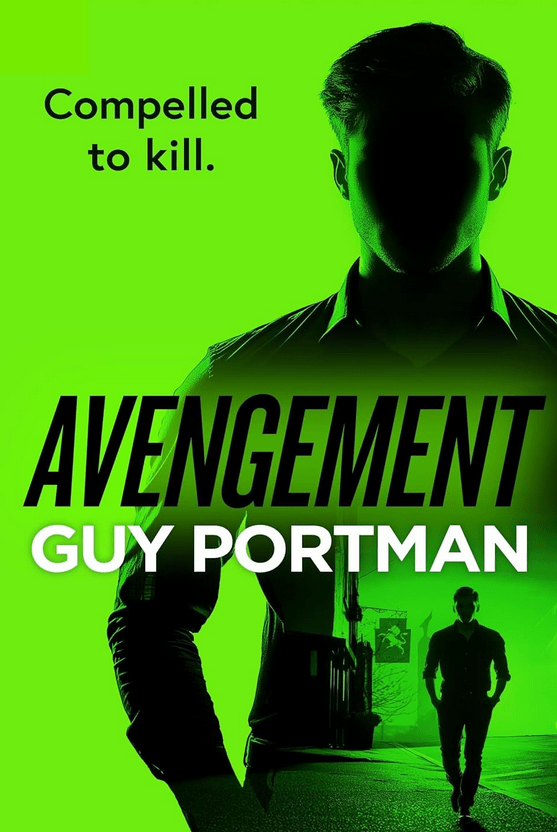
AVENGEMENT. . . Between the covers

We rejoin our not-so-friendly neighbourhood sociopath Dyson Devereux in a London pub, where he is celebrating the end of his university exams with fellow undergraduates. He is miles away in his head, however:

“I left Tollington nearly eight years ago and have only been back twice. Aunt didn’t want me there after I pushed her daughter, Beatrice, off a cliff. It was considered to be an accident, but Aunt was suspicious. In my mind’s eye, I see Beatrice plummeting into the mist. This is my favorite memory.
“Ha, haha.”

Dyson needs to get a job, but before that rather tedious necessity, there are three more names on his to-kill list, and they are all in the Dorset town of Tollington. Top Trumps is the lecherous Dr Trenton who, years earlier had seduced Mrs Devereaux (while her husband was dying of AIDS) and filled her so full of tranquilisers that she lapsed into a fatal coma. Two elderly twins – Virulent Veronica and Conniving Clementine – who run a tea-shop must also die because of their persistent taunting of the younger Dyson, publicly stigmatising him for his father’s alleged sins. After eventually passing his driving test, Dyson tours local used car yards for his first set of wheels. He has one main criterion. The car’s boot must be wide enough to accommodate the Samurai sword – honed to razor sharpness – which hangs on he bedroom wall of his student digs.

Dyson is devastated to learn that one of the malignant twins has thwarted his vengeance by dying of old age. Undaunted, he executes her sister and returns to London where, after befriending the daughter of an Indian billionaire. he is invited to an the launch party of an art exhibition by a young man called Sebastian

‘A grim-faced waiter, wearing a bright green tail coat, materializes next to me.He is holding out a plate.
“Tuna balls with cream cheese and red onion.”
I help myself to one. It tastes piquant. The exhibition’s art is being put to shame by the seafood Hors d’Oevre. Sebastian is devoid of artistic talent. However, he has one thing going for him. His German mother is an heiress to a pharmaceutical fortune.’

After a few false starts, Dyson finally puts the Samurai sword to use in the manner for which it was designed, and his trilogy of vengeance seems to be over. Despite some interest from the police, he has covered his tracks so carefully that the two most recent crimes cannot be pinned on him, and he begins his working career in the less-than-exotic offices of a London borough council in their Green Spaces Department. This segues fairly neatly into the first book – in publishing chronology – of the series, Necropolis, which I reviewed in 2014 (click here to read)

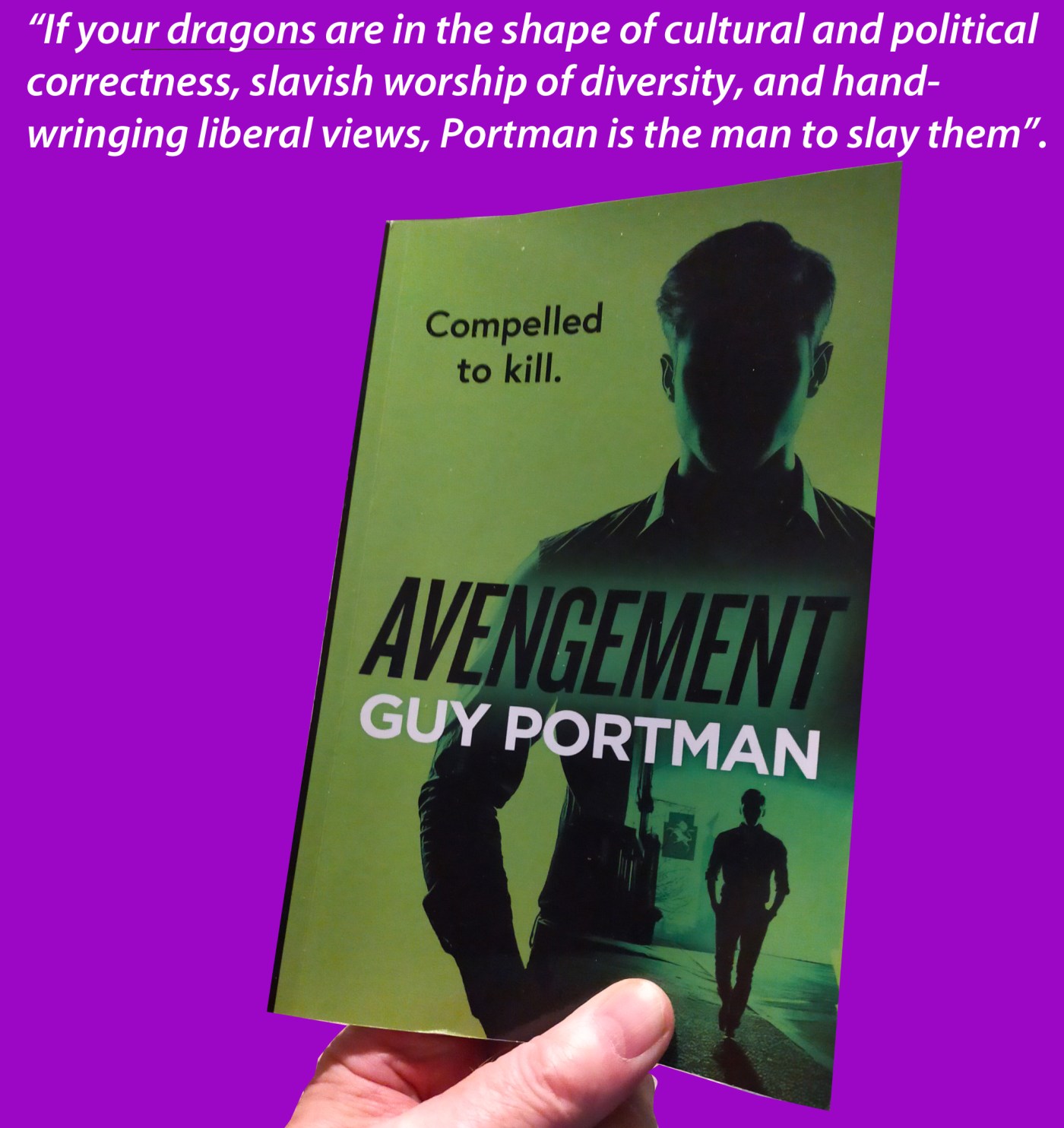
Satire in Britain is, in my view, in a fairly bad way at the moment. Like comedy, it seems to have just been absorbed into the prevailing metropolitan liberal mindset, which only considers the political right as a legitimate target. Private Eye is a shadow of its former self, and I gave up on HIGNFY years ago. Rare is the journalist who challenges the prevailing Islingtonian doctrines through comedy, Rod Liddle being perhaps one exception. I can’t think of anyone who writes quite like Guy Portman. Jonathan Meades is similarly trenchant and iconoclastic, but even his last novel had to be crowd-funded, as no publisher would touch it. If your dragons are in the shape of cultural and political correctness, slavish worship of diversity, and hand-wringing liberal views, Portman is your St George. Avengement is available now.

THE BARRAGE BODY . . . Between the covers

It is December, 1944, and we are in the Birmingham suburb of Erdington. Further afield, and quite unknown to both the residents of Erdington and the American soldiers shivering in their foxholes in the Ardennes Forest, Hitler is about to launch his last desperate gamble in what would come to be known as the Battle of The Bulge. In Erdington, war-wise, things are relatively quiet, but a barrage balloon unit, staffed by young women of that WAAF, is parked up at the Dunlop rubber factory, commonly known as Fort Dunlop.

It is here that Detective Chief Inspector Sam Mason is summoned, initially to investigate what appears to be a case of malicious communications, but things escalate rapidly. First it seems that someone has stolen vital blueprints for new and improved tyres for Lancaster bombers, and then, a body is discovered tethered to a barrage balloon which has unaccountably broken free.

Mason has a veritable 2000 piece jigsaw to put together. So many questions. Who was the man found dead in the barrage balloon cables? Why was jack-the-lad teenager Simon Samuels found in a similar position? What is the connection to Samuels’ father, a guard at a Staffordshire POW camp. Painstakingly, Mason and his redoubtable Sergeant O’Rourke have to move the pieces one by one until they begin to make a recognisable picture.

Sam Mason is quite unlike most British coppers in contemporary CriFi, partly because of the era in which was working. Because it is the 1940s we are quite content for him to rather stolid, happily married, prone to the aches and pains of late middle age. His deceptively gentle and slow-moving approach masks a sharp mind and a critical eye for detail. Here, he patiently absorbs the facts of a strange case, and delivers the goods.

This is the fourth Erdington Mystery. I enjoyed and reviewed the first of them, The Custard Corpses. The series couldn’t be more different from the books for which Porter is, perhaps, better known – dramatic swords, shields and helmets dramas from Saxon and Norman times. The books have one thing in common, however, and that is the setting – Mercia, the ancient kingdom we would now call The Midlands where, incidentally, Porter was born and brought up. The Barrage Body is original, inventive, nostalgic, absorbing, and I loved it. Published by MJ Publishing, it is available now.

GENESIS . . . Between the covers

Guy Portman has written a splendid series of dystopian satires centred around a sociopathic killer called Dyson Devereux and, after his demise, his son Horatio, who has inherited his father’s rather peculiar intelligence. Now, in the first of two prequels, Genesis gives us a glimpse into the life of the eleven year-old Dyson. It is 1985, and Dyson’s father, long since separated from his mother, has died of what we  would coyly come to describe as ‘an AIDS-related illness.’ Portman’s black humour kicks in early when, at Devereaux senior’s funeral, there is a grotesque spat between a rather fey young man (presumably the partner of the deceased) and Dyson’s aunt.

Within weeks, Dyson is an orphan. His mother never recovers from a coma induced by the prescription drugs provided by her lover, the predatory Dr Trenton. Dyson vows revenge, but shares his maximum venom for his hateful cousin Beatrice, who has taunted him relentlessly over his father’s death. After living with her and his Aunt for a while, he is sent away to boarding school. Intellectually he thrives. His rapid grasp of Latin singles him out, but his status among his peers – minor foreign royalty, sons of the landed gentry and dimwits who happen to be good at rugby – is less certain. His heroic status among (most of) his fellow pupils is cemented, however,  after he engineers a memorable encounter with a boy’s glamorous mother in her Mercedes, with half the members of Upper Four B watching from behind the bushes. This memorable feat is also his downfall, as it leads to his expulsion.

Dyson’s main obsession is his cousin Beatrice. He daydreams of ways he could cause her demise. In his most exotic and Byzantine vision, he has written to Jimmy Savile (this is the 1980s, remember) asking for Beatrice to be guillotined live on TV, as the climax to that week’s Jim’ll Fix It. The unfortunate girl’s actual demise is, however, marginally less less spectacular, and it involves a parish church outing to visit Beachy Head.

Readers who are familiar with Portman’s books will know what to expect, but for novitiates, here’s a brief primer. The author has a high powered literary rifle, and in its cross-hairs are Britain’s ‘lanyard class’, metropolitan socialists, indoctrinated social workers, people whose social consciences overlook all manner of atrocities, Guardianistas, bumbling teachers and so-called ‘community leaders’. Portman’s aim is unerring. Just like Finland’s fabled White Death, Simo Hayha, every time he squeezes the trigger, the target falls. Yes, this is satire, and fiction, but his writing carries a salutary message.

Guy Portman pushes the boundaries of humour up to – and occasionally beyond – the limits that some people might find acceptable, but  he provides me, for, one, with laugh-out-loud moments. He is also a great literary stylist with a vast amoury of cultural references, and is one of our funniest living writers. Genesis is out now, and I will be reading and reviewing the next episode – Avengement – very soon.

BLACKWATER . . . Between the covers

The book begins with a terrific passage:

The child looked like a porcelain doll. Dark eyelashes resting on pale cheeks, softly pouting lips, sandy hair swept neatly under a flat brown cap. Delicate hands folded across a miniature cotton shirt and waistcoat. A figure of peace, placed in repose on the bracken as if simply lying down to rest next to a pyramid of rocks. Even the bluish tinge to the skin could have explained away by the moonlight.

Sarah Sultoon is not the first writer to exploit the dank mysteries of the Essex marshes. In Bleak House, Dickens used the perennial swirling mist and sense of despair as a metaphor for the obfuscations and terminal lack of transparency which enmesh Jarndyce v Jarndyce. The River Blackwater exists. It rises in rural Essex and expands into a considerable estuary, but the island in this novel is pure fiction.

On starting the novel I wondered how someone could sustain a thriller billed to be about the fabled Millennium Bug – something that never actually happened. I should have had more faith. The discovery of a dead child on Blackwater Island is only briefly mentioned on the news as the world waits for computer systems to shut down, and passenger jets to tumble from the sky, but journalist Jonny Murphy is sent down to Essex to investigate. What he finds is truly astonishing.

Deeply embedded in the mystery is Murphy, aided and abetted by his American ‘not quite’ girlfriend Paloma. He is certainly fearless, but I was reminded of those female characters in Hammer horror films, who decide to go and investigate the ruined church at midnight, dressed in a negligee, and armed only with a flickering candle. Despite our cries of ‘Don’t go there!’ she does, as does Johnny.

This is indeed a weird and wonderful fantasy. The closest comparison I can come up with may only chime with readers who share my my advanced years, but Blackwater is rather reminiscent of the African tales of H Rider Haggard. I suspect no-one reads him these days, but back in the day his fantastical tales of adventure were very popular. Essex is a long way from darkest Africa, but Sarah Sultoon emulates Haggard by creating a cast of intriguingly odd characters. Instead of Gagool, the malevolent witch in King Solomon’s Mines, we have Judith, the strange landlady of The Saxon: Haggard gave us the imposing Ayesha in She, (as in She Who Must Be Obeyed) but here we have ‘Jane’, the Amazonian former special forces trooper who lurks on the island. Sultoon then decides to go for broke and throw into the mix triplets, a grief-stricken recluse and an emaciated druid.

Aside from the goings-on in the riverside hamlet of Eastwood, where Judith’s pub serves only plates of local oysters and glasses of a locally concocted spirit consisting mainly of ethanol, there is a serious background which revolves round biological warfare and the way governments across the world will lie to the people who elected it, all in the name of ‘national interest’. Despite the improbable storyline, Blackwater is immensely entertaining, and I read it over a couple of enjoyable evenings. It is published by Orenda Books and is available now.

THE REST IS DEATH . . . Between the covers

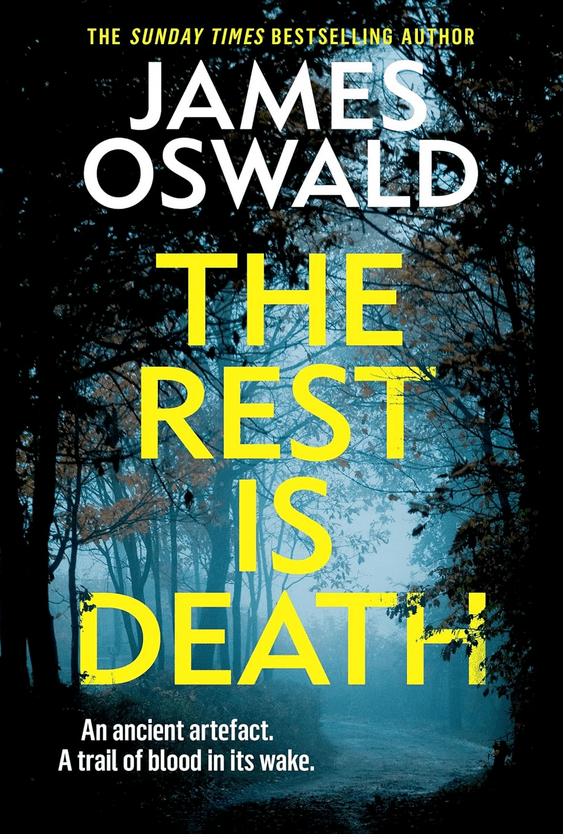
In a silky smooth segue from 2024’s For Our Sins, Edinburgh copper Tony McLean has returned from temporary retirement and is asked to investigate an apparently trivial break-in at a Biotech facility. Nothing seems to have been taken, no-one was harmed, so why is a Detective Chief Inspector sent on the job when it would normally be handled by a uniformed Sergeant? The answer is simple. Drake Biotech is owned and funded by billion are Nathanial Drake, who just happens to be on WhatsApp terms with Scotland’s First Minister.

When an old school chum approaches DI Janie Harrison with a request to look, for her missing boyfriend, a Serbian carpenter, Janie does a perfunctory search, but assumes the man has gone to ply his trade elsewhere. She has logged the photos from her chum’s phone, and is horrified to find, that when she is called out to woodland where a hastily buried body has been found, the remains are that of Vaclav Mihailovic.When the autopsy is carried out on the Serbian, the pathologist is both baffled and shocked. The unfortunate man is opened up, but there is no stench of decay. It seems that the gut bacteria that continue working away after the heart stops beating are mysteriously absent. There is no bloating and no breakdown of tissue.

Halfway through the book, Oswald escalates and complicates the narrative. First, the driver of the van that took the intruders to Blake Biotech is identified, but then rapidly disappears. McLean suspects he is working for an external intelligence agency. A professional protester called Sanderson, believed to be one of the Biotech vandals is found sitting on a park bench, stone dead. Then the bodies of both Sanderson and Mihailovic are stolen from the city mortuary. Long time fans of the Tony McLean novels have become accustomed to an element of the supernatural appearing in the narrative. Here, it comes in page one, but it is another 60 pages before we realise the relevance to Nathaniel Drake and his interests.

McLean ponders the situation:

“We’ve got a break-in at the lab by animal rights activists who turn out to be a diversion for some MI5 spook doing God knows what. One of the team turns up dead in the park, looking like he’s not eaten in months and shouldn’t have had the strength to wield a spray can, let alone smash up a lab. I’d really like to know what he died from, just in case I’ve got a new disease about to spread through the city.

But someone breaks into the mortuary and steals his body before the pathologist can have a proper look. And whoever does that has the ability to break the servers of a sophisticated security services company to order.

A company that, it turns out, is a fully owned subsidiary of Drake Corporation, whose labs were broken into. And am I going round in circles?”

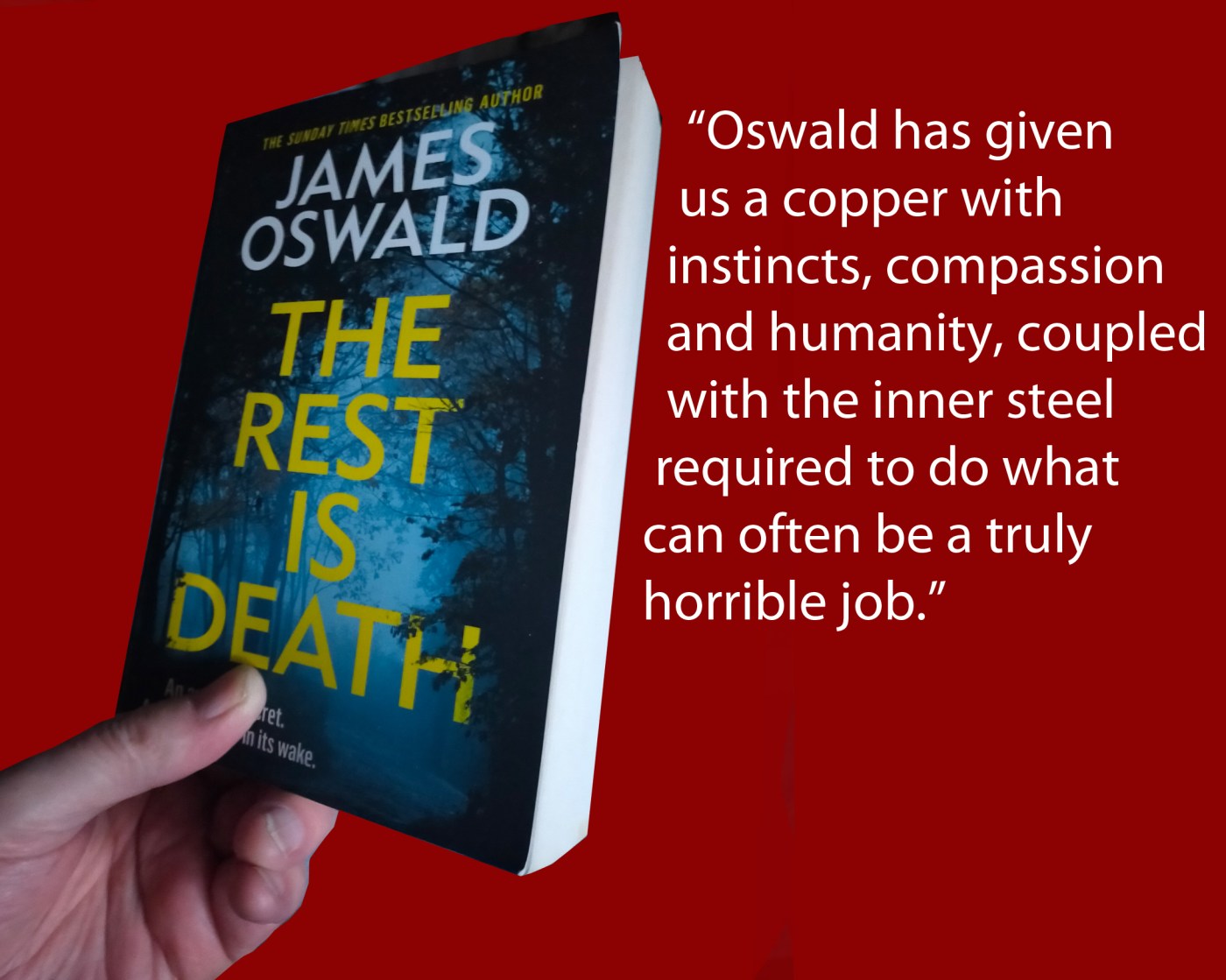
Within the CriFi genre, police procedural investigations are not natural bedfellows with the paranormal. The late Phil Rickman made it work – in spades – and James Oswald does a pretty good job. He certainly pushes the boundaries here, and gives us a finale with an archetypal mad professor locked in a life or death struggle with McLean, Harrison, and the mummified heart of a man who was court magus to Vlad Dracul in the medieval Carpathian Mountains. All this aside, Oswald has given us a copper with instincts, compassion and humanity, coupled with the inner steel required to do what can often be a truly horrible job. The Rest is Death is published by Headline, and is available now.


Blog at WordPress.com.

Up ↑