Search

fullybooked2017

Month

October 2025

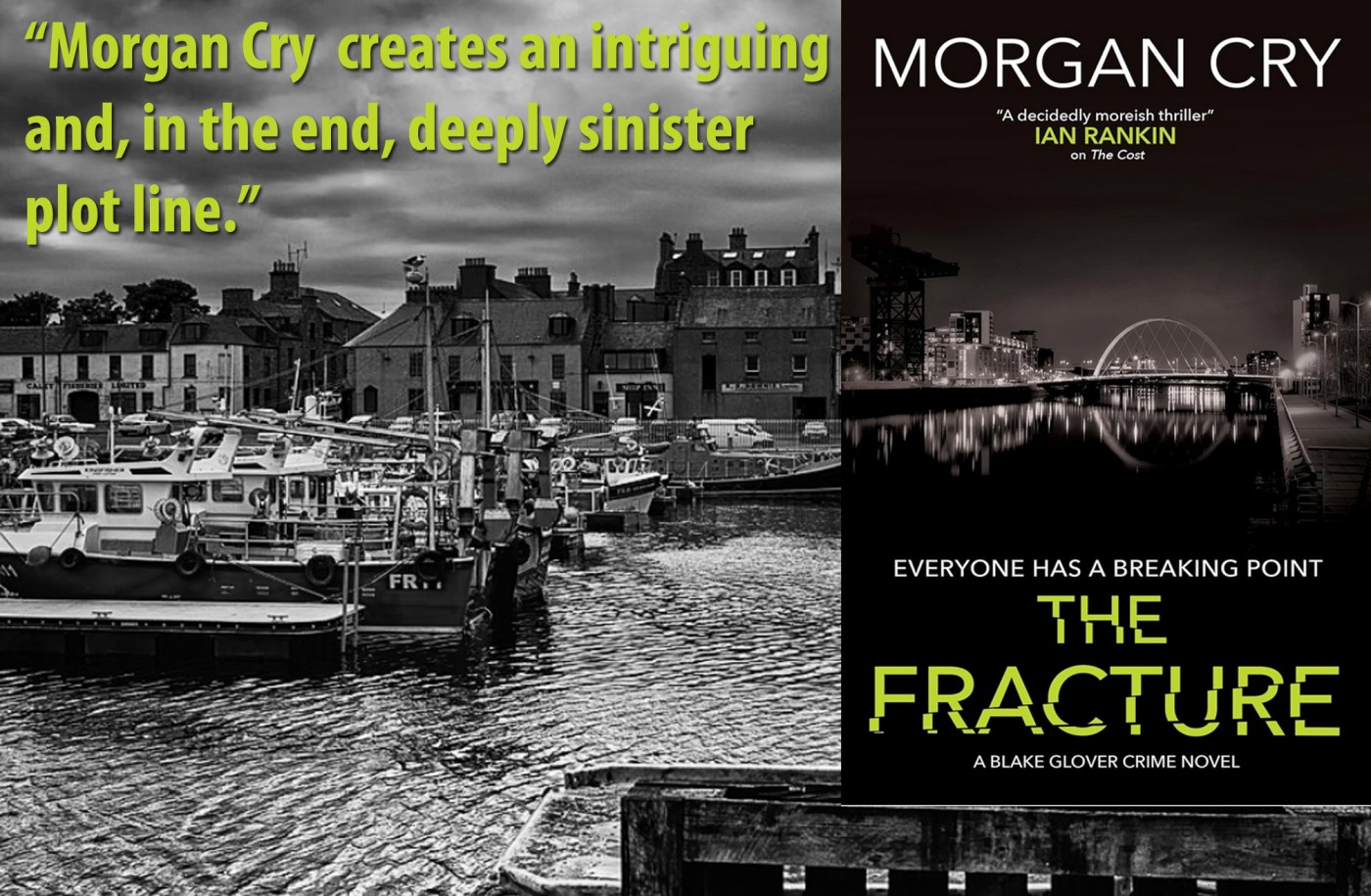
THE FRACTURE . . . Between the covers

Blake Glover – BG to his friends – is a fifty-something taxi driver in his home town,the bleak fishing port of Fraserborough on Scotland’s north east coast. In a former life he was a police officer on the mean streets of Glasgow. His career ended after a messy attempt – involving planted evidence – to bring drug boss Mitch Campbell to justice. Now, Campbell has been arrested and tried, legitimately, and is awaiting sentence in Glasgow’s notorious Barlinnie prison. Glover is about to find out that Campbell has long reach, despite his incarceration.

The book begins, however, with a dramatic and, apparently, unconnected scene. Out on the desolate Fraserborough shoreline, a homeless alcoholic guzzles his last few mouthfuls of ‘Buckie’ (Buckfast tonic wine) but sees something perturbing out there in the darkness. A man has has walked out onto the beach, taken off his clothes, shoes and socks, and walked out into the white horses of the tide. The drunk staggers towards the beach calling out, but he is too late; the man has disappeared. The strange event has a temporarily sobering effect on the drunk, and he returns to the town and reports what he has seen.

Meanwhile, attending the funeral of an elderly lady he knew from childhood, Glover notices something disturbing. In the teeth of a furious and drenching storm, one of the pallbearers loses control of his rope lowering the coffin into the grave. That corner of the coffin thuds into the earth – and splits. The gravediggers in the mini JCB furiously pile the earth on top of the coffin before Glover can investigate, but he drives away from the churchyard trying to make sense of what he saw. He learns that in the darker corners of the funeral business it is not unheard of for relatives to order and pay for a top of the range oak coffin, only for the corpse to be switched to a more fragile plywood version at the last minute.

The man on the beach left his wallet with his clothes and has been identified as Ray Cocklestone, a former local farmer. He is classed, at least for now, a missing person, but few locals think it will be long before he is declared a suicide. Glover is interviewed by the police, as he may have been one of the last people to have talked to Cocklestone, having taken him in his taxi from his home to a local pub.

Morgan Cry (pen name of Gordon Brown, but no, not that one) creates an intriguing and, in the end, deeply sinister plot line which links the mystery of the splitting coffin and the disappearance of Ray Cocklestone with the truly dreadful things that take place courtesy of The Dark Web and the anonymity it gives its users. The Mitch Campbell storyline develops separately, and is one which comes to threaten not only Glover’s relatively modest current career, but his freedom and, perhaps, his life itself.

There are two central characters in the novel. One is the flawed, but likeable Glover. His lifestyle is certainly destructive, at least from a dietary point of view. He exists on industrial quantities of service station pasties and Mars bars, washed down with copious draughts of that peculiar Scottish delicacy, Iran-Bru. His taxi driver life is a miasma of unwashed passengers and the sickly scent of yet another air-freshener dangling from the rear view mirror. The other imposing presence in the book is Fraseborough itself. The town is frequently battered by the storms swirling in from the North Sea. The reluctant hedgerows and trees dolefully wear their permanent Christmas decorations of discarded plastic bags and wrappers from last night’s fish supper. The pubs, the houses, the leisure centres and the rain washed supermarket car parks are all bleak enough, but the people of the town are lovingly painted for the most part, with their impenetrable Aberdeenshire accents and their abiding love of gossip. The Fracture will be published by Severn House on 4th November.
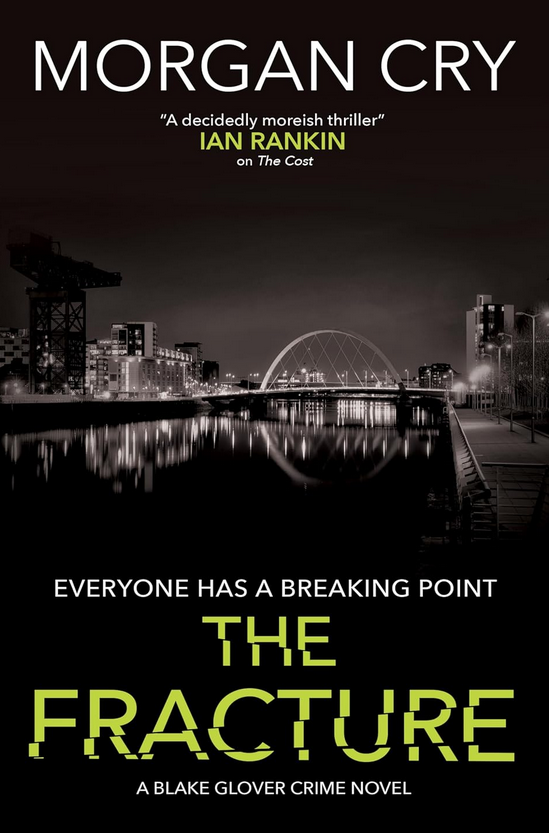


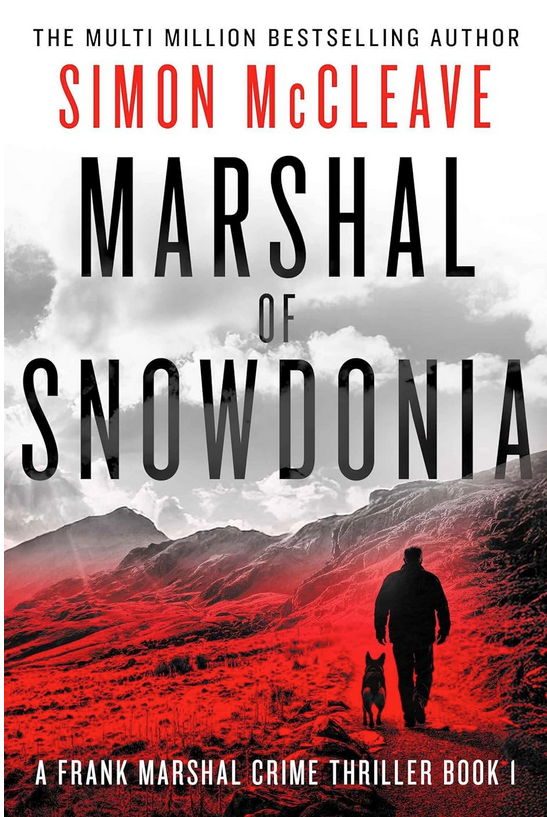
MARSHAL OF SNOWDONIA . . . Between the covers

Frank Marshal is a seventy year-old former senior detective. He lives in a former farmhouse in Snowdonia, and volunteers as a national park ranger. He has, as they say, baggage. His wife Rachel has dementia. His son committed suicide in that self same house. His daughter Caitlin lives in England with her waster of a boyfriend and their son Sam. A not-so-near neighbour, as the area is sparsely populated, is another retired from the justice system, but Annie Taylor was a High Court Judge. Now, her sister Megan has gone missing from her rented caravan in a hilltop trailer park.

The book has a prologue which describes a woman – time-frame presumably the present – being held against her will in a remote location. When Marshal discovers bloodstains beneath the decking of Megan’s caravan, a full police investigation kicks in. Megan’s errant son, Callum, had lived with her in the caravan. Annie and Marshal track him down to his (absent) father’s house. The youth tries to escape on his moped. Marshal pursues him, but only succeeds in running him off the road into a river. Marshal rescues him, but now Callum is in hospital, suffering from amnesia. Big question. Is the memory loss genuine or a pretence?

Marshal may be a gentle father, grandfather and former policeman, but he would never survive the current scrutiny that subtly shapes modern officers to the mould set by the metropolitan liberals who run the UK legal system. Only the knowledge of the disastrous consequences of him shooting a predatory salmon poacher prevents him from pulling the trigger while, when Caitlin’s lowlife partner – TJ – arrives in Wales demanding access to his son, Marshal has no compunction in planting several bags of marching powder (recently discovered hidden in Megan’s caravan) in TJ’s car. And if the local police should find the drugs, then who is he to correct their sums when they make two plus two equal five?P.

When the body of Annie’s sister is found dead on the beach at Barmouth, strangled with thin wire, Marshal has a grim thought running through his thoughts. The wire garotte was the favoured method of a notorious serial killer, Keith Tatchell years earlier. Now Tatchell is serving life imprisonment. Two equally horrific options spring to Marshal’s mind: was Tatchell wrongly convicted and is the real killer still out there?; is Meghan’s killer someone connected to Tatchell and seeking revenge?

McCleave gives us a brilliant plot twist to reveal the true villain, but ends the novel with a suggestion that Frank Marshal may have more trouble on his hands in the next installment of what promises to be an addictive series.

I could no more be a professional writer than I could open the batting for England. The pressure to write something that sells and produces good reviews – and pays the bills – would, for me, be intolerable. Writers (unless they are TV celebrities) must constantly search for some draw, some hook, that will attract readers – and sales. I read hundreds of crime novels and, amid the gimmicks, the split time frames and the hysteria of desperate publicists, it is a relief to read a novel that is just impeccably written, with a solid narrative, and peopled by plausible characters. Marshal of Snowdonia is one such, and I can heartily recommend it. It was published by Stamford Publishing earlier this year.

BLACK AS DEATH . . . Between the covers

This novel is the final episode in an Icelandic CriFi saga and, as ever, I am late to the party. Long story short, An Áróra’s sister Ísafold was being abused by her partner Björn, and when Ísafold went missing, with her body found much later, it was assumed that Björn was the killer. When his body is then found at the same site, the investigation is blown wide apart. An Áróra is in a relationship with Daníel, a detective, and when he finally reveals the chilling fact that Ísafold’s body has had the heart ripped from it, this grisly twist sets the stage for a thrilling and addictive narrative.

For series newcomers like me it takes a page or three to discover what An Áróra actually does for a living. She is a freelance forensic accountant, employed by various agencies – some government owned, some private – to mine down into the financial affairs of companies who seem to be doing rather too well.

Flashbacks tell us about Ísafold’s relationship with Björn, and they make painful reading, typifying everything we think we know about women who are dependent on abusive boyfriends or husbands. Björn was a minor cog in a drug empire run by a man called Sturla Larsen. Daníel has asked An Áróra to investigate the affairs of a coffee house chain called Kaffikó. They seem small and insignificant compared to the big international players, so why are they making a huge profit? An Áróra learns that Kaffikó have an influential private investor  who owns half of the company stock.

It is then ‘answers on a postcard’ time as it appears that someone is using Kaffikó as money laundering scheme, and there are no prizes for anyone making the connection between the two apparently unconnected cases. It is easy to see why the five book series has been an outstanding success. The writing has tremendous pace, and verve, with An Áróra a striking and convincing central character. LIke most English readers my knowledge of the original language is absolute zero, but the translation by Lorenza Garcia seems both fluid and fluent.

My only criticism is that the ending was rather downbeat, but then who I am I to expect happy endings from the Icelandic Noir genre! Black as Death is ingeniously plotted, taut, and, occasionally, very bloodthirsty.  It is out today, 23rd October, and published by Orenda Books.

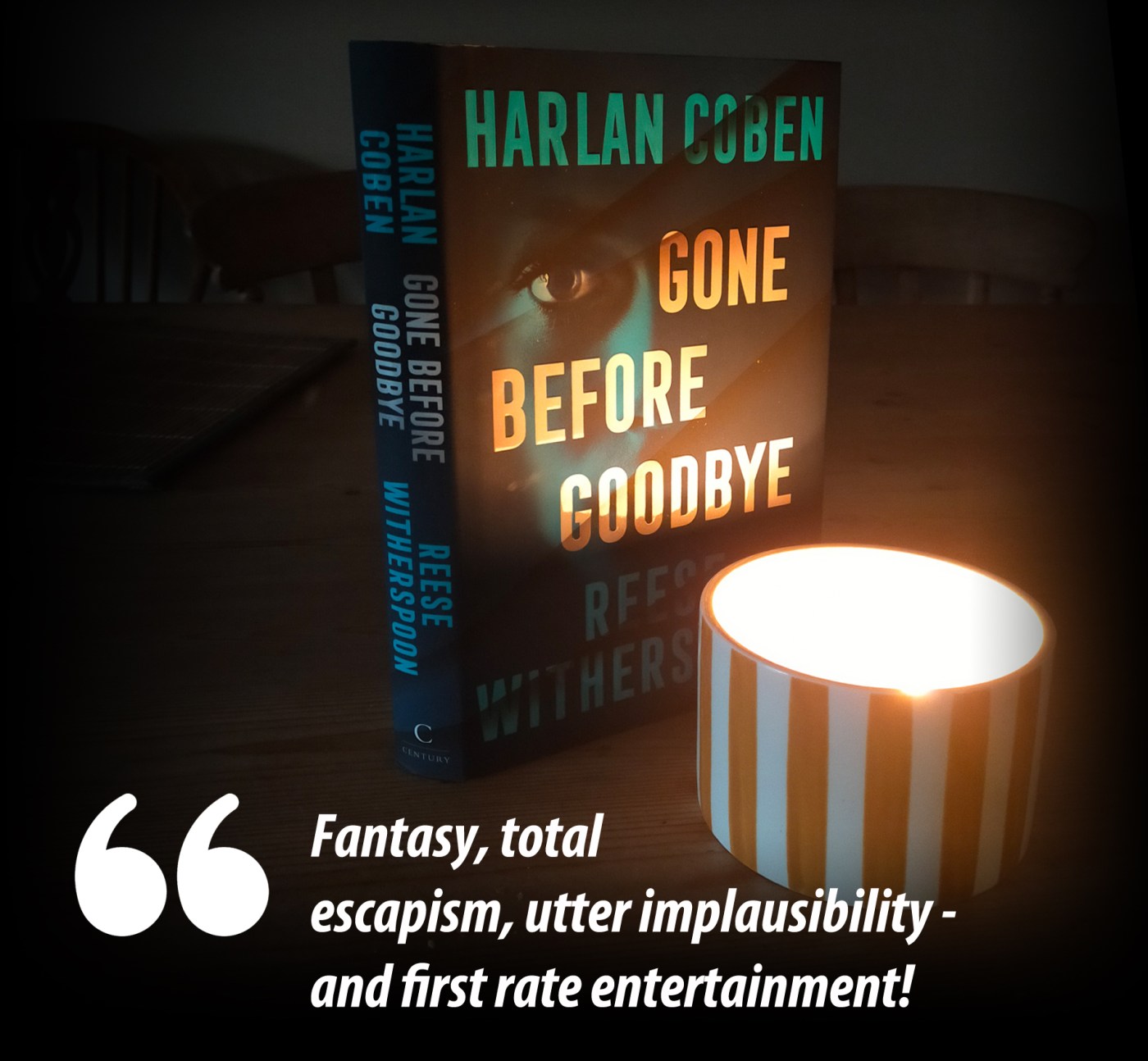
GONE BEFORE GOODBYE . . . Between the covers

Maggie McCabe is – or was – an internationally renowned reconstructive surgeon, who used her skills as a volunteer in some of the worst hell holes on earth, like Libya during its extended civil war. Then, everything went pear-shaped. Traumatised by stress and grief, she took to stabilising herself with pills. Then, one day, she took too many of the wrong kind, botched a surgical procedure, and found herself at the wrong end of a malpractice claim. Now, stony broke and shunned by former colleagues she is offered a job to operate on a reclusive Russian oligarch. All her debts will be cancelled. The malpractice suit will mysteriously disappear.

All too good to be true? Of course it is, but then this is mainstream American crime fiction, where almost anything can happen – and usually does. The novel is the kind of celebrity partnership which makes publicists become dewy-eyed, and makes hard working ‘proper’ novelists apoplectic with a blend of rage and envy. I don’t ‘do’ much mainstream film or TV, so while the name Reese Witherspoon was vaguely on the edge of my consciousness, I had little idea who she was or what she has done. In contrast, I have read many Harlan Coven novels and, with the proviso that they have all had that typical transatlantic slickness, I have found them readable and entertaining. As with most writing collaborations, who wrote what is not immediately obvious, but is the book any good?

Short answer is yes, it is improbably entertaining. You will need, if course, to leave any residual sense of disbelief with the cloak room attendant before you enter this particular literary room. We have ‘griefbots’, totally life-like AI reconstructions of a deceased loved one that can be installed on your ‘phone, and with whom you can chat any time you want; we have a Russian monster do powerful that he can recreate Maggie McCabe’s own operating theatre in an annexe of his winter palace, complete with instrument trays in precisely the same position as she is used to; we have the self same gentleman who has multiple ‘genuine’ copies of the Mona Lisa, one of which was actually painted by LdV himself. Oh I almost forgot. The Russian big shot hosts a gala ball, with a stage set up for a world megastar to perform. The star? None other than Watford’s finest, Sir Reginald Kenneth Dwight (if you know, you know)

Maggie turns in before EJ can sing Rocket Man. She has two surgical procedures to complete the next day – a facelift on the oligarch, a breast augmentation on his girlfriend – and she needs sleep. The surgery goes as planned, but then things begin to unravel. Maggie survives being disposed of (by being tipped out of a helicopter into the bottomless chasm of a disused mine) and ends up (don’t ask) being taken to Dubai by of former physician-turned-CIA-agent.

Meanwhile, back in New York, Maggie’s biker father in law, known as Porkchop, is on the case, and he is a man to be reckoned with. Dubai is, naturally, a whirlwind of opulence, subtly concealed violence – and a mixture of revelation and mystery for Maggie. She has a brief and scary reunion with her Russian oligarch – Oleg Ragorsvich – and learns that his recently enhanced girlfriend – Nadia – is not who she appears to be. Then, via London, Paris and Bordeaux’s Gare Saint Jean (and an escort of French bikers) she and Porkchop are on their way to a former vineyard where all is about to be revealed.

What we have is fantasy, total escapism, utter implausibility – and first rate entertainment. Gone Before Goodbye will be published by Century on 25th October. You can read my reviews of other Harlan Coben novels by clicking the author image (above{

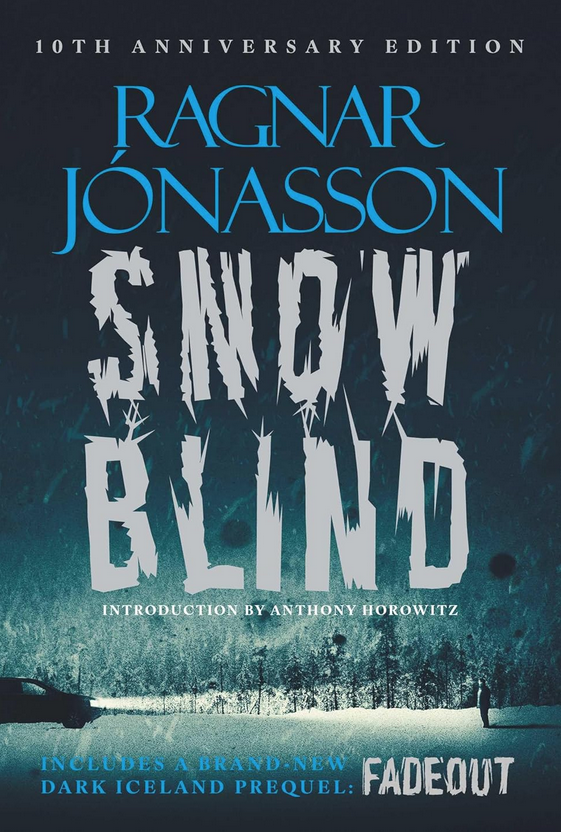
SNOWBLIND . . . Between the covers

Orenda books published Snowblind  in 2015 (original Icelandic publication in 2010) and it was an instant success. Here, we have the tenth anniversary edition with a bonus – Jónasson’s first novel, Fadeout. Such was the international success of Snowblind that Fadeout was rather left behind. It is described as a prequel but, to be pedantic, Snowblind is, at least in the order of events depicted, the sequel. This review focuses entirely on Snowblind, but I will return to the earlier novel at a later date.

The initial narrative is not particularly straightforward, as there are flashbacks and flashforwards. The latter is a horrible word, but the alternative is prolepsis which sounds rather like an uncomfortable medical condition. The bottom line is that Ari Thór Arason, a newly qualified police officer has left his girlfriend behind in Reykjavik, and taken up a job as assistant copper in the remote northern village of Siglufjörður. His boss, Tómas assures him that the only crimes committed locally are drink driving and the occasional bar punch-up. When Hrólfur Kristjánsson the village’s only celebrity resident, is found dead at the foot of a staircase in the local theatre, Ari Thór is under huge pressure to sign the death off as an accident.

Hrólfur was a celebrated author, but lived in rather superior isolation in his home town, basking in his former celebrity. Meanwhile, Ari Thór feels largely ignored by his girlfriend, but has been charmed by another young woman, Ugla, who is teaching him to play piano.While Ari Thór and Tómas brood over Kristjánsson’s fatal fall, the ‘crime-free’ fishing village faces another shock, brilliantly described in one of the many astonishing passages of prose in the book. A little boy is allowed out by his parents to play in the freshly fallen pristine snow.

“He revelled in the snow; it was in his blood. The darkness was comfortable and snug. The sight of the angel, a beautiful snow angel, didn’t frighten him. He knew the woman. He had played often enough in her garden that he even remembered her name. What he couldn’t understand was why she was lying so still, and why she wasn’t wearing a jumper. In his eyes, the blood red snow that formed a halo around her was beautiful, a vivid embellishment to the rest of the pearl white garden. He didn’t want to disturb her and with one last glance at the wondrous sight, made his way home, stopping just once on the way to make a snowball.”

The woman is Linda, wife of Karl, a stalwart of the am-dram group and, incidentally, an addicted (and serially unsuccessful) poker player.Jonasson uses a clever double metaphor for the (2010) situation in Iceland. Younger citizens are still reeling from the spectacular collapse of the country’s banking system, but for older people there is a more potent symbol. The humble herring was once a dietary staple across Europe, but overfishing meant a catastrophic decline in stocks. “You should have been here when there was herring”, one old lady tells Ari Thór.

As the investigation into the attack on Linda and Kristjánsson’s death appears to be going nowhere fast, Jonasson deploys the time honoured device of a community isolated. Agatha Christie and others preferred islands cut off by stormy seas; the Icelandic equivalent is, naturally enough, an avalanche which closes the only road in and out of Siglufjörður. The eventual solution to the crimes is elegant and thoughtful, even if Ari Thór‘s personal situation is about to become even more complicated. This anniversary edition of Snowblind will be published by Orenda Books on 23rd October.

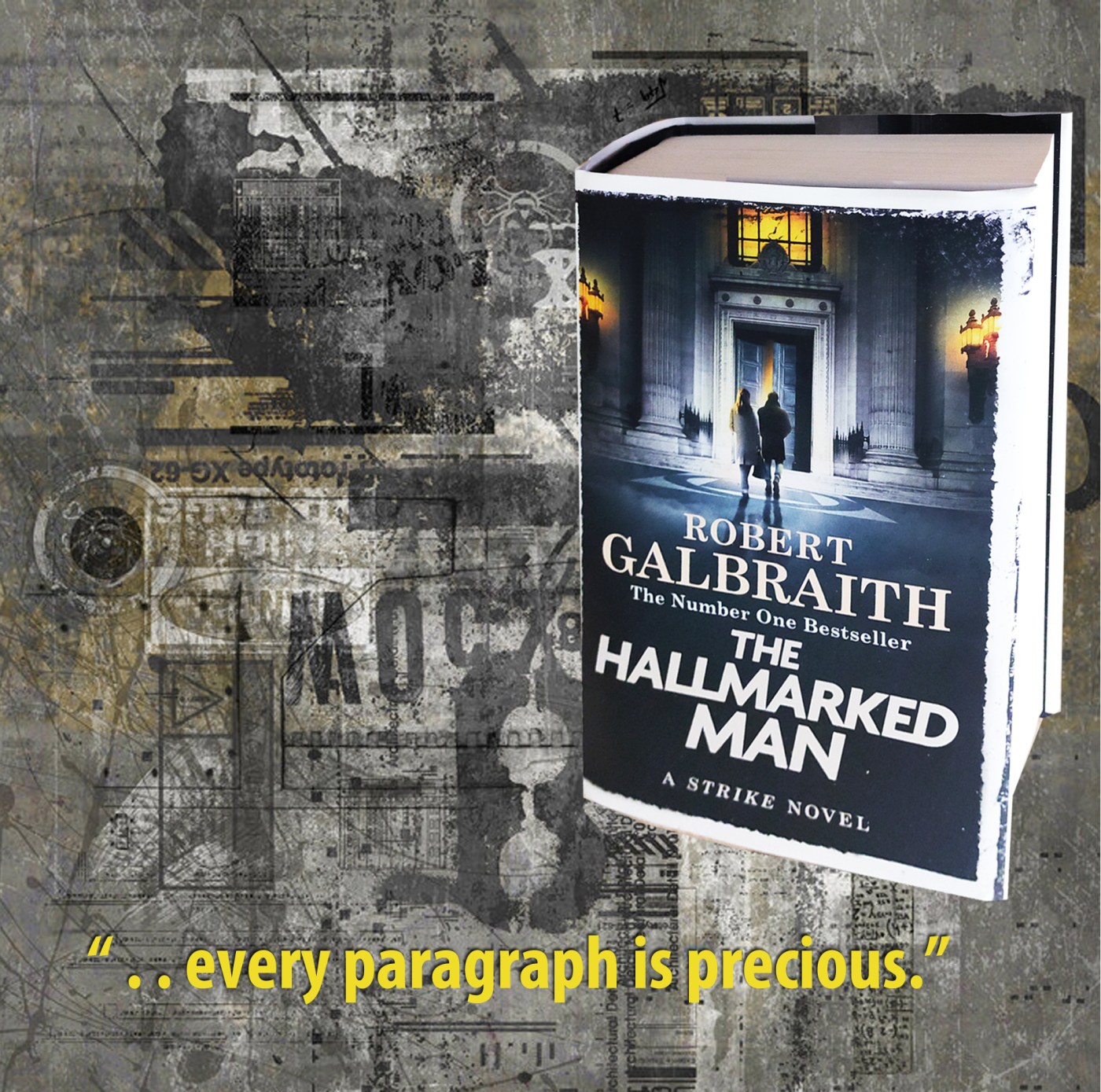
THE HALLMARKED MAN . . . Between the covers

Confession time. Neither I nor my children were born recently enough to have been remotely interested in Harry Potter, and so when JKR entered the CriFi world with her Cormoran Strike books, I was only mildly interested. My loss. My mistake. ‘Bestseller’ is a fluid and relative term, much abused by hyperactive publicists, but if ‘Robert Galbraith’ has sold thousands of books, then good for her. She writes beautifully. Former military policeman turned private investigator Strike is “a broken-nosed Beethoven… over a stone off his ideal weight..” And with just half a leg.

The London PI has a deliciously fraught relationship with his business partner Robin Ellacott. He tries to push back thoughts that he is in love with her while, at the same time, mourning the suicide of his girlfriend, who slit her wrists in the bath because she knew what he knew. Meanwhile, Robin is unattainable, because of her commitment to her Met Police detective partner.

The latest case begins in a  bizarre fashion. Strike is summoned to a near-derelict house in rural Kent, where a rich restaurateur, Decima Mullins, conceals a three-week-old baby beneath her poncho. The baby’s father, she tells him, was Rupert Fleetwood, an impoverished but well-connected ne’er do well. She believes he is dead, murdered and mutilated in a botched raid on a celebrated London silversmith. Her problem is that the police have identified the body as that of someone else altogether, and Decima wants closure.

A subtle touch of genius is the way in which the early action is framed around the English conventions of Christmas. Galbraith avoids the obvious, but hints at the family tensions; singletons quietly dreading the few days back with mum and dad, despite the echoes of happier times; the monstrous extravagance of Harrods; the relentless joviality in pubs and bars, smothering – for a while – any sense of loneliness, loss and insecurity, yet all the while, making for an emotional hangover that is sure to descend once the TV adverts ditch snowflakes and baubles for the equally false promises of holidays under a Mediterranean sun.

This book is very, very long, at just short of 900 pages, but its length gives the author the space to write with great perception and detail, in an almost Dickensian or Hardyesque way, about the way the main characters react and speak to each other. In the hands of a lesser writer, this might make for laborious reading, but here, every paragraph is precious.

Galbraith introduces a touch of the esoteric into the plot, and what can be more esoteric than the arcane symbolism of Freemasonry? The original robbery which gave us the dismembered corpse of – well, there’s something of a queue to join this particular ID parade – involved Masonic silver artifacts, not intrinsically priceless, but of great significance to the initiates.

I must mention the quotes at the beginning of each chapter. Some are from an obscure manual for Freemasons, written by Albert Pike, but others, from Matthew Arnold, Robert Browning, AE Housman are more evocative. We also hear the voice of John Oxenham, a long forgotten writer from the early twentieth century.

Nagging away, like a persistent bass counterpoint under the main tune, is the situation between Robin, her Met boyfriend Ryan, and Strike. Ryan Murphy seems to be everything that Strike is not; conventionally handsome, deeply in love, resolutely honest and utterly devoted to Robin. Murphy wants the elusive first home, the hungry cry of an infant in the night. But what does Strike want, or offer? Robin tells us:

“He was infuriating, stubborn and secretive when she wished he’d be open. But he was also funny and brave, and he’d been honest tonight when she’d expected him to lie. He was, in short, her imperfect best friend.”

The plot is Byzantine in its complexity, and Strike and Ellacott scour the country from Sark to Scotland before they finally discover the identity of the ‘hallmarked man’ and who killed him.. The denouement – in an unremarkable terraced house in the West Midlands – is breathtakingly violent, but my abiding thought about this magnificent novel is, “My God, how did she do this?” The Hallmarked Man is published by Sphere and is available now.

A RAGE OF SOULS . . . Between the covers

This begins as one of the most baffling and impenetrable of Simon Westow’s cases. We are in Leeds, 1826. He solves a case of fraud, the fraudster is sentence to hang, but reprieved. He then returns with his wife to shadow the man he originally tried to defraud. The man, who calls himself Fox, seems connected to his victim, a Mr Barton, via Barton’s wayward son, Andrew. Westow, like Ulysses in Tennyson’s great poem, no longer has “that strength which in old days Moved earth and heaven,” due to a serious wound sustained in a previous case, but his eyes, ears – and legs on the street are provided by his lethal young assistants Jane and Sally.

One of Nickson’s many skills as a writer is to point out the dramatic contrast between the industrial stink of Leeds and the uncorrupted countryside not many miles outside the city. Andrew Barton goes missing, so Jane and the boy’s anxious father make the journey in a chaise towards Tadcaster. Jane investigates the ancient church of St Mary, Lead, solitary and empty in a lonely field. Near the church runs the Cock Beck, which was reported to have run red with blood during the nearby Battle of Towton in 1461, and as she crosses the stream , she makes a terrible discovery.

Quietly, Nickson references the timeless joy of reading. Jane, once an illiterate street urchin, has been taught to read by Mrs Shields, the old lady who has become the mother she never had. Now, Jane spends her spare hours immersed in the novels of Sir Walter Scott and James Fenimore Cooper, borrowed from the circulating library. The printed words take Jane away from the perils and drudgery of her own existence to a world of daring, adventure and hope. In his own way. Nickson does precisely the same thing.

There is a deep sense of poetry in the book, not just in the words, but in the juxtaposition of images. The book begins with Jane witnessing the result of a horrifying industrial accident.  A young girl is being roughly carried to the surgeon, her leg mangled beyond repair. This haunts Jane throughout the book, but then, near the end, there is a kind of redemption. One of the regular characters who ekes out a living on Westow’s streets is Davy, the blind fiddler. Jane’s trauma is redeemed:

“Up by the market cross, Davy Cassidy was playing a sprightly tune that ended as she drew close. He gazed around with his sightless eyes and a girl appeared whispering a word into his ear. He lifted his bow and began to play again, low, mournful. Then the girl stepped forward and began to sing. Jane knew her face. She’d lived with it for months. She’d seen it contorted with pain as the girl was carried from the mill, her leg in shreds. Then when it returned night after night in her dreams. Now she was here, one-legged, supported by a crutch, a voice as unearthly sweet as a visitation as she sang about a girl who moved through the fair. She stood transfixed as a disbelief fragmented and disappeared. The pain she’d heard in the girl that day in February had become beauty. The small crowd was silent, caught in the words, the singing while the world receded around them. The last note ended, a stunned silence, then applause and people pushing forward to put coins into the hat on the ground.”

Eventually, by a mixture of judgment perseverance and good fortune, the mysterious Fox is run to ground in a bloodthirsty finale. A Rage of Souls is Chris Nickson at his best – complex, compelling and, above all. compassionate. It will be published by Severn House on 7th October. You can take a look at earlier Simon Westow books here.

Blog at WordPress.com.

Up ↑