

An awareness of the power and influence of the English landscape is central to the writings of so many of my favourite crime writers, let alone books by literary giants such as Eliot, Dickens and Hardy. In no particular order Phil Rickman’s Merrily Watkins novels would be diminished without the brooding power of the Welsh Marches and the haunting legacy of forgotten settlements and abandoned Victorian chapels; the Philip Dryden novels of Jim Kelly are all the more intriguing due to their being set in the inward-looking hamlets and distrustful communities of the Cambridgeshire Fens. Cities have landscapes, too; Chris Nickson’s Leeds and the ancient palimpsest of London’s long history as revealed in the late Christopher Fowler’s Bryant & May novels are vital parts of the narrative process.
WG Hoskins walked and drove the length and breadth of post-war England, and came up with a magisterial account of how our country was shaped and created.The relentless speed of change meant that Hoskins’ book was out of date almost before print copies were on the shelves in 1955. Even his revision, two decades later, has been questioned by modern writers. His historical account from the earliest human habitation to the Industrial Revolution remains set in stone, however.
Modern observers will not be slow to spot the ironies made apparent by what he writes. He laments, aided by the powerful poetry of John Clare, the destruction – by the parliamentary enclosures in the early nineteenth century – of the ancient heathlands and vast common fields. These vast open spaces were replaced by tiny fields, each bordered by impenetrable thicket hedges of hawthorne. In recent times, ecologists have, of course, railed against the grubbing up of these hedges, and the creation of endless prairies of wheat fields to satisfy modern industrialised agriculture.
Hoskins notes that the enclosure movement provoked a huge rise in the diversity of small songbirds, and the related decline of raptors. Now, it seems, that the ornithological establishment is hell-bent on on the recreation of habitats for birds like Red Kites – even if their predation means death and destruction for smaller birds. What goes around, comes around, I suppose, and I am not qualified to take a position on this debate.The socio-political ironies abound, however. Of the effects of the frantic search for coal (to power the steam driven industrial revolution) Hoskins observes:
“In the Lancashire township of Ince, there are today 23 pit shafts covering 199 acres; one large industrial slag heap covering six acres, nearly 250 acres of land underwater or marsh due to mining subsidence, another 150 acres liable to flooding and 36 disused pit shafts. This is the landscape of coal mining.”
A modern reader of newspapers and magazines will not have to search far to find contemporary eulogies for the wonderful days when coal was king, or imprecations heaped on the heads of those who engineered the collapse of the British coal industry while knowing full well that coal could be bought cheaper elsewhere.
Looking back to historical crime fiction, one of my favourite series is the Bradecote novels, set in twelfth century Worcestershire. Author Sarah Hawkswood was a distinguished historian before she began to write the novels, but it is impossible to believe that Hoskins’ wonderful account of how England was shaped was not at the back of her mind when she wrote her stories. Likewise, Chris Nickson’s novels of nineteenth century Leeds are full of the sulphurous stench of mill chimneys, the insanitary houses and the poisoned rivers that Hoskins describes in his account of the later stages of the industrial revolution.
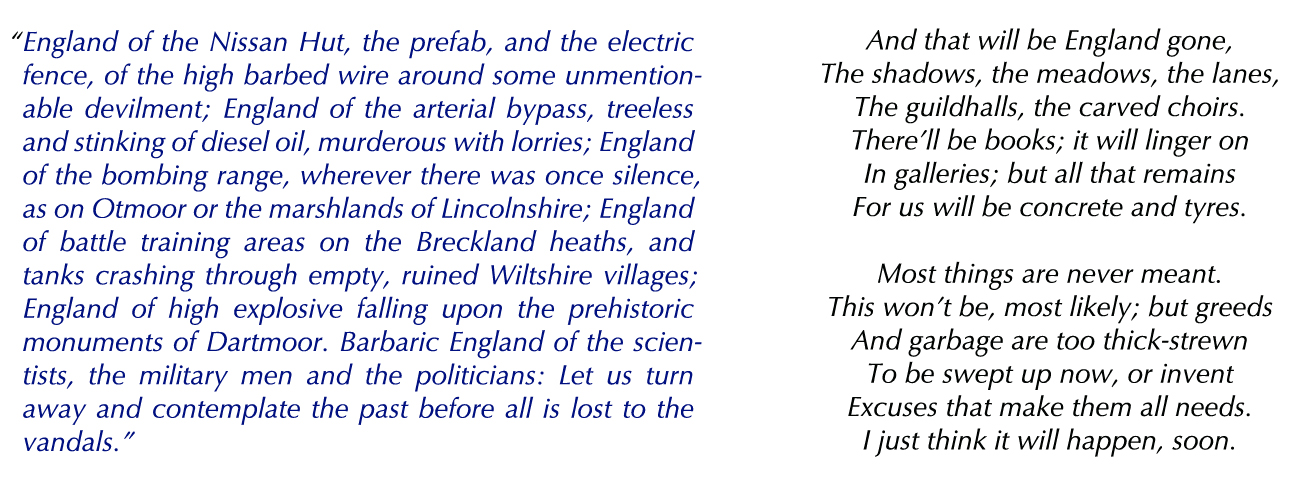
Hoskins was lucky enough – or diligent enough – to be able to end his days in the relatively unspoilt Oxfordshire countryside, but he had a deep anger for what England had become. Below, on the left, is an angry passage from the final chapter of his book and, beside it, the last two verses of Philip Larkin’s ‘Going, going’ (1972)
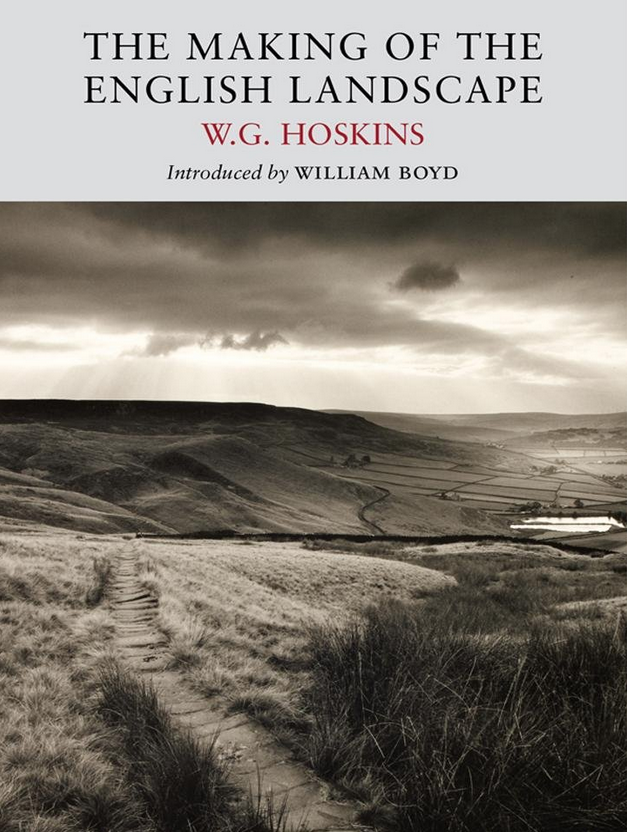
The Making of the English Landscape is a magnificent tour de force; it is essential reading for those who care about England and the spirit of our ancestors who sculpted the human landscape. This edition is published by Little Toller Books and is available now.


 fullybooked2017
Leave a comment