

I reviewed an earlier novel in this series twelve months ago, and you can read what I thought of The Torments by clicking the link. Now, Annie Jackson (with her brother Lewis) returns in another mystery set in the evocative landscape of the Scottish Highlands. Annie’s USP, to be flippant for a moment, is that she has inherited a curse, passed down through female ancestors. She is subject to terrifying revelations that show how certain people she knows are going to meet their death. In the last book her vision was that of a young man from the local lifeboat crew being killed in a car accident. He duly was, and Annie suffered opprobrium for her perceived inability to issue a credible warning.
In that previous novel, she survived a life-and-death struggle with a satanic madwoman called Sylvia Lowry-Law. Lowry-Law is now a permanent resident of a secure mental hospital but, exercising her rights under the bizarrely liberal UK legal system, she requests a meeting with Annie. The prisoner offers to remove Annie’s familial curse, but asks, in return, that Annie searches for – and finds – Lowry-Law’s long lost son.
Annie is sent in the direction of Lowry-Law’s former solicitor in Edinburgh, but the office is now empty except for the former receptionist, an elderly woman called Joan Torrans. She reveals that her former boss took his own life some weeks earlier. Returning to the now deserted office a few days later, after Torrans suddenly dies, Annie and Lewis discover a mysterious room, its door concealed behind a bookcase. In the room is a sinister altar surmounted with a horned skull and spent candles. It seems that the solicitors were connected to a satanic cult known as The Order.
As Annie and Lewis discover that The Order dates back centuries, and is deeply embedded in Scottish history, they learn that its modern operations are financed by a poisonous web of blackmail aimed at some of the richest families in the land. Then, a shocking act of violence turns the narrative on its head.
The author reminds us that in some parts of Britain, the past lays a heavy hand on the shoulder of the present. Annie and Lewis face a struggle, not only against the present day black arts of Sylvia Lowry-Law, but against centuries of superstition, folk memory, and bloody deeds soaked into the very landscape. The finale is worthy (and this is for older readers) of something the cult director Roger Corman might have concocted for one of his Edgar Allan Poe adaptations.
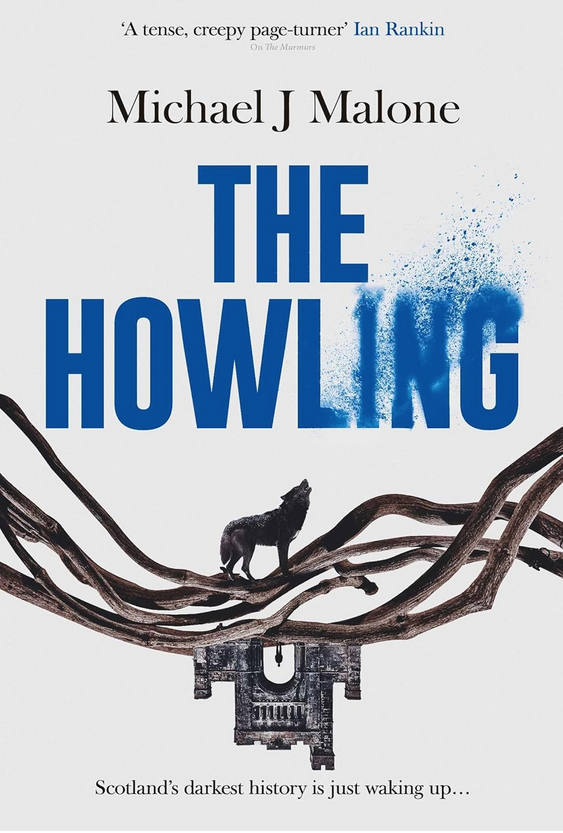
The Howling is a gripping read, and mines into a deep seam of violence embedded in Scottish history and legend. The misty lochs, forbidding hillsides and bleak settlements are perfect settings for memories of witchcraft and lycanthropy. I am normally no fan of split time narratives, but that is just a personal gripe, and the device is skillfully used here to tell the story of a terrible wrong that was done centuries earlier. The Howling is published by Orenda Books and is available now.


 fullybooked2017