Search

fullybooked2017

Month

August 2025

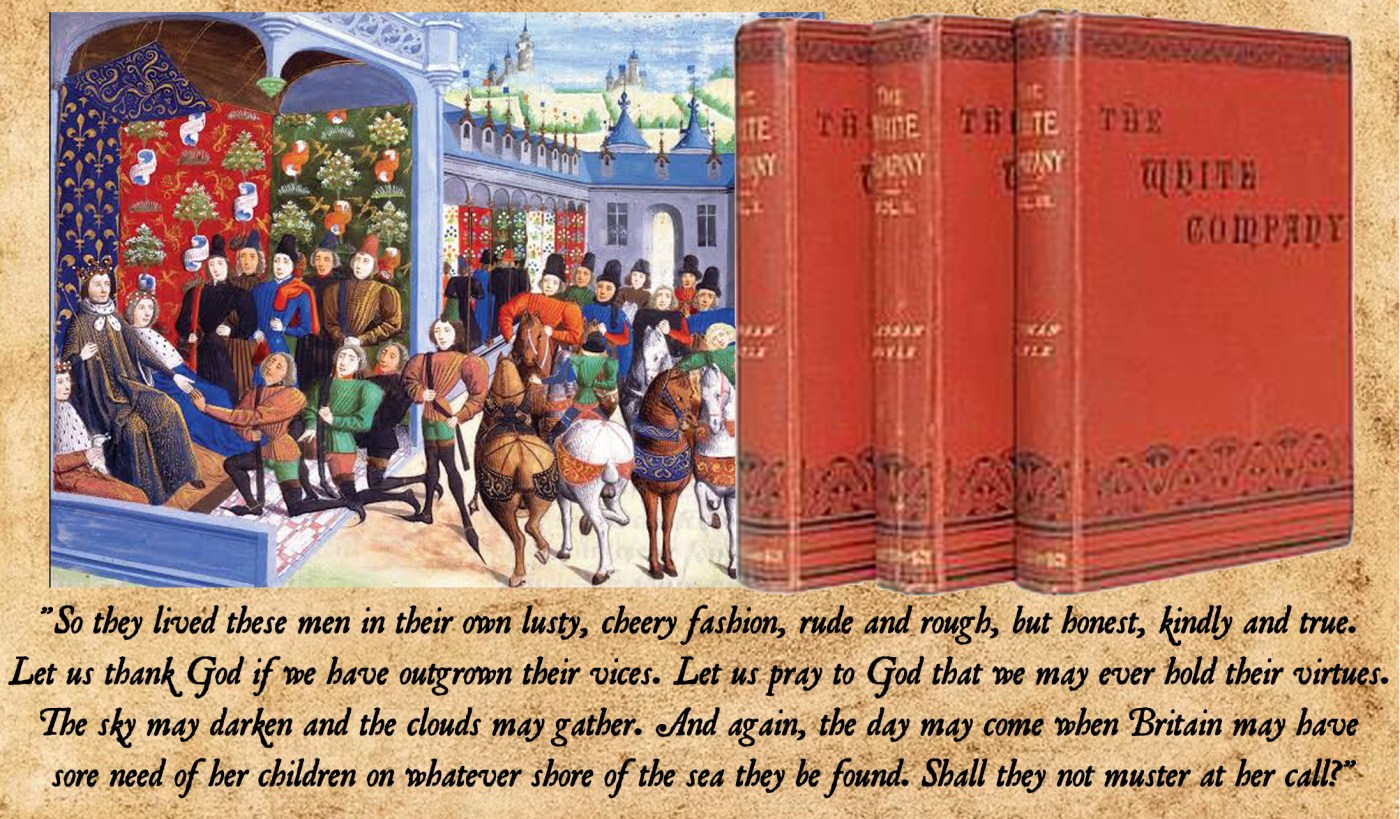
THE WHITE COMPANY . . . Classics revisited

It is well known that Arthur Conan Doyle came to resent the immense commercial success of his greatest creation, Sherlock Holmes. Despite the wealth and fame he enjoyed as a result of those short stories and novellas, Conan Doyle was dissatisfied. Other full length novels were written. Micah Clarke (1889) was set in the Monmouth rebellion, while the Brigadier Gerard stories, boastful tales of a veteran of Napoleon’s army, began in 1894. The White Company (1891) was something quite different.The historical background to this novel is the 1367 campaign led by Edward (The Black Prince) to restore Peter (Pedro) as King of Spain.

The political allegiances are complex, and beyond the scope of this review. Suffice to say, the Prince’s forces in France are boosted by a body of men at arms and archers, led by Sir Nigel Loring, a Hampshire Knight, and his trusted retainers.Chief amongst these is Alleyn, a minor Saxon noble who has been educated by the monks of Beaulieu Abbey, and Samkin Aylward, a veteran archer. We follow these men across The Channel, and down through the battle scarred wastelands of South West France. I have no knowledge that Doyle ever visited the area for research purposes, but this is one of many magnificent descriptions of the terrain:

“The whole vast plane of Gascony and of Languedoc is an arid and profitless expanse in winter, save where the swift flowing Adour and her snow-fed tributaries, the Louts, the Oloron and the Pau run down to the sea of Biscay. South of the Adour, the jagged line of mountains which fringe the skyline send out long granite claws running down into the lowlands and dividing them into gavs or stretches of valley. Hillocks grow into hills and hills into mountains, each range overlying its neighbor until they soar up in a giant chain which raises its spotless and untrodden peaks, white and dazzling against the pale blue wintry sky.”

The biggest challenge facing writers of novels set in medieval times is dialogue and language. The earliest writer to come to terms with this was Sir Walter Scott. Many years later,  Doyle gave us his version. In the 1960s Edith Pargetter (Ellis Peters) and Umberto Eco had their four penn’orth and, more recently, Sarah Hawkswood and Diane Calton Smith have given us their versions. The bottom line is that none of these writers have the faintest idea how people spoke to each other back then. All they can do is create a style and stick to it. The dialogue in this novel is grandiose and florid, full of improbable imprecations such as, “By the Holy Rood,” and “By my ten finger bones,”

After a cataclysmic battle between the outnumbered White Company and thousands of Spanish knights, the book ends improbably, but with a sense of glory and noble sacrifice. Doyle went on to work with distinction as a Medic in The Boer War and his son, Kingsley, served throughout The Great War, only to die of influenza in 1918. The final words of this novel confirm that Doyle had a deep sense of connection with the idea of English heroism and sense of duty. Perhaps the final words of this novel have a sense of prophecy about them:

“So they lived these men in their own lusty, cheery fashion, rude and rough, but honest, kindly and true. Let us thank God if we have outgrown their vices. Let us pray to God that we may ever hold their virtues. The sky may darken and the clouds may gather. And again, the day may come when Britain may have sore need of her children on whatever shore of the sea they be found. Shall they not muster at her call?”

Some modern readers will certainly find the book overly romantic, and wonder at the seeming implausibility of the chivalric code of honour. Historically, the narrative owes much to the chronicles and poems of Jean Froissart, whose account of the times continued to inspire creative artists. Indeed, Elgar’s Froissart Overture was composed just a year before The White Company was published. For me, rereading the book after many, many years was a sheer joy, and serves as a reminder of just how good a writer Doyle was.



			

THE DEVIL’S SMILE . . . Between the covers

This is the sequel to The Lollipop Man (read my review from earlier this year) and we are reunited with reluctant student investigator Adrian Brown, and his friend Sheila Hargreaves, a TV journalist and co-presenter of Yorkshire Crimetime, a regional TV show featuring local criminal activity.. Adrian’s social life is not exactly glittering, and consists largely of optimistic – but largely disappointing – trips to gay pubs and clubs in mid 1990s Leeds. A recent Yorkshire Crimetime featured the murder of a young gay man, a waiter at a local Italian bistro.

Thanks to a timely intervention by his housemate, Adrian has survived the consequences of one drunken pick-up too many, in the shape of an encounter with a predator called Edmund. Meanwhile, Sheila’s  co-presenter Tony Tranter has gone missing. He is a narcissistic drunk, and has a reputation for unreliability, but this time his absence seems more serious. Then, Tranter’s car is found abandoned under Leeds railway station, bearing signs of a violent struggle. Not long after, his body is found nearby, concealed beside one of the vast Dark Arches above which is the station, and below which the captive River Aire roars and foams. Sheila, fed information by her journalist friend Jeanette Dinsdale, know knows that a scandal was about to break. Tranter was a member of an exclusive and secretive club, where underage girls and boys were provided to provide ‘entertainment’.

The initial, and benevolent, reaction of the TV people is that Tony Tranter was killed in revenge for some criminal who had been brought down as a result of Yorkshire Crimetime’s actions. Sheila suspects differently, but goes along with the initial impetus to record a TV special which will enlist the help of tens of thousands of viewers to bring Tranter’s killer to justice. Adrian, meanwhile, has finally reported his assault to the largely uninterested West Yorkshire Police, concerned

I have tagged this novel as #historicalcrimefiction, but it just doesn’t seem that long ago. I was never an addicted viewer, but Crimewatch was, for a few years a major BBC show. Main presenter, the earnest and clean-cut Nick Ross, with his ‘glamorous assistant’ Sue Cook, purported to solve crimes by presenting re-enactions of crime scenes, and inviting viewers to telephone in with information. It seems bizarre that it lasted as long as it did, and is haunted by the supreme irony that the murder of one of its later presenters, Suzanne Dando, remains one of the great unsolved crimes in British history. Sheila Hargreaves’s show is something similar, and has a huge audience.

It is worth taking a moment to look at Leeds as a crime novel setting. In terms of output, the stories of Chris Nickson take some beating, and he has set his novels in different historical periods, my favourites being the Tom Harper books which follow the Leeds copper from the late Victorian era through to the end of The Great War. In terms of grim and grimy readabiity, the GrandDaddy has to be David Peace’s Red Riding Quartet, set from 1974 to 1983, which pretty much encompassed the era of ‘The Yorkshire Ripper’. My review of two of those books is here.

Back to this novel. Daniel Sellers has Sheila, Adrian, the police (and us) following a series of imaginatively crafted red herrings, until a thrilling finale reveals the truth. This enterprising and addictive thriller will be published by Allison & Busby on 21st August.

THE PRINCIPAL DAY . . . Between the covers

Fenland is, today, an area of Cambridgeshire and Norfolk that was once a primeval swamp, where people survived on tiny islands just high enough above the brackish water to provide shelter and sustenance. Now, the name survives as a District Council, but the waters have long since been drained and tamed. Three novelists have found the flatlands suitable for detective stories. The greatest remains Dorothy L Sayers, albeit through one book only. The Nine Tailors (1934) is a fiendishly complex murder mystery set after The Great War, although the thunderous power of barely restrained rivers is never far away. Jim Kelly’s Philip Dryden books tap in to a more sinister side of the landscape, typified by endless skies, church towers and unbroken horizons. He tells us of isolated communities, ancient jealousies and the heavy hand of history. I nominate Diane Calton Smith to complete the triumvirate. Her novels, set in Wisbech from the time of King John up to the 15th century, portray a landscape that changes little, but a social structure that has evolved.

The Principal Day, her latest,finds us in the town in 1423, with a rather splendid late medieval church (little changed today) but in a world that has changed much since the earlier novels. Local farm workers are no longer serfs and villeins, but – in the case of more skilled men – free agents who can seek employment with whoever is prepared to offer the best pay.

There is a school. Situated in a tiny room above the porch of the parish church, it is presided over by Dominus Peter Wysman, a decent enough man, but not greatly respected by one or two of his older pupils. One of the pupils, Rupert of Tilneye is a reluctant scholar, and is just days away from leaving school to go and help run his family manor at nearby Marshmeade. After several humiliations by by the teacher, he resolves to pay the man back by slipping a tiny quantity of ground up yew leaves into his drink. Yew is, of course, a deadly poison when consumed in quantity, but Rupert administers just enough to produce a violent laxative effect, much to the amusement of the scholars.

Much of the story centres on Wisbech’s Guild of The Holy Trinity, of which Peter Wysman is a member The Guilds have no modern equivalent save perhaps Freemasonry. To belong to the Guild, you had to be rich and influential, and its chief, the Alderman, was someone of great influence. They regularly dined on rich roasted meats washed down with wines imported from Europe. When, on The Principal Day (a significant day of celebration and ceremony, often centered around the feast day of the guild’s patron saint or a major religious holiday, in this case the Feast of The Holy Trinity) the Guild members gather for a lavish feast. Wysman is taken unwell, rushes outside into the Market Place, where he collapses and dies.

Rupert’s cruel prank on Wysman was widely known to the scholars. When they are questioned, Rupert is arrested for murder and thrown into the dungeons of Wisbech Castle. His mother, Lady Evelyn, is convinced that he is innocent, and travels to Ely, where she enlsists the help of Sir Henry Pelerin, the Bishop’s Seneschal. He agrees to investigate the case.

In one way, Diane Calton Smith has crafted an excellent medieval police procedural. Sir Henry Pelerin is, I suppose, the long suffering Detective Inspector, while the Constable’s Sergeant-at-arms is a bent copper worthy of modern novels. We even have a version of the stalwart of many a thriller, the brusque and abrupt police pathologist. In the end, we even have that Golden Age prerequisite, the denouement in the library. In this case, however, the principal suspects are assembled at a feast to celebrate St Thomas’s Day. If you will pardon the obvious comment, it is here that all doubt is removed from Pelerin’s mind as to who poisoned Magister Wysman.

Diane Calton Smith weaves her magic once again, and entrances us with a tale shot through with dark deeds, heartache, love and perseverance but – above all – an astonishing ability to roll away the centuries and bring the past to life. The Principal Day is published by New Generation Publishing and is available now. For more on Diane’s Wisbech books follow this link.

KISS HER GOODBYE . . . Between the covers

I reviewed a previous Frankie Elkins book, Before She Disappeared, (click the link to read) in 2021, and I made the point there that Frankie is one of the more implausible heroines in modern CriFi. Rather like Jack Reacher she travels with pretty much just the clothes she is standing up in, and a bag containing a few toiletries and ID documents. Her ‘job’? I use the quote marks advisedly, because she hunts for missing people. She doesn’t charge a fee, but usually finds temporary employment in the town of city where her investigations begin. She has taken all kinds of jobs from barkeep to cleaner. but here she appears to land on her feet. Or does she?.

Here, she gets a job as pet-sitter for Bart, a ridiculously rich gamer in Tucson Arizona. The house is huge and futuristic, and the pets? Here comes Frankie first little problem. The main pet is a huge Green Iguana called Petunia, and Frankie has a roomful of exotic snakes to feed with frozen rats and live crickets. And Frankie just hates snakes.

It’s safe to say that Frankie has a disturbing history. Here, she gazes into the eyes of a little Afghan girl.

My name is Frankie,” I murmur. She stares at me. Stares, stares, stares, until I can feel each of my sins. All of my secrets slowly being stripped bare. I let her take my full measure. The losses I have felt, the pain I’ve inflicted, the sad little girl who still lives deep inside me, longing for her father to sober up, wishing for her mother to come home. The damaged woman I’ve become, unable to stay too long or connect too deeply because the sheer anxiety of such intimacy makes me want to drink.’

Her latest crusade? To find Sabera Ahmadi, an Afghan woman who has disappeared from her temporary refugee accommodation in Tucson, leaving her husband and young daughter behind. In her own words, Sabera describes the horrific events of the previous few years. It is a particularly grisly episode in modern history, but just the latest chapter in a sorry tale of foreign powers believing they could impose some kind of external rule on Afghanistan. From the disastrous military adventures of the British in the 19th century, to the futile 1980s attempts by Russia to prevent the rise of Islamic extremism, and concluding with the equally ineffective attempts by the Americans and British to democratise the country, the inexorable resilience of the vile Taliban covers Sabera’s life like a funeral shroud.

Sabera’s husband Isaad also goes missing, but when he is found dead, with evidence that he has been tortured, Frankie feels she is no closer to the core or the case, despite help from a diverse collection of allies, including Daryl (Bart’s chauffeur and minder), Roberta (Daryl’s ballroom dance partner) and Marc, a police detective, and brother to Roberta . Oh, yes, we mustn’t forget Genni, Bart’s six-feet-four transvestite housekeeper.

However, Sabera is far from being a hapless victim of international war games, or an archetypal submissive Muslim woman. It transpires that before the Taliban retook Kabul, Sabera – like her mother before her – was already involved with international intelligence agencies, and she was valued for her mastery of several languages, and a skill with numbers and code that made her a valuable asset.

Frankie (as ever) has bitten off more than she can chew, and finds that the truth behind Sabera’s disappearance is more disturbing – and potentially deadly for all concerned – that she could have ever imagined. Lisa Gardner gives us a book that is impeccably researched and has full-on relentless pace. Kiss Her Goodbye is published by Century and will be available on 14th August.

Blog at WordPress.com.

Up ↑