
This is one of those books, and I use the italics advisedly. The basic story that we are led to believe is that a married couple called Hope and Drew have entered into surrogacy arrangement with a woman called Lauren. Presumably, this involved Lauren’s ova and Drew’s sperm, and thanks to the wonders of modern medicine, the two combined in Hope’s womb, and she gave birth to a boy called Sam. Again I use ‘presumably’, because the bulk of the book comprises first person narratives from the three main characters, and we have no way of knowing if they are reliable accounts or not.
The book begins in the present day, and Lauren, having taken Sam from Hope and Drew, is living in a remote fishing village in Spain. Meanwhile, an Interpol warrant has been served on her and she is visited by the Spanish police. Sam is packed off with Lauren’s new boyfriend to stay with his relatives, and Lauren returns to Britain to face the music. So far, so straightforward.
Then the narrative goes into recall/split time frame mode, full of ‘two years earlier’ and ‘six weeks later’ chapter headings. Personally, from an enjoyment point of view, I hate this device, but so many authors seem to use it, so it was a case of ‘grimace and bear it’. It’s almost certainly just a personal thing. Different first person narratives are one thing, and I can think of no better example in literature than William Faulkner’s As I Lay Dying, but there, the time frame didn’t confuse things. It was simply different people observing events in their own way, and the narrators were witnessing the same events at the same time.
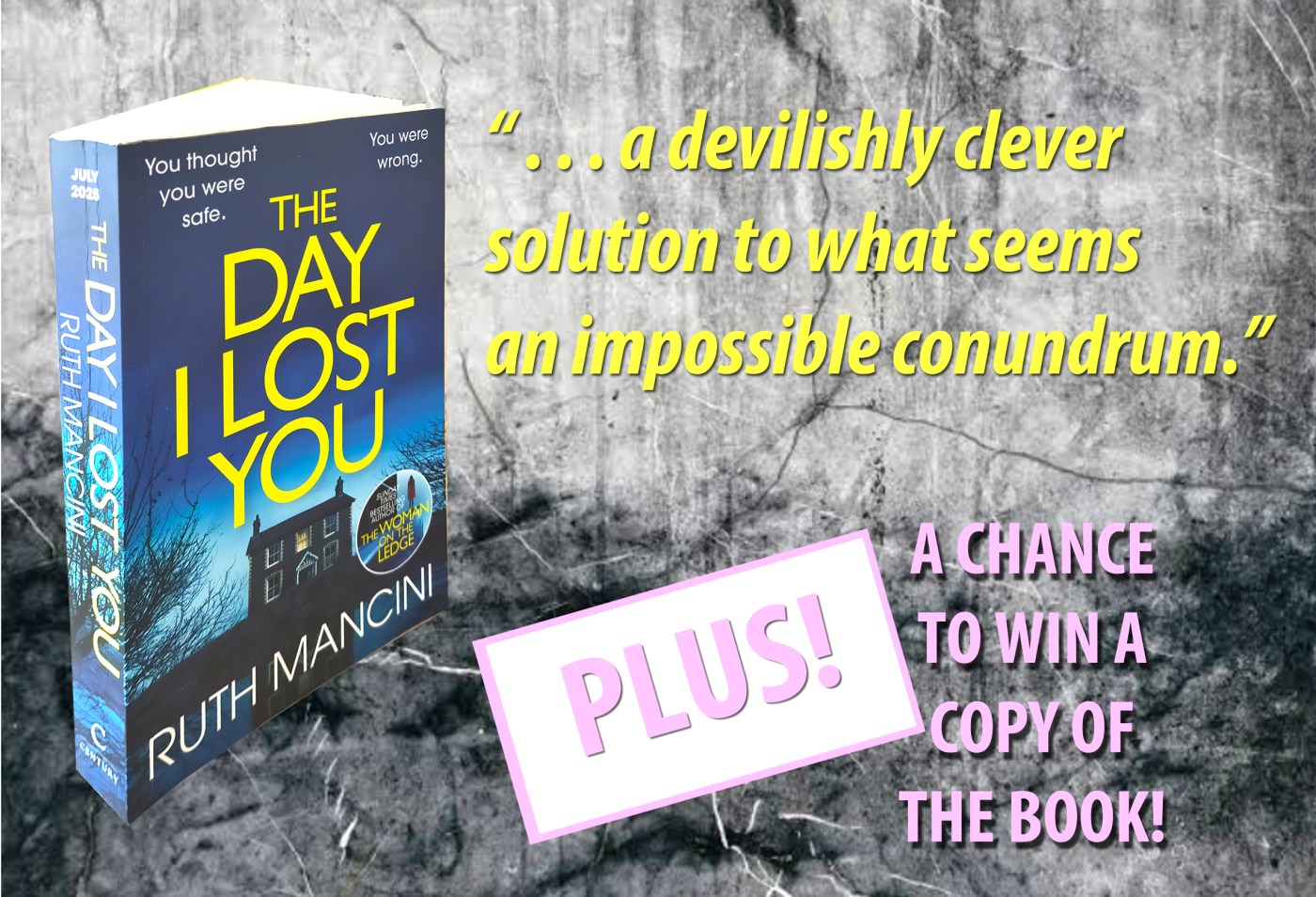
What follows next is a master class in deception from Ruth Mancini. She lures us into one false assumption after another, until we have Lauren, Hope and Drew in a virtual suspects’ line-up, leaving us to look into their eyes trying to decide who is lying and who is telling us the truth. The answer, when it finally comes, is a devilishly clever solution to what seems an impossible conundrum. The Day I Lost You is a very apt title, as it could be argued that it applies equally to the three main adult characters. Each has lost someone and so, in a way, this is three different tragedies woven into one powerful story. I suppose that there is a happy ending, of sorts, but Ruth Mancini shines a bright and revealing light into the lives of women who long to have children, and how they suffer when fate – and biology- seem to conspire against them. This book will be published by Century on 31st July.
I have a mint copy up for grabs in a prize draw, and entry is simple. Follow me on X at @MaliceAfore (I will reciprocate), then DM me the code printed below. You will then be in the digital hat, and I will draw a winner at 10.00pm on Monday 4th August. UK addresses only.
46329


 fullybooked2017