

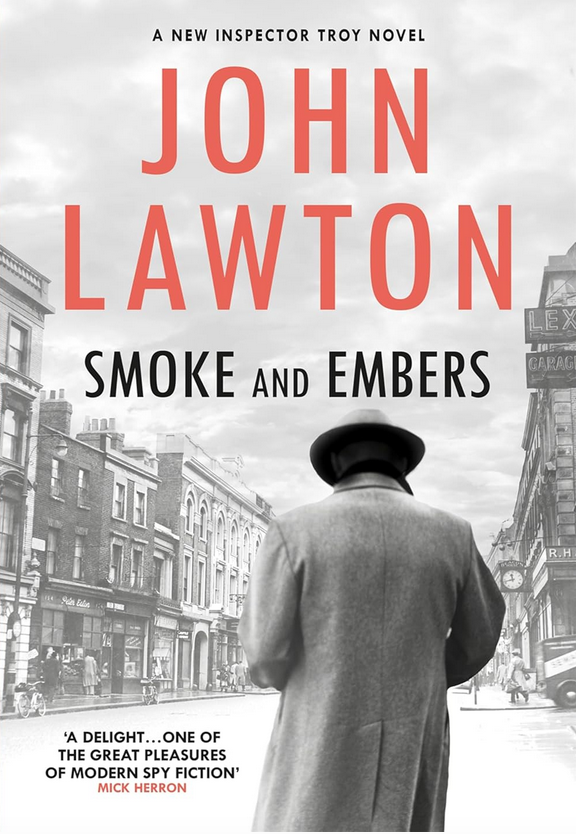
Fans of John Lawton’s wonderful Fred Troy books, which began with Blackout (1995) will be delighted that the enigmatic London copper, with his intuitive skills and shameless womanising, makes an appearance here. Throughout the series Troy, son of an exiled Russian aristocrat and media baron, subsequently crosses the paths of all manner of real life characters including, memorably, Nikita Kruschev. For those interested in Troy’s back-story, this link Fred Troy may be of interest. He is not, however, central to this story. We rub shoulders with him, for sure, and also with his brother Rod, a Labour MP who serves in Clement Attlee’s postwar government. We are also reminded of characters from the previous novels – Russian soldier and spy Larissa Tosca, and the doomed Auschwitz cellist Meret Voytek. The book begins with sheer delight.
“Brompton Cemetery was full of dead toffs. Just now Troy was standing next to a live one. John Ernest Stanhope FitzClarence Ormond Brack, 11th Marquis of Fermanagh, eligible bachelor, man-about-town, and total piss artist.”
As ever in Lawton’s novels, the timeframe shifts. He takes us to 1945, the year of Hitler’s final annihilation, and to 1960 and the capture of Adolf Eichmann. Central to story is the fate of Europe’s Jews, their destruction at the hands of the Nazis, and then their almost complete rejection by Poland, Palestine, Britain, America and Russia after what was, for them, a hollow victory in 1945. Lawton’s story hinges on the lives of three young men. First is Sam Fabian, a German Jew, a mathematician and physicist who is saved from Auschwitz by a misfiring SS Luger and a compassionate Red Army officer. Then we have Jay Heller, a gifted English Jew who, immediately after joining up in 1940, is head hunted into the British intelligence services. Finally, we have Klaus LInz von Niegutt, minor member of what remains of the German aristocracy, who finds his way – or is led – into the SS. He is, however, not a violent man, and only does the bare minimum to remain ‘one of the chosen’. His significance in the novel is that he was one of the scores of staff – cooks, clerks and secretaries – who were in Hitler’s bunker in those fateful days at the end of April 1945.
With an audacious plot twist, Lawton gets Sam Fabian to England, where he finds work with a millionaire German Jew called Otto Ohnherz whose empire while not overtly criminal, is founded on the success of ventures that, while not quite illegal, are extremely profitable. He can afford to employ the best professionals. This is his barrister:
“It was said of Jago that by the time he’d finished a cross-examination, the witness would be swearing Tom, Tom, the Piper’s son had been nowhere near the pig and had in fact been eating curds and whey with Miss Muffet at the time.”
When Ohnerz dies, Jay takes over the empire, and becomes involved with maintaining Ohnerz’s rental property business. While making sure the money still rolls in, he sets out to improve the houses, particularly those rented by tenants recently arrived from the Caribbean. It is when Jay’s broken body is found on the pavement below his headquarters that the story seemingly takes a turn towards the impossible. What Troy and the pathologist discover certainly had me scratching my head for a while. Lawton’s use of separate narratives and times allows him to set a seemingly unsolvable conundrum regarding the ultimate fates of Jay, Sam and Klaus. To be fair, he provides clues, using a rather clever literary device. I won’t reveal what it is, but when you reach the last section of the book, you may need to revisit earlier pages. Smoke and Embers shows a profound understanding of the dark realpolitik that followed the end of the war in Europe, and is full of Lawton’s customary wit and wizardry. It is published by Grove Press UK and is available now.


 fullybooked2017
Leave a comment