

Anthony Horowitz is – deservedly – celebrated as an author and screenwriter. In the Daniel Hawthorne novels he plays himself, and there are frequent allusions to the world of publishing and TV production. In this novel the central character is Susan Ryeland, a freelance literary editor. She has just returned from a spell living in Crete with her hotelier boyfriend, but the charms of the sun, blue sea, olives and tsikoudia lifestyle have worn thin and she is back in London.
Her first commission on returning to England is to read through a manuscript of what is politely known as a continuation novel. Atticus Pünd was the central character in a highly successful series written by Alan Conway, and Susan had edited the books, despite having a fractious relationship with the author. Conway died in dramatic circumstances, but now a writer called Eliot Crace – himself the grandson of widely venerated author of children’s fiction – has resurrected Pünd. Susan is no fan of continuation novels, but this is Mr H having a little joke at his own expense, as among his own novels are ‘continuations’ of Sherlock Holmes and James Bond.
Make no mistake, the structure of this book is more complex than any of Horowitz’s books that I have read previously, but perhaps it is similar in the two books – Magpie Murders and Moonflower Murders – which preceded this title. I do not watch much mainstream television, and I was unaware that these novels had also been filmed for the small screen.
Not long after Susan has offered to read through the first part of Eliot Crace’s reimagining of Atticus Pünd, we get to read it with her, and it tells of Pūnd, aware that he is terminally ill, investigating the death by poison of an English aristocrat in her villa in the south of France. We have, then, a novel within a novel. it must be one of the greatest challenges for a writer to make readers of a sequential novel aware of what has happened in previous books without labouring the point. Horowitz doers it well here, so I won’t waste paragraphs explaining what happened to Susan in the previous two books. Here, she learns from Eliot Crace that his grandmother, far from being the sainted creator of million-selling children’s books, adored by countless fans, was actually a vindictive, intolerant and spiteful old woman. Anthony Horowitz has set up a delightful conceit – and I use the term in its positive sense.
There is added piquancy in the fact that Susan Ryeland, the narrator of the ‘outer’ novel, is being paid to edit/criticise the content of the ‘inner’ novel, penned by Eliot Crace who, at first glance, appears to be mad, bad and dangerous to know. Anthony Horowitz is, like it or not, deeply embedded in the world of TV drama. There are many of us who think that Foyle’s War was the best show we ever watched. AH retains a keen eye for the best and worst of prime time TV drama and, using the voice of Susan Ryeland, he sneaks in a mention of ‘one that got away’, a thoughtful and intelligent series called Boon, starring Michael Elphick.
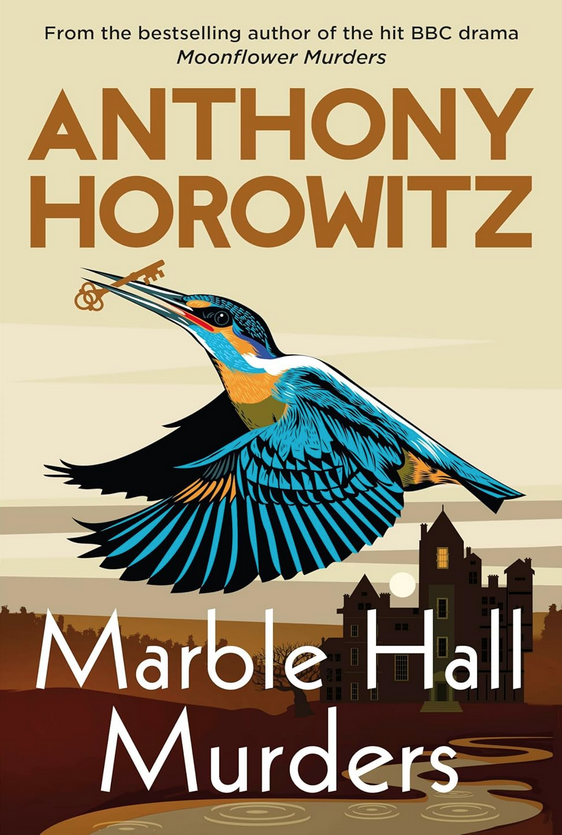
This is a complex novel containing layers within layers, but the nub is that Eliot Crace, although just a child, witnessed (or believed he had) his grandmother’s murder. Having lived with this secret for decades, he now decides to reveal the identity of the killer in his Atticus Pünd pastiche. When he himself dies in suspicious circumstances, we must assume that his killer is not someone from a novel, but a real person, still living, and someone who cannot afford the truth behind the death of Miriam Crace to become public knowledge. I hope this is not a spoiler, but astute readers will be alerted by the beautiful cover image of Alcedo Atthis.
A long read, this, not far short of 600 pages, and Anthony Horowitz has cooked up an intriguing blend of elements. We have Golden Age Crime, complete with incriminating anagrams, arcane use of poison, the glittering world of wealthy people and, naturally, the ‘in the library’ denouement where the killer’s identity is revealed. Throw into the mix a candid view of the rather bitchy world of publishing, a rather engaging police officer, and we have something for everyone. The television version of this novel, with Lesley Manville playing Susan. will be on your screens soon. Meanwhile, the book comes out in hardback, published by Century, on 10th April.


 fullybooked2017