Search

fullybooked2017

Month

April 2025

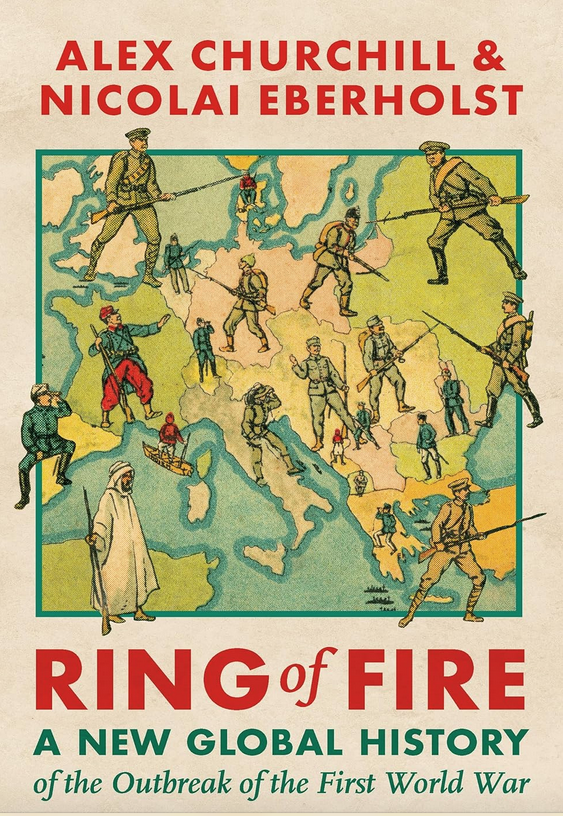
RING OF FIRE . . . Between the covers

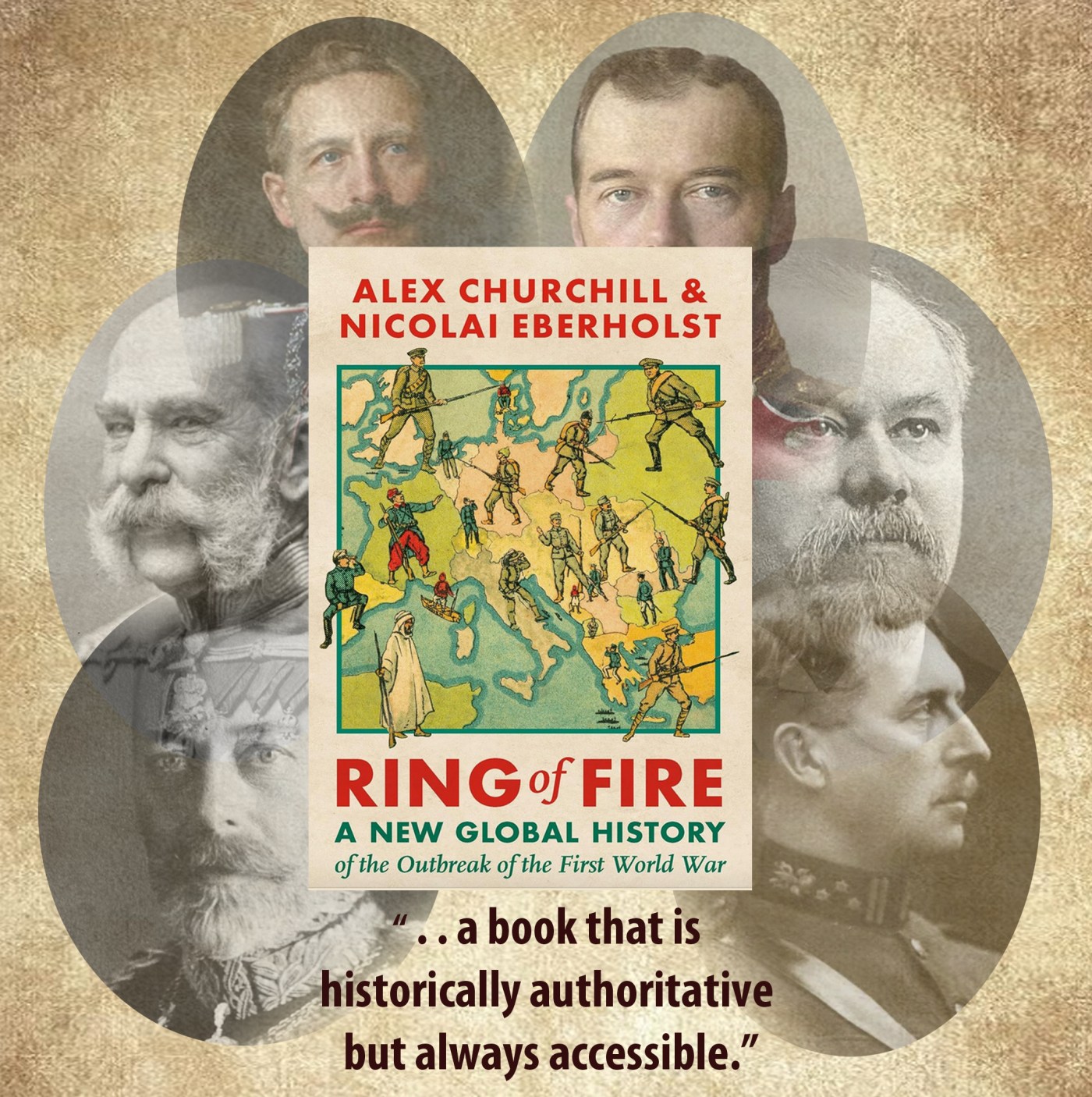
In my reading experience, the definitive account of the outbreak of The Great War remains Barbara Tuchman’s The Guns of August (1962). The author made us flies on the wall in cabinet meeting rooms across Europe, and hidden observers within General Staff offices of the armies of Germany, Britain, France and Russia. This book is very different. Its premise is that this was a truly global conflict, principally due to the vast colonial outreach of the major powers. Men and women, ordinary citizens of places in Africa that were ruled from London, Berlin, Paris and Brussels, remote settlements in the Caucuses who were subject to the rule of the Tsar, shoeless peasants in the outer reaches of the ailing Ottoman empire, and those living in the United States and South America who were part of the colossal diaspora from Europe – all felt the rough hand of destiny on their shoulder.

The celebrated (but not always admired) historian AJP Taylor famously argued that the outbreak of the war was inevitable, due to military planning relying on inflexible railway timetables. Once the trains, packed with tens of thousands of men, headed off to their destination, then conflict was inevitable. This theory is easily challenged but Churchill and Eberholst give this example:
Britain’s rail network comprised some 23,000 miles of track. On 4th August 1914, 130 companies were effectively taken over by the government. At Aldershot, from 5th August officers were being handed dossiers that revealed the plan for their departure. For instance: ‘Train No 463Y will arrive at siding B at 12.35 a.m., 10th August. You will complete loading by 3.40 a.m.’

Britain’s army in 1914 was tiny compared to those of France, Germany and Russia. It was even outnumbered by the army of Belgium, but it was superbly trained and had relatively recent battlefield experience in the Boer Wars. The key difference between Britain and the empires of France and Germany was in the existence of Britain’s white dominions. Australia, Canada, New Zealand and South Africa were, in theory at least, at one with the mother country’s foreign policy.

One of the many valid points made by the authors is the vexatious question of perceived neutrality. Long before the first shots were fired in the war, developed nations needed vast quantities of imports and, were they fortunate enough to possess natural resources, ships to export material and goods elsewhere. The ownership of cargo vessels was perhaps not as opaque then as it is now but, for example, if a Swedish ship sailed into Hamburg loaded with iron ore, did that compromise Sweden’s notional neutrality? What if an American ship loaded with wheat were headed for the Port of London? Did that make the vessel fair game for German submarines?

The authors remind us that by the time the trenches ran from Switzerland to the Belgian coast, maps were able to be made showing every dip or fold in the land and – literally – every large shell crater. In the dying days of August 1914, particularly in the rural areas of Galicia, East Prussia and Serbia, the landscape was a complete mystery to field commanders. Knowledge of the terrain was almost completely absent, resulting in disastrous tactical blunders by all sides.

Comparing different kinds of horror brought about by war is, perhaps, futile, but as an amateur historian brought up on grim tales of life in the Western Front trenches, I was struck by the descriptions of the relentless carnage of these early weeks of the war. Yes, it was a war of movement but, in particular, it was fought in intense August heat. Men on the march were driven mad by thirst; tinder-dry fields and woods caught fire quickly, cremating the dead and wounded alike. This was a new kind of war; medical services were woefully inadequate to meet carnage on this scale. I was quickly disabused of any notions I had that these early battles between the huge armies were somehow cleaner and less grisly than the trench warfare which followed them.

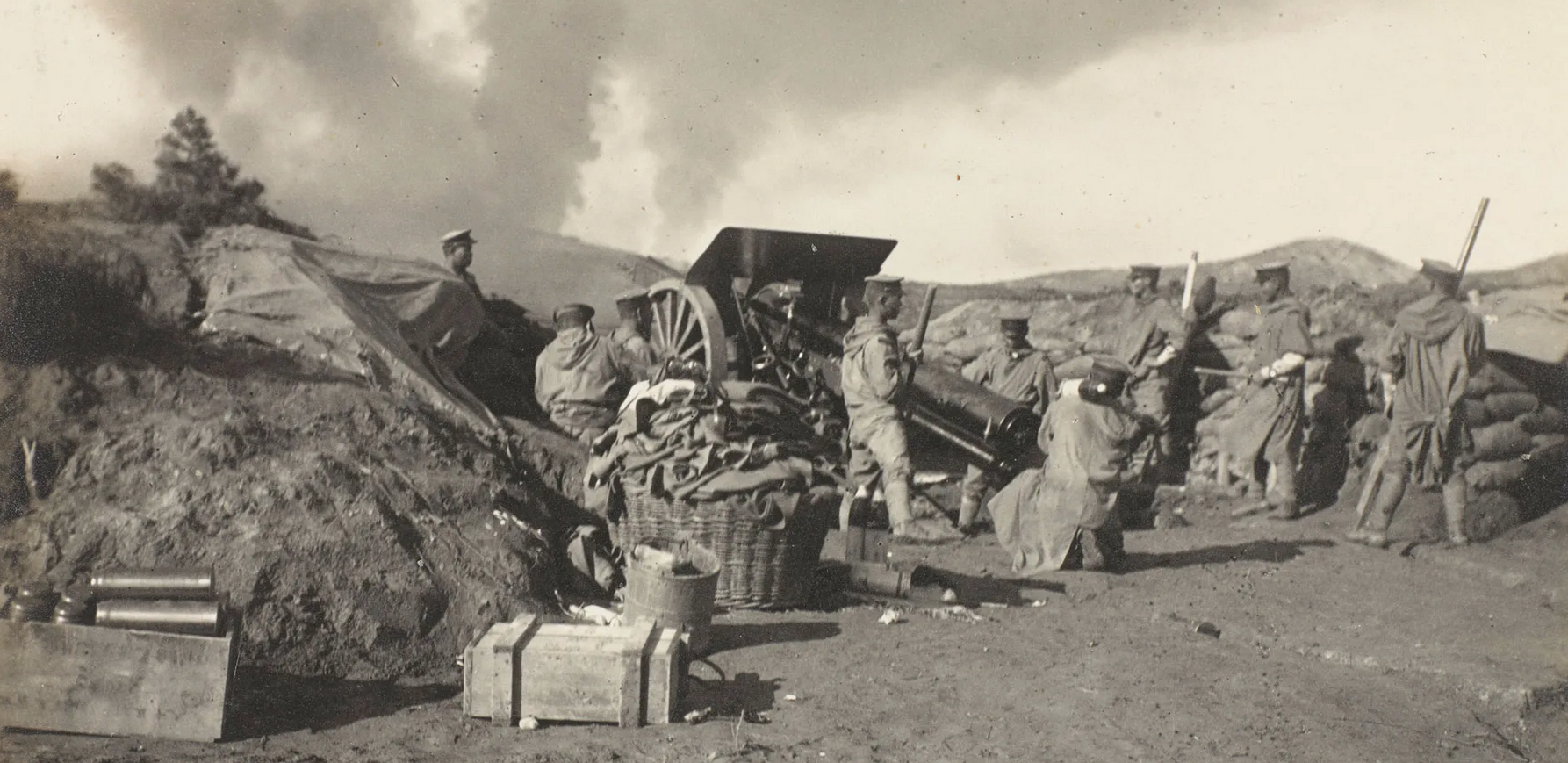
Another surprise (at least to this woefully ignorant reader) was to learn that Japan and Britain fought together to drive Germany out of Chinese city of Tsingtao (below) between August and November 1914. It is a sobering reflection on the fragile nature of national alliances to think that less than a decade earlier, Japan and Russia locked horns in a savage war. Now, they were, notionally, allies in a war against Germany.
As autumn turned into winter, the major powers were all unsteady on their feet. The French had suffered astonishing losses in the east, but had engineered a miracle on The Marne. Germany’s relentless advance through Belgium had been thwarted, and they had back-pedalled in disarray to dig in north of The Aisne. Despite the debacle at Tannenberg, Russia had inflicted a monstrous defeat on Austria Hungary in Galicia. This account, from a Hapsburg officer, is horrific :

‘Scenes from Dante’s Inferno were happening on the road. Driven by instinct, both men and horses pressed forward, regardless of the corpses and wounded lying on the ground. Horses hooves were treading over bellies and heads. Intestines, guts, brains mixed with mud covered the road with a bloody mess. The screams of the wounded, men and horses, together with the cracking rifles, grenade and shell explosions drove one to near insanity.’

I am always intrigued by writing partnerships, and ponder the (largely irrelevant) question, “Who did what?” Whatever the respective inputs were here, Churchill and Eberholst have written a book that is historically authoritative but always accessible. UK Great War literature tends, for quite laudable reasons, centred on the Western Front and the great calamities that took place there, but here we have a timely reminder of the days before the trenches were dug “from Switzerland to the sea” and the horrific slaughter that took place in places with names that have long since vanished from the map. Ring of Fire will be published by Apollo on 8th May.
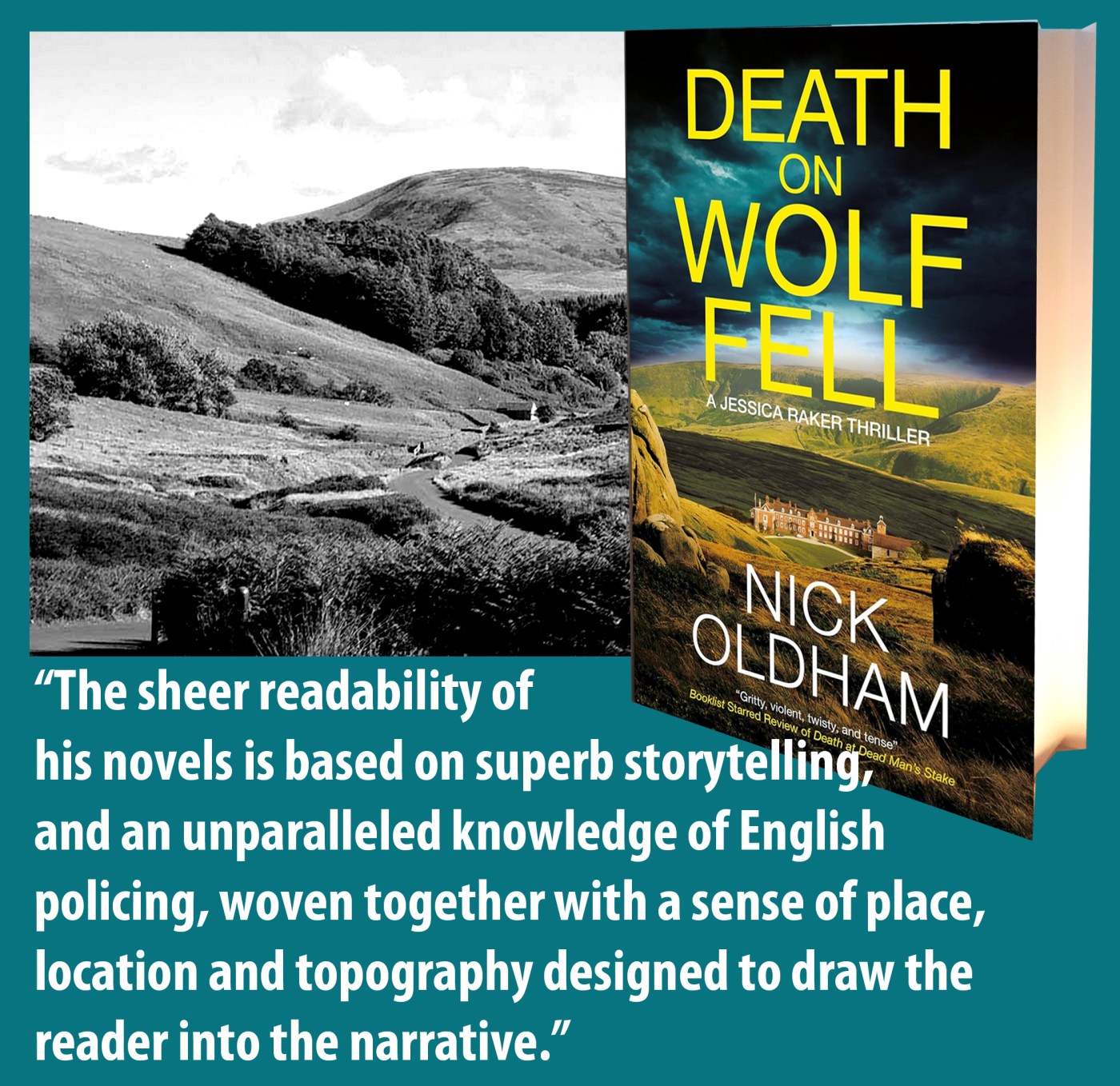
DEATH ON WOLF FELL . . . Between the covers

This is the next instalment of the career of Lancashire DS Jessica Raker, to whom we were introduced in “Death at Dead Man’s Stake”. Jess resumes her head-to-head battle with gang boss Maggie Horsefield, a ruthless and vindictive woman who is at the apex of the criminal fraternity, but someone who swims in the toxic waste in terms of human decency. It complicates matters that Jess’s daughter Lily and Maggie’s offspring Caitlin are BFFs at school.

It’s fair to say that Jessica Raker has something of a turbulent past. Born and bred in the district she now polices, she gravitated to London, where her career in the Metropolitan Police concluded dramatically with her shooting dead a feckless younger member of a serious crime gang. When a retaliatory contract was taken out on her life, she was relocated to Clitheroe. She has two children, but her relationship with husband Josh is, to say the least, threadbare, although they are still together.

This story starts with Lance Drake, a petty crook somewhere near the bottom of Maggie Horsefield’s barrel of criminal employees, facing his worst nightmare. He is being released on license from HMP Preston, where he has been quite happily spending the last few months, safe from the inevitable retribution which has awaited him since he shot his mouth off to the police, thus losing his boss tens of thousands of pounds in a drug shipment.

Inevitably, given that Horsefield has her employees embedded at every level of the criminal justice system, Drake is soon grabbed, and when the hood is taken from his head, he finds himself cable-tied to a chair sitting, ominously, on a large plastic sheet spread on the floor of a disused mill, with Horsefield sitting nearby, fondling a zombie knife. Jess Raker’s team have had their eyes on this mill for some time, rightly suspecting that is part of Horsefield’s drug distribution business and, happily for Lance Drake, they choose that moment for a raid.

Most of Horsefield’s goons get away, the mill plus an industrial quantity of ‘merchandise’ go up in flames, and the stage is set for a dramatic encounter as Horsefield and her lover, London gangster Tommy Moss, plan a multi-million pound raid on Wolf Fell Hall, an ancestral home which contains scores of priceless old master paintings. Along the way, we learn more about the team of officers around Jessica Raker. There is the intelligent and resourceful PCSO Samira Patel, who yearns to become a ‘proper’ copper. CID officer Dougie Doolan is one of Jessica’s mainstays, but she suspects he is hiding a grim secret. Her boss, Inspector Price, we strongly suspect may be a wrong ‘un, but is he actually feeding information to the dreadful Maggie Horsefield?

One thing you will not find in a Nick Oldham novel, thankfully, is the remotest trace of sympathetic hand-wringing for his villains. Yes they may come from awful families with dreadful parents but, like all of us, they have a choice. If they take the wrong road, then they have no-one to blame but themselves. For Oldham, once a working copper in hives of scum and villainy like Blackpool, they have made their choice and deserve everything they get. He has a direct, no-frills narrative style. The sheer readability of his novels is based on superb storytelling, and an unparalleled knowledge of English policing, woven together with a sense of place, location and topography designed to draw the reader into the narrative. Death on Wolf Fell will be published by Severn House on 6th May.

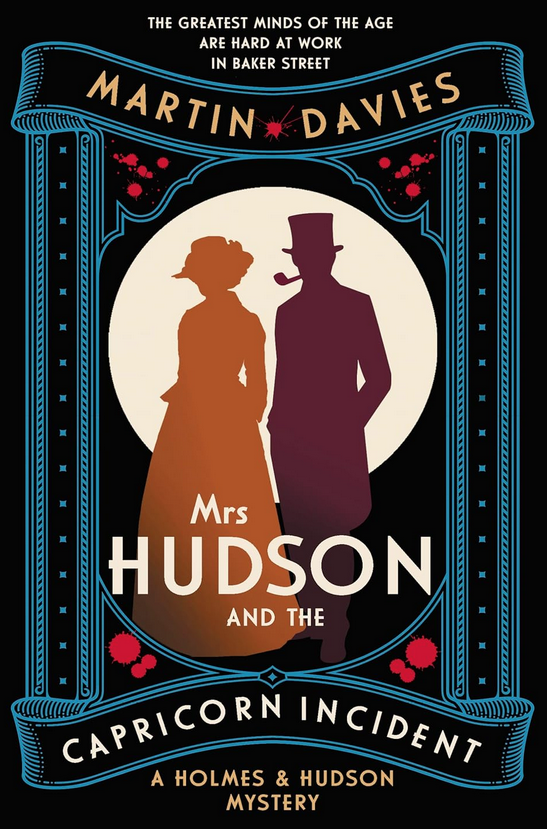
MRS HUDSON AND THE CAPRICORN INCIDENT . . . Between the covers

The canonical 56 short stories and four novellas featuring Sherlock Holmes have left so-called ‘continuation’ authors with plenty of subordinate characters to draw on. Dr Watson, inspector Lestrade, Moriarty and brother Mycroft have each been the central character in novels. I suppose it was only a matter of time before Mrs Hudson took centre stage. Martin Davies took up the challenge in 2002 with Mrs Hudson and the Spirit’s Curse, but here, events are narrated by a girl called Flotsam, who recalls events rather in the way that the good Doctor reminisces about the cases his old friend solved.

Flottie was an orphan girl, saved from a life of degradation by the kindness of Mrs Hudson, but is now a very bright young woman who has seeks education where and whenever she can find it. She is now highly literate and socially adept (but still working downstairs).The story unfolds through her eyes and ears. The substantive plot centres on Rosenau, a tiny Duchy in the Balkans, squeezed between the competing demands of the ailing Ottoman empire, Austria-Hungary and fervent Serbian nationalists. It’s survival depends on an impending marriage between Count Rudolph and Princess Sophie who, hopefully will provide a legitimate heir, ensuring the Duchy’s survival. Rosenau is, of course, fictional, but the Balkan powder keg was, at the turn of the century, frighteningly real. Everything goes awry when, first, the Count goes missing while on a European skiing trip and, second, when the princess is abducted from a London residence.

Reviewers and critics are perfectly entitled to question the validity of the still-vibrant Sherlock Holmes industry. Why, over a century after the last Conan Doyle tale was published, are we still seeing (and here, choose your own description) continuations, homages, pastiches and re-imaginings of crime fiction’s most celebrated character? The answer is simple – because people buy the books or borrow them from the library. Conan Doyle tired of his man, and tried to end it all, in the hope that readers would be drawn towards his other novels, like Micah Clarke or the Brigadier Gerard series. He was forced to relent. As a former prime minister said, “You can’t buck the market.” She was correct, and it must be assumed that two decades after the first novel in the series, people still buy these books and, for publishers, that is it and all about it.

Is this book any good? Yes, of course. Conan Doyle planted a seed which has grown into the mother of all beanstalks, and the Sherlock Holmes phenomenon is as busy as it ever was. Martin Davies reconnects us to a world which is endlessly appealing: chaste bachelors of independent means, a strictly ordered society, a London unsullied by antisemitic mobs, a railway system that ran with clockwork precision, handwritten letters delivered several times daily, a world that challenged the chant of Macbeth’s witches, ‘fair is foul and foul is fair’. This moral ambiguity has no place in the world of Mrs Hudson or Flottie. The tone of the book? Light of heart in some ways, with a certain amount of comedy. Here, a caricature aristocratic old gent opines on marriage:

“Wedding, for goodness sake? Weddings are ten a penny. When I was a lad, a man got married in the morning, introduced his wife to his mistress at lunchtime, and was at the races in the afternoon. And so long as he honored his debts, no one thought the worse of him.”

The humour reminded me very much the very underrated series of Inspector Lestrade novels by MJ Trow. As in those novels. this author provides some good jokes: A famous actress confides in Flottie.

“The important thing is to remember that your skirts are your enemy and speed is your friend. Which is quite the opposite of how we usually think about things, isn’t it?”

She is talking about the new enthusiasm among young women for cycling.

I have made this point before, but it is worth repeating. The canonical Holmes short stories were just that – short. Conan Doyle could take one problem, and allow his man to solve it in just a few pages. Even the four novels were brief. Short stories don’t sell these days and the concept of novels serialised in print and paper magazines is dead and buried, therefore modern Holmes emulators have to spin out the narrative to the regulation 300-400 pages. So, there has to be subplots and other investigations going on, and this almost always means that the narrative tends to drift. So it is here, with the Rosenau crisis sharing the pages with the search for someone called Maltravers, a serial swindler. Martin Davies handles this dilemma as well as anyone else, and presents us with an entertaining tale that is well worth a few hours of anyone’s time. There were occasional longeurs, but the last few pages were rather wonderful. Mrs Hudson and the Capricorn Incident is published by Allison & Busby and is available now.

MARBLE HALL MURDERS . . . Between the covers

Anthony Horowitz is – deservedly – celebrated as an author and screenwriter. In the Daniel Hawthorne novels he plays himself, and there are frequent allusions to the world of publishing and TV production. In this novel the central character is Susan Ryeland, a freelance literary editor. She has just returned from a spell living in Crete with her hotelier boyfriend, but the charms of the sun, blue sea, olives and tsikoudia lifestyle have worn thin and she is back in London.

Her first commission on returning to England is to read through a manuscript of what is politely known as a continuation novel. Atticus Pünd was the central character in a highly successful series written by Alan Conway, and Susan had edited the books, despite having a fractious relationship with the author. Conway died in dramatic circumstances, but now a writer called Eliot Crace – himself the grandson of widely venerated author of children’s fiction – has resurrected Pünd. Susan is no fan of continuation novels, but this is Mr H having a little joke at his own expense, as among his own novels are ‘continuations’ of Sherlock Holmes and James Bond.

Make no mistake, the structure of this book is more complex than any of Horowitz’s books that I have read previously, but perhaps it is similar in the two books – Magpie Murders and Moonflower Murders  – which preceded this title. I do not watch much mainstream television, and I was unaware that these novels had also been filmed for the small screen.

Not long after Susan has offered to read through the first part of Eliot Crace’s reimagining of Atticus Pünd, we get to read it with her, and it tells of Pūnd, aware that he is terminally ill, investigating the death by poison of an English aristocrat in her villa in the south of France. We have, then, a novel within a novel. it must be one of the greatest challenges for a writer to make readers of a sequential novel aware of what has happened in previous books without labouring the point. Horowitz doers it well here, so I won’t waste paragraphs explaining what happened to Susan in the previous two books. Here, she learns from Eliot Crace that his grandmother, far from being the sainted creator of million-selling children’s books, adored by countless fans, was actually a vindictive, intolerant and spiteful old woman. Anthony Horowitz has set up a delightful conceit – and I use the term in its positive sense.

There is added piquancy in the fact that Susan Ryeland, the narrator of the ‘outer’ novel, is being paid to edit/criticise the content of the ‘inner’ novel, penned by Eliot Crace who, at first glance, appears to be mad, bad and dangerous to know. Anthony Horowitz is, like it or not, deeply embedded in the world of TV drama. There are many of us who think that Foyle’s War was the best show we ever watched. AH retains a keen eye for the best and worst of prime time TV drama and, using the voice of Susan Ryeland, he sneaks in a mention of ‘one that got away’, a thoughtful and intelligent series called Boon, starring Michael Elphick.

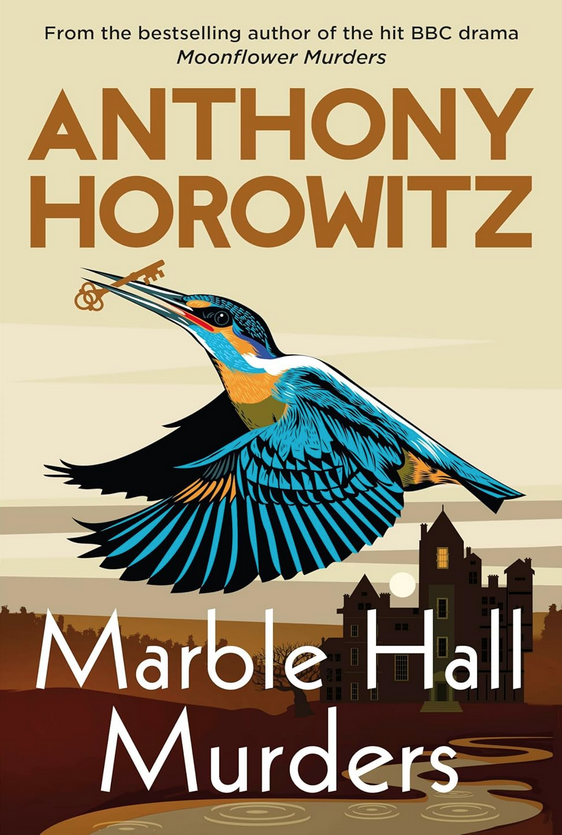
This is a complex novel containing layers within layers, but the nub is that Eliot Crace, although just a child, witnessed (or believed he had) his grandmother’s murder. Having lived with this secret for decades, he now decides to reveal the identity of the killer in his Atticus Pünd pastiche. When he himself dies in suspicious circumstances, we must assume that his killer is not someone from a novel, but a real person, still living, and someone who cannot afford the truth behind the death of Miriam Crace to become public knowledge. I hope this is not a spoiler, but astute readers will be alerted by the  beautiful cover image of Alcedo Atthis.

A long read, this, not far short of 600 pages, and Anthony Horowitz has cooked up an intriguing blend of elements. We have Golden Age Crime, complete with incriminating anagrams, arcane use of poison, the glittering world of wealthy people and, naturally, the ‘in the library’ denouement where the killer’s identity is revealed. Throw into the mix a candid view of the rather bitchy world of publishing, a rather engaging police officer, and  we have something for everyone. The television version of this novel, with Lesley Manville playing Susan. will be on your screens soon. Meanwhile, the book comes out in hardback, published by Century, on 10th April.

Blog at WordPress.com.

Up ↑