Search

fullybooked2017

Month

March 2025

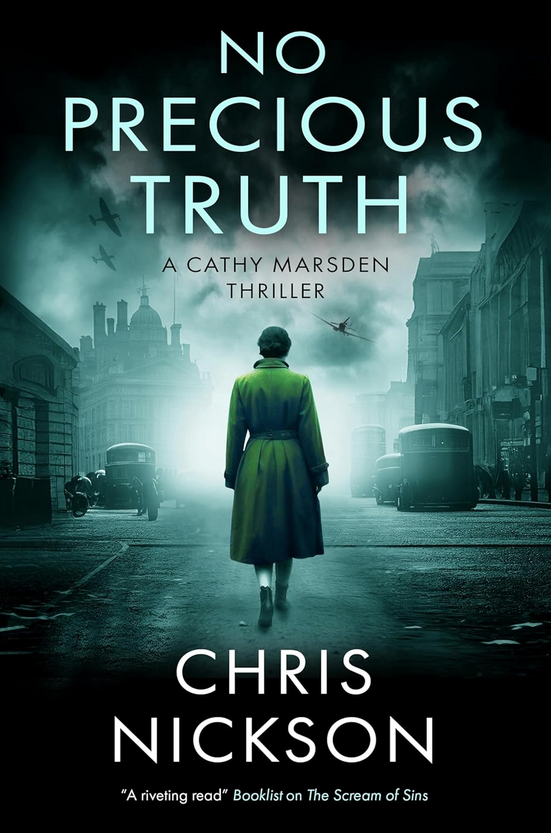
NO PRECIOUS TRUTH . . . Between the covers

In my reading experience, there is no living writer so closely associated with one place than Chris Nickson. Phil Rickson had his Welsh Marches, Robert B Parker had his Boston, Colin Dexter had his Oxford and Christopher Fowler had his (peculiar) London. Sadly, Time has borne those four sons away, but Nickson’s Leeds is now rediscovered in the first of a new series.

It is February 1941. Cathy Marsden is a Sergeant in the Leeds police, but has been seconded to the Special Investigations Bureau, a unit recently set up to investigate black marketeers and other criminals looking to make money out of the war. She is astonished when her older brother, Daniel, turns up at the office. As far as she was aware he was humdrum civil servant in London, pushing pens and folders of documents from one desk to another. Like her, however, he has been seconded, but to another top secret intelligence service, and he is in Leeds to track down a dangerous Dutch double agent called Jan Minuit.

Although I have read and enjoyed them all, Nickson’s Leeds novels tend to have a similar plot, which is basically a manhunt. This enables the author’s creations from Simon Westow to Tom Harper (who gets a brief mention here) to pound the streets of the city in search of a villain. The technical aspect of this is not complicated, as it enables Nickson to put his unparalleled knowledge of the topography to good use. He is clearly in tune with a kind of of geopsychology, which enables readers to follow the footsteps of his characters across the decades, so that thoroughfares like Briggate, The Headrow and Kirkgate become as familiar as our own back yards.

If Minuit is bent on sabotage, Leeds has two prime targets for an agent of The Third Reich. One is pretty much in the open. The Kirkstall iron foundry has been producing components for military vehicles since WW1 and is hard to disguise. The Avro factory at Yeadon, however has been covered in camouflage and disguised – from the air – as open country. This ‘shadow factory’ is working day and night to produce Lancaster bombers, as well as the less celebrated (but equally vital) Anson.

Nickson has a well-established style. It is propulsive. Short sentences. A sense of urgency. Genuine narrative drive.

“Cathy turned off the ring road and started up Wheatwood Lane.The daylight was lasting longer, barely a stretch of dusk on the horizon. Ahead of her, the hill rose steeply, fields on either side, farmland.No chance to go more than a few yards.The road was filled with police cars, a pair of ambulances and the black coroner’s van.,”

“Monday dawned sour with threatening clouds, the colour of old bruises. The air was thick and damp. Yesterday’s promise of spring had vanished like a magician’s illusion. Instead, the rain felt that it like might begin at any time. At least it would deter the Luftwaffe.”

There is a thrilling conclusion to the team’s pursuit of Jan Minuit, and it is Cathy’s resilience and strength which eventually brings the spy/saboteur to his knees. Chris Nickson’s skill lies in his ability to convince us that we are standing beside his characters and sharing their world. In this case, it is Cathy Marsden’s wartime Leeds, with its rationing and privation, its fear that clear nighttime skies will be a gift to the Luftwaffe, and the ever present fear in the hearts of local women that their father, husband, brother, son or boyfriend will be the next name on the mounting list of casualties.

Nickson also reminds us that the horrors of WW1 cast a long shadow. Cathy’s father, once a strapping Yorkshire lad, was gassed in the trenches, and over thirty years later is a wreckage of a man, struggling with the essentials of existence – such as breathing. No Precious Truth will be published by Severn House on 1st April.
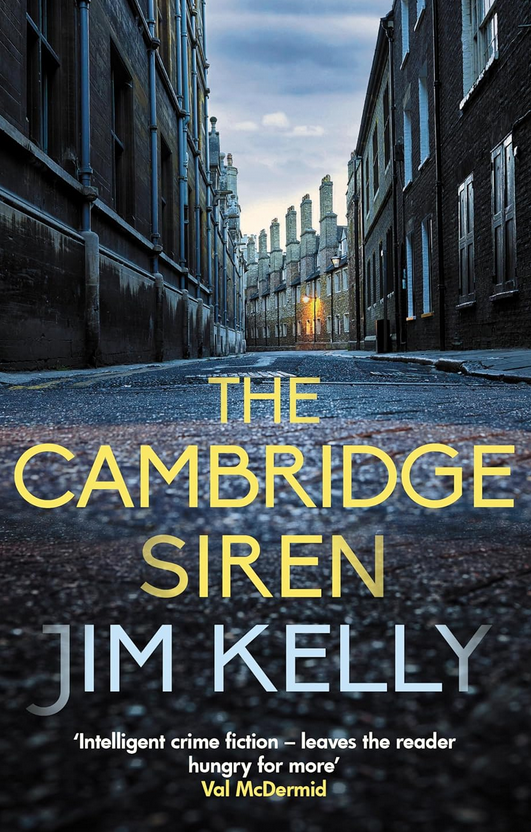
THE CAMBRIDGE SIREN . . . Between the covers

This is the fourth in Jim Kelly’s excellent series set in Cambridge during WW2, featuring senior police detective Eden Brooke. If you click the images below, you will be able to read my reviews of the previous three novels in the sequence.

Brooke served in The Great War, but had the misfortune to fall prisoner to the Turks. The Ottomans, rather like their Japanese brethren twenty years later, were brutal – not to say sadistic – captors, and Brooke’s eyes were permanently damaged. He and his wife Claire are certainly ‘a family at war’, however. Their daughter Joy’s husband is a submariner, while son Luke is away training in Scotland for some ‘hush hush’ activity.

Brooke has plenty on his hands. A dead man is discovered in a city air raid shelter. Cause of death? Wrists neatly slit. Too neatly, according the medical officer; suicides rarely if ever manage to slit the second wrist properly after self-inflicting the first wound. And why does the unidentified man have Brooke’s telephone number inked on his hand? Hundreds of miles away, on board his submarine, Lieutenant Ben Ridding has to examine a faulty periscope, which recently caused two torpedoes to miss their target by a considerable margin. He finds that one of the lenses has been purposely set askew. It was manufactured at the Vulcan works in Cambridge. A coded message to the Admiralty is passed on to Brooke, who begins an investigation.

Kelly has a magnificent eye (and ear) for period detail. Here, Brooke takes a witness to the morgue to investigate a corpse.

“Brooke led Mrs. Brodie to the table: twenty strides, the metal Blakey’s* on his shoes striking the quarry tiles. It was a ceremony with all the subtle horror and indecent haste of an execution.”

*Blakey’s were little metal plates nailed onto the leather soles and  of shoes to preserve them

Another two dead men are discovered, each in the vicinity of a shelter. The dead men found in the shelters have two things in common. Each has minor disability, thus eliminating them from service in the forces, and each had stayed at The Laurels, a rather strange guest house outside the city. Despite posting a police ‘spy’ inside the Vulcan works, the latest batch of periscopes reaches its destination in Barrow-in-Furness. From a shipment of twelve, two have been sabotaged.

Jim Kelly’s other two crime fiction series – The Philip Dryden Ely novels and the Peter Shaw books, set a little to the north in Kings Lynn, are dominated by the pull of the the landscape. Eden Brooke’s world is more intimate, centred on the college gateways and narrow city byways of Cambridge, but he is ever aware that just beyond the city lights (now dimmed by wartime regulations) is the primeval vastness of The Fens, now largely drained, but still desolate and sparsely populated.

“The Fens, as Brooke had been taught by his father in a lecture illustrated by a map which still hung in his old bedroom at Newnham Croft, lay in three levels: North, Middle and South. The north stretched to Lincoln across the silty fields south-west of the Wash.”

Despite the apparent failure to  solve the mystery of the periscopes, Brooke turns his attention to The Mystery of The Laurels. If that sounds like a story from a Sherlock Homes collection, it is appropriate because, using an attention to detail worthy of the great man, Brooke discovers a complex and lucrative conspiracy whereby wealthy young men can pay to avoid being called up into the armed forces. In WW1, it took Britain over two years to resort to conscription, but it was re-introduced  in 1939, almost immediately after war was declared. In solving the murders, however, Brooke has inadvertently trodden on some very important toes. Involved, although rather at a tangent to the call-up conspiracy, is a notable British scientist connected to a major defence project. As in aside, it is worth noting that while Hitler was obsessed with what have been called ‘wonder weapons’ (at the expense of solid and reliable military kit) Churchill was fascinated by rather weird developments. One such features in this novel. If you Google Project Habbakuk you will discover more.

Once again using a potent blend of observation and intuition, Brooke solves the periscope problem, and the book ends with a joyful family reunion, but one tinged with uncertainty. Brooke is an endearing character, a deeply thoughtful and ascetic man in some ways, but with unlimited courage and a steely sense of duty. The Cambridge Siren is published by Allison & Busby, and available now.

NOBODY’S FOOL . . . Between the covers

In the last Harlan Coben book I read, Think Twice, the DNA of a man who died decades ago turns up at a recent murder scene. Coben loves these ‘impossible’ scenarios, and here, he sets us another one. When he was on a gap year trip to Europe twenty-two years earlier, Sami Kierce had a passionate fling in a Spanish resort with a young fellow American called Anna. It all ended grimly when, after yet another evening fueled by booze, drugs and sex, Sami wakes, as usual, in Anna’s arms. Problem. He is covered in Anna’s blood and clutching a knife.

Now, Sami, thrown off the police force for various indiscretions, scratches a living as a PI in New York, also turning a more-or-less honest buck giving evening classes in criminology to a bunch of weirdos. When one of his classes is joined by a woman who, if not Anna is, surely, a clone, Sami does a classic double-take. So many questions, already. First up is how Sami managed to get back Stateside after the Costa del Sol incident with Anna. We do find out, eventually. Second is how ‘Anna’ appears to be living in a Connecticut mansion, deep in a forest and protected by armed heavies and belligerent dogs.

As if having one dramatic backstory weren’t enough, Sami has two. Before he had to throw in his badge, Sami was engaged to a fellow officer, Nicole Brett. Then she was murdered by a nasty piece of work called Tad Grayson, who was arrested, tried, and given a life term. But now, thanks to nifty footwork by his legal team, Grayson is out, and determined to prove that he did not kill Nicole. All of which, naturally enough, does not improve Sami’s sunny demeanour. ‘Anna’ is actually Victoria Belmond who, back in the day featured in the mother-and-father of all ‘missing heiress’ stories. Victoria disappeared on New Years Eve after a party, and what happened in the next eleven years – until she turned up sitting in a corner booth of a Maine diner – remains a mystery. Victoria was – literally – mute for many months thereafter and even, when speech returned, remembered nothing of where she had been and with whom.

After his abortive attempt to follow ‘Anna‘ on the night she came to his class, Sami has become a person of interest to the Belmond family and, much to his surprise, he is offered a small fortune to do what the police and FBI failed to do – discover the truth about Victoria’s disappearance. He even uses the Belmond’s largesse to take a quick trip to Spain along with wife Molly and their baby son, and here he finds the police officer who dealt with the case back in the day. He learns that he was the victim of a very clever scam involving ‘Anna’ and her drug hustling boyfriend.

Just when this particular reader was reflecting that this was just one more engaging – but slick and formulaic – American thriller, something truly awful happens and, 308 pages out of 414, everything I thought I understood about the plot is turned on its head. Reviewers are forever trying to think up new metaphors and catchy phrases to explain astonishing plot twists, so all I can say is that this one is up there with the best. I can also say that in the hands of a lesser writer that Harlan Coben, it would probably be a disaster, but he pulls it off with his customary flair. Nobody’s Fool was published by Penguin on 27th March.

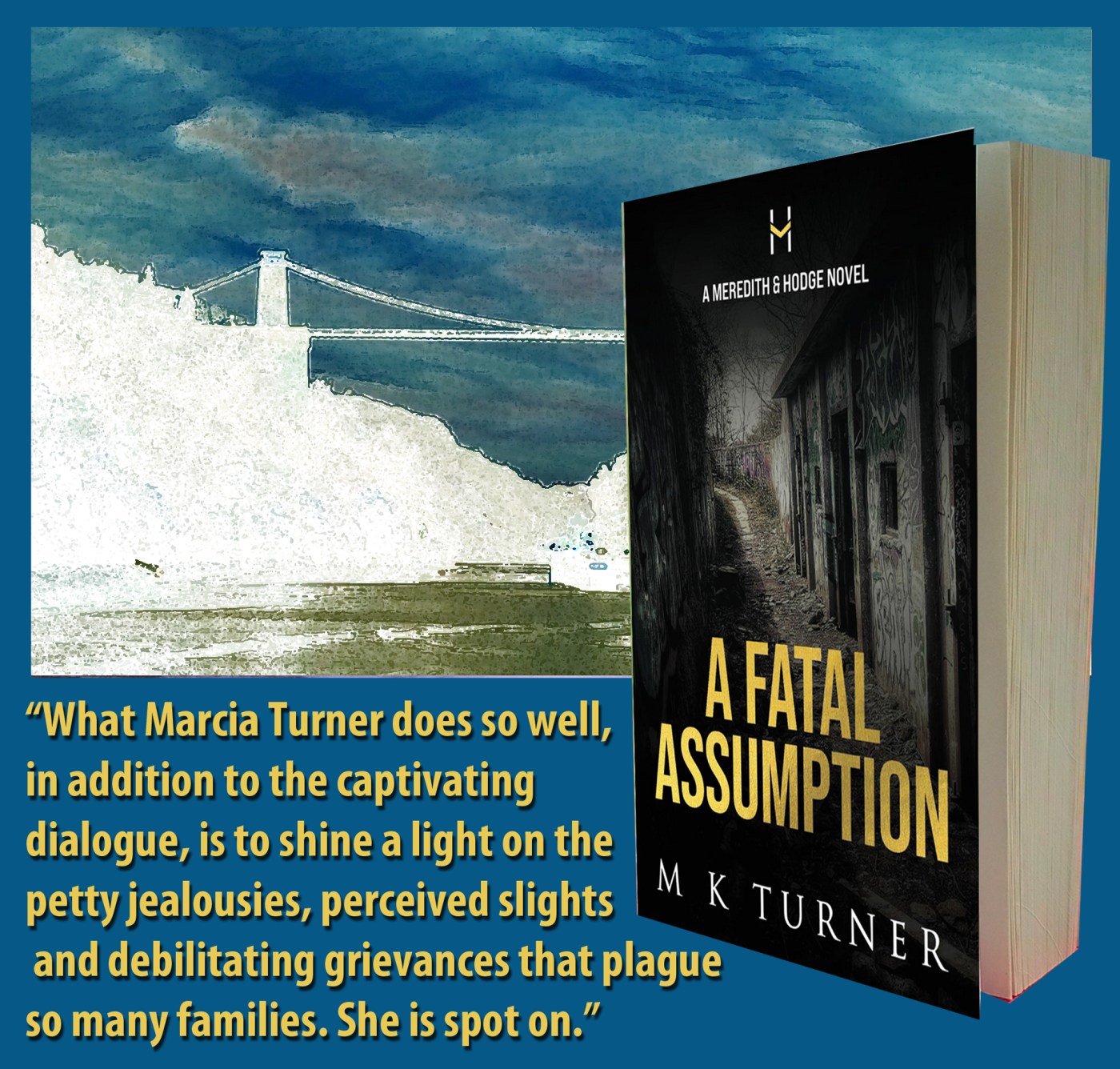
A FATAL ASSUMPTION . . . Between the covers

These Bristol based Meredith & Hodge cold-case-crime novels are rather special. Their latest case seems unsolvable. For starters it’s over a decade old. Christine Hawker was making breakfast for the children with husband Mike was upstairs getting them ready for school. The smoke alarm goes off. Mike discovered it has been triggered by a pan of burned porridge. But where was Christine? Puzzled, he took the kids to school, but then he disappears, too. The case baffled everyone, and gradually slid further and further back down the “To Do” list.

Now, the case has been reopened, because Mike Hawker’s remains have been inadvertently exposed by the bucket of a digger preparing the ground for a new supermarket. Meredith & Hodge? DCI Meredith and his wife, fellow officer Patsy Hodge are the ideal husband and wife team. Except – at the moment – they’re not. Patsy is on extended sick leave after a case went horrifically awry and has fled to relatives in New Zealand. Meredith? He’s getting over jetlag in a budget Auckland hotel having flown in to try to save his marriage.

By any standard, this is a terrific police procedural novel. Yes, all the operational details are convincing and the plotting is cleverly done. For me, however, it is the dialogue that sparkles. Marcia Turner enlivens her characters by what they say, and the idioms they use. For example, an elderly man says that he is a bit ‘mutton’. Younger readers might be baffled, but Turner knows that people of this character’s generation would recognise the rhyming slang. Mutt ‘n’ Jeff were comic book characters back in the day. Mutt ‘n’ Jeff became rhyming slang for ‘deaf’ and this later evolved into ‘mutton’ – a double play on words.

Meredith’s peacemaking overture in New Zealand is favourably received, and the pair return to the UK and face the mysteries of the Hawker case. The extended family dynamic is complex, and throws up a number of grievances. In no particular order. Christine’s father died of cancer when she was in her early teens, and she had become embittered that her mother remarried so quickly, suspecting that the relationship may have been blossoming while her father was on his bed of death. Mike’s father is cantankerous and an awkward customer, and his peace of mind was not improved a few months before his son’s disappearance when a young man met him and introduced himself as his long-lost son, conceived in a youthful fling decades earlier.

Meredith’s team clutch at what seem to be increasingly flimsy straws of evidence and imperfect recollections. What about the mysterious white van seen near the Hawker’s house on the day of the abduction? It is of no help at all that several of the potential suspects worked in trades where the proverbial ‘white van’ was ubiquitous. As is probably the case in real life criminal investigations, forensic questioning unearths all manner of ill-concealed grievances and grudges within the extended family of Mike and Christine Hawker.

Despite the proverbial quote suggesting the opposite, it is inspiration rather than perspiration which finally lifts the veil for Meredith, and it comes by way of a pleasant couple of hours the detective spends with his baby grandchildren. The next day, he calls the investigative team together, and on the whiteboard writes one simple word. The culprit returns to the interview suite, confesses, and the cold case team can chalk up another success. What Marcia Turner does so well, in addition to the captivating dialogue, is to shine a light on the petty jealousies, perceived slights and debilitating grievances that plague so many families. She is spot on. We all know what she is writing about. Thankfully, it doesn’t make us all murderers, but – as they say – we have all been there. From 127 Publishing, this excellent police thriller is available now.

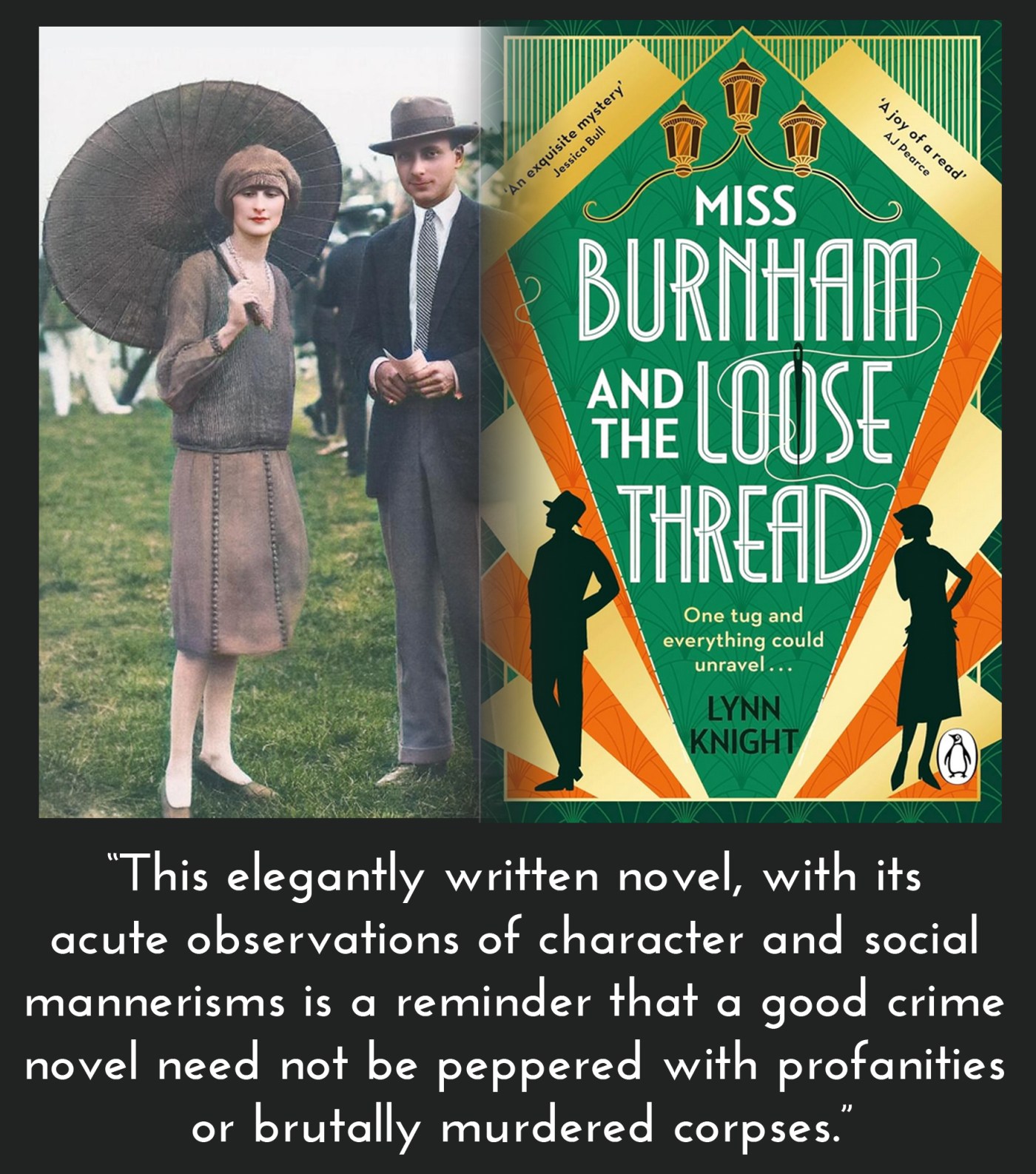
MISS BURNHAM AND THE LOOSE THREAD . . . Between the covers

It is the spring of 1925 and we are in suburban London. Rose Burnham is a talented designer-dressmaker, and has set herself up in business with her sisters. She isn’t making a fortune, but she hopes that the improving weather will bring in new orders. One of her regular customers is Phyllis Holmes, whose late father has left her relatively well off, even though she is basically a handmaiden to her demanding mother. In an attempt to broaden her social life, the shy and sheltered Phyllis has fallen into the clutches of a man – recommended by Cupid’s Arrows, a matrimonial agency  –  who is, to use the epithets of the time, both a bounder and a cad. Lynn Knight may have had these wonderful lines by Sir John Betjeman in mind:

“Let us not speak, for the love we bear one another—
Let us hold hands and look.”
She such a very ordinary little woman;
He such a thumping crook;
But both, for a moment, little lower than the angels
In the teashop’s ingle-nook.”

The so-called War To End All Wars has been over, at least in Europe, for seven years, but it casts a long shadow:

“Here was Mrs. Carlton, an optimistic bride when Rose first saw her at Webb and Maskry in the spring of 1914. But now a desperate wife seeking refuge in clothes. If she could fill her days with dress fittings and like distractions, she would be able to spend less time looking at her husband’s disfigured face.”

When Miss Holmes visits Rose’s workshop and tearfully confesses that she can neither pay her existing bills nor commission any new dresses because she has been swindled, Rose must act. Yes, she is sympathetic to her client’s dilemma, but if she cannot track down the man who has appropriated Phyllis’s fortune – around £40,000 in today’s money – she knows that she and her sisters will be unemployed, and probably be forced to return to their previous lives as shop assistants. Rose decides to present herself at Cupid’s Arrows as an anxious spinster, in the hope that she will be pointed in the direction of the man who stole the heart of Phyllis Holmes – not to mention her money. Lynn Knight has a wonderful eye – and ear – for the 1920s. Invited to a soirée, Rose observes her fellow guests: “

“Three men in their own larger circle, feet spread firmly apart, like a Gilbert and Sullivan chorus, were broadcasting their views to the room. Single emphatic words; coal – taxes – prices – punctuated their talk. Except for a side parting, a watch chain and a Ramsay McDonald mustache, there was little to distinguish one man from the next.”

This elegantly written novel, with its acute observations of character and social mannerisms is a reminder that a good crime novel need not be peppered with profanities or brutally murdered corpses. Finally, a word to readers whose interests tend to lie in the dark streets and lurid neon of Noir, or those who like their crime novels red in tooth and claw, with a high corpse count. Yes, this story may seem soufflé light and lacking in high drama, but it is a beautifully observed study of social mores and expectations in a society that was still trying to find its feet after an international cataclysm. The focus is almost entirely on the female characters, and the underlying theme is that of women – tens of thousands of whom took on men’s roles during the war – who are determined not to return to pre-1914 status quo.

Parallel to this world of emerging female emancipation, Lynn Knight also highlights a society where men over the age of 25 are shaped by – and judged on – what they did and where they were between 1914 and 1919. Some (literally) limped back into their pre-war world. Some struggled to survive in a land Lloyd George egregiously promised would be “fit for heroes to live in.” Others, like the tricksters of Cupid’s Arrow, turned to more reprehensible methods to make a living. This novel is published by Bantam, and is available now.

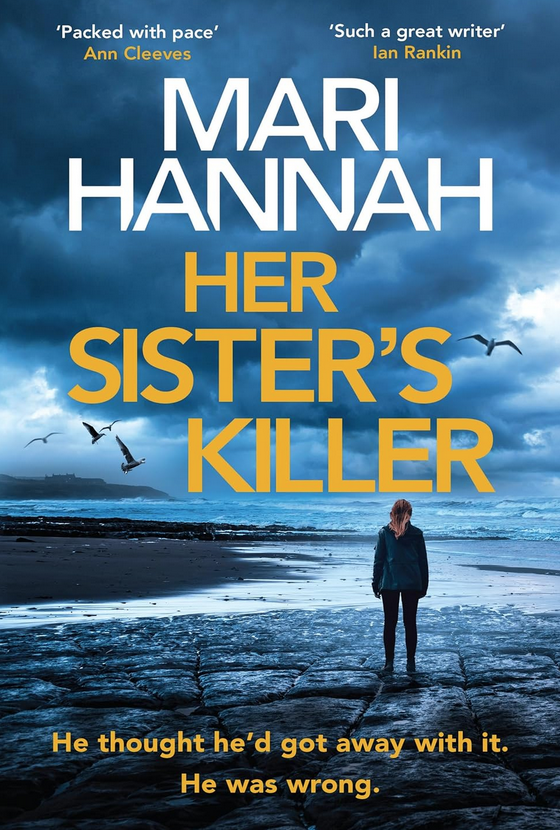
HER SISTER’S KILLER . . . Between the covers

All too often, opening pages of crime novels headed ‘Prologue’ are enigmatic flashbacks, and they leave the reader wondering what their relevance is to the emerging narrative. Not so here. It is short, brutal and and painfully obvious. A Tyneside detective has been called to a murder scene. The body is that of his teenage daughter. That was then.

Now. For some arcane reason, when police Sergeants are promoted to Inspector, they have to serve a term in uniform, away from their home station. So it is that Frances ‘Frankie’ Oliver – the younger sister of the girl whose murder is revealed in the prologue –  is sent away from the city hub of Newcastle to the relative backwater of Berwick – England’s last outpost before the Scottish border. Her first major call-out is a serious RTA – with fatalities. In the back of a wrecked van, Frankie finds a seriously injured child, his wrist secured to a stanchion with cable ties.

Meanwhile, DCI David Stone – Frankie’s on-off romantic interest, acting on loose talk overheard at a police social function, has reopened the investigation into the unsolved murder of Joanna Oliver. Frankie’s secondment to Berwick takes on a life of its own as, amid the wreckage beside the A1, evidence emerges that an organised crime gang has been hard at work trafficking children.

Mari Hannah has penned a classic ‘two plot’, novel, in that DI Frankie Oliver is heading up a multi-agency investigation into a Bulgarian people smuggling gang, while DCI David Stone is in charge of a covert cold-case operation into the murder of Frankie’s sister. Why covert? Stone believes that a serving policeman was her killer and, the law being what it is, any involvement by Frankie Oliver would mean the case would be thrown out of court.

I have meta-tagged this book as a police procedural which, on one level, it is. There is so much more, however. Mari Hannah’s ability to create vividly authentic characters is here for all to see. In no particular order, we have retired copper Frank Oliver, father of Frances, the murdered Joanna and older sister Rae; his torment at being called to a murder scene, only to find that the victim is his own daughter is lifelong; Frankie herself is a brilliant police officer, fearless but vulnerable, intuitive but analytical; David Stone is a ruthless career policeman but, like Frank Stone, the scar on his heart from when his former lover, Jane, was shot dead by an insane gunman, has never healed; I was also particularly taken with rookie PC Indira Sharma who, apart from his boss (Detective Superintendent Bright) is Stone’s only confidante. She is new to the job, but incisive, courageous and has a gimlet eye for detail.

The best crime novels have an authentic sense of place and location and, as with her Kate Daniels novels, Mari Hannah’s heart is never far from England’s north east and the contrast between the bright lights of ‘big city’ Newcastle, and the windswept horizons of rural Northumbria. There is so much to admire about this novel but I suspect, like me, you will be left breathless by David Stone’s ruthless and remorseless interview room demolition of Joanna Oliver’s killer at the end of the book. I don’t do checklists, but if I did, I would be ticking the boxes for brilliant thriller, credible characters, narrative verve, great sense of place and bloody good read. Her Sister’s Killer is published by Orion and is available now.

THE WILD DATE PALM . . . Between the covers

In 1882, a group of Romanian Jews, fleeing religious persecution, bought land in Palestine and, with later help from the Rothschild family, founded the town of Zikhron Ya’akov. It is here in the years just before The Great War that we meet Shoshana Adelstein, elder daughter of a farmer whose vineyards contribute to the local wine making industry. After a love affair that ends unhappily, she marries a wealthy Turkish businessman, and moves to Constantinople.

1915 finds her bored, restless and stifled in a loveless marriage, but with her adopted country at war with Britain, France and Russia, she is anxious about her people in Palestine and, deceiving her husband, boards a train to Haifa. What she sees – displaced Armenian Christians being harried and beaten by Turkish soldiers –  as the train trundles over the Anatolian plateau, shapes the rest of her life. On her return to Zikhron Ya’akov and appalled by what she has witnessed from the train window, Shoshana envisages that after the Armenians, the Jews living across the Ottoman empire will be next, and she vows to take action.

Together with her brother Nathan and her lover, Eli, Shoshana creates an intelligence network to gather information on Turkish troop movements, defensive works, logistics and troop morale. Eventually, contact is made with the British administration in Cairo, but as Shoshana’s network expands, its vulnerability to betrayal increases exponentially. I can take or leave some of the more frothy romantic sections of this book, but when Shoshana reconnects (they had met briefly before the war) with a certain young army officer called Thomas Edward Lawrence, the spark (for me) was lit.

Lawrence is in Cairo with his colleague, archaeologist – and intelligence agent – Leonard Woolley, and they are determined to disrupt the Turks in every way possible. History hands us so many ironies: Lawrence and the Jewish intelligence agents have a common enemy in the Turks, of course, but look for totally incompatible outcomes. Lawrence has promised an Arab homeland to the tribesmen he leads, while Shoshana and Nathan want a land where Jews can prosper.

The best fiction closely shadows real life and, in both reality and imagination, the worst betrayals come from within. Not from a snarling enemy, but from those once thought to be friends. The Wild Date Palm is a chastening example of how easily loyalty can be corrupted. The title of the book is deeply significant as, in the last chapter, Diane Armstrong slows us that life can truly spring from death, and that despair can be the mother of hope.

The slaughter of Armenian Christians before and during The Great War is a matter of historical record,  Two decades later, another horrific act of genocide occurred and Danuta Julia Boguslawski, born in 1939 in Kraków, Poland, is well qualified to write about such things. She and her family survived the war and, in 1948, they emigrated to Australia. Now, writing as Diane Armstrong, with a long and successful career as a writer behind her, she has written a novel of great power and compassion, set in a time of turmoil and unimaginable cruelty. Published by HQ fiction, The Wild Date Palm is available now.

AS I LAY DYING . . . Classics revisited

Firstly, I am not going to argue that this book by William Faulkner is a crime novel in the way that Intruder in the Dust, Sanctuary and several others are deeply rooted in crime and the justice system. The only illegal act in the book is when one of the characters, driven crazy by his own demons and recent events, commits arson.

We are in rural Mississippi, in the 1920s. The Bundren family are hard scrabble farmers who eke out a living growing cotton and selling lumber. Anse and Addie Bundren have five children. In order of age they are Cash, Darl, Jewel, Dewey Dell (the only girl) and Vardaman.
It is high summer, and Adddie Bundren is dying. The title of the novel, incidentally, comes from a translation of Homer’s Odyssey.
As I lay dying, the woman with the dog’s eyes would not close my eyes as I descended into Hades.”

We must assume
that Addie has cancer, as she is worn down to skin and bones. Two things here; any medical help is via Dr Peabody who is many miles away (and expensive); secondly, although Anse makes optimistic remarks about seeing his wife up and well again, it is obvious that the family (with the exception of Vardaman) know the truth. In a macabre touch, Cash – a skilled carpenter – is actually making his mother’s coffin outside in the yard just beyond her window. Addie breathes her last, and Anse reveals that he has made a promise to his wife that she will be buried near her own folks in Jefferson, many days away for a cart and mule team. It is from this point that the source of Faulkner’s title becomes apposite.

Stories told by multiple narrators were nothing new, even in the 1930s, but in my reading experience Faulkner is unique in that here, he uses fifteen different pairs of eyes – each given at least one chapter – to describe Addie Bundren’s last journey. We hear from the seven Bundrens including, perhaps from the afterlife, Addie herself. The eight other voices are neighbours and people who observe the fraught progress of Addie’s coffin to Jefferson.

The Bundren’s odyssey is a startling mixture of horror and the blackest of black comedy. Several vivid chapters describe their attempt to get across a river swollen by torrential rain. it is catastrophic, The mules are swept away and killed, Cash has his leg broken but – with great difficulty – Addie’s coffin is saved. The ghoulish comedy centres on the fact that the summer heat is having an unpleasant but inevitable effect on the unembalmed body of Addie Bundren. The people in settlements and homesteads where the cortege rests for the night are, understandably less than impressed, and each evening, as the sun sets, vultures descend from the heavens and perch near the coffin, sensing a meal.

The essence of the book is the skill with which Faulkner uses the journey (perhaps, on one level, an allegory) to describe the Bundren family. Darl has the most to say, and his thoughts reveal a deeply intelligent and perceptive individual, but one whose sensitivity could bring danger – which it does. Cash is stoical, courageous and unselfish, while young Vardaman’s bewilderment at the turn of events leads him to have strange flights of fancy. Seventeen year-old Dewey Dell is conscious of her own sexuality, and has a big secret – she is two months pregnant. Anse is a simple farmer and somewhat overwhelmed by his children. His determination to grant Addie her last wish in death is, perhaps, a result of being unable to bring her much in life.

Which leaves us with Jewel. He is very different from his siblings, possibly because he has a different father. This isn’t revealed until mid way through the novel, but it is significant. His father is Whitfield, a local hellfire preacher. To his half siblings Jewel seems permanently angry, and vexatious. Faulkner only gives Jewel one chapter, which rather confirms that he is not much given to introspection. Two actions show Jewel’s nobility of spirit. Having secretly worked at night for another farmer, he has saved enough money to buy a horse, which sets him apart from the others. When the mules are killed at the river, he allows his precious horse to be traded for a replacement team. In the same incident, when Cash and his precious tools are thrown into the river, with Cash lying badly injured and senseless on the bank, Jewel repeatedly dives into the turbulent water and, one by one, the tools are recovered.

The battered funeral party, minus Darl, whose obsessions have turned into apparent insanity, eventually bury what is left of Addie ‘alongside her own folks’, and it is left to Anse to provide two final moments of mordant humour. Books like Sanctuary and its sequel Requiem for a Nun certainly serve up plentiful reminders of the ‘evil that men do’, but As I Lay Dying is rather different. There is abundant misfortune and weakness, certainly, but apart from the lecherous pharmacist near the end who tries to take advantage of Dewey Dell, there’s little malice, many examples of human kindness, but – above all – an astonishing mixture of poetry, pathos, black humour and narrative skill. As I Lay Dying was first published by Random House in 1931.

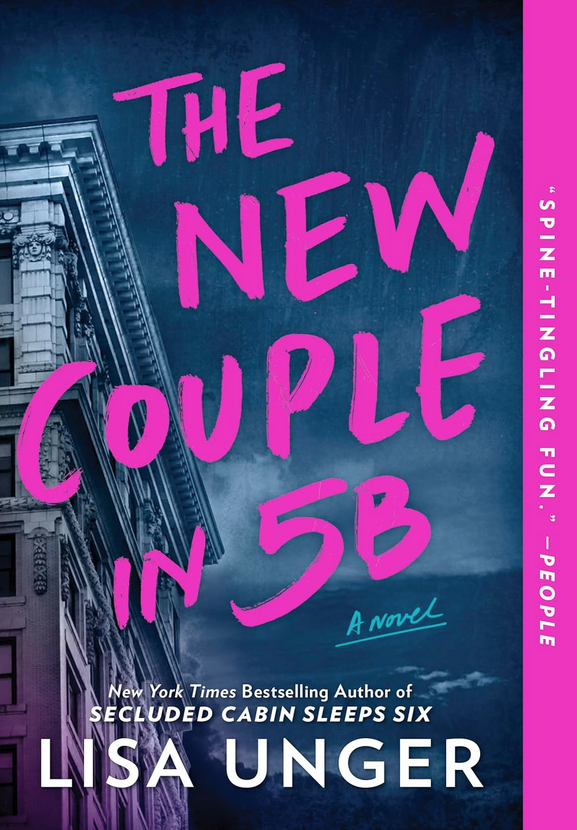
THE NEW COUPLE IN 5B . . . Between the covers

This is a classic example of what one critic, perhaps unkindly, called ‘anxiety porn.’ Rosie and Chad Lowan are a young New York couple, she a writer with a moderately successful first novel, but struggling with the second: he is an actor, yearning for the big break. Bit parts in commercials and the role of Third Witch in an adventurous off-Broadway production of The Scottish Play help with the bills, but the couple are just about solvent. Then, fortune seems to smile on them. They have been providing end-of-life care to an Ivan, an elderly journalist who owns an apartment in The Windermere, an exclusive and historic building – think The Dakota, and you are close.

When the old man dies and (ignoring his daughter) leaves the apartment to Rosie and Chad  it looks as if all their Christmases have come at once, but this is a psychological thriller, so we know things are going to turn nasty in short order. The apartment has, apparently, seen its shared of tragedies over the decades and, before long, strange things begin to happen.The Windermere has, shall we say, a lurid history. Built around the shell of a church destroyed by fire in 1920 (but retaining the gargoyles) it has been the scene of several tragedies. In 1932 its architect and builder, ruined by the Great Depression, dived to his death from a high window. Suicides by various methods and defenestrations, while neither regular nor frequent, have lent a certain ‘character’ to the building.

Inexplicable things start to happen to Rosie. She sees a strange little boy, presumably the spectre of a child who died in the elevator shaft; the imperturbable and ever-present doorman, Abi, although suavely polite, exudes menace; Rosie’s immediate neighbours, Charles and Ella seem kind and gentle, but what are they hiding? And why, on the residents’ internet forum, has the thread Ghosts of the Windermere been deleted by the admins?

When Ivan’s daughter, presumably still smarting at losing out on her inheritance, is found dead, hanging from a beam in her photography studio, la merde frappe le ventilateur, as the French probably don’t say. It doesn’t help that Rosie and her editor, Max, are the ones to find the corpse. Apart from a few chapters which are narrated by a woman who lived in the apartment now occupied by Rosie and Chad, Rosie is the principal narrator. and CriFi convention means that if this is still the case half way through the book, then it is highly unlikely that Rosie is a wrong ‘un. So who are the bad guys? Cui bono?

Frequent readers of this kind of psychological thriller will know that only one thing is certain, and that is that most of the supporting actors are either not who they say they are, or have evil intent towards the central character. So it is here, but you can make your own deductions as the pages fly by. I confess that I have a ‘view’ of modern American CriFi. I am a huge fan of, to name but two, Harlan Coben and Jonathan Kellerman. Each book is polished like a gemstone, slickly plotted and with authentic dialogue. Formulaic? Yes, but – like the ‘secret’ recipes of Coca Cola and Kentucky Fried, it works. Every single time. This novel fits that bill perfectly. What we have here is a readable and engaging thriller with surprises lurking at every bend in the road. If it sticks to the rules of the game, then I am not complaining. It is published by Park Row Books and is available now.

Blog at WordPress.com.

Up ↑