

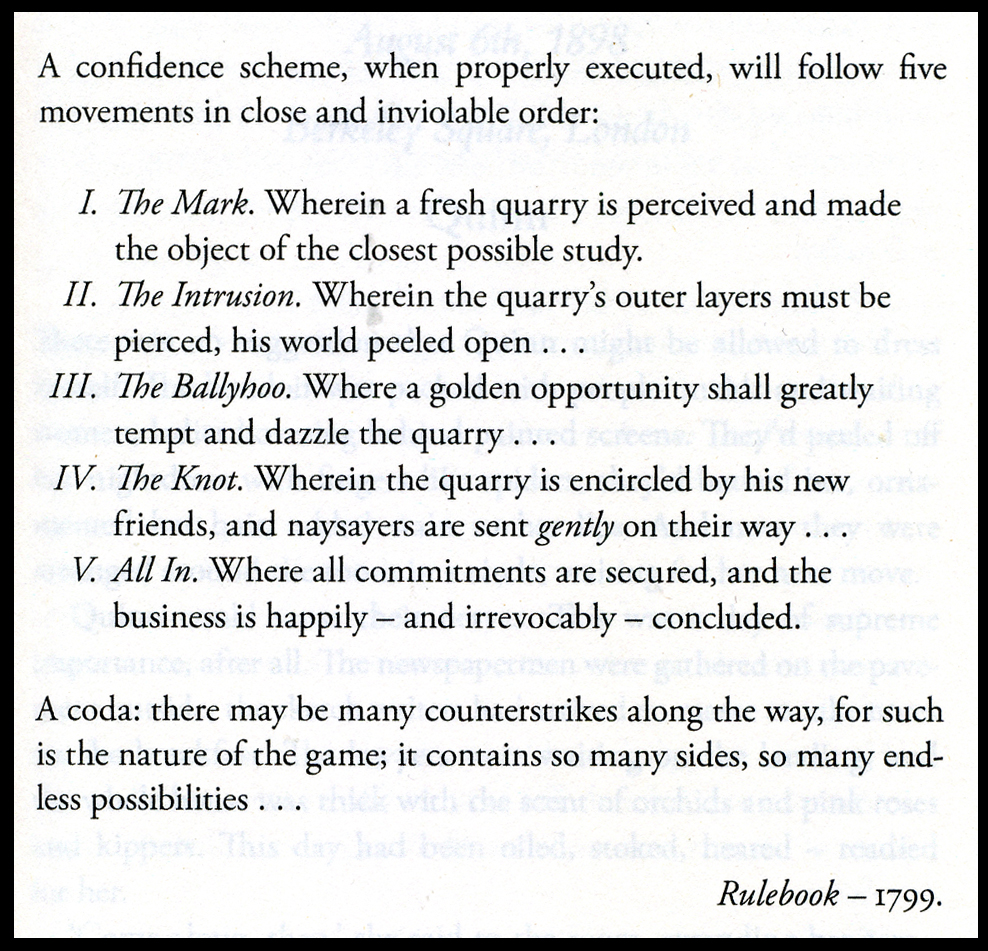
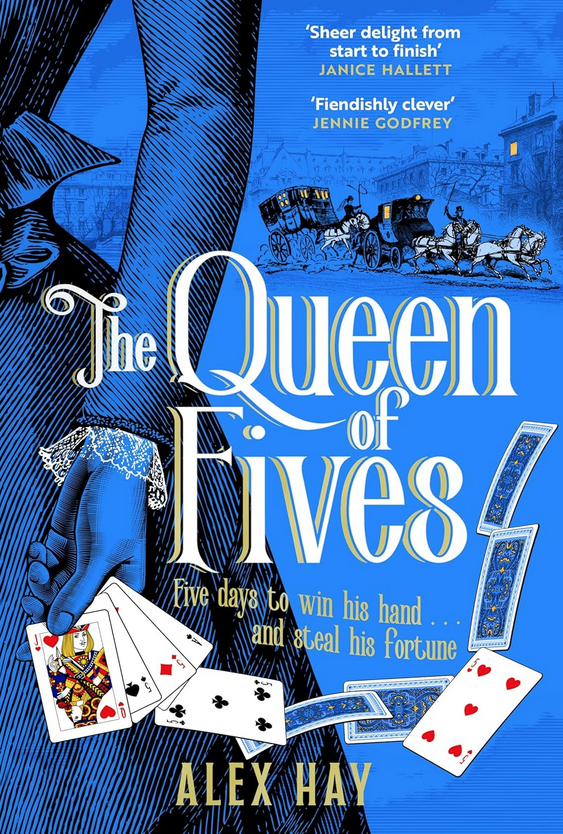
Alex Hay spins a yarn that is a preposterous as they come, but the more audacious the schemes of Quinn le Blanc become, the more entertainment the book provides. Quinn is a confidence trickster, dedicated to separating fools and their fortunes. Her home is a house in Spitalfields, and we are in the last years of Queen Victoria’s reign, a full ten years since the streets and alleys near le Blanc’s house echoed with the cries of “murder!” as yet another lady of the night was struck down by Britain’s most infamous serial killer. I may be be wrong, but the author may be giving a nod to Victorian theatre techniques, and the ability of its writers and directors to fool audiences with special effects. These, superbly described in The Fascination, by Essie Fox, are from a time long before CGI and earlier studio fakery. Le Blanc has one task. In five days, she has to meet and snare one of London’s most eligible bachelors, Max Kendal. He is alleged to be improbably wealthy, but possibly a case of ‘asset rich, cash poor.’ With the aid of Mrs Airlie, a refined former fraudster, she prepares to set her trap. The ‘Fives’ in the book’s title refers to a kind of protocol which has five separate stages to guide the potential fraudster.
Quinn receives a surprise invitation to the Duke’s ball, but she is suspicious:
“Quinn could smell it: the scent of the game, sweet and rotten. She didn’t trust the Duke, didn’t trust this card. She needed to find out what exactly he was concealing. The serpent was uncoiling in her heart.”
Being a high class female confidence trickster is not just a matter of desire, deception and decolletage. Quinn has to be able to do the kind of small talk the woman she was impersonating would be comfortable with. At the Duke’s ball:
“Yes, she was entranced by hunting, shooting, fishing, riding, stalking, hymns, cows,, dogs, lakes, children, her dear- departed parents, embroidery, automobiles and English beef.”
By the time Quinn has worked her way to the third stage of the scheme – The Ballyhoo – Alex Hay has made us aware that there is at least one other player in the game who intends nothing but malice and and disruption to Quinn’s plans. This mysterious person is introduced as The Man in the Blue Silk Waistcoat, but they clearly have shape shifting powers when they metamorphose into The Woman in the Cream Silk Gown. This person is not the only challenge facing Quinn. Victoria – Tor- Kendal, Max’s sister, is a force of nature. She is unconventional and a sexual predator, but her main concern is for her own fortunes should Max marry. The siblings’ stepmother, Lady Kendal is deceptively demure, but beneath her lightweight airs and graces is a formidable intelligence and steely self-will.
“There was something impenetrable about Lady Kendall. Something opaque, as if her roots had been dug deep, deep into the ground. She gave the outward impression of perfect, doll-like refinement, but there was absolute strength there.”
Alex Hay eventually lets us know the identity of the mysterious shape-shifter who is determined to sabotage Quinn’s attempt to snare the Duke and his fortune. Then, in a delicious twist, we learn that the Duke’s apparent sincerity regarding a marriage is just as insubstantial as that of Quinn. Not to spoil the fun, but I can’t resist a little teaser. If you recognise these lines, then you will know what is going on.
“He sipped at a weak hock and seltzer
As he gazed at the London skies”
Throughout the novel, the prose is rich, florid, and decidedly decadent – totally appropriate to what cultural historians have termed the ‘fin de siècle’, a period of dramatic contrasts between rich and poor, morally indulgent and haunted by the ghosts of Swinburne, Wilde, Beardsley, Verlaine and Sickert. The wedding breakfast prior to the marriage of Quinn and Max is wonderfully grotesque. Hieronymus Bosch had been dead for nearly four centuries, while it would be twenty more years before Otto Dix and George Grosz assaulted bourgeois sensibilities with their savage cartoons. Alex Hay trumps them all:
“Around them, the footmen were placing mountains of food upon the table. Collared eels, roast fowl, slabs of tongue, joints of beef, biscuits, wafers, ices, cream and water. The mayonnaise shuddered, glutinous and sick-making. Everything smelled taut, stewed, drenched in vinegar.”
This is a wonderful example of how a spectacularly good novel does not have to feature characters with whom we claim moral kinship. Quinn is simply awful – an unscrupulous predator with the moral compass of a centipede. Tor Kendal is a narcissistic ‘problem child’ with zero awareness of social or human sensibilities. Perhaps the closest to being a ‘good chap’ is Duke Maximilian, but it is not easy to decide if he is “nice but dim” or just another player in the brutal chess game played by the minor nobility in late Victorian England. This is a terrific read which assaults our senses with descriptions of the more bizarre aspects of English social life in the dying years of the 19th century. Best of all, it has gyroscopic plot which spins on its own axis innumerable times before Alex Hay persuades us that it all makes sense. Published by Headline Review The Queen of Fives is available now.


 fullybooked2017