Search

fullybooked2017

Month

February 2025

SANCTUARY . . . Classics revisited

I have come to the novels of William Faulkner (left) late in life. Perhaps that is just as well. I am not sure how, as a younger man, I would have dealt with his baleful accounts of one or two truly awful human beings. Having just read Sanctuary, my first reaction is a sense of having been exposed to the very worst of us. The psychotic little gangster Popeye is an embodiment of genuine evil. He is warped both physically and mentally but seems invulnerable, echoing Shakespeare’s description of Julius Caesar ‘Why man, he doth bestride the narrow world like a colossus’.

The novel was published in 1931, which in itself gives pause for thought. I can’t think of an earlier novel published as mainstream fiction which dealt with depravity in the same way. The version that made it into print was, however, a toned down version of Faulkner’s original manuscript. In one sense, Sanctuary embodies the way Shakespeare adapted Aeschylean tragedy. Yes, there are truly evil people at work here, but the main characters are fundamentally unremarkable folk who, through a toxic blend of circumstance and human frailty, are brought down.

The story is this. A humdrum lawyer, Horace Benbow, leaves his wife, and makes his way to the town of Jefferson, where he has a property, shared with his sister. On the way, he meets a Memphis gangster known as Popeye, who takes him to a semi-derelict plantation house, where a bootlegger called Lee Goodwin brews his moonshine. Perhaps the only thoroughly decent person in the book is Goodwin’s common-law wife, Ruby. She prostituted herself to raise money for lawyers when he was first tried for murder, stuck by him while he was away fighting in the The Great War, and brings up their sickly child in the most challenging of circumstances. By a trick of fate, 18 year-old college girl Temple Drake ends up at the property. She is assaulted by Popeye, while a simpleton called Tommy is shot dead. Temple is taken off by Popeye to a Memphis brothel run by a woman called Reba, where she meets another petty crook called Red. Goodwin is arrested for the murder of Tommy, and the story hinges on Goodwin’s murder trial, where he is defended by Benbow.

Faulkner’s narrative style in Sanctuary is much more conventional than in some of his other novels. While it is not quite the same as the “show or tell” option, one of his techniques here is for something to happen, but the exact details are only fully revealed to the reader some time after. Three examples: we don’t learn the grim details of what Popeye did to Temple in the corn store until Goodwin’s murder trial: although Temple hints at it very briefly; it is only when Reba and her lady friends are consoling themselves with gin after Red’s funeral that the details of the sordid relationship between Popeye, Temple and Red become clear. Likewise, it is only in the final pages of the novel, when Popeye is on trial for a murder he could not have committed (because he was miles away at the time, murdering someone else) that we learn of his tormented and traumatic childhood.

The courtroom drama has been a fiction staple for decades, and they range from the dry and interminable wrangling of Bleak House, via the comedic genius of Israel Zangwill in The Big Bow Mystery, to the smarts of Michael Connolly’s Micky Haller novels, but it is the trial of Lee Goodwin which becomes the pivotal moment of Sanctuary. The adversarial nature of American court rooms lends itself readily to dramatic fiction even when the court is in some sophisticated city like New York or Boston. When the court is in a febrile small Southern town, the novelist will lick his/her lips in anticipation.

The novel, even its bowdlerised state, had so much in it that was impossible to film at the time and, probably today, too (please don’t give Lars Von Trier any ideas) but in 1933 a cinema version of the story was made, called The Story of Temple Drake, with Miriam Hopkins in the title role. Despite its inevitably sanitised version of the novel, it is said to be one of the films that prompted the Hays Code, a self censuring set of rules by film executives that set out just what could and couldn’t be seen in mainstream films. They tried again in 1961, but this was an amalgamation of Sanctuary and its 1951 sequel Requiem For A Nun.  Faulkner, despite holding his nose at some of Hollywood’s excesses, was frequently employed by film makers, most notably as co-writer of the screenplay for Howard Hawks’s The Big Sleep. He still didn’t manage to resolve the question, “Who killed the chauffeur?”(For aficionados only)

Sanctuary concludes with two men dying for crimes they did not commit, and a young woman whose journey takes her through brutal rape, sexual decadence and perjury reaching a kind of limited restoration, but leaving behind her a trail of broken lives. Some commentators have decided the book is an allegory, and when people decide on this approach they inevitably disagree on what it is an allegory of, and choices range from the destruction of the Old South to middle-class apathy in the face of evil. For me it is, first and last, a very good crime novel. Faulkner was way ahead of the Noir game here, and although he openly admitted that the book was written to make money from those who like sensationally lurid stories, it remains a revealing glimpse into the darkness of the human soul.

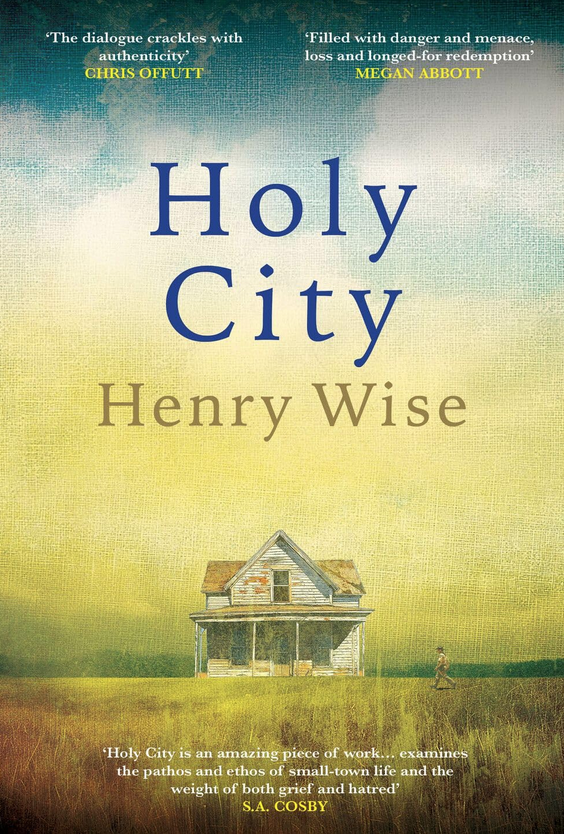
HOLY CITY . . . Between the covers

Deputy Will Seems has returned to his home in rural South Virginia after working for ten years in the state capital, Richmond. He finds a place turned in on itself, a place of despair and senseless minor criminality. It’s name? Euphoria County. Will muses on what he sees:

“People around here seemed to live in a cloud of defeat, self-wrought and inherited. Whites had the lost cause, Blacks had slavery. It would seem they should be pitted against each other, but they were really dug in behind the same trench. And the rest of the state, the rest of the country was out there.”

Will attends a house fire he has seen while on patrol and, before the fire crew can get there, he pulls a man from the blaze. The man – Tom Janders – is already dead, but on closer investigation the cause of death is knife wounds. After recovering from smoke inhalation, and leaving the emergency services to do their job, Will finds a man apparently trying to leave the scene and, although he has a deep personal connection to the fugitive – Zeke Hathom – has no alternative but to arrest him. Will’s boss, Sheriff Mills is firmly convinced that Zeke Hathom is the killer, but Will is not certain. What he is certain of is that he must tread carefully. Unknown to anyone else, he is sheltering Sam Hathom, Zeke’s errant son. Sam is wanted for minor criminality, but he also has a drug addiction, and Will is trying to wean him off it. There is a blood bond between Sam and Will. Years ago, when they were in their teens, they were inseparable, but one night they were set upon by a gang of other youths. Sam was beaten within an inch of his life, sustaining permanent facial injuries, but Will was too terrified to help his friend.

Meanwhile, Zeke’s wife has hired a private investigator from Richmond to prove her husband is not the killer. Bennica Watts has been forced into the profession because she was sacked from Richmond police for illegal acquisition of evidence. When she arrives in Euphoria County she is introduced to Will, and he agrees to her posing as his new girlfriend from out out of town while she goes about her work.

Like many other novels set in the American South, in Holy City the past is never far away. It might be the relatively recent past like Will’s youthful friendship with Sam, but ever present, though, is the folk memory, the almost palpable sense of eternal division between Black and White. No matter how many Confederate statues are pulled down the perceived injustice of what happened after Appomattox in April 1865 lingers in the blood of ancestors of the people that erected them, and this is nowhere better described than in William Faulkner’s Intruder In The Dust (click link to read the passage) For Black people, the sense of gross injustice – historical and current – is like a bloodstain that no amount of scrubbing can remove. A quote from this novel, referring to the relationship between Will and Sam, could also refer to the broader cultures into which they were born:

“They were trapped in a shared past.”

A common feature of what has come to be known as Southern Noir is the way the landscape broods and mirrors the sense of loss and resentment felt by the humans who live and work in it. You can find it in novels by William Faulkner, James Lee Burke, Greg Iles and Wiley Cash, to name just four. Henry Wise clearly knows his southern Virginia, and he portrays a land that has history, but whose time has gone. Many former tobacco fields have been abandoned for more saleable crops; the once-abundant flocks of quail have either been shot out of existence or have moved elsewhere; out of town and dotting the dusty highways are houses that look abandoned but may well not be, at least by living humans.

“The trees they saw now seemed grown to die, honed for some miserable end.The occasional building, house, church, trailer, lay unbelievably ravaged by vine and dark growth against the wan green moonlight glinting off the uneven road.They passed a shroud of bubble wrap tangled against a tree.”

Thanks to an audacious gamble by Bennica Watts the murderer of Tom Janders is identified, but although this means Zeke Hathom is eventually exonerated, the case has left numerous casualties, both in the physical sense of blood being spilled but, even more dramatically, the skeletons of the past are, metaphorically, unearthed and their bones bear witness to deeds of utter evil and depravity. This is a beautifully written but dark and dystopian novel, seared by startling moments of genuine pain and sexual violence. There is a flicker of redemption for one group of characters in the novel, but for others, it is as if the past has thrust its withered hand from the grave and swept them down into the depths where it resides. Holy City is published by No Exit Press and is available now.

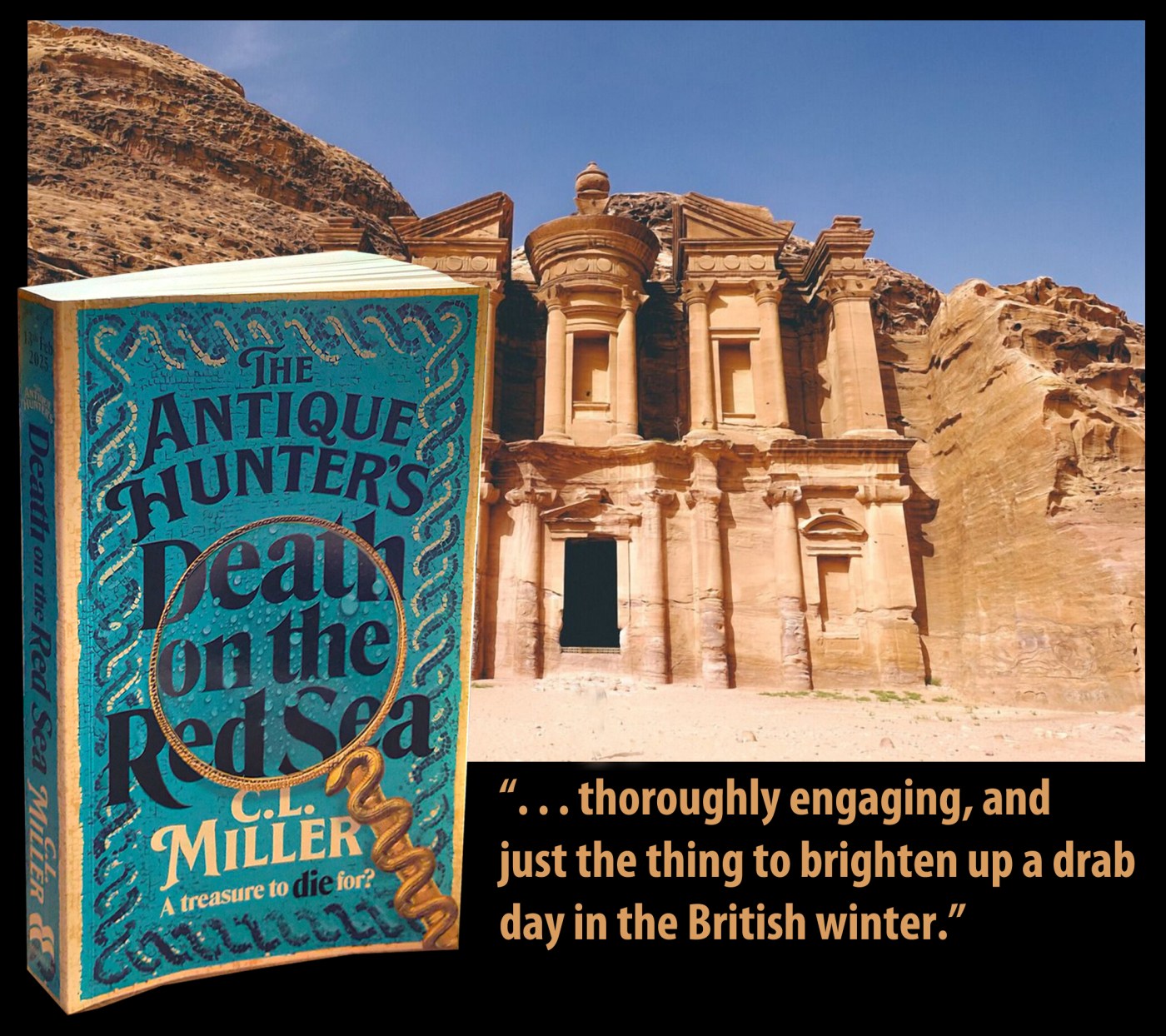
THE ANTIQUE HUNTER’S DEATH ON THE RED SEA . . . Between the covers

There’s a backstory to this engaging novel of skullduggery in the international antiques trade, but I’m going to be mean and direct you to my review of the debut novel in the series The Antique Hunter’s Guide To Murder. A few minutes read will explain everything! Now, Freya Lockwood and her eccentric Aunt Carole have inherited the antiques business owned by the late Arthur Crockleford in Little Meddington, Suffolk.

A quick peep at the author’s bio will tell you that she is lucky enough to live in Constable country. The action starts in that idyllic spot, but soon moves further afield. In pursuit of a stolen painting – and involves trying to solve a murder at a little maritime museum in Lowestoft, our two Noble Dames join a specialist antiques lovers cruise sailing from Greece to Jordan. Central to the plot is the existence (or not) of a mysterious antiques crime supremo known as The Collector. The legend has been around for 200 years, so we are not talking about a supernatural being, but more like a criminal version of The Pope, in that a new Collector is elected when the old one dies.

Back in the 1970s the now unjustly forgotten crime novelist Colin Watson wrote a book called Snobbery With Violence, in which he excoriated the Golden Age of crime fiction. The writers, he believed, portrayed a world which, if it ever existed, was totally removed from the humdrum lives acted out by most readers of the genre. As good a writer as he was, I think he missed the point. CL Miller is not setting out to emulated Sayers, Marsh, Allingham or Christie, but she does allow Freya and Caroline to achieve what, for most of us, would be ‘the impossible.’ Freya and Caroline desperately need to join the cruise, so crucial to the plot. In one paragraph, Carole beguiles the flunky at the other end of the phone to let them join the cruise and, with the next call, books flights to Cyprus so that she and Freya can be piped on board the ship. Implausible? Yes, of course it is, but entertaining? Absolutely.

Back to the plot. Freya and Carole blag their way aboard the MVGoldstar as it cruises sedately towards the Red Sea and the ancient ruins of Petra. There is a convention in this kinds of mystery that very few people are who they claim to be, and so it is on the decks and in the luxury restaurants of the ship. Much mayhem ensues, including gunfire echoing around the magnificent ruins of Petra, an FBI agent posing as a member of the ship’s crew, an enigmatic painting which may (or may not) contain a clue to the whereabouts of a priceless Ming vase, and all manner of villainy from people posing as respectable tourists. The book is, of course escapist, but thoroughly engaging, and just the thing to brighten up a drab day in the British winter. It is published by Macmillan, and is available now.

THE MASKED BAND . . . Between the covers

Two things immediately endeared me to the the main character in the book (a.k.a. the author, I imagine) First, he is a fan of country music, and was quick to reference the divine trio of Emmylou, Dolly and Linda. Second, he is no fan of the more self indulgent excesses of modern jazz. But there’s a good story here, too.

The Okay Boomers are a celebrity amateur rock band. In two ways. Confused? The five-piece outfit are actually media celebs themselves, but they wear masks on stage. Masks of Bob Dylan, Mick Jagger, Paul McCartney, Debbie Harry and David Bowie. They play a pub gig in the affluent London district of Barnes, and have an ‘after party’ at the mansion owned by one of the band members. When a body is discovered the next morning, dead as can be on the gravel underneath a balcony,  DI Garibaldi hops on his bike (literally, as he doesn’t drive) and joins the investigators at the crime scene. The dead body is eventually revealed to be that of Frankie Dunne, an unremarkable young man who – apparently – was completely unknown to any of the Okay Boomers.

Bernard O’Keefe has some sly fun with a couple of the celebrities. There’s Larry Benton, a former footballer turned presenter who sees himself as the champion of middle class liberal sentiments, and Charlie Brougham, the handsome, floppy-haired toff whose boyish charm once graced many a British comedy drama. Hmm. Let me ponder. Who could he have been thinking of?

As you might expect, beneath the veneer of showbiz cameradie, the members of The Masked Band have, in private, little good to think or say about each other. In a rather neat bit of technical business Bernard O’Keeffe has five of the band masks go missing from the crime scene, with the  only surviving mask – that of Mick Jagger – placed on the face of the defenestrated corpse, thus placing the latex Bowie, Dylan, Harry and McCartney faces out there in the community and ready to be used and abused.

We know from the brief and enigmatic prologue, that a young man who has drunk well rather than wisely heads of in search of his girlfriend and his missing ‘phone. He arrives at the house where he thinks both are and ….. end of prologue.

Were you to organise a convention of fictional Detective Inspectors you would need something larger than the average town hall. So how does DI Jim Garibaldi measure up? Italian heritage, obviously; lapsed Roman Catholic, parents died together in a road accident – hence his refusal to learn to drive; his marriage broke down, but he has a bond with his son, renewed every time they go to Loftus Road to watch QPR; he is widely read but wears his learning lightly.

Garibaldi is an engaging central character. Like all the best fictional DIs, he is prepared to think outside the box. The quirky copper resolving cases that baffle his senior officers is an oft repeated trope in police procedural novels, but it works well here. The identity of the person responsible for Frankie Dunne’s death does not exactly come out of the blue, but it is cleverly hidden until the final pages. This is a thoroughly engaging police procedural tale with just the right blend of mystery, dry humour and credible characters. The Masked Band is published by the Muswell Press and is out now.

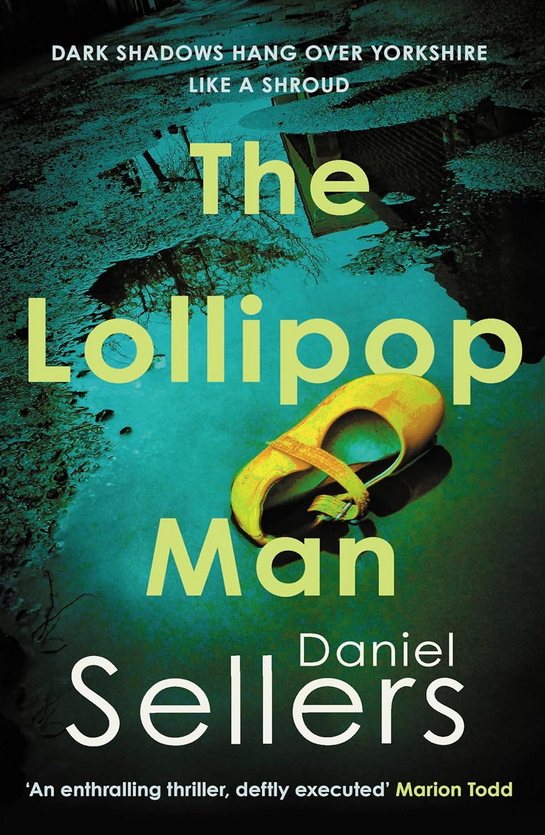
THE LOLLIPOP MAN . . . Between the covers

It is 1994, and we are in West Yorkshire, in the district known as the Calder Valley. An old friend of mine called it Cleckhudderfax, a neat blend of three of its major towns. The main character is a young man known as Adrian Brown. I say ‘known as’ because he was christened Matthew Spivey. When he was 10, he was abducted by a serial killer later dubbed The Lollipop Man, who had already claimed three victims – little girls. Nothing was ever found of them except bloodstained clothes. But here’s the strange thing. Adrian/Matthew was found and returned, unharmed, to his parents. It was then decided that he should change his name to allow him to grow up without constant attention from the media.

Now, Adrian is employed as a  trainee reporter-cum gofer with the local newspaper. An unusual lad, is Adrian. He is intelligent, but socially insecure. He is also gay, which was is not an easy road to travel in the landscape of the sometimes toxic masculinity of West Yorkshire in the 1990s. When, after a gap of ten years, another little girl disappears, Adrian is drawn into the messy periphery of the police investigation, along with Sheila Hargreaves, a TV journalist and presenter.

There are several characters on the periphery of this drama but their significance is not immediately obvious to the reader. We have Edna Worley, a middle aged busybody who is obsessed with appearing on local news or getting her name in the papers. When she is found dead on a canal towpath it seems clear that she has been murdered for something she knew. We also have the habitues of the district’s only gay pub, a collection of losers including a barman who doubles as a drag Queen. When one of the regulars, a petty crime sponger known as ‘Little Phil’ also turns up as a corpse in the canal, Adrian is forced to examine the integrity of the people he views as his friends.

It’s fair to say that Adrian isn’t the most inspiring of central characters. Midway through the novel, he is forced to examine how he has screwed up:

“He did a gloomy stock take. He lied to his parents about his sexuality and about his social life. He’d found a dead body and lied about that, this time to the authorities.He’d tampered with evidence. He’d drawn his best friend into a conspiracy to conceal his earlier misdemeanor. Then, with that same friend, he’d broken into a pensioner’s house and stolen his murdered sister’s private papers. Since then, he’d also managed to fall out with his friend and with his parents and had shouted at and run away from a well-loved television presenter.”

There is a tragi-comic episode where Adrian is discovered ‘making hay’ with his boyfriend. Bursting unannounced into the bedroom is a relation who promptly tells her husband, who storms round to Adrian’s parents house. His timing couldn’t be worse, as Adrian’s mum had been childminding a neighbours’ little girl, who appears to have snatched by The Lollipop Man while she was playing in the back garden. Therefore, the crowded front room of the terraced house is full of coppers and social workers. Not exactly the ideal place, one might think, for Adrian’s sexual preferences to be made public. Adrian survives relatively unscathed, and goes on, with the help of a mate, to put two and two together and find the correct answer, lurking in a rather gothick and isolated former tannery on the edge of the moors.

This is certainly not a police procedural, as the coppers seem to make one blunder after another, but it is an entertaining thriller taking us back to the days of mobile phones the size of bricks, and a northern England still under the shadow of the misdeeds of Myra Hindley and Peter Sutcliffe. The book’s title refers to the vague recognition of several witnesses that the abductor was dressed in a white coat and a military style peaked cap, similar to the garb worn by people escorting children across busy roads at going home time. The Lollipop Man will be published by Allison and Busby on 20th February.

INTRUDER IN THE DUST . . . Classics revisited

Published in 1948,  this is regarded by some as Faulkner’s masterpiece. Any modern reader, picking up a Faulkner novel for the first time needs to adapt quickly to his style; either that, or put the book back on the shelf. Be prepared for long paragraphs with minimal punctuation. This, in 1948 was, of course, nothing new. Writers as diverse as Proust and Joyce had written in what became known as the “stream of  consciousness” style. You will also need to be alert and follow the text closely to understand who is speaking. You will rarely find anything as obvious as “Grant said,” or “Mother replied,”.

The novel is set in the fictional  town of Jefferson, within Yoknapatapha County. It is almost certainly based on the city of Oxford, Mississippi, where Faulkner lived for much of his life. He has little in common with Thomas Hardy, except that both men drew maps of the area where their novels were set, Hardy’s, of course, being of Dorset and its surrounds. We can date the action in the novel fairly accurately, as one of the characters refers to ‘the atom bomb’ which would only become public knowledge after August 1945.

The main character is a teenage boy called Charles ‘Chick’ Mallison. He comes from a very respectable and well-to-do white family. Early in the story, he is out fishing with some other boys, when he falls into the creek. His friends try to get him out, but he is then rescued by an austere black man called Lucas Beauchamp. Their early relationship is established when, after being taken to Beauchamp’s cabin to dry out, Charles attempts to pay the man for food he has been given. Beauchamp throws the money to the ground.

A couple of years later, Beauchamp is arrested for shooting dead a local white man called Vinson Gowrie whose kinsmen are all criminals. It is fully expected that at some point, Gowrie’s relatives will storm the jail and lynch the prisoner. Charles’s uncle is Gavin Stevens, the county attorney and, in true lawyer fashion, he has no particular position on whether or not Lucas did kill Gowrie, but is more concerned with matters of proof and evidence.

Charles is friends with a young black boy called Aleck Sander, son of the woman who cooks for the the Mallison family, and he was with Charles when Lucas rescued him from the creek. Charles goes to talk with Lucas in the jail, and is persuaded to go and dig up the coffin of the recently buried Gowrie, because Lucas is sure that a proper examination will show that the man was not killed by a bullet from Lucas’s old revolver, but with something of a different calibre. It is at this point that Faulkner introduces the character of Eunice Habersham, a rather eccentric and elderly white woman who keeps chickens. She is a descendant of one of the early settlers in the county; she is thin and apparently frail, but made of stern stuff. She has a truck, and with Charles’s horse Highboy in tow, they go out to the remote graveyard and dig up the coffin.

What happens next is for you to find out. This book may be 77 years old and a classic of literature, but it has many of the elements of a crime thriller, and reviewers – even amateurs like me – never give the game away. I will be neither the first nor the last to point out the similarity between this novel and the best-seller that came out 12 years later, which also featured a black man unjustly accused of a crime, with the events viewed through the eyes of a white teenager. Suffice it to say that the two novels have different endings, but both reflect on racial injustice in the American South, although Faulkner’s book is set decades after that of Harper Lee.

The full glory of Intruder In The Dust is the poetic language encased in prose, albeit prose of an unconventional nature. I have referred elsewhere to Faulkner’s majestic words describing the faint hope that if a Southern boy squeezes his eyes closed and holds his breath, Pickett’s charge might never have happened or had a different outcome. There is, however, more. So much more. Here, he describes the atmosphere within the black community of Jefferson waiting for the inevitable raid by the Gowries in the town jail, and the immolation of Lucas Beauchamp.

“But not now, not tonight:  where in town except for Paralee and Aleck Sander, he had seen none either for twenty four hours but he had expected that, they were acting exactly as Negroes and whites both would have expected Negroes to act at such a time; they were still there, they had not fled,  you just didn’t see them – a sense a feeling of their constant presence and nearness: black men and women and children breathing and waiting inside their barred and shuttered houses,  not crouching cringing shrinking, not in anger and not quite in fear:  just waiting, biding, since theirs was an armament which the white man could not match nor –  if he but knew it, even cope with  patience;  just keeping out of sight and out of the way.”

It is one of the great ironies of modern sensibilities that if an unknown writer presented this manuscript to a modern publishing house, it would certainly be rejected. It’s all about words and language, obviously. Regarding the current debate over the capitalisation of the word Black and its obverse, in this review and elsewhere I have avoided capitals in both cases.

PICKETT’S CHARGE, THE SOUTH, & WILLIAM FAULKNER

In his 1948 novel Intruder In The Dust, William Faulkner tells of a black man accused of a murder he did not commit. Eventually, due to the efforts of a white teenager and an elderly lady, the real killer is identified. Along the way, Faulkner attempts to explain – but not apologise for – the residual bitterness felt by white people in the South, so many decades later, about the outcome of the Civil War. General Robert E Lee is a heroic figure in Southern mythology. He came close to winning the battle of Gettysburg in 1863, but on the third day of the battle his hopes hinged on what we now think of as a military blunder. Confederate forces, under General George Pickett, made a full frontal assault on Union forces holding high ground. The charge was a disaster, and although Lee won later battles, that afternoon is known as The High Watermark of The Confederacy. Faulkner’s character voices what remains one of the finest short pieces of prose in the English language. It is the ultimate “what if?”

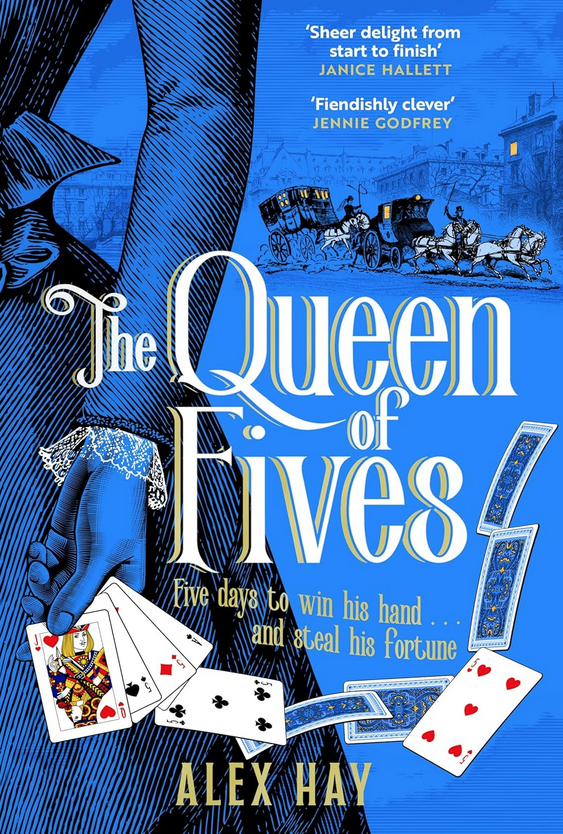
THE QUEEN OF FIVES . . . Between the covers

qo5005 copy

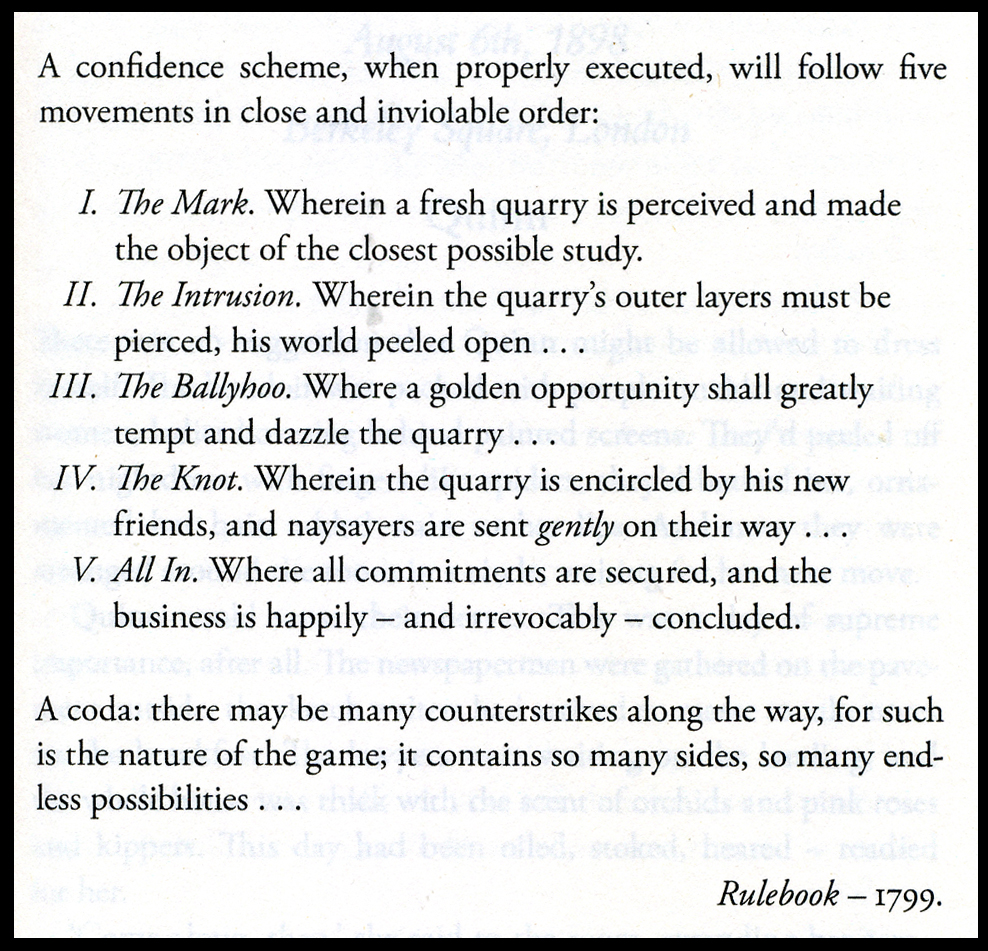
Alex Hay spins a yarn that is a preposterous as they come, but the more audacious the schemes of Quinn le Blanc become, the more entertainment the book provides. Quinn is a confidence trickster, dedicated to separating fools and their fortunes. Her home is a house in Spitalfields, and we are in the last years of Queen Victoria’s reign, a full ten years since the streets and alleys near le Blanc’s house echoed with the cries of “murder!” as yet another lady of the night was struck down by Britain’s most infamous serial killer. I may be be wrong, but the author may be giving a nod to Victorian theatre techniques, and the ability of its writers and directors to fool audiences with special effects. These, superbly described in The Fascination, by Essie Fox, are from a time long before CGI and earlier studio fakery. Le Blanc has one task. In five days, she has to meet and snare one of London’s most eligible bachelors, Max Kendal. He is alleged to be improbably wealthy, but possibly a case of ‘asset rich,  cash poor.’ With the aid of Mrs Airlie, a refined former fraudster, she prepares to set her trap. The ‘Fives’ in the book’s title refers to a kind of protocol which has five separate stages to guide the potential fraudster.

Gospel

Quinn receives a surprise invitation to the Duke’s ball, but she is suspicious:

“Quinn could smell it: the scent of the game, sweet and rotten. She didn’t trust the Duke, didn’t trust this card. She needed to find out what exactly he was concealing. The serpent was uncoiling in her heart.”

Being a high class female confidence trickster is not just a matter of desire, deception and decolletage. Quinn has to be able to do the kind of small talk the woman she was impersonating would be comfortable with. At the Duke’s ball:

“Yes, she was entranced by hunting, shooting, fishing, riding, stalking, hymns, cows,, dogs, lakes, children, her dear- departed parents, embroidery, automobiles and English beef.”

By the time Quinn has worked her way to the third stage of the scheme – The Ballyhoo – Alex Hay has made us aware that there is at least one other player in the game who intends nothing but malice and and disruption to Quinn’s plans. This mysterious person is introduced as The Man in the Blue Silk Waistcoat, but they clearly have shape shifting powers when they metamorphose into The Woman in the Cream Silk Gown. This person is not the only challenge facing Quinn. Victoria – Tor- Kendal, Max’s sister, is a force of nature. She is unconventional and a sexual predator, but her main concern is for her own fortunes should Max marry. The siblings’ stepmother, Lady Kendal is deceptively demure, but beneath her lightweight airs and graces is a formidable intelligence and steely self-will.

“There was something impenetrable about Lady Kendall. Something opaque, as if her roots had been dug deep, deep into the ground. She gave the outward impression of perfect, doll-like refinement, but there was absolute strength there.”

Alex Hay eventually lets us know the identity of the mysterious shape-shifter who is determined to sabotage Quinn’s attempt to snare the Duke and his fortune. Then, in a delicious twist, we learn that the Duke’s apparent sincerity regarding a marriage is just as insubstantial as that of Quinn. Not to spoil the fun, but I can’t resist a little teaser. If you recognise these lines, then you will know what is going on.

“He sipped at a weak hock and seltzer
As he gazed at the London skies”

Throughout the novel, the prose is rich, florid, and decidedly decadent – totally appropriate to what cultural historians have termed the ‘fin de siècle’, a period of dramatic contrasts between rich and poor, morally indulgent and haunted by the ghosts of Swinburne, Wilde, Beardsley, Verlaine and Sickert. The wedding breakfast prior to the marriage of Quinn and Max is wonderfully grotesque. Hieronymus Bosch had been dead for nearly four centuries, while it would be twenty more years before Otto Dix and George Grosz assaulted bourgeois sensibilities with their savage cartoons. Alex Hay trumps them all:

“Around them, the footmen were placing mountains of food upon the table. Collared eels, roast fowl, slabs of tongue, joints of beef, biscuits, wafers, ices, cream and water. The mayonnaise shuddered, glutinous and sick-making. Everything smelled taut, stewed, drenched in vinegar.”

This is a wonderful example of how a spectacularly good novel does not have to feature characters with whom we claim moral kinship. Quinn is simply awful – an unscrupulous predator with the moral compass of a centipede. Tor Kendal is a narcissistic ‘problem child’ with zero awareness of social or human sensibilities. Perhaps the closest to being a ‘good chap’ is Duke Maximilian, but it is not easy to decide if he is “nice but dim” or just another player in the brutal chess game played by the minor nobility in late Victorian England. This is a terrific read which assaults our senses with descriptions of the more bizarre aspects of English social life in the dying years of the 19th century. Best of all, it has gyroscopic plot which spins on its own axis innumerable times before Alex Hay persuades us that it all makes sense. Published by Headline Review The Queen of Fives is available now.

BURIED IN THE PAST . . . Between the covers

Heather Peck’s Greg Geldard books are, as far as I am aware, unique in that they operate almost as serials, with at least one case continuing from the previous novel, alongside a new investigation. The previous novel Beyond Closed Doors (click for more details) dealt with the troubling case of two children going missing, after their mother was murdered by their father. The book ended with Kate and Jake Mirren being held captive by a reclusive woman in a perfectly ordinary village bungalow. She feeds them well, and looks after them, but they are not free to leave the room in which are confined. The case weighs heavily on Geldard’s mind, as his boss and other senior officers having metaphorically, at least, ticked the box marked ‘missing, presumed dead’.

One of the plotlines here is centred on the vexatious pursuit of hare coursing. Far from the open fields of East Anglia, it has a long history, and in some countries it is regulated and controlled by official bodies, and is regarded as a sport for the gentry. Here, it is very different. It has been illegal since 2004, and is, at least in my backyard, largely carried out by those who, in polite speech, are known as ‘The Travelling Community.’ As I write this, villages not far from me are still reeling from the havoc caused a few days ago by a convoy of twenty five four-by-four vehicles, driven by balaclava clad men, cutting a swathe of destruction across fields and  property and leaving burnt out vehicles in their wake. In this novel, farmers who try to disrupt the activity become victims of violence and arson. When a farm worker dies from a blast caused by one of the arson attacks, this becomes a murder investigation.

While this carries on, hampered by Covid restrictions, Heather Peck focuses on the strange case of the Mirren children. We know they are still alive, but the mystery is why the woman who has, albeit benevolently, imprisoned them in the first place. The apparently inoffensive and ordinary bungalow becomes the scene of something much more dramatic towards the end of the book, when Heather Peck cleverly weaves in a story line which she introduced in the early pages, buy appeared to have no apparent connection with the events in East Anglia.

Like many readers, I always want my crime stories to have a definite and developed sense of place, and Heather Peck definitely doesn’t let us down. In my case, it helps that Greg Geldof’s stamping ground is not too far away from where I live, and I can appreciate the depth of knowledge and fondness for the fields and waterways of Norfolk and Suffolk which are embedded in the story. Buried In The Past is as enthralling and addictive a police thriller as you could wish to read. It is published by Ormesby Publishing, and is available now. Incidentally, the book ends, as all good serials should, by leaving us in suspense after Geldard suffers a harrowing few days, but I have blacked out the final words to avoid a spoiler!

Blog at WordPress.com.

Up ↑