

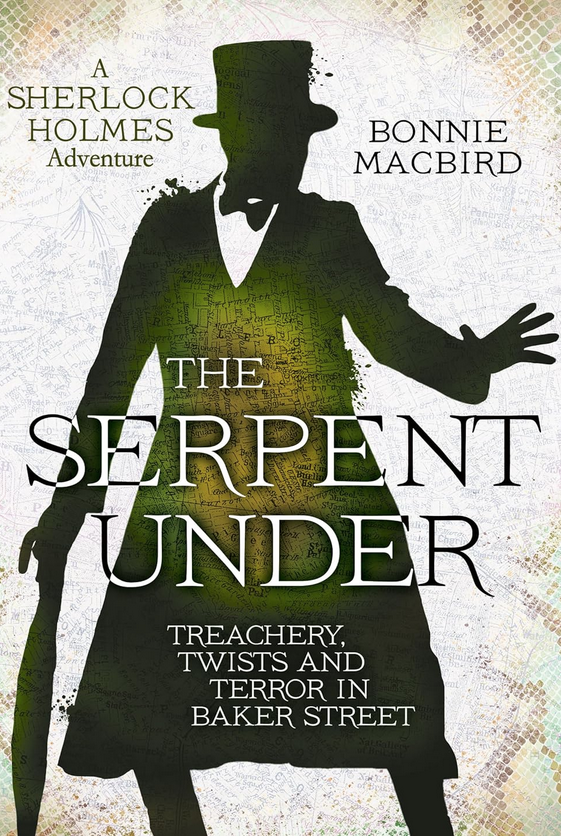
Leaving aside for a moment the question of whether or not this Sherlock Holmes pastiche is any good, I will tell you that in terms of design and printing, it is to be treasured. The cover is magnificent, and the illustrated capitals at the beginning of each chapter are a delight – each a miniature masterpiece.
To the text. Holmes and Watson receive an urgent summons to Windsor Castle, where a lady-in- waiting to an elderly duchess has been found dead in her bath. Palace officials have peremptorily declared the death as suicide, cleaned the area where the body was found, and moved her remains to another chamber. One glance at the corpse of Miss Jane Wandley is enough for Holmes to realise that she has been murdered. Not only is it impossible that the two slashes on her wrists to have been self administered, she is covered in fresh and unhealed tattoos, depicting an ancient symbol, the Ouroboros – a snake eating itself.
We are reunited with one of the more improbable characters in this series, a young girl known as Heffie, who is an ex-officio member of the Baker Street Irregulars (a staple of the original stories), a gang of street urchins who use their anonymity to eavesdrop on conversations between ladies and gentlemen on London’s highways and byways. They were a brilliant invention by ACD, as they give Holmes eyes and ears in places where he would be too conspicuous to be effective. Heffie is roughly spoken, but highly intelligent and observant. There is just a hint of Pygmalion about this, as Heffie is anxious to speak ‘proper’ as Holmes, in his Henry Higgins mode, corrects her language and pronunciation.
Bonnie MacBride wastes no time in presenting us with a selection of dubious characters. Jane Wandley’s own father will not leave his Home Counties mansion to identify his daughter’s body sending, instead, his estate manager Peter Oliver, a handsome and charismatic university graduate. Jane Wandley’s fiancée, a vulgar and vain German of very minor royal descent, has a cast iron alibi for the probable murder timeline, but is definitely a person of interest.
The key to the mystery lies in the elaborate and professionally executed tattoos on the dead woman. Someone is obviously sending an arcane message, but to whom? And what is the message? Holmes traces the tattoos to the work of a celebrated Japanese artist, much in demand in his home country where his top customers are Yakuza gangsters. However, he was in London at a Japanese cultural event, was kidnapped along with his little daughter and forced to work on Jane Wandley with a knife held to his daughter’s throat. She has been released, but of him there is no sign. Things become more complex when it is discovered that Jane Wandley’s younger brother is an artist who creates designs for an upmarket fabric company. His patterns all feature, guess what? Snakes.
Holmes tributes, pastiches, homages – call them what you will – are almost as old as the original stories. I can cope with most of them, provided they stay in period. Attempts to put him in modern dress, or make him Steampunk, or recast him in a comedy parody, are, for me, beneath contempt. Life shortens by the day, and so I don’t have statistics, but I make an educated guess that SH ‘reimaginings’ probably now outnumber the originals.
I have made this point before, but it is well worth repeating. With the exception of the four novella-length tales, A Study in Scarlet, The Valley of Fear, The Sign of Four and The Hound of the Baskervilles, all other Holmes stories were short and pithy, aimed at magazine readers. Modern novelists are, therefore faced with an inbuilt challenge, which is to keep their stories ticking over throughout 400 pages or so. Hence the need for having other story lines running parallel to the main one – in this case the mystery of who is attempting to damage and disrupt a fledgling women’s rights movement. I have a rather ‘left field” yardstick for these books. If I can imagine Holmes’s dialogue being delivered by Jeremy Brett, then all is well. In The Serpent Under, all is not just well, but flourishing. This is a clever re-imagining of our old friend, and very, very readable. Published by Collins Crime Club, it is available now.


 fullybooked2017
Leave a comment