Search

fullybooked2017

Month

January 2025

BYE BYE BABY . . . Between the covers

bbb spine012 copy

DI Jack Hawksworth is a rising star in the Metropolitan Police. He is clever, charismatic, and very good looking. His life has not been without tragedy. His parents died in a dreadful road accident, but thanks to a family bequest, he is able to live in an otherwise unaffordable apartment in London’s much sought-after Hampstead. When a man in Lincolnshire is found dead with his hands apparently clutching the remains of his genitals – and his lips – local police soon realise that this is too big for them to handle, and Hawksworth and his team are called in.

The killing is soon repeated in almost identical circumstances, but in Sussex, and it becomes obvious that there is a serial killer at work. The two dead men are linked by where they went to school – an unremarkable High School near Brighton, but what happened back in the day that someone should want to enact such terrible vengeance? Meanwhile, Hawksworth has become romantically involved with a young woman called Sophie who lives in the apartment above his. She suffers from a wasting disease and is mostly wheelchair bound, but she is funny, intelligent, vivacious – and very attractive.

One of Hawksworth’s team, DS Kate Carter is – despite being engaged to an IT expert called Dan – becoming increasingly smitten with her boss, but is trying (and mostly failing) to keep things as professional as possible. Fiona McIntosh invites readers to fall into the same traps as her investigating coppers, and those traps involve us making assumptions, which she delights in overturning. The plot is labyrinthine in its twists and turns, and McIntosh achieves the difficult task of making both the police officers – and us readers – have more than a sneaking sympathy for the killer.

As good as this novel is, in publishing terms it is unusual, in that it was first published in Australia in 2007. It is mildly frustrating that it ends enigmatically, at least in terms of Hawksworth and the serial killer. The follow up novel was Beautiful Death, which is, according to Amazon UK, a steal at just under £60, due to the strange price protocols of the world of publishing! Presumably, Australian readers know what happened next. The author was born in England, but seems to spend much of her time in the beautiful city of Adelaide. I can only say that Bye Bye Baby is a complex and sometimes gruesome read, but a brilliant police thriller. As I mentioned earlier, this is the first in an established series, but UK publishing rights are now with No Exit Press, and this edition is available now.

Screen Shot 2024-12-26 at 17.55.56

THE QUICK AND THE DEAD . . . Between the covers

tqatd spine013 copy

The Thameside borough of Southwark, 1597. Kit Skevy aged 20, is a street criminal employed – or perhaps enslaved – by a man whose trade would, in our day, be described as gangster. Will Twentyman is feared for his violence and venality. He also controls Mariner Elgin. A few years older than Kit, she is a cut-purse, a thief who specialises in relieving wealthy people of their cash. She has a complex history, having once worked on a sailing ship disguised as a boy. When her first menstruation betrayed her, she was locked up for the remainder of the voyage, and now belongs to Twentyman.

One of Twentyman’s more profitable sidelines is grave robbery, delivering corpses to anatomists or those engaged in alchemy. When a group of armed men discover Kit and Mariner exhuming a body, Kit happens to be carrying a vial of a strange substance he recovered from the body of a friend who died in a fire caused by an alchemical experiment. The vial breaks and the the liquid, perhaps something like phosphorus, ignites and plays across his fingers.

Kit is taken prisoner and his captors, wrongly, believe that he has strange powers. Kit learns that his captor is Lord Isherwood, but the nobleman’s son, Lazarus – himself an alchemist in search of hidden truths, befriends him, and orchestrates his escape. Perhaps ‘befriends him’ is euphemistic, as there is an erotic attraction between the two of them.

At one point, Emma Hinds suggests that Kit may have the anatomical irregularity of possessing both male and female characteristics. The author describes herself as “a Queer writer and playwright living in Manchester whose work explores untold feminist narratives”, so this novel is not a run-of-the-mill historical tale. Mariner also escapes from Twentyman’s grip after being drawn to Lady Elody Blackwater, a wealthy widow who is also consumed by the search for the elixirs of alchemy. There is sexual electricity between the two women and, despite their social differences, they become lovers. There is a thread of eroticism running through this book, which is unusual in ostensibly similar historical fiction.

In the last few pages of the novel we are drawn into the burgeoning world of late Elizabethan theatre, and we are introduced to an ambitious actor/playwright from Warwickshire. Emma Hinds brings us a vivid (and sometimes lurid) vision of a dystopian late-Elizabethan – era London, peopled by whore-masters, alchemists, body snatchers, cut-purses and political opportunists. Kit and Mariner are unconventional heroes. If nothing else, they are street fighters who know all the tricks to enable them to survive in a Southwark so grotesque that it might have been painted by Hieronymus Bosch.

The contrast between the middens initially occupied by Kit and Mariner, and the rose-water life style of the gentry could not be starker. The relationship between the two is that of brother and sister as each is attracted to people of their own sex. The Quick and The Dead is a complex and, in some ways, a challenging, novel. Emma Hinds has clearly spent long hours on the topography of late 17thC London, and the bizarre attempts by alchemists to attempt things which science would eventally prove to be impossible.. It was only in the age of Newton, a century later, that the work of alchemists was finally sidelined.

The author also reminds us that despite the heroics of Drake, and the fortuitous weather, Spanish/Catholic claims to the crown of England did not end in 1588. As Kit and Mariner go from crisis to crisis, a second Spanish invasion fleet is waiting at anchor in the middle distance. The Queen would only have another four years to live, and the agents of Scotland’s King James are already busy.

This is a compelling portrait of late Elizabethan England, an absorbing mix of fierce politics, wonderful architecture and drama, but sullied by bestial social conditions. Emma Hinds seems to be telling us that same-sex relationships were, in those days, not the burning issue that they were later to become. She may be right. In the novel the name of Christopher Marlowe is occasionally evoked, and one school of thought suggests that homosexuality brought about his downfall but, whatever his preferences, he was not hunted down in the way that Oscar Wilde and Alan Turing were to be in more recent times. The Quick and The Dead is publlshed by Bedord Square and available now.

Screen Shot 2024-12-30 at 12.46.56

ARDEN …Between the covers

arden005 copy

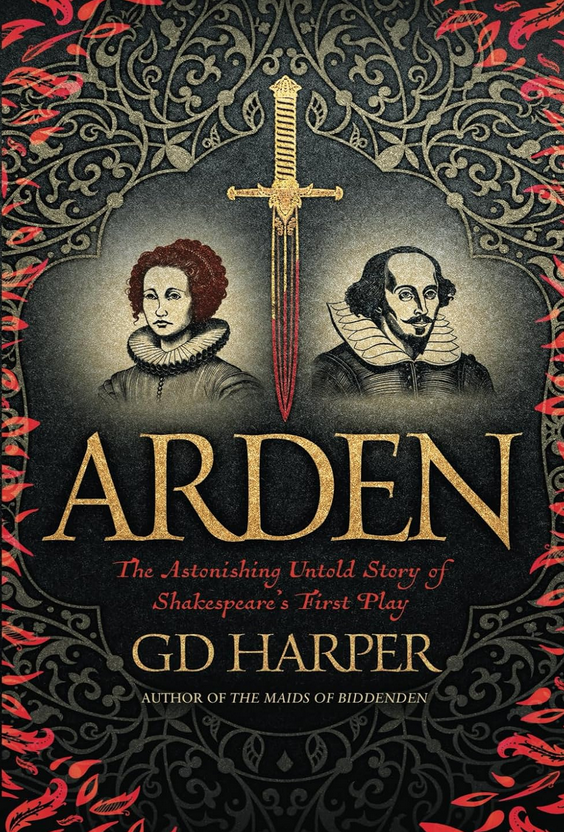
This cleverly crafted novel has two timelines. In the first, we follow the fortunes of Alice Arden, nee Brigandine. She is married to Thomas Arden, a Kentish merchant, and we are in the fourth and fifth decades of the sixteenth century, in the dying days of the rule of Henry VIII, and the brief reign of his son, the boy King, Edward VI. A young Warwickshire man, Will Shakspere*, who works as a glove maker in his father’s business, is the second subject. We are in the same century, but in its final two decades. On the throne is the daughter of Ann Boleyn, Elizabeth.

*I have retained the spelling of the surname used in the novel, rather than the modern alternative.

Alice has been married off to Thomas Arden, an unscrupulous merchant who, for all his cut and thrust in the business world, has absolutely no interest in Alice as a sexual partner. Her dismay is compounded by the fact that, before her marriage, she had an intense physical relationship with a local tailor, Tom Mosby. Thomas and Alice have moved to the town of Faversham, where Thomas has been made Mayor. When Mosby turns up and seeks to renew his relationship with Alice, she is drawn into a maelstrom of desire and wrong decisions that will have fatal consequences.

The dissolution of the monasteries, in the later years of the reign of Henry VIII, might be viewed as an act of cultural vandalism today, but for the secular world at the time, it provided endless business opportunities. The monasteries had huge land holdings and when Henry’s Treasury put these acres up for sale, merchants and investors sensed an unmissable business opportunity. Inevitably, rivals clashed, and two such were Thomas Arden and Sir Anthony Aucher. It is no exaggeration to say that they were sworn enemies.

As this rivalry blew hotter and hotter, Arden and his wife had come to an astonishing domestic arrangement. Tom Mosby had reappeared, and had sought out his former lover, Alice. Arden was still dependent on the patronage of Sir Edward North, Alice’s stepfather. Arden reluctantly allowed Alice and Mosby to carry on their passionate affair, metaphorically under his nose, but literally under his roof.

Years on from the events in Faversham, Will Shakspere is increasingly frustrated with his lot. He and his wife Ann and their three children rely on Will’s wage from his father’s glove business. Will is not a great craftsman. Profits are made by making the maximum pairs of gloves from any given hide, and Will botches more often than he succeeds. In a desperate attempt to provide meat for his table and leather for his workshop, Will tries to poach a deer from Charlecote Park, but he is caught by Sir Thomas Lucy’s gamekeepers, and is forced to flee Stratford to avoid serious punishment. He scrapes out a living in London as a bit-part actor, trying his best to send money home to Anne and his children.

The book’s title resonates throughout its pages, but in different ways. It was the dense forest that covered much of what is now the West Midlands in Roman times. It was the family name of Shakspere’s mother. They had once been noble, but had fallen from favour long ago. And of, course, it became Alice’s married name when she and Thomas were wed.

Will eventually makes his mark as a playwright in London, but before works such as The Taming of the Shrew made him rich and famous, he dramatises the events in Faversham fifty years earlier. However, as it contains obvious references to families who are still rich and powerful, it is never performed properly.

Aeschylean tragedy, used by Shakspere in such works as Hamlet, Othello and Macbeth, is based on the idea of men and women brought down not because they were inherently evil, but because of poor decisions, ambition, vanity, and human traits like jealousy. Thomas Hardy’s Mayor of Casterbridge is one such and, like him, Thomas Arden comes to grief when he offends one too many local officials and merchants, and loses all his power and authority. Alice Arden, another tragic figure, makes the mistake of trusting her lover, Tom Mosby, and becomes sucked in to a plot to kill her husband. It goes disastrously wrong and, within hours of the deed, she is arrested, thrown into jail, tried and burnt at the stake, but not before she is subject to an astonishingly vile act of revenge by the local authorities. Decades later, Shakspere learns of this and, now a celebrated and wealthy man, is determined to place on record the last hours of Alice Arden’s life.

Arden is beautifully written, with meticulous historical research. Alice Arden is a truly tragic figure, certainly not a heroine, but a woman brought low by her own desires and poor choices. I have not read a book that brings Will Shakspere to life with such energy since Anthony Burgess’s 1964 novel Nothing Like the Sun. Arden is published by Ginger Cat and is available now.

Screen Shot 2024-11-27 at 17.06.59

GONE . . . Between the covers

gone spine011

Bristol DCI John Meredith is not at peace with the world. His wife and fellow police officer Patsy Hodge was seriously injured when she came face to face with a serial killer. Her physical injuries are, albeit slowly, healing. Mentally, however, she is shattered. Her relationship with Meredith is now fraught, riven with anxiety and tension.

At work, Meredith is saddled with an exasperating pair of cold case crimes. Decades ago, two young women, unknown to each other and years apart, caught trains from Bristol to London. Neither reached their destination, and their bodies were eventually discovered in separate locations in farmland near Reading. What links the two cases is that the forensics indicate that the two young women were not killed when they first disappeared. It seems that they lived for years before being killed. But where? And with whom? Doing what,? The timeline suggests that the first girl, Jasmine was killed in 2008/9, while Louise disappeared in 2010. Could Louise have been Jasmine’s successor, a replacement of some kind? Jasmine Jones was given up by her mother, put in care and then fostered. She married a man called Carl, but the relationship disintegrated when he had a fling with another woman. Louise Marshall was another woman anxious for a fresh start and a new job, but she found only violence and an unmarked grave.

As is often the way in crime fiction, we know the answer to the puzzle facing the investigators long before they do. In this case, there is a decidedly weird and disfunctional farming family who have a disconcerting habit of employing women as a sinister mix of housekeeper and bed-mate – and then killing them.

As involving as this is, the real beating heart of the book is John Meredith’s personal life. The scene where he meets up with his first true love (after Patsy ups sticks and goes to stay with relations in New Zealand) is brilliantly written, and so, so poignant. They wine and dine, make it back to her hotel and …. I am not going to spoil it for you, but it is the most emotionally intuitive piece of writing I have read for a long time.

John Meredith is an engaging and complex man. Realising that Patsy is mentally damaged, he is bowed beneath her slights, physical indifference, and emotional instability, but he never buckles. He hopes (rather than believes) that somewhere ahead are the sunlit uplands of the days before Patsy was so badly wounded. He wants to believe what Philip Larkin once wrote. “What will survive of us is love.” It is, at the end of the day, all he has to offer.

The dark secrets of Brandon farm are eventually exposed to sunlight and justice – after a fashion – is served. What will remain with me about this book, however, is the wonderfully observed account of Meredith’s personal life. Yes, we know that most fictional police Inspectors have tangled lives away from the job. I could start with Tom Thorne, Alan Banks and John Rebus, but CriFi buffs do not need me to continue the list, as it would be a long one. My last words of praise for this excellent novel are to say that the dialogue, copper to copper and Meredith to acquaintances and family, absolutely sparkles. Gone is published by 127 Publishing and is available now.

Screen Shot 2024-12-19 at 17.25.50

THE SERPENT UNDER . . . Between the covers

TSU spine008 copy

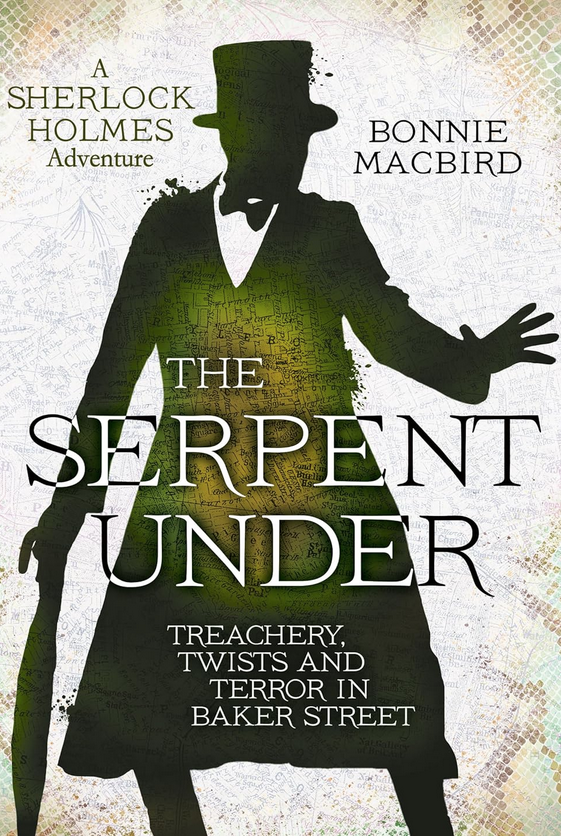
Leaving aside for a moment the question of whether or not this Sherlock Holmes pastiche is any good, I will tell you that in terms of design and printing, it is to be treasured. The cover is magnificent, and the illustrated capitals at the beginning of each chapter are a  delight – each a miniature masterpiece.

To the text. Holmes and Watson receive an urgent summons to Windsor Castle, where a lady-in- waiting to an elderly duchess has been found dead in her bath. Palace officials have  peremptorily declared the death as suicide, cleaned the area where the body was found, and moved her remains to another chamber. One glance at the corpse of Miss Jane Wandley is enough for Holmes to realise that she has been murdered. Not only is it impossible that the two slashes on her wrists to have been self administered, she is covered in fresh and unhealed tattoos, depicting an ancient symbol, the Ouroboros – a snake eating itself. 

We are reunited with one of the more improbable characters in this series, a young girl known as Heffie, who is an ex-officio member of the Baker Street Irregulars (a staple of the original stories), a gang of street urchins who use their anonymity to eavesdrop on conversations between ladies and gentlemen on London’s highways and byways. They were a brilliant invention by ACD, as they give Holmes eyes and ears in places where he would be too conspicuous to be effective. Heffie is roughly spoken, but highly intelligent and observant. There is just a hint of Pygmalion about this, as Heffie is anxious to speak ‘proper’ as Holmes, in his Henry Higgins mode, corrects her language and pronunciation.

Bonnie MacBride wastes no time in presenting us with a selection of dubious characters. Jane Wandley’s own father will not leave his Home Counties mansion to identify his daughter’s body sending, instead, his estate manager Peter Oliver, a handsome and charismatic university graduate. Jane Wandley’s fiancée, a vulgar and vain German of very minor royal descent, has a cast iron alibi for the probable murder timeline, but  is definitely a person of interest.

The key to the mystery lies in the elaborate and professionally executed tattoos on the dead woman. Someone is obviously sending an arcane message, but to whom? And what is the message? Holmes traces the tattoos to the work of a celebrated Japanese artist, much in demand in his home country where his top customers are Yakuza gangsters. However, he was in London at a Japanese cultural event, was kidnapped along with his little daughter and forced to work on Jane Wandley with a knife held to his daughter’s throat. She has been released, but of him there is no sign. Things become more complex when it is discovered that Jane Wandley’s younger brother is an artist who creates designs for an upmarket fabric company. His patterns all feature, guess what? Snakes.

Holmes tributes, pastiches, homages – call them what you will – are almost as old as the original stories. I can cope with most of them, provided they stay in period. Attempts to put him in modern dress, or make him Steampunk, or recast him in a comedy parody, are, for me, beneath contempt. Life shortens by the day, and so I don’t have statistics, but I make an educated guess that SH ‘reimaginings’ probably now outnumber the originals.

I have made this point before, but it is well worth repeating. With the exception of the four novella-length tales, A Study in Scarlet, The Valley of Fear, The Sign of Four and The Hound of the Baskervilles, all other Holmes stories were short and pithy, aimed at magazine readers. Modern novelists are, therefore faced with an inbuilt challenge, which is to keep their stories ticking over throughout 400 pages or so. Hence the need for having other story lines running parallel to the main one – in this case the mystery of who is attempting to damage and disrupt a fledgling women’s rights movement. I have a rather ‘left field” yardstick for these books. If I can imagine Holmes’s dialogue being delivered by Jeremy Brett, then all is well. In The Serpent Under, all is not just well, but flourishing. This is a clever re-imagining of our old friend, and very, very readable. Published by Collins Crime Club, it is available now.

Screen Shot 2024-12-26 at 16.26.47

CRIMEA . . . Between the covers

crimea003 copy

I am a keen amateur historian, with a particular fascination for military history. In 2024 I read and reviewed 70 novels, so finding time to read non-fiction was difficult. Come Christmas, I had already completed the reviews for January blog tour commitments, and so I had time to read a book which has been sitting, ignored and unloved, on my shelves for some time. Like many people of a certain age I knew where Crimea was, and had a working knowledge (or so I thought) of the Charge of The Light Brigade, and Florence Nightingale. But that was about it.

Screen Shot 2025-01-13 at 10.31.33Orland Figes (left) is an academic historian and Russia specialist, and here he brings to life one of the most peculiar and apparently pointless wars of the nineteenth century. Figes warns us at the beginning that covering the causes of the Crimean War is going to take time – and pages – so he asks us to bear with him. One of the  reasons that the Russian armies of Tsar Nicholas I went to war against three Empires and a little Island state was broadly known as The Eastern Question. There have been compete books written on this alone but, put simply, it is this. The Ottoman (Turkish) Empire had reached its zenith in terms of territory by the end of the seventeenth century. By the 1850s it was in serious decline, and Western countries feared that its demise would create a political vacuum which the Russians would all too gladly fill.

Casualties

There were three what might have been called ‘set piece battles’, at Alma, Balaclava and Inkerman. If that term suggests orderly squares of men, columns of disciplined cavalry and text book manoeuvres, then it is wildly inappropriate. I read with increasing disbelief as Figes describes an utter chaos of misunderstood commands, lack of proper maps and idiotic leadership. That Russia ‘lost’ these encounters was down to a very important piece of military technology. The British and French infantry used Minié rifles. Although they were still muzzle loaded, the barrels had internal rifling – a series of concentric ridges which made the bullet spin in flight, thus giving it increased rang and accuracy. The Russians, in contrast, still used old fashioned smooth bore muskets – inferior in every way.

What sucked the life blood out of the warring armies was the central event of the war – the siege of Sevastopol. This port was the home base of the Russian Black Sea fleet, and it was considered that while it was still in Russian hands, the war would drag on interminably. Month after month, the piles of dead mounted, and there were occasional truces so that each side could bury its dead, with senior officers from both sides meeting ‘on the half way line’ to chat civilly and exchange cigars. Military historians, both amateur and expert, will recognise the irony that less than a century later, the city would again receive a long and bloody battering, but this time at the hands of Hitler’s Wehrmacht.

History is a strange bird. It can endlessly change colour and identity, while both proving – and refuting – our theories. In Crimea the Russians were defeated by superior technology, despite their available supply of men at arms. In 1944, the Russians defeated superior technology because they had overwhelming military numbers.

As a fluent speaker, reader and writer of Russian, Figes has been able to access – and make sense of – countless first hand written reports of what people suffering during the Sevastopol siege experienced. Here, a Russian doctor is barely able to comprehend the state of some of the men who present themselves at his field hospital.

“Without a doubt, the most terrible impression was created by those whose faces had been blown up by a shell, denying them the image of a human being. Imagine a creature whose face and head have been replaced by a bloody mass of tangled flesh and bone-there are no eyes, nose, mouth, cheeks, tongue, chin or ears to be seen, and yet this creature continues to stand up on its own feet, and moves and waves its arms about, forcing one to assume that it still has a consciousness. In other cases in the place where we would see a face, all that remained were some bloody bits of dangling skin.”

Sevastopol eventually fell or, to be more precise, was abandoned by the Russians in the first days of September 1855. They knew that siege would only ever have one outcome. Everything that could be of any use to the enemy was destroyed, and a huge fire engulfed the city. They left behind thousands of wounded, hoping the the victors would show compassion. Sadly, the burning city was seen by the French and British as too dangerous to enter, and when they finally moved into the ruins, the war correspondent for The Times, William Russell, saw a vision of hell.

“Of all the pictures of the horrors of war which have ever been presented to the world, the hospital of Sevastopol offered the most heart rending and revolting. Entering one of these doors, i’ve been held such a site as few men, thank God, have ever witnessed… The rotten and festering corpses of the soldiers, who were left to die in their extreme agony, unattended, uncared-for, packed as close as they could be stowed, saturated with blood which used and trickled through upon the floor mingling with the droppings of corruption.”

The war puttered and stuttered on for a little longer and, without beating a drum, Figes reminds us that there was one essential difference between Britain and the other participants. Britain was the sole parliamentary democracy. Lord Palmerston, prior to 1855, had been very much for escalating the war, and when he became Prime Minister in that year, he maintained his hawkish mood. Whatever the limited enfranchisement was in 1850s Britain, it did resemble something like democracy, unlike the imperial system which kept Tsar Alexander, Emperor Napoleon III and Sultan Abdulmecid in power. The axiom is ‘to the victor, the spoils’ but the Treaty of Paris, which officially ended the war in 1856, was not unduly punitive to Russia. Yes, the Black Sea was declared a neutral zone but Alexander II continued to rule Russia until his assassination in 1881. Napoleon III’s apparently warlike credentials kept him in power until 1870 when he discovered that facing Bismarck’s army was rather different from fighting the brave – but disorganised – Russians.

It is hard to discover any positives about Britain’s involvement in the Crimean War. In terms of geo-politics, the country’s influence in Europe remained peripheral. For decades, the French harboured the belief that Britain had not ‘done its bit.’ Orlando Figes has provided us with a definitive and compassionate account of a strange – but very bloody- affair. Published by Penguin, the book is available now.

Screen Shot 2025-01-11 at 17.26.23


Blog at WordPress.com.

Up ↑