

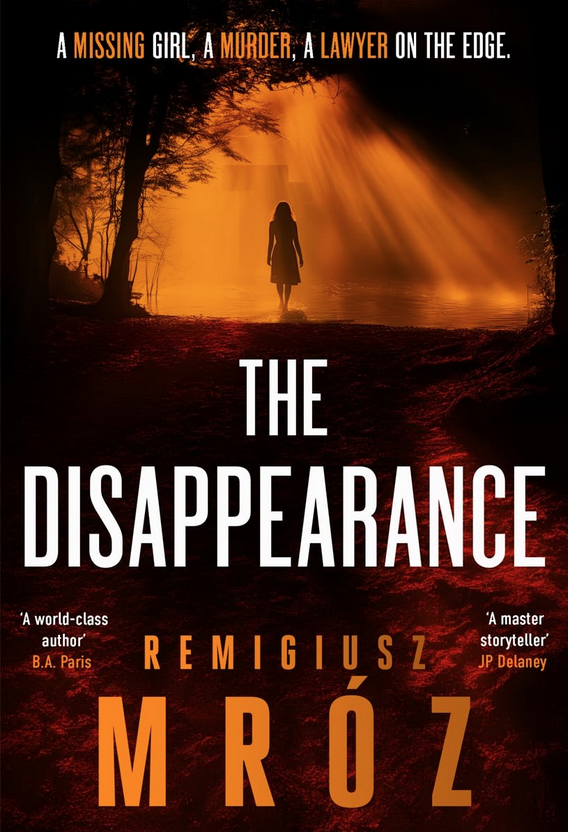
At the heart of this excellent legal thriller is the conundrum of how it is that the legal team defending seriously evil people can do their job. The novel is set in Poland, but we can look at notorious cases in the UK. Brady and Hindley, Shipman, Dennis Nilsen, Dale Cregan – each had lawyers and barristers fighting their corner in the courts, and trying their best to convince the jury that their clients were innocent. The fact is that the legal teams are taught not to believe or disbelieve what their clients are saying. They have one job, and one job only, and that is to use every skill at their disposal to present the available evidence to the court as persuasively as possible. It is not in their remit to search for ‘the truth’. That is real life, of course, but in crime novels, lawyers regularly break away from witness statements and points of law to go ‘into the field.
Joanna Chylka, senior member of a top Warsaw law firm, is called by an old acquaintance from younger days, Angelika Slezyngier. Joanna is solitary, abrasive, and abrupt. She has few friends, and Angelika is certainly not numbered among them. Angelina’s three year-old daughter has been abducted from the lakeside house, near the border with Latvia and Belorus, and the police have decided that Angelika and her businessman husband, Awit, are responsible.
To the police, the case has all the elements of a locked room mystery. Awit says he set the alarm, covering most of the windows and doors, but not the skylights, at 7.00 pm, when (they say) Nikola was safely in bed. No alarms were triggered, and there is no sign of a break-in, but the little girl is gone. An elderly man, Antoni Ekiel, who lives near the Slezingier house. tells Joanna that he saw Awit walking away with Nikola on the night of her disappearance.
When Joanna and her trainee, a young man called Kordian Orynsk, arrive at the scene, they are confronted with a complete lack of evidence. The house has an extensive alarm system covering all the doors and windows, and it seems a physical impossibility for the toddler to have been taken away through one of the skylights.
Kordian is younger and has fewer battle honours than his senior partner. He is inclined to believe what Angelika and Awit are saying, but Joanna keeps insisting that what he believes is irrelevant. Their job is to convince the court that the Slezyngiers are not involved in their daughter’s disappearance.
Mróz gives us few clues about Joanna’s age or appearance. We are left to assume that she is perhaps in her late 30s, and still very attractive, as she turns heads whenever she and Kordian go into a bar or a restaurant. Her treatment of Kordian is little short of cruel. She is sarcastic, constantly critical of his opinions and judgments, and scathing about his lifestyle choices. She is firmly in the red meat camp, while Kordian is edging towards vegetables or – if he wants to indulge – ethically sourced fish.
The case comes to court, and Angelika makes a statement which turns the case on its head, compels her to employ a different legal team, and puts Awit in the line of fire. When Joanna is involved in a serious road accident, and barely escapes with her life, Kordian has to follow his instincts while Joanna is in intensive care fighting for her life.
In the end, the initial instincts of Joanna and Kordian prove to be wide of the mark, as the fate of Nikola Slezyngier is revealed. The court scenes are intense, and the Polish landscape is a memorable background to this tense and nervy thriller. Disappearance was translated by Joanna Saunders, published by Zaffre Books, and is available now.



 fullybooked2017