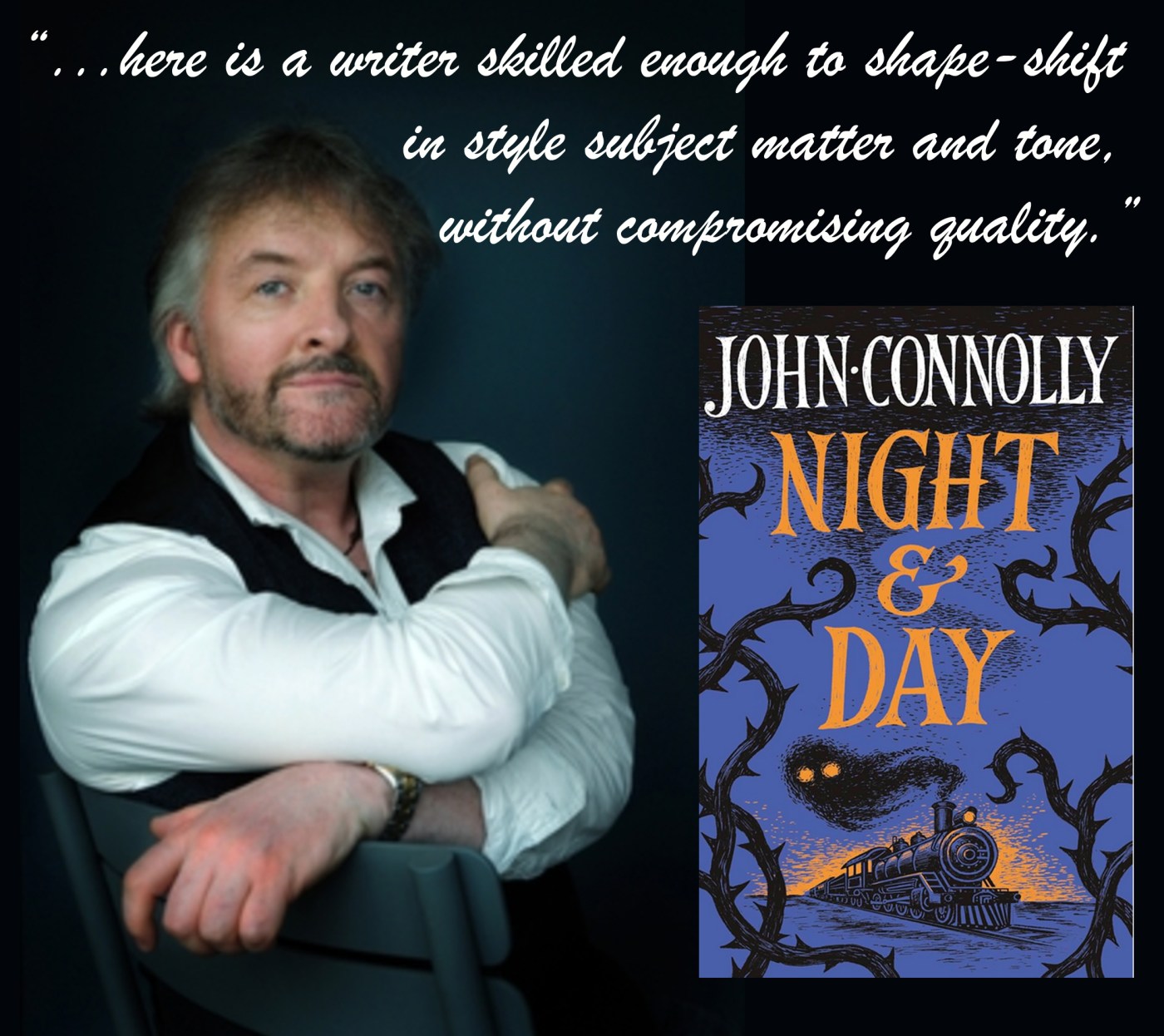

This is a collection of macabre tales from the creator of PI Charlie Parker, the private investigator from Portland, Maine. As fans of that series will testify, Parker is no stranger to the paranormal and the deadly creatures it allows into the human realm. Here, John Connolly presents a variety of supernatural experiences, ranging from the whimsical, through science fiction to extreme terror.
The Pilgrim’s Progress: A Tale of The Caxton Private Lending Library & Book Depository
Here, we learn the origin of one of the strangest libraries in the world. Its stock consists solely of first editions of great novels, each of which has been presented to the collection by someone (dressed as, if you are sceptical) one of its characters, shortly after the author’s death. We are in the precincts of Westminster Abbey in the fifteenth century, and in the company of William Caxton and his apprentice Wynkyn de Worde. The building they rent from the monastery contains the printing press that has recently produced the first bound copy of The Canterbury Tales. They are astonished when, one fine day, who should turn up on their doorstep but the Knight, the Miller, the Wife of Bath, the Nun’s Priest and the Summoner? What follows stretches Caxton’s credulity to its limits, and raises the interesting problem that, should he print a version of the New Testament, would it trigger The Second Coming?
And All the Graves of All the Ghosts
In this poignant story, Connolly gives us a perfectly normal family who move into an old house, and soon discover that there is ‘a presence’. In a corner of one of the rooms, it is always cold. There is a mysterious draught and, very soon, a misty shape begins to manifest itself. The shape eventually becomes more solid, and the young woman it resembles is clearly in mortal terror of something she has discovered on the floor at her feet. This phantom causes the family to disintegrate, and the narrator is left, more in tune with the nameless spectre than with his real-life family.
Evenings With Evans
Ghosts and phantoms are meant to be malevolent and spiteful, determined only to avenge wrongs inflicted on them when they were corporeal, they can also be benign. Here, a man is driving his car, his family alongside him, when he instinctively swerves to avoid a fox. The car crashes, fatally injuring his wife, son and daughter. Living alone in the old house they shared, he vows to find – and shoot – the distinctly marked fox that he blames for the death of his family. As his obsession grows ever more fierce, he is distracted by bizarre happenings in his ancient wine cellar. He sees flickering candlelight and, when he investigates, he finds a table set out with a wine glass, and a bottle of his very decent claret. This plays our beautifully, and Connolly suggests to us that death is not the end, and reunion with those we have loved and lost is not impossible.
Abelman’s Line
This a strange one, and no mistake. I had to use the ‘back button’ several times to clarify in my mind what was going on. It is what could be called science fantasy. We have a group of scientists, sometime in the not too distant future. They have devised a device that can warp physical time, and basically create parallel time lines for people they choose as subjects. Perhaps ‘targets’ is a better word, because the physicists are all Jewish. They take Nazi war criminals who are now long dead, but have evaded justice to die in relatively peaceful old age, often somewhere in South America. Put simply, the scientists ‘rewind the tape’ (to use an analogue term) of the Nazis’ lives, and then cause something deeply unpleasant – and terminal – to happen to them before they can pass away in their sleep in, say, a Chilean care home. I have to add the rider that I think that was what was going on. Readers with other ideas, please feel free to get in touch!
The Mire at Fox Tor
Connolly is very much in traditional ghost story mode here. We have the familiar trope of two men dining together, and one has a tale to tell. These fellows only ever have surnames, and they are usually bachelors with a public school or military background. Tenley, is one such, and an austere sort of chap who used to go on long hikes across hills and moors. He had been determined to navigate the dangerous Fox Tor Mire on Dartmoor. I instantly thought of Grimpen Mire in the classic Hound of the Baskervilles, but Fox Tor Mire conceals terrors even worse the Conan Doyle’s spectral dog. As Tenley strides across the morass, stepping from tuft to tuft, a mist descends, and he loses his sense of direction. His compass work has been honed to perfection, but now the needle seems to swing this way and that, leaving him totally disoriented. When a little boy appears out of the miasma, his troubles are only just beginning.
The Bear
This is a whimsical little story which has a deep vein of sadness and an ineffable sense of loss. I think it works as an allegory, rather an account of literal events. We are in Ireland, with a mother and her two young boys. Their father is no longer part of the family, and so the woman and her sons have taken a holiday cottage in North Kerry. While the mother is away shopping, a bear appears. The lovely illustrations by PJ Lynch show that this isn’t a wild beast, but more of a Pooh or Paddington. What happens when the mother returns changes the mood altogether.
The Flaw
This is probably my favourite story in this collection, because it is pure MR James. Did you ever read his tale The Mezzotint? It describes a museum curator who receives a mysterious print, which begins to change, and shows a rather nasty figure bit by bit abducting a child from a house. In Connolly’s version, a man buys a painting of some ancient standing stones. The character, Hayden, has inherited a cottage, and from his bedroom window, he can actually see the stones, known as The Five Good Children. What happens next is deeply disturbing, but I strongly suggest that you buy or borrow the book and find out for yourself.
Unquiet Slumbers
This is as charming a short story as I have ever read, but it is hard not to give the game away with spoilers. We are back in The Caxton Library. Remember, its unique way of sourcing books is that when author dies, a copy of their most famous work is left on the library’s doorstep, usually accompanied by the main character from the book. For no other reason than it is a deeply spiritual place the library has relocated to be in the sacred shadow of Ely Cathedral, with its mighty tower and unique Octagon. The librarian, a Mr Hanna, is peeved that someone has broken a window trying to get in. He repairs it, but when it happens a second time, he is astonished to see that he has a visitor. If I tell you that the year is 1848, and you have an amazing song written by an 18 year-old woman in 1978 running through your head, you might guess the identity of Mr Hanna’s visitor.
Our Friend Carlton
From Victorian Cambridgeshire we move to modern day New Jersey and a trio of crooks. We never learn the narrator’s name, but the other two are Stanhope and Carlton. Carlton has become something of a liability, as in terms of money belonging to some deeply unpleasant people, he has adopted a very loose understanding of the old Latin phrase, meum et teum. So he has to die. The trio go to the depths of Wharton State forest, ostensibly for a leisurely stroll, and Stanhope puts a .22 hollow point into Carlton’s skull, and they bury the corpse. Sadly, that is not the end of the matter.
“Stanhope couldn’t understand why our friend Carlton wouldn’t, or couldn’t, accept that he was dead and do what dead people did, which was stay that way.”
What we have here is a collection of stories written over the years by John Connolly, each commissioned differently, as he explains at the end of the book. Perhaps this explains the dramatic variety in moods, textures and themes of the tales. What is astonishing is that here is a writer skilled enough to shape-shift in style subject matter and tone, without compromising quality. Published by Hodder and Stoughton, Night and Day is available now.
THESE NINE STORIES TAKE UP JUST OVER HALF THE BOOK.
THE FINAL STORY, HORROR EXPRESS, IS NOVELLA LENGTH,
SO I WILL REVIEW IT SEPARATELY.



 fullybooked2017