
Search

fullybooked2017

Month

October 2024

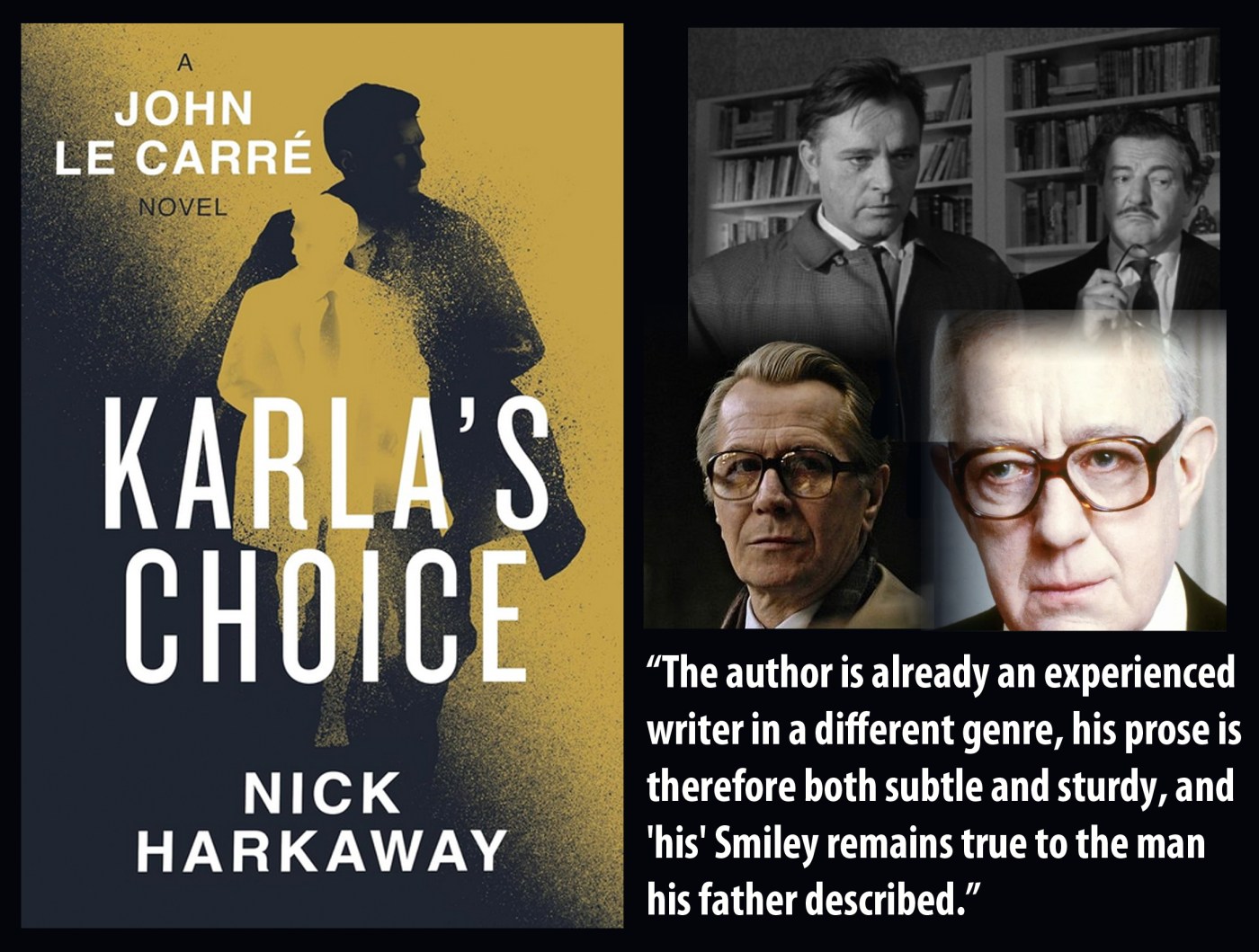
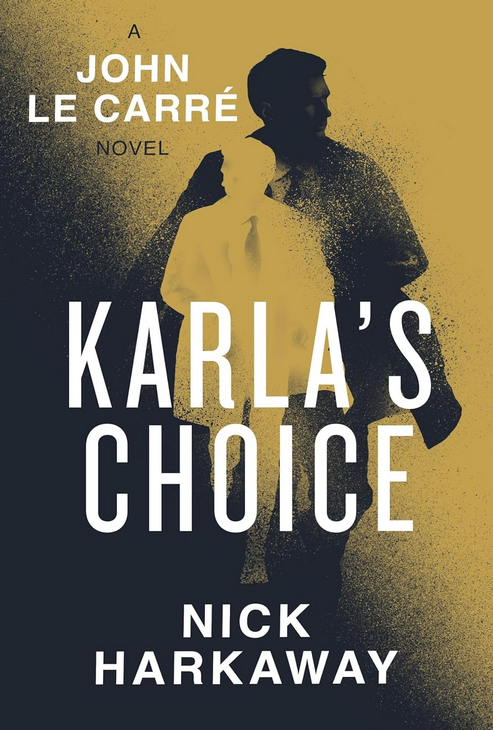
KARLA’S CHOICE . . . Between the covers

kc086 copy

We are in a wintry London in 1963. Older readers will recall that it started snowing on Boxing Day 1962, and it barely relented for weeks, with temperatures plummeting across the country. Susanna Gero is just one of the many thousands of Hungarians who fled to the west just 6 years earlier, after Russia had put down an uprising with its trademark brutality. She works at a shabby literary agency called Baánáti & Clay. Mr Clay never existed, and Laszlo Baánáti is missing. As part of a scheme of retribution devised by the Kremlin, agents have been despatched to the West to kill people who had the effrontery to leave the Soviet Union and its vassal states. One such is Miki Bortnik, and his target is Baánáti . Between the airport and Baánáti’s office Bortnik has a kind of epiphany, and meekly surrenders to the British authorities.

Baánáti’s disappearance is brought to the attention of the British intelligence service, and for old Le Carré buffs, we are back in the familiar world of The Circus, alongside Control, Connie Sachs, Percy Alleline, Bill Haydon, Toby Esterhase and – of course – George Smiley. Our man has taken early retirement of sorts in the wake of his involvement in the death of double agent Alec Leamas on the Berlin Wall (The Spy Who Came In From The Cold, Richard Burton in the film). Smiley is persuaded to make a temporary return to work in order to trace Baánáti, who is actually a Soviet agent called Ferenzc Róka. There is mention of the ominous sounding Thirteenth Directorate. This was basically a KGB hit squad, set up to deliver Moscow’s summary justice to former citizens across the world who had irritated Stalin.

Smiley discovers the reason for Róka’s disappearance. He has a son, now in his early twenties. Léo is young man of much promise, something of a gilded youth, but prone to upsetting local communist party officials. The lad has now been taken into custody. Róka has abandoned the pretence that he is a mild-mannered London literary agent, and via a series of false passports is on his way to central Europe to save his son. It is with  some inevitability that Control sends Smiley off to Berlin, to rescue Róka and his son from the Ministerium für Staatssicherheit (Stasi).  Smiley hopes that assistance will be given by Hans-Dieter Mundt, nominally leader of the East German Secret Service, the Abteilung. Mundt is actually a double agent who works for the British.

The book’s title, by the way, refers to the man who leads The Thirteenth Directorate. In the three books known as The Karla Trilogy, Le Carre provides an extensive biography of the agent, but we never meet him in person. The BBC cast Patrick Stewart in the role for TV, but he was glimpsed only briefly.

Control complicates matters by sending Susanna off to Berlin in the belief that her presence may help to smoke out Róka. The ploy does not work, as Susanna goes ‘rogue’ on her Circus companions, and things come to a head with a dramatic encounter on the streets of Budapest

How does it feel to be back among old friends? To be honest, it is such a long time since I read the original books or watched any adaptations, that I had to use Google to remind me of some of the characters, but the chill of the Cold War remains inescapable. Harkaway cannot be aiming purely at aficionados of his father’s books, so what will younger readers make of it, coming as they do to the Le Carré ensemble for the first time? The author is already an experienced writer in a different genre, his prose is therefore both subtle and sturdy, and ‘his’ Smiley remains true to the man his father described.

George Smiley remains one of fiction’s most enduring but enigmatic characters. He is not, however, a fragile Ming vase too delicate to be handled. Here, he not only survives, but is given fresh shape and form in a vivid reminder of how espionage was done in the dark ages before the digital revolution. Karla’s Choice is published by Viking/Penguin and is available now.
Screen Shot 2024-10-03 at 19.54.12

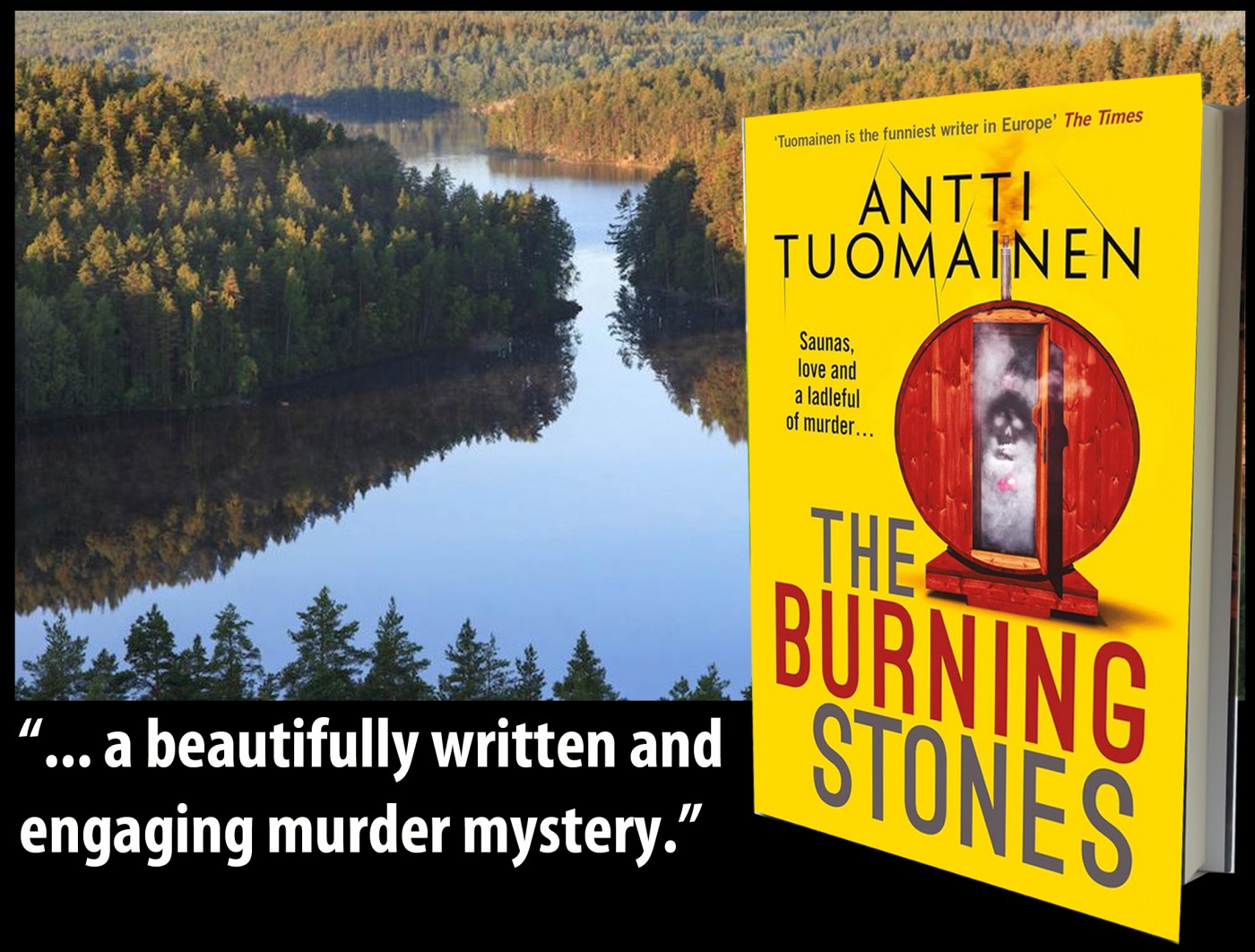
THE BURNING STONES . . . Between the covers

tbs spine083 copy

Anni Korpinen is sales director at a firm called Steam Devils. They make stoves for saunas and are based in the little Finnish town of Phutijärvi. She is 53 years old, and married to a waster called Santeri. He is obsessed with historic F1 motor racing, and spends most of his time replaying classic races via scratched VHS tapes. He also buys and sells F1 memorabilia, such as socks reputedly worn by Mika Haakinen. Sadly, he never turns a profit.

When the new CEO of Steam Devils, Ilmo Räty, is found burned to a cinder in his own sauna, the hunt is on for his killer. When the firm’s founder, Erkki Russula, calls a meeting and states that he sees Anni as the obvious successor to Räty, she becomes the person with most to gain from his death. Key personnel at Steam Devils include:
Susanna Luoto – Finance Manager
Mirka Paarmajarvi – Logistics Manager
Jarkko Mutikallio – CEO’s PA
Porkka – Technical Director
Kaarlo – Senior Advisor

Of course, the sauna is completely central to Finnish culture, and part of the accoutrements are little squares of towel cloth which separate the bum cheeks from the wooden bench, and are essential both for hygiene and preventing the skin from becoming stuck to the wood. They are known, at least in English, as ‘bumlets’. When one of the bumlets from Anni’s home sauna, conveniently embroidered with her name, is found in the vicinity of Ilmo Räty’s sauna, she knows she is in big trouble. Reijo Kiimalainen is the community’s senior policeman, and he harbours a grudge against the Korpinen family. Many years ago, both he and Anni’s late father had both been stalking the same elk, the largest in the local forest. The hunting season started at 6.00 am, and at precisely one minute past, Anni’s father shot the beast. Ever since then, Kiimalainen has been convinced that skulduggery had taken place.

Once Anni realises that she is prime suspect in the Rati murder case, she does what all wrongly accused prime suspects do (at least in crime novels) – she turns detective. Although she realises that she is not Sherlock Holmes, but a stove retailer, she is intelligent and resourceful. Her investigations take her to an abandon resort with a sauna the size of a sports stadium, and here she witnesses another sauna related death. This time the victim – the engineer Porkka – is stabbed in the head with the sharpened metal handle of a ladle used to sprinkle water on the hot stones which are an integral part of Finnish saunas.

Anni’s task is made more complicating by the strange behaviour of Kahavuori, a holiday complex owner, to whom Anni had been hoping to sell 64 sauna stoves. When he hears of the death of Raty, he refuses to close the deal. Instead, he adopts what seems to be a very unhealthy obsession with finding the killer. The problem is that Kahavuori is an ardent fan of True Crime documentaries, and he has a vivid imagination. When Anni catches him snooping in her sauna, she clouts him with a lump of wood. When he recovers consciousness, he outlines his theory, and Anni wonders if the crack on the head hasn’t further addled his brain

There is a genuinely touching backstory behind the hunt for the murderer. They are both in their fifties now, but three decades earlier, Anni and policeman Janne were engaged and in love. It was Anni who handed back the ring, but now, as Janne reveals that Anni’s husband Santeri is not the clueless bungler she thinks he is, events take an unexpected turn.

On the cover of the book is a quote from The Times: “Tuomainen is the funniest writer in Europe.” He may well be, but humour is a complex business and takes many forms. I don’t think you will be belly laughing as you read The Burning Stones, and I do wonder how well humour in one language survives translation into another, but I did enjoy the sheer freakery-geekery of Santeria and his idiotic obsession with old motor races. Is he mad? Probably not in a medical sense, but I did wonder why Anni married him in the first place. That aside, The Burning Stones is a beautifully written and engaging murder mystery. It is translated by David Hackston, published by Orenda Books and available now. You can find out more about Antti Tuomainen on social media – he is @antti_tuomainen on X, and on Facebook facebook.com/AnttiTuomainen

Screen Shot 2024-09-29 at 19.28.06

THE WITCH’S DAUGHTER . . . Between the covers

Screen Shot 2024-09-23 at 19.10.53

The central characters of this powerful novel are Grand Duchess Militza Nikoleyevna, married to a cousin of Tsar Nicholas II, and her daughter Princess Nadezhda Petrovna. The background, as you might guess, is the decline and fall of the Romanovs, and two headed monster that was WW1 and the Russian Revolution.

The early pages set the tone. The catastrophic failures of the Russian Army, culminating with the Battle of Tannenberg, turn the world on its head for Russian citizens, be they of noble birth or peasant stock. Of course, at that time, the centre of the Imperial Universe was Petrograd, and we learn of the impact on those close to the Tsar’s court of the murder of Rasputin. Historians both professional and, like myself, amateur, have long pondered the great paradox that is Russia. Perhaps no other place on earth can provide such examples of great beauty in architecture and music, but also of the most bestial behaviour by human beings. One of the great ironies is that the place where the revolution burst into flames was a city literally built on a swamp, and costing the lives of 100,000 workers. They died to give Peter the Great access to The Baltic and – arguably – a pathway to make Russia a great international nation.

The Witch of the title is Militza. In her private thoughts she describes how she ‘created’ Rasputin. What are we to make of this? She muses:

“Maybe if she explained how she and her sister fashioned the Holy Satyr from wax, mixed it with dust from a poor man’s grave and the icon of Saint John the Baptist; how she moulded the creature, rolling and warming the wax in her hands; how she baptised it with the soul of an unborn child, the dried up foetus, miscarried by the grand Duchess Vladimir all those years ago; and how they’d called on the Four Winds and the koldun -the insatiable, unconscionable, licentious, duplicitous, covetous, impious, soused, drunk and self appointed Holy Man man from Siberia – Rasputin had come. Just as she had commanded.”

Screen Shot 2024-09-23 at 19.27.27Nadezhda is also a paradox. Despite her scorn for her mother’s ‘sorcery’ she carries with her a bottle of water, allegedly from the frozen waters of the River Neva that melted around the corpse of Rasputin after he was hauled from its depths. While nursing an admirer, a young man called Nicholas Orlof, severely injured in the unrest, she falls back on the old wisdom of her mother. The author (left) allows us to make up our own minds as to the efficacy of the spells and incantations.

The novel doesn’t take sides politically, but I must confess I have a long standing sympathy for the Russian nobility, and it still angers me to read about the utter brutality of what happened on 16th/17th July 1918 in Yekaterinburg. Yes, Nicholas II was weak, and his regime presided over breathtaking inequality by modern standards, but his sins pale into insignificance when judged against those of Lenin, Stalin and, dare I say it, more recent rulers of Russia.

The author puts Nadezhda centre stage as revolution takes over the streets of Petrograd, and the Tsar’s soldiers commit atrocities in an attempt to emulate Canute and turn back an inexorable tide. She is drawn into the animal vigour of the protests, bread marches and the resounding choruses of The Marseillaise. Perhaps I am wrong to say this, but it  reminds me of modern day youngsters from impeccable middle class backgrounds taking to the streets to demand the downfall of Israel, or attacking paintings to draw attention to climate change. 

As we know, the Tsar’s abdication saved neither him nor his wife and children. Historians still argue over the apparent rejection, by King George V, of his cousin’s request for sanctuary. This book suggests that, even if it had been granted, the Tsar and family would never have made it to Britain unscathed. When Lenin returns in his sealed train, the gunpowder keg explodes:

“The Neva was thawing. There was an open stream some 20 yards wide alongside the banks while the centre still remained frozen. And along with the filth swirling through the streets and the slush came the rats and the rebels. No one was working. No one wanted to work. No one was being paid. It was anarchy. Nearly 2,000,000 had now deserted the front and they were loitering in the city with nothing to do. Starving, cold, penniless and angry, they were ripe for the plucking. All Lenin had to do was reach out and take them.”

And take them he did. Militza, Nadezhda and the remainder of the minor Romanovs escape to Crimea where they just about manage to survive until they are rescued by ships of the British navy. A few minutes on Google will reassure readers that Malitza, Nadezhda and Nicholas lived long lives, but each – of course – died thousands of miles away from Petrograd. Only the most rabid and bitter socialist would fail to be touched by the sheer horror of the destruction of the Russian aristocracy described here. Yes, many of them were vain, privileged, and oblivious to the social injustice endemic under Romanov rule. But they were human. Like Shylock, they were entitled to ask{
“ If you prick us, do we not bleed? If you tickle us, do we not laugh? If you poison us, do we not die?”
This novel is the result of astonishing historical research, but above all, it is a tale of human resilience, courage and that ineffable human quality immortalised by the words of St Paul, “But the greatest of these is love.” Published by Aria, the book is available now in all formats.

Screen Shot 2024-09-23 at 19.06.32

Blog at WordPress.com.

Up ↑