

Readers who have also watched the successful TV series dramatising the Vera Stanhope novels will have their own views on how Brenda Blethyn’s Detective Inspector matches up to the woman on the printed page. I stopped watching TV versions of police procedurals years ago, with the demise of John Thaw, so my take is purely based on the book. Vera Stanhope is a dowdy, frumpish woman in her 50s, lonely and probably a social misfit. Brought up by an eccentric father, Hector, in a moorland cottage in Northumbria, denied (by premature death) a mother’s love, she is a formidably intelligent detective. She drives a battered Land Rover, has holes in her socks, and doesn’t suffer fools gladly.
Here, she is handed a complex case that has splintered into myriad issues. At its heart is the apparently motiveless murder, by hammer attack, of an undergraduate and part time social worker, Josh Woodburn. A teenage girl, Chloe Spence, who was a reluctant resident at Rosebank, where Josh worked shifts, has gone missing. Where is she, and why was film and media enthusiast Josh, unbeknown to his family, moonlighting with shifts at a children’s home?
Vera has the death of one of her team, a Detective Constable called Holly, on her conscience, but she takes a maternal interest in Holly’s replacement, Rosie Bell, a rather glamorous and fashion conscious young woman who is actually a very good copper. When another inmate of Rosebank, a young chancer called Bradley Russell is found dead in a remote hillside bothy, the case becomes more complex.Without, I hope, giving too much away, Vera’s hunch is that Josh Woodburn’s death is connected with what he was really doing at Rosebank. Josh was a decent, caring young man, and very good with the children, but that wasn’t the main reason he was there. When Vera, with the help of fellow officer Charlie, joins the dots, the picture also explains why Brad also had to die.
Both the season and the mood of the book are distinctly autumnal. Vera’s work is her life, and there seems to be little outside the job. The depressing world of broken homes, absent fathers, and a society where children’s homes are run by shadowy corporations on a distinctly for profit basis does not improve Vera’s downbeat view of the world but, to borrow a line from Matthew Arnold’s Thyrsis, “The light we sought is shining still.”, and in Vera’s case the faint glimmer is provided by bringing justice to the dead. She couldn’t be more different from Derek Raymond’s nameless detective in the Factory Novels (click for more information) but they have the same fierce resolve.
If years of reading police-procedural crime novels has taught me anything, it is that well-balanced, happily married Detectives are not fun. Vera Stanhope is forever on the edge of things, caught up in her own personal history and sense of regret, reluctantly wearing a halo of missed opportunities and ‘what ifs’.. Her fierce empathy with those society has cast aside, combined with her innate shrewdness and ability to pick out a ‘wrong-un’ make her one of the genre’s most treasured creations.
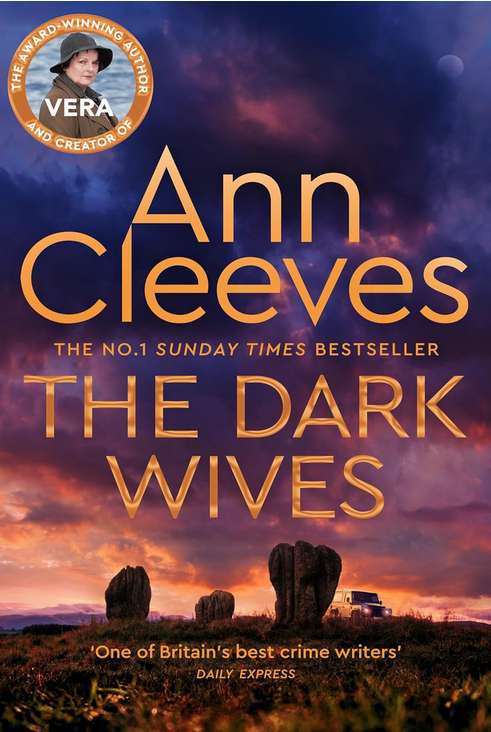
The Dark Wives of the title are three stone monoliths on the fellside near Vera’s home. Legend has it that they were three strong willed women who were turned to stone by husbands fed up with their feistiness. In the preface, Anne Cleeves writes:
“The book is dedicated to teens everywhere, and especially to The Dark Wives – uppity young women with minds of their own, struggling to find a place in a difficult world.”
The novel is published by Macmillan and was published on 29th August.


 fullybooked2017
September 2, 2024 at 8:42 am
Thanks for the blog tour support x
LikeLike