Search

fullybooked2017

Date

June 3, 2024

THE BURNING . . . Between the covers

TB SPINE054 copy

The novel starts in London, March 2020 and, like millions of other people, the Mountford family are sitting watching the news, and there is only one item – The Lockdown. Stringent rules about association and movement have been imposed, but Tony Mountford is nothing if not a quick thinker. He and his family are lucky. They own a holiday cottage in the south of England, and he decides on the spur of the moment to pile everyone and everything into the car and head south. They avoid police patrols, and arrive safely at the cottage. Across Britain, and the rest of Europe, a million nightmares are being enacted as the Covid death toll rises, but for the Mountfords, their nightmare is only just beginning.

The cottage, although it has been brought up to date after a fashion, is ancient: it has a resident ghost, or other-worldly presence; when sensed, it has been entirely benign, to the extent that it is mentioned as a selling point in the advertising brochure. Some renters have even placed a ☹️in their Trip Advisor review, disappointed that it never appeared during their stay.

Something, however, has jarred and jolted the spiritual ambience of the old stones out of kilter, and a far more sinister manifestation has claimed the cottage. There is a dramatic moment when, while Tony and his wife Charlie are making love in front of the log burning stove, with the children all sound asleep upstairs, a spectral hand grips Charlie’s throat. Far more chilling, however, is the moment when eight year-old Alfie appears at the foot of the stairs one night and says:

Daddy, there’s a man in my room.

Without giving too much away, the Mountfords’ stay at the cottage doesn’t end well, and after a few months the property is back on the market. Gavin and Simon are a fairly wealthy gay couple and they become the new owners. They decide to gut the interior of the building, stripping it right back to beams, brick and stone and – as far as the local council planners will allow – fully modernise it. In the process they make two startling discoveries. They find a deep well beneath the house, but of greater significance is that the builders have unearthed  steps leading down to what can only be described as some kind of a cell. It has bars on the door, through which something of the inside can be seen, but the door remains resolutely locked. Robert Derry has a profound understanding of the latent power of old buildings, ghosts or not, and he describes it beautifully:

“After all, the heavy wooden beams were once living breathing things, until some mediaeval carpenters had cut them down in their prime. Then as seasoned joists they’d been hoisted up to hang from finely crafted oak A-frames, each chiselled peg dovetailed into carved sockets like ancient teeth in an angled jawbone. Dead men, whose hands had once lovingly laboured to shape each broad blade that would one day bear a ton or two of hand-hewn reads. The same dead men that now lay their heads further up the lane; a yew lined root that leads to a secluded graveyard which has long since laid its single tracked secrets to rest.”

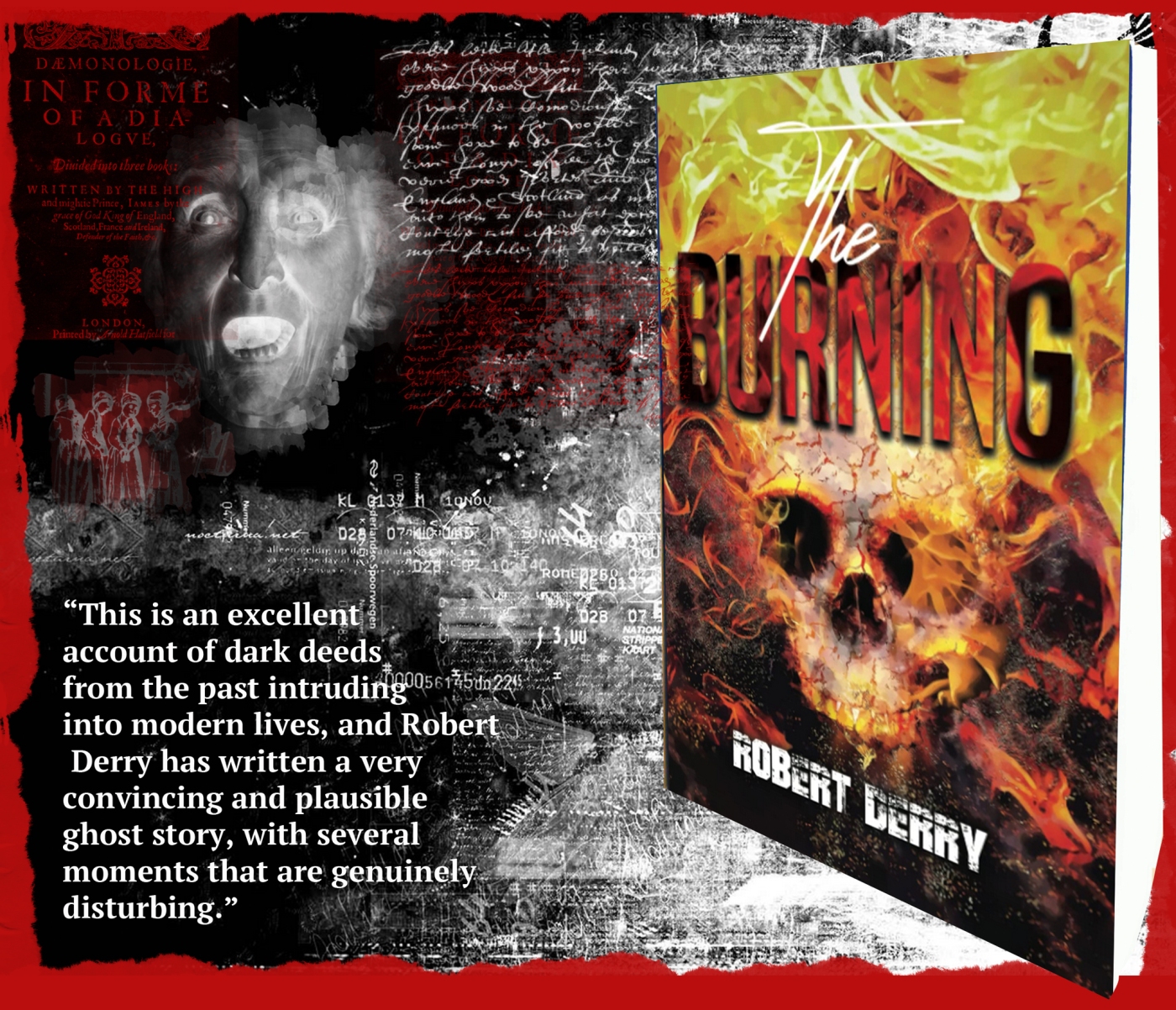
As Gavin researches the history of what they pair had hoped would be their ‘forever home’, it is clear that in the mid seventeenth century the house witnessed truly evil acts, and that trauma seems to have been absorbed into the very bricks and mortar. Someone – or something – seems trapped, angry and in pain, and will not leave Gavin and Simon in peace until it is freed. This is an excellent account of dark deeds from the past intruding into modern lives, and Robert Derry has written a very convincing and plausible ghost story, with several moments that are genuinely disturbing. The Burning is independently published, and is available now.

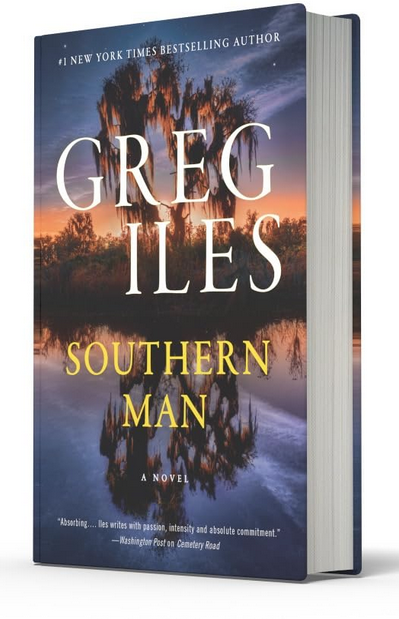
SOUTHERN MAN . . . Between the covers

SM SPINE

This is a massive book physically as it is over 900 pages long. Emotionally, it is huge, as it deals with suffering, death, revenge, remorse and corruption with relentless intensity. Politically it is intensely topical as it deals with the prospect of a Donald Trump second term as POTUS, and the mood of the voters who put him into the White House in the first place. Historically, it is deeply challenging, as it looks at the legacy of over two centuries of prejudice and cruelty in the southern states of America.

The title refers to a 1970 song by Neil Young where he excoriates the archetypal redneck southern male. The song may (or may not) have triggered a musical duel with Lynrd Skynrd, when their response was Sweet Home Alabama. The novel features Mississippi lawyer, politician and author, Penn Cage, who appeared in previous Greg Iles novels. Click the link for more information.

The back story here is complex, but in a rather large nutshell:

Penn Cage, has an obscure terminal cancer which is slowly killing his octogenarian mother.
Cage lost a leg beneath the knee in a road accident.
He is a civil liberties campaigner.
Dr Tom Cage, Penn’s father, a much respected physician, wrongly imprisoned, died in prison riot at Parchman Farm penitentiary.
Cage is a widower. His wife died of cancer and, much, later, his fiancée was murdered.
He has a twenty-something daughter called Annie, also a liberal minded lawyer.

The early narrative darts back and forth between current events and the days following Dr Tom Cage’s death in the prison riot. The reasons for Tom’s incarceration are complex, but Greg Iles spells it out with great clarity. Present day couldn’t be much more topical. Donald Trump is gathering momentum for a second bid for the presidency, but the almost unthinkable has happened. A charismatic war veteran called Robert Lee White is aiming to be the first independent candidate since Ross Perot in 1992, and he has a huge following via his Tik Tok videos and a very popular radio show. He came to national prominence when he led a special forces team searching for a notorious Taliban leader. They found him, and White administered the coup de Grace.

Present day. As Bobby White hones his media profile for TV audiences, he receives a boost. Attending a largely black music festival, he heroically rescues Annie Cage and several others, mostly black youngsters, who have serious bullet wounds after white Sheriff’s deputies open fire on the crowd after a shooting incident. However, Bobby White’s pitch for POTUS has a serious problem. He lacks the prerequisite adoring wife and clutch of tousle-haired children. Why? I can only direct you to the coded words at the end of many a Times obituary – “He never married.”

The deaths at the music festival have serious repercussions. Within days, a treasured pre Civil War mansion,  is burned to the ground. and there is a calling card from The Bastard Sons of The South, apparently a militant BLM organisation. Penn Cage, as a white man, is thrust onto the horns of a dilemma. He is white with serious influence in political circles, but he is also widely respected with the black community, both for his own integrity, and the legacy of his late father. Can he prevent a bloodbath, as the calls for revenge lead to a disastrous polarisation on the streets between black and white factions?

The conflict is not just between black and white people. America has a bewildering number of layers of law enforcement. At the apex is the FBI. Their remit extends across the nation, irrespective of state boundaries. Then we have Sheriffs, appointed by vote. They and their deputies rule the roost over large state subdivisions, known as Counties. Large towns and cities will have their own independent  police departments. Last, but by no means least, are the National Guard. They are volunteers, but basically members of the armed forces, and will usually have access to military standard weapons and vehicles. In Southern Man, each one of these agencies come head to head in the streets of Natchez, while the barge-trains and freighters battle against the Mississippi current, beneath the cliff top where thousands of black peace protestors stare in the muzzles of National Guard issue AR-15 rifles.

There is a substantive second story which emerges at different times in the novel. Penn Cage’s mother has been researching her family history, and has pretty much completed it. What it reveals is that Cage and his daughter are descendants of a woman who was the product of a union between a slave owner and one his female slaves. This document allows Greg Iles to explain the complex and often contradictory relationships between slaves (before and after emancipation), and their owners. He also makes the point that the members of the victorious Union army were all too often nothing like liberating saviours.

Cage’s declining health make him rather like Tennyson’s Ulysses:

Tho’ much is taken, much abides; and tho’
We are not now that strength which in old days
Moved earth and heaven, that which we are, we are;
One equal temper of heroic hearts,
Made weak by time and fate, but strong in will
To strive, to seek, to find, and not to yield.

With an increasing sense of frustration, he tries to get to the bottom of who seems to be manipulating the perilous situation on the streets, as rival groups – militant Black activists, peaceful protesters, far right militias, City police and Sheriff’s Deputies edge ever nearer to a cataclysmic explosion of violence.

Greg Iles just doesn’t take sides. He is scathing and abrasive about everything to do with the concept of the honourable South. He has little truck with historians like the late Shelby Foote, who, memorably, appeared several times in Ken Burns’ magisterial documentary The Civil War, and attempted to explain that a typical Southern Man of the Confederate era was not always a brutal redneck bent on raping and brutalising black people.

In several ways, Penn Cage mirrors the real life author.

Both lost part of a limb in a road accident.
Both had fathers who were doctors.
Both had mothers who died of cancer.
Both have a rare form of cancer.

This is a brilliant novel, for sure, which rolls a rock away, and exposes all manner of nasty creatures scurrying away from the light. Is there any room for nuance in the north v south controversy? Greg Iles doesn’t think so, and his superb writing underscores his argument. Me? I am on the fence, not because I approved of the concept of slavery, or the horrors meted out to its victims, but because when you severely punish a nation – which the South thought it was – there are unintended consequences, as The Treaty of Versailles proved in 1919. Post Appomattox 1865, a long lasting sense of grievance was born, and it has yet to die of old age. So-called White Guilt looms large in the novel, as my occasional visits to North Carolina suggest to me that it does in real life.

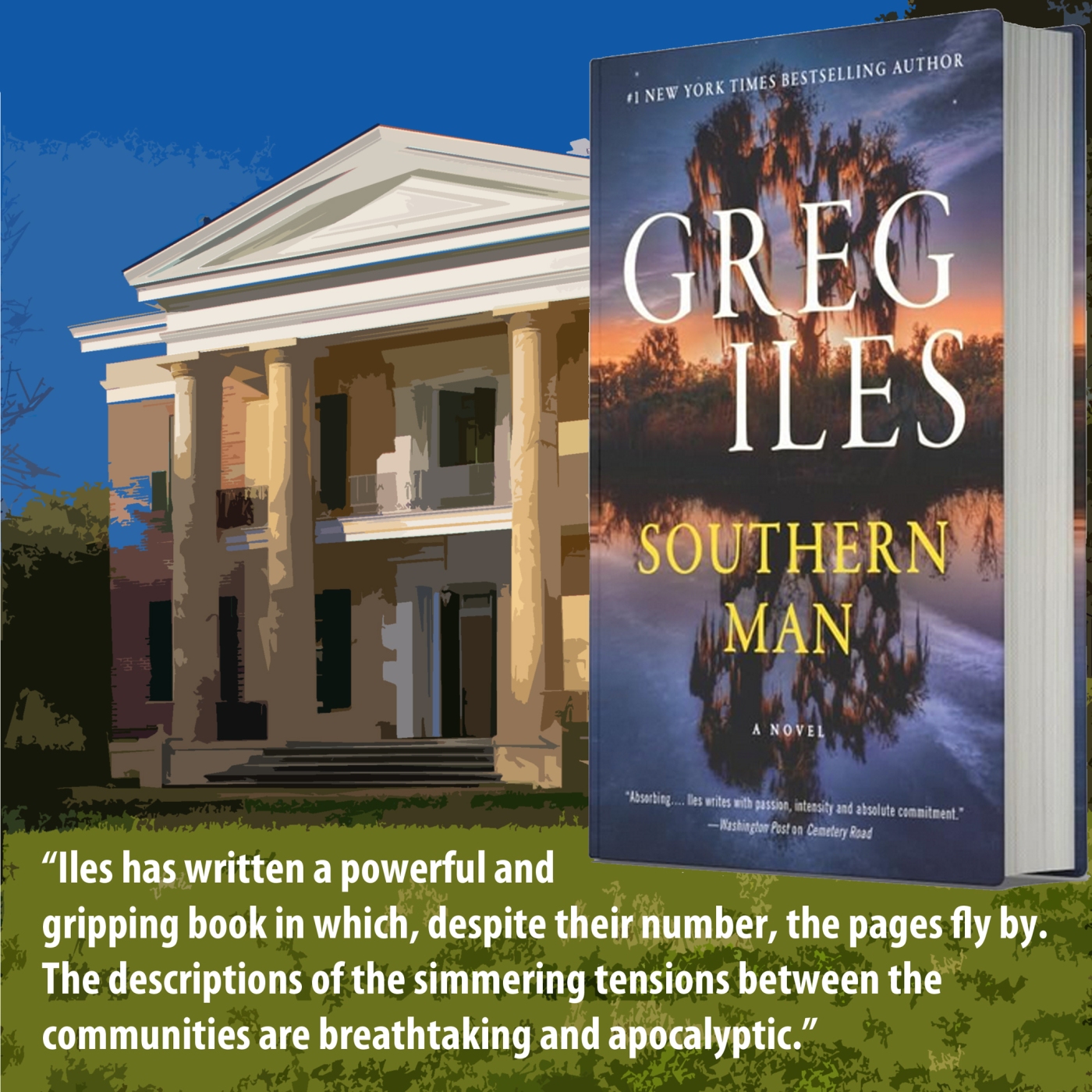
Aside from the politics, Iles has written a powerful and gripping book in which, despite their number, the pages fly by. The descriptions of the simmering tensions between the communities are breathtaking and apocalyptic. I only hope that in the months to come, they remain fictional. if they play out in real life, there will be a second War Between The States, and America will suffer grievously. Southern  Man is published by Hemlock Press and will be out on 6th June.

Screen Shot 2024-06-03 at 17.52.05

Blog at WordPress.com.

Up ↑