

Search

fullybooked2017

Month

May 2024

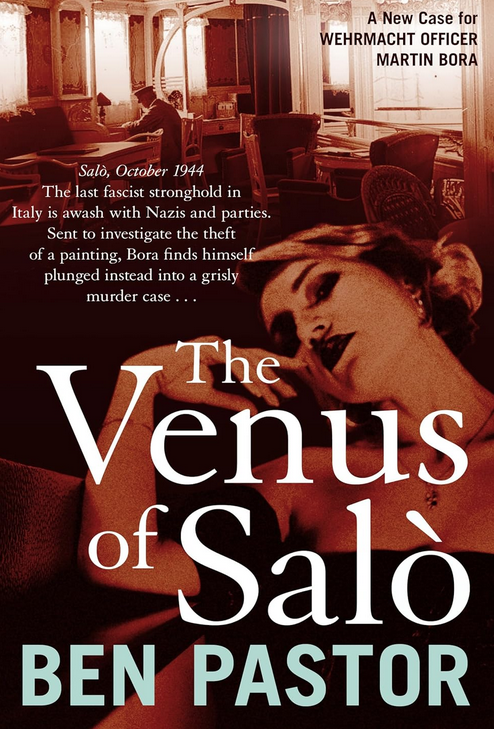
THE VENUS OF SALO . . . Between the covers

tvos spine052 copy

Not for the first time, I am a late arrival at the party. This is the eighth book in a series featuring Wehrmacht soldier, Colonel Martin Bora. We find him in the north of Italy, in October 1944. It is a strange time in Italian  history. The Allies have, at huge cost, breached the various German defensive lines, even the formidable Gothic Line. But winter, with its rain and snow, is not far away, and the  fighting in late 1943/early 1944 was a brutal and sapping experience the Allies are unwilling to repeat. In the far north, there is a last pocket of Fascism. This time line of that eventful period may provide a useful backdrop.

25th July 1943, Mussolini dismissed by KIng Victor Emmanuel III and arrested.
12th September  1943, Mussolini rescued from imprisonment by German special forces.
23rd September 1943, Italian Social Republic created, with its capital at Salò.
29th September 1943, the rest of Italy surrenders to the Allies.
28th October 1943, National Republican Army (Esercito Nazionale Repubblicano) created, loyal to Mussolini.
8th December 1943, Republican National Guard created, loyal to Mussolini.
4th June 1944, Allies enter Rome.
20th July 1944, Hitler survives the von Stauffenberg assassination attempt.
14th October 1944, Rommel commits suicide. Announced as death from complications from an earlier road accident.

Most of the action takes place in and around Salò, a town on the shores of Lake Garda. In the mountains and valleys around, German forces and Italian troops loyal to Mussolini are fighting a savage war against Italian partisan groups. Martin Bora, a veteran of campaigns including a spell on the Eastern Front, has been driven by Gestapo agent Jacob Mengs to Salò, where he is told to investigate the theft of a priceless Titian painting, known as The Venus of Salò. It had been ‘borrowed’ from its owner – Giovanni Pozzi –  a rich Italian textile magnate, and was hanging in the HQ of the local German army commander when thieves created a diversion, and cut it from its canvas.

In the novel, everyone is at each other’s throats. The ENR can’t stand the RNG (see the timeline), the SS and the Gestapo loathe the regular German army, and the German high command have scant respect for their Italian allies. Even the Italian partisans – divided into communist and royalist bands –  are at daggers drawn with each other; both however are contemptuous of local farmers and peasants, especially those they suspect of being collaborators.

As Bora investigates the theft of the painting, there are three deaths which puzzle him. First, a music teacher hangs herself. Then, the maid of a renowned soprano apparently shoots herself with a pistol given to her by an RNG captain, and a seamstress is butchered with a razor-sharp blade. While trying to work out how the three deaths are connected, Bora is entranced by his own flesh and blood ‘Venus’ in the shape of Annie Tedesco, widowed daughter of Giovanni Pozzi. What Bora doesn’t know (but we do, of course) is that all the while he is being set up by the Gestapo and SS. Orchestrated by Jacob Mengs, a dossier of Bora’s apparent disloyalty to the Third Reich is being prepared and, in the wake of the July plot.

Most of the book’s characters are fictional, with the exception of a few more exalted figures (left to right, below), such as SS Obergruppenführer Karl Wolff (Himmler’s adjutant), Marshal Rodolfo Graziani, head of Italian troops loyal to Mussolini, Generalfeldmarschall Albert Kesselring, and top SS man Herbert Kappler.

Fourmen

The notion, in WW2 fiction, of ‘the good German’ as a central character, is certainly not new. Perhaps the best known of these characters is the late Philip Kerr’s Bernie Gunther, but there is also a good series by Luke McCallin featuring Hauptmann Gregor Reinhardt. The ‘good German’ as a concept in real history is much more complex; at a senior level, Rommel was forced to commit suicide over his alleged involvement in the von Stauffenberg plot, and Admiral Wilhelm Canaris, chief of the Abwehr (German Military Intelligence), was hanged for treason by the SS just weeks before Hitler committed suicide. Shamefully, Albert Speer, after his release from prison in 1966, made a decent career – lasting almost twenty years – as a media personality and TV ‘talking head’ on the Nazi era.

Ben Pastor’s brilliant novel is an engaging mix of military history. murder mystery, love affair and a study in pyschopathy. Beyond the fiction, however, she reminds us that, for the Allies, the fighting continued almost to the proverbial eleventh hour – the surrender of German forces was formally accepted on 2nd May 1945. The carnage in Italy cost the German army between 30K – 40K dead. The allies suffered more grievously, with deaths estimated as 60K – 70K. The Venus of Salò is published by Bitter Lemon Press and is out now.

Screen Shot 2024-05-08 at 19.53.52

THE ESTATE . . . Between the covers

estate spine051 copy

Police Scotland’s Detective Inspector Cara Salt has been sidelined (because of a serious career blip, of which more later) into what can only be described as a dry and dusty branch of law enforcement, the Succession, Inheritance and Executory Department, SIE for short. Their job is to deal with breaches of the law that happen as a consequence of wills that upset people who assumed they were going to be beneficiaries but, for whatever reason, feel they have been short-changed.

A celebrity hedge fund manager, Sebastian Pallander has died on TV. No, not ‘died’ as in a comedian who fails to get a laugh, but ‘died’ as in suffering a massive heart attack while being interviewed on a live politics programme. It is his will – and its consequences – that are central to this story. When one of Sebastian’s sons, Jean Luc, manages to blow himself up while trying to sabotage a wind turbine, DI Salt is initially surprised to be asked to investigate. Along with her recently acquired assistant, DS Abernathy Blackstock, she visits the site of the wind farm, and finds that young Jean Luc is in many pieces, decoratively spread across the Scottish hillside.

Blackstock is not all he seems to be. The fifty-something Sergeant has not only been working on a top secret investigation into the late Sebastian Pallander’s links to highly dubious Russian money men, but he is the scion of a formerly wealthy branch of Scotland’s aristocracy.

One by one, the Pallander siblings seem to be the in the cross hair gun-sights of some rather nasty people. First Tabitha is kidnapped, then rescued by a mysterious man who tells her that she and her husband must make themselves scarce. When the hotel they are staying in, anonymously, catches fire, Cara Salt decides that Tabitha needs sanctuary – with none other than her former boyfriend – and fellow copper, Sorley MacLeod, now running a  laptop refurbishment business in London, but with an lonely fishing cottage out in the Essex marshes as a retreat.

Meanwhile, Silas Pallander, once destined to take over his father’s business but – since the reading of the will – relegated to manager of the family estate, has also been seized, along with his personal assistant Anna. He is forced to sign certain papers, and then the gang make a hasty exit, leaving Silas and Anna to emerge, blinking, from their captivity, to find themselves in a disused Belgian airfield.

About halfway through the book, we learn the reason that Cara Salt is now involved in a policing operation that is as far from the mean streets of Glasgow as it could be. She had headed up a police take-down of a violent local gangster. It went pear-shaped and, faced with her Detective Sergeant – Sorley MacLeod – being held at gunpoint by the man who was the target of their raid, she took a chance and fired two shots. The first shattered MacLeod’s shoulder, but the second hit the gangster right between the eyes. Salt was sidelined and, after a long and painful recovery, MacLeod left both the police force and the world of Cara Salt.

Macleod and Tabitha Pallender, after a helter-skelter chase and a too-close-for-comfort brush with the bad guys, are eventually reunited with Salt and Blackstock, and are whisked back to relative safety in the Pallander company helicopter. However, anyone connected to the Pallander financial empire is about to enter a whole world of hurt. Pallander and his associates had for years basically been operating a Bernie Madoff-style financial scam and, with his death, the corporate chickens are about to come home to roost.

Screen Shot 2024-04-30 at 18.43.53

Towards the end of the book Denzil Meyrick (left) throws a sizeable spanner into the works in terms of what we think we know about what is going on, but this nothing to the shock we get during his version of the classic crime novel denouement in the library. In this case, it’s not the library, but the baronial dining room of Meikle House, the home of the Pallanders. The Estate is fast paced, witty and full of those plot twists that make Meyrick’s books so entertaining. It is published by Transworld/Bantam and is available now.

THINK TWICE . . . Between the covers

think twice spine053 copy

A bit of back story. Myron Bolitar (read my review of an earlier book in the series HERE) is a New York sports agent who, before a career-ending knee injury, was a top basketball player. One of his bitterest rivals on the court – and in romance –  was Greg Downing. Bolitar went on to become his agent, but not before impregnating Downing’s soon-to-be wife Emily, a young woman they had fought over. The resultant child, Jeremy, now a serving soldier, was brought up to be the Downings’ son. Citing psychological problems, Downing retired from sport, and went to the Far East to “find himself”. He never returned, but his death was announced, and his ashes returned to the USA. Bolitar, being a decent man and putting past grievances to one side, gave the eulogy at his memorial service.

Understandably, Bolitar’s jaw drops when two FBI agents enter his office, and tell him that Downing’s DNA has been found at a recent murder scene. We know from the very start of the book that someone is very good at committing murder and putting someone else in the frame by acquiring their DNA via, say, a hairbrush or a used tissue, and leaving it at the scene of the crime. To say more would be to spoil the fun, but all I will say is that readers should not make assumptions. Across New York and its suburbs, people are looking at serious jail time for crimes we know they didn’t commit but, strangely, as well as irrefutable forensic traces, the suspects have motive, too. Like the young woman who worked a building contract with her father, for a big developer. When that developer simply refused to pay them, citing shoddy workmanship, was she finally driven to desperation, borrowed her father’s rifle and shot the crooked developer dead?

Many fictional American investigators have a brutal sidekick who can be relied upon to dish out extreme violence from time to time. Robert B Parker’s Spenser had Hawk, John Connolly’s Charlie Parker has Louis, and Myron Bolitar has Windsor Horne Lockwood III, a billionaire playboy who loves guns – and using them. Here, he rescues Bolitar from having a toe removed by mobsters, and plays an important part at the end of the book. The relationship between Win and Myron is complex. Win is borderline psychotic, and he does things which, in his mind, are for the good, while knowing full well that Myron would not conscience such behaviour. He doesn’t utter the words, but he is thinking, “I will do this so you don’t have to.”

The plot becomes more complex page by page, and I trust it is not a spoiler to say that Greg Downing is very much alive and well. What neither Bolitar, Win, Emily, Jeremy nor we readers know is why Downing faked his death and – most importantly – with whom. The FBI involvement develops far beyond the two agents we met at the beginning of the novel, and heads right to the core leadership of the agency, but all the while, the pieces of the puzzle stubbornly refuse to fit together, until Coben creates a tense and violent conclusion played out – of all places – under the gloomy Gothic shadow of the Dakota Building on the edge of Central Park, while a busker does his unknowingly ironic stuff with John Lennon’s Imagine.

The book is trademark Harlen Coben – razor sharp East Coast dialogue, relentlessly entertaining, witty, and with enough violence to keep noir fans satisfied. The back cover blurb describes the author as a ‘Global Entertainment Brand.’ I am a bit old fashioned, and would much rather think of him as an immensely talented writer. Think Twice is published by Century and will be out on 23rd May.

THE INSTRUMENTS OF DARKNESS . . . Between the covers

Connolly spine049 copy

For those new to the series, Charlie Parker is a private investigator from Portland, Maine. He is haunted by a the past, chiefly the murder of his wife and daughter many years ago. In this, the twenty-second in the series, he is hired by lawyer Moxie Costin to investigate the disappearance of a toddler, Henry Clark. After a blanket soaked in his blood is found in the boot of her car, his mother, Colleen, is suspected of his murder, although no body has been found.

Connolly is a master at sowing seeds of doubt and tension. I can think of only one other writer as capable of subtle suggestions of menace and foreboding, and he – Montague Rhodes James – died in 1936. This is a house in the Maine woods, where we suspect evil lurks:

“Some places discourage curiosity. They trigger an ancient response, one that advises us not to linger, and perhaps not even to mention what we might have discovered. Pretend you will never hear, a voice whispers, and it takes us a moment to realise that it is not our own. Be on your way. If you forget me, I might forget you in turn.”

As the search for Henry takes a disturbing turn, It’s not until page 247 that Parker makes the phone call hardened fans of the series have been waiting for. He calls New York and tells Tony Fulci, “They’re on their way.” ‘They’, of course, being Parker’s long time allies, Angel and Louis. They have a certain effect on people. A woman Parker has been interviewing catches site of Angel and Louis outside a store.
“Are they with you?” Beth asked.
“They’re my associates.”
“They don’t look like private detectives. Don’t take this the wrong way, but they look like criminals. If they came into the store, I’d lie down on the floor with my hands behind my head.”
“Sometimes,”I said, ”that’s precisely the effect we seek.”

One of the joys of reviewing the Charlie Parker series is that one can simply let the author speak for himself. Here are a couple of examples where Connolly is in full Raymond Chandler mode:

“Optimistically, if nothing else, the town also posted two inns. Judging by the pictures on its website, the first promised prison mattresses and food to match, while the second screamed Gay Couple Heading For A Messy Divorce. We picked the latter.”

Parker describes a dingy bar:
“Its interior smelled of dust, urine, and drain cleaner, the floor was permanently littered with fragments of shattered glass and broken dreams, and even the furniture had tattoos.”

With the help of an enigmatic woman called Sabine Drew, who has a kind of second sight, Parker realises little Henry’s disappearance is connected to a strange relationship between his father, and a mysterious woman called Mara Teller. It seems that Teller can shape-shift between a desirable delegate at an upmarket business conference, and an unremarkable woman called Eliza Michaud who lives with her brother and sister in an isolated house deep in the forest near the town of Gretton. By the time Parker and his buddies have made the connection between the Michaud family and Henry’s disappearance, warfare has broken out between the Michauds and a collective of far-right hoodlums who have established a camp on the other side of a creek that divides the properties.

John Connolly combines the Meccano nuts and bolts of putting a crime novel together with a poetry that dazzles. Perhaps you don’t believe in the supernatural, but he takes your disbelief, and shakes it to death like a terrier gripping a rat. No living writer connects us to evil in the same way. This is a deeply scary book. It is published by Hodder & Stoughton and will be out on 7th May

I

Blog at WordPress.com.

Up ↑