Search

fullybooked2017

Date

April 17, 2024

THE PARIS PEACEMAKERS . . . Between the covers

TPP SPINE041 copy

The guns that began their incessant thunder in August 1914 are, at last, silent. The German field army has surrendered, the Kaiser’s High Seas Fleet lies at anchor in Scapa Flow, and Wilhelm himself has abdicated. In Paris, the great, the good – but more importantly, the victorious –  are assembling to pick the bones out of five years of carnage. Meanwhile, we meet the Rutherford family. Their home is in Thurso, on the stormy north eastern coast of Scotland. Jack is just one of nearly 900,000 British men to have paid what was poetically called ‘the supreme sacrifice’. His sisters are both now in France: Corran is with a charity in Dieppe, bringing some sort of education to young soldiers who have had academic opportunities denied them for the last five years. Stella is in Paris, having been engaged as one of the hundreds of typists needed to record the decisions and arguments in the drama shortly to be played out at Versailles. Alex is still on Royal Navy duties, with his ship keeping a watchful eye on a war that is still being fought between Russian Bolsheviks and the Tsarists they overthrew.The novel follows the lives and loves of the Rutherford girls.

Flora Johnston handles the historical background well. It is now widely acknowledged that the Treaty of Versailles did not end the war between Germany and her enemies. It merely put it in on hold for twenty years. There was not to be a new world, or anything remotely like the ‘land fit for heroes’ that optimists imagined, either in Britain or France,and certainly not in Germany. In vain did US President Wilson strive for some kind of settlement that would be for all time. Who can blame France – with 1.4 million dead, thousands of villages reduced to rubble, its industry shattered and a priceless architectural heritage destroyed – for wanting to make Germany pay?

We see 1919 through many different eyes, and this is a story skillfully told. Arthur, Corran’s teacher colleague is embittered by the sacrifices his own parents made to educate him, and white-knuckled with anger that, back home, his own family, protesting against the lack of jobs, are faced with baton charges by police. Rob Campbell, once Corran’s intended fiancée, is worn down and traumatised by his work as a battlefield surgeon. His fondest hope is purely escapist, and it is that one day he might be able to relive his glory days on the rugby pitch. But with so many of his fellow players rotting under the French and Belgian soil, what hope does he have?

The game of rugby is a powerful motif in this story. in an England-Scotland game in March 1914 the thirty young men are at the peak of fitness, chests bursting with pride. Too many of those chests would, in the coming turmoil, simply become targets for German bullets and shell fragments. On New Year’s Day 1920, the first game of any consequence to follow the war was played, between France and Scotland. It is a small and hesitant step forward, but there are too many missing names of the teamsheets.

The story is a remarkable blend of history, romance and social observation. Flora Johnston is a fly on the wall at a bitter ceremony in a young man’s bedroom that must have been repeated countless times across Britain and, indeed, France, and Germany:

She felt again the overwhelming sadness of sorting through Jack’s possessions yesterday. All over the country there were houses like this, filled with the ephemera of hundreds of thousands of lives that had unexpectedly ceased to exist. Clothes and footballs, bicycles and egg collections, razors and comics and diaries and gramophone records. So much of it: surely far too much for the nations attics or rubbish heaps or junk shops to absorb.”

The Peacemakers of Paris reaches out to so many different readers. WW1 buffs who appreciated Birdsong and Pat Barker’s trilogy will find something here. Those who like romance, a hint of heartbreak, but an optimistic ending will also be happy. Most importantly, anyone who enjoys a novel which is well researched with convincing characters will not be disappointed. Published by Allison & Busby, the book is available now.


Screen Shot 2024-04-17 at 17.30.01

THE KITCHEN . . . Between the covers

kitchen spine039 copy

As her name suggests, Hamburg State Prosecutor Chastity Riley has American antecedents, but her work and life are both firmly centred in the German city that sits astride the River Elbe. Author Simone Buchholz leaves us pretty much to our own devices to imagine what she looks like, but we know she smokes, enjoys a drink or three, can be foul-mouthed, and has an on-off relationship with a chap called Klatsche.

From the word go, Buchholz drops a broad hint about what is going on, but Riley only finds out much later. Her immediate problem is that two packages of body parts have been recovered from the Elbe, disturbed by dredging. The men have – literally – been expertly butchered and the parts neatly wrapped up in plastic and duct tape. It turns out that the dead men have a history of serious abuse towards women, and a witness report suggests that two women are linked to the killings.

A third body is found, this one being intact, but Riley has another problem to solve. She has a friend named Carla, who runs a coffee shop and is a very important part of Riley’s life, fulfilling the dual function of sister and mother. When Carla is attacked and raped by two men, Riley becomes angry with the police’s apparent lack of urgency, but is powerless to intervene. As well as trying to solve the mystery of the Elbe packages she is central in a current court case where two people traffickers are on trial. Their business model was to travel to rural areas in places like Romania, and persuade young women that a glamorous lifestyle awaits them in Germany. The reverse is true, of course, and the girls are soon put to work in Hamburg’s notorious sex trade.

Events in Riley’s personal and professional life seek to be spinning out of control. First, thanks to the defence lawyers in the trafficking case successfully making out that their clients are really nice chaps who had traumatic childhoods, and who’ve just had a bit of bad luck recently, the smirking criminals get the lightest sentence possible. Then, she and Klatsche discover that Carla – with the assistance of a shady friend called Rocco – have done what the police failed to do, and have captured the two rapists. It is only with the greatest reluctance that Riley realises she must persuade Carla to hand the two men over to the police.

Screen Shot 2024-04-05 at 18.48.52

When, with a mixture of instinct and sheer luck, Riley identifies the two women responsible for the three earlier murders, her professional integrity is put to its sternest test. In some ways this is a very angry book and is centred on the evil that men do, particularly to women. It is obviously entirely appropriate to the tone of the book that much of it is set in the St Pauli district of Hamburg, an area that began its notoriety centuries ago as a place that provided entertainment for sailors. Its infamous Reeperbahn remains a living – and sadly prosperous – example of women being made into a commodity to please men. Despite her obvious anger, however, Buchholz (left) doesn’t moralise. Chastity Riley realises that Hamburg is what it is, and  if the needle of her moral compass occasionally swings in an unexpected direction, then so be it.

The Kitchen proves that a book doesn’t have to be 400 pages long to be effective. The prose is precise, spare, icy cool and as dark as ink. Simone Buchholz has serious style – in spades. The book was translated by Rachel Ward, published by  Orenda Books and is available now.

Screen Shot 2024-04-17 at 17.27.08

THE GRAND ILLUSION . . . Between the covers

TGU spine036 copy

London. The early summer of 1940. British military leaders, politicians and the general public are wondering quite what to make of Dunkirk. Yes, over three hundred thousand allied servicemen have been rescued from the jaws of Hitler’s Blitzkrieg, but they have left behind them their weapons, millions of rounds of ammunition and countless thousands of gallons of fuel. The British Expeditionary Force might still exist, but it has few rifles, artillery pieces or tanks (even if their were any fuel to propel them).

Against this gloomy backdrop, we meet Daphne Devine and Jonty Trevelyan. They are busy entertaining audiences at London theatres with their conjuring act. Daphne is, of course, the archetypal ‘glamorous assistant’, flashing her shapely legs before the climax of their act, where she apparently gets sawn in half by The Grand Mystique. In much more secret places than the Metropolitan Edgware Road, intelligence officers are wondering just how they can remove the gloves from the British establishment who don’t yet realise that their Nazi opponents have torn up the rules of war and are fighting a very dirty fight. Just as Daphne and Jonty are enlisted as unlikely secret weapons, news comes that the  SS Arandora Star, taking hundreds of internees and prisoners of war to Canada has been  torpedoed and sunk by a German U-boat with the loss of more than 800 lives. Daphne’s Italian uncle is one of those lost.

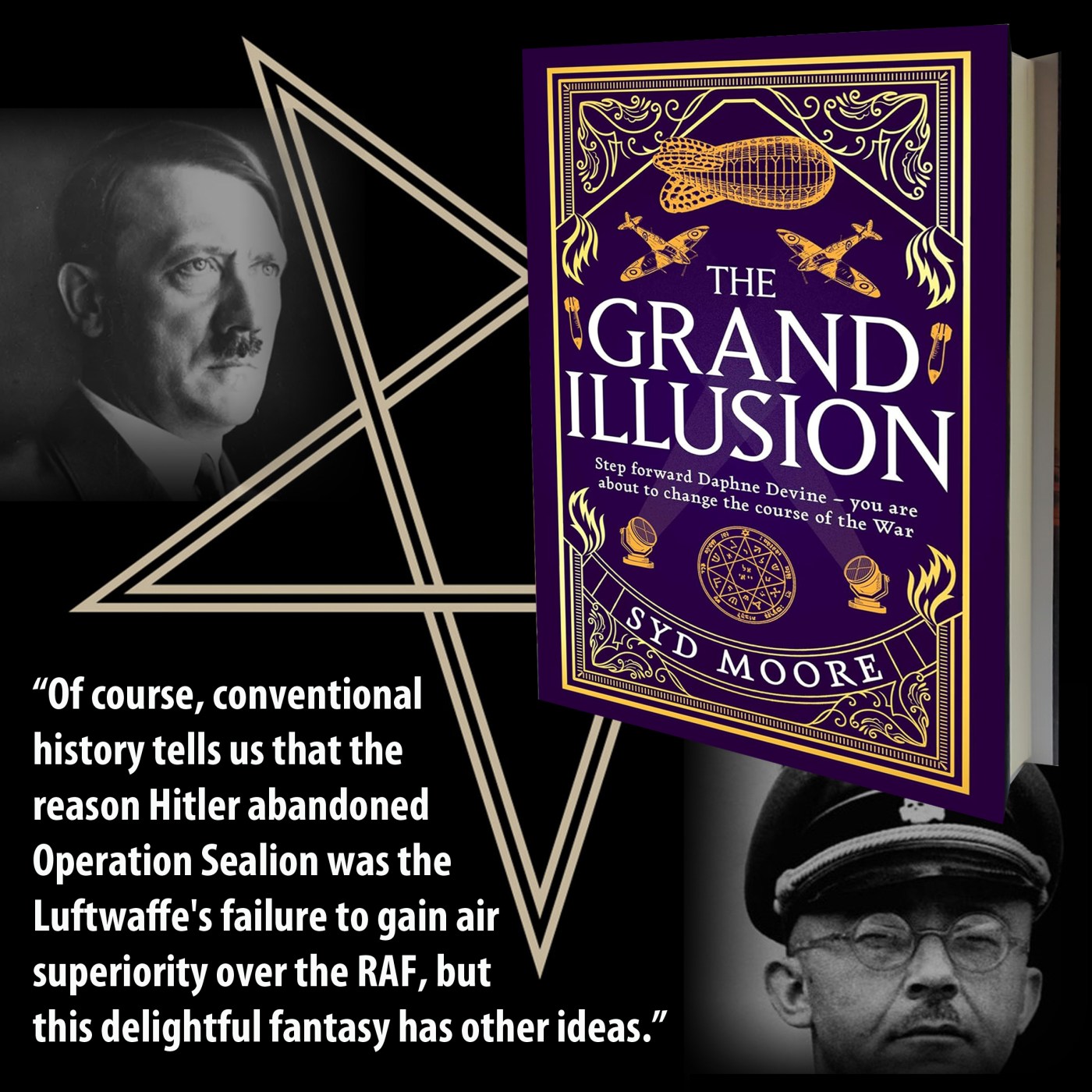
Unsure of what is to be asked of them, Daphne and Jonty say goodbye to normal life, and are whisked off to a high security unit which seems to specialise in camouflage, pretence and making German aircraft make as many mistakes as possible in identifying targets on the ground. Then, events make another lurch in the direction of the unexpected. The ‘behind-the-scenes’ directors of this unlikely drama have become aware that the Nazi high command are, to a man, deeply susceptible to the occult and the power of astrology.  This is the list. The initials are fairly obvious, although I admit to wondering what Reinhardt Heydrich was doing their, as this was only 1940. Then I remembered Hitler’s deputy, that strange who flew a plane to Scotland, and spent the last years of his life in Spandau Prison.

TGI quote

Then, Syd Moore introduces us to the delightful fulcrum on which the rest of the novel pivots. In a briefing Daphne and Jonty are astonished to learn that they are required not just to create an illusion of some astral phenomenon which will deter Hitler and his cohort from invading Britain, but to actually dabble in the Black Arts and recreate the demonic force which – so they are told – wreaked hell and destruction on The Spanish Armada in 1588, thus enabling Sir Francis Drake to continue his game of bowls, safe in the knowledge that the spell has already been cast.

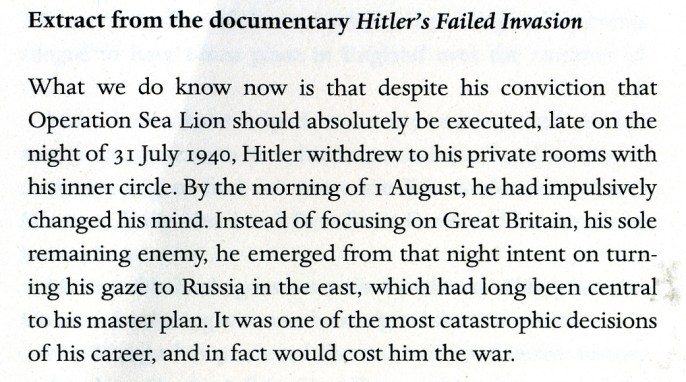
On 31st July 1940, In the full knowledge that there are German spies nearby, observing their every move, Daphne and the other specialists create an elaborate and dramatic psychic event. It is a spectacular illusion. Or is it just an illusion? That is the enigma with which Syd Moore leaves us. Of course, conventional history tells us that the reason Hitler abandoned Operation Sealion was the Luftwaffe’s failure to gain air superiority over the RAF, but this delightful fantasy has other ideas.

TGU quote038 copy

The Grand Illusion is published by Magpie Books and is available now.

Blog at WordPress.com.

Up ↑