There is an aphorism attributed to George Orwell which goes:
“We sleep safe in our beds because rough men stand ready in the night to visit violence on those who would do us harm.“
It echoes Rudyard Kipling’s famous poem, ‘Tommy”, where he says:
“For it’s Tommy this, an’ Tommy that, an` Chuck him out, the brute! ”
But it’s ” Saviour of ‘is country ” when the guns begin to shoot”
In a nutshell, we want our soldiers to be savages when they face the enemy, but except them to revert to civilised and urbane when they walk our peaceful streets, far away from conflict.
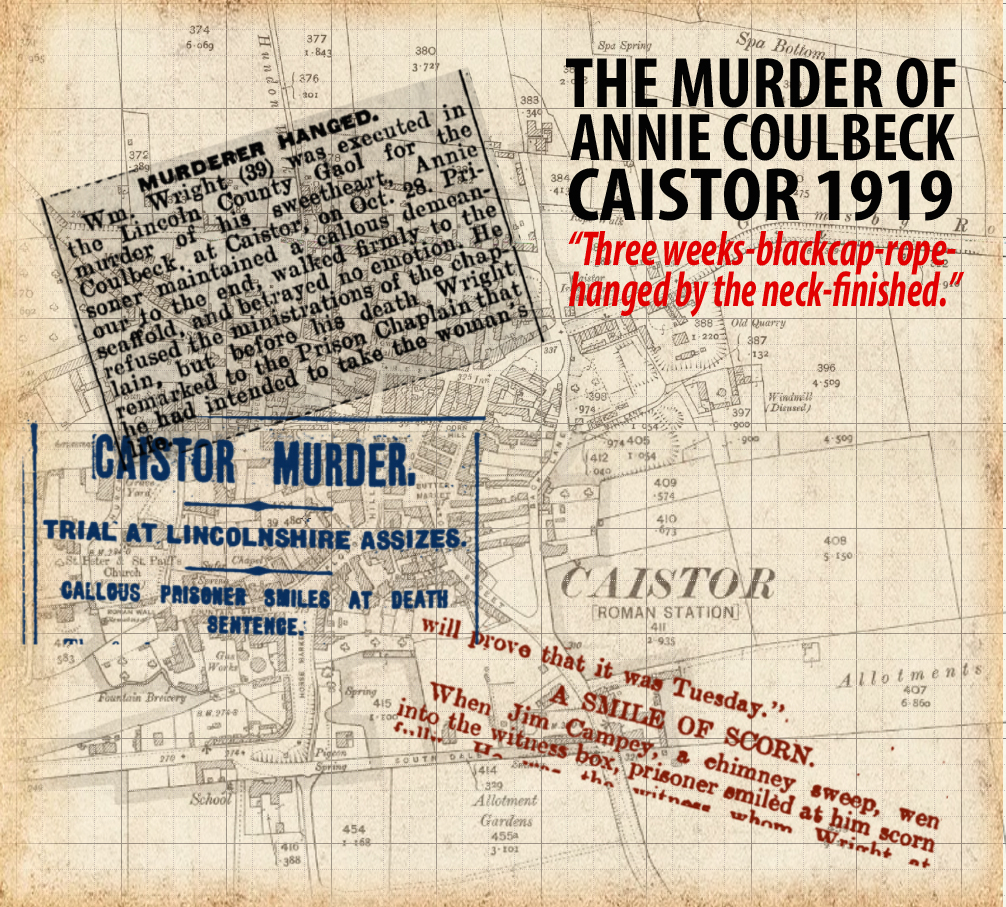
This prelude is in no way an excuse for the murder of a woman in the Lincolnshire village of Caistor in the autumn of 1919, but it points to the problems that some former soldiers have when they leave the world of government-endorsed killing, and walk again down peacetime streets.
William Wright was certainly not from an impoverished or brutal background. He was born in 1880, and the 1881 census shows that he was the youngest of three children to Charles Wright, a tailor, and his wife Jamima. He worked for his father for a while in his teens but it is recorded that he joined the army in 1898, and fought in the Boer War. Peacetime clearly didn’t suit him, as between 1907 to 1914 he received 32 convictions, mostly for theft, vagrancy and drunkenness.

1914 came, and with it the chance to turn whatever demons plagued him in the direction of the Boche. His military record was to be no better than his civilian one, however, as In 1916 he was sentenced to death for striking his superior officer. The sentence was commuted to one of five years penal servitude and then further reduced to two years hard labour.
The army was clearly glad to be rid of Wright, and when he returned to Caistor in 1918, he struck up a relationship with Annie Coulbeck. We know relatively little of Annie. We know that she was 34 at the time of her death, was probably born in the nearby village of Stallingborough, and some sources suggest that she was simple minded. More pertinent to this story is that she had the misfortune to meet William Wright, and was pregnant with his child. In October 1919, her daily employment was to look after the children of a Mrs Plummer at her cottage near Pigeon Spring on Caistor’s Horsemarket. The picture below dates from 1908.
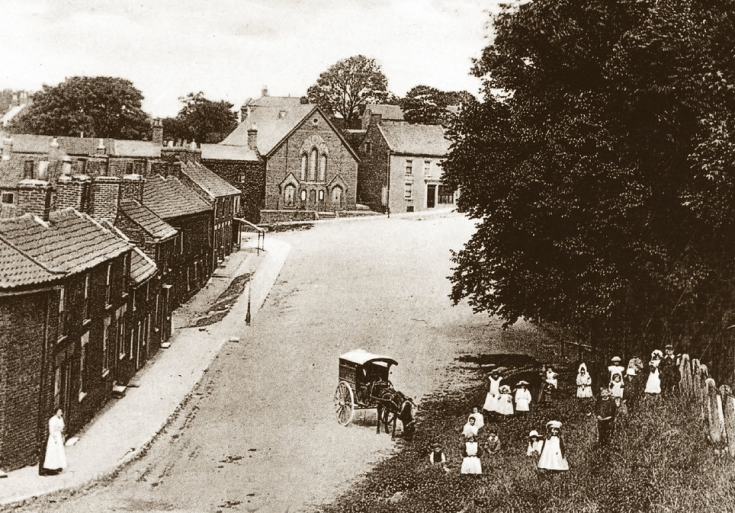
This is an extract from a short video about the Horsemarket, and is well worth watching, as it places Pigeon Spring on the photograph.
On the afternoon of 28th October 1919, William Wright came to visit Annie Coulbeck at Pigeon Spring. On the morning of the 29th, Annie Coulbeck had not arrived to look after the children, so Mrs Plumer sent one of her daughters to see if Annie had slept in. What the child found sent shock waves through the peaceful rural community.
TO FOLLOW
A DREADFUL DISCOVERY
AN INNOCENT BROOCH
A SMILING PRISONER
MORE WORK FOR MR PIERREPOINT


 fullybooked2017
Leave a comment