

SO FAR: Sutton in Ashfield, Friday 27th June, 1924. Nine year-old Rosa Armstrong, after coming home from school for lunch never returned to her classroom. A shopkeeper sold her a bag of sweets during the afternoon, but now she is missing. Her frantic mother has been asking and searching, but with no luck. In the early hours of Saturday morning, a man approaches a policeman on duty in Mansfield Market Place, and confessed that he has killed Rosa. The man was Arthur Simms, who is married to Rosa’s older sister, Ethel.
Less than a mile from Rosa’s home on Alfreton Road, there used to stand a mission chapel, known as St Mark’s. It was nothing much to look at, been mostly constructed of corrugated tin. It disappeared in the 1970s when the road, the B6023 was altered. It stood at the top of Calladine Lane, also now totally changed. The short animation above shows its location. Arthur Simms gave chillingly accurate directions to the police:
“Go straight up Alfreton Road to St. Mark’s Church and then turn down the ash road leading to the side of St. Mark’s Church. Turn onto the first footpath to the left and she is under the hedge in the second field.”
What the police officers found was later recounted in court:
“The body was face downwards on the ground with the legs wide apart. A mohair bootlace had been tied round the girls neck; her left hand was grasping a paper bag containing sweets; in the right hand was a strand of grass, and marks were found on several parts of the body, including the nose, ear and thigh. The clothing was in a normal position, but a mohair bootlace was missing from one of the deceased’s shoes. The prosecution stated that it would be proved that the girl had no money or sweets when she left home. Around the place where the body was found, for a radius of about 5 yards, the grass had been trampled down, and eight yards away was a depression as if somebody had laying down.”
Rosa was buried on Tuesday Ist July, and the account of the occasion is still deeply poignant, nearly a century later.

At this point, it is worth spending a moment to look at Arthur Simms. One of the problems with researching him and his history, is that while all the newspaper reports refer to him as “Simms” the only genealogical record I can find of him is under the name “Sims”. During his trial, the only possible defence was one of insanity, and it was stated that he had been badly treated as a prisoner of war, which led to mood swings and, perhaps, what we now know as PTSD. As I said earlier, I was sceptical of his father’s claim that had managed to serve in both India and France, and also managed to become a POW, when – in normal circumstances – he could have seen only two years service, at best. However, diligent researchers on The Great War Forum helped me with the following information.
Simms went to France in late March, 1918. This coincided with the Kaiserslacht, the massive German offensive which threatened to turn the tide of the war. He was captured on 10th April, and was sent to a prison camp in Germany. When he was repatriated in late November, he was not discharged, but after two months at home, he transferred to The Border Regiment and was sent to India. There he stayed until September 1920 when, after some time at a barracks in Carlisle, he became fed up of waiting for his release, and simply discharged himself and came home. He married Ethel Mordan (née Armstrong) in December 1921.
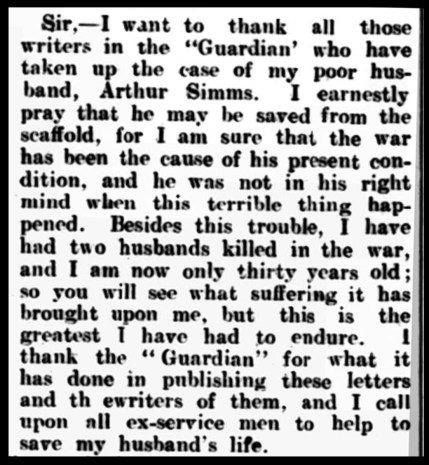
Inevitably, Arthur Simms was sent to Nottingham Assizes to be tried for murder, found guilty, and was sentenced to death. Despite appeals for clemency, such as the letter (left) written to the press by his wife, he was hanged in Bagthorpe Gaol, by Thomas Pierrepoint on 17th December 1924. The greatest mystery of this sorry affair is that there appeared to absolutely no motive for what Arthur Simms did. Rosa’s clothes were not disturbed in any way and her post mortem confirmed that there been no sexual activity evident. To use the euphemism of the press, she had not been “interfered with”. There was no evidence of animosity between the girl and her brother-in-law, family members later stating that they had been “on the best of terms.”
Looking back at this tragic affair we would do well to remember that apart from poor Rosa, there are other victims, perhaps none more so than her older sister Ethel. If it was the war that unhinged Arthur Simms, then by the end of 1924 the young woman had lost three husbands to that dreadful conflict.
The image of Rosa in the graphics is colourised and enhanced from a rather grainy contemporary newspaper photograph. It would be deeply ironic if it was the school photo that Rosa wanted sixpence for on the last afternoon of her life.
Click the image below to read other historical
true crime cases from around the country.


 fullybooked2017