Search

fullybooked2017

Month

November 2023

MURDER AT HOLLY HOUSE . . . Between the covers

MAHHSPINE

Screen Shot 2023-11-26 at 18.28.51The novel is subtitled The Memoirs of Inspector Frank Grasby, and Denzil Meyrick (left) employs the reliable plot-opener of someone in our time inheriting a wooden crate containing the papers of a long-dead police officer, and exploring what was committed to paper. Will crime writers in a hundred years hence have their characters discovering a forgotten folder in the corner of someone’s hard drive? I doubt it – it won’t be anywhere near as much fun.

We are in December 1952, although the book starts with an intriguing police report from three years earlier, the significance of which becomes apparent later. Frank Grasby is in his late thirties, saw one or two bad things during his army service, but is now with Yorkshire police, based in York. He is a good copper, albeit with a weakness for the horses, but has made one or two recent blunders for which his punishment is to be sent of the remote village of Elderby, perched up on the North Yorkshire moors. Ostensibly he is there to investigate some farm thefts, but the Chief Constable just wants him out of harm’s way – and the public eye – for a month or two.

Meyrick unashamedly borrows a few ideas from elsewhere. Rather like Lord Peter Wimsey’s car getting stuck in the snow at the beginning of The Nine Tailors, Grasby’s battered police Austin A30 gives up the ghost just short of the village as the snow swirls down, and he has to make the rest of the journey on foot. In Elderby he finds, in no particular order:

♣ A pub called The Hanging Beggar.
♣ Police Sergeant Bleakly – in charge of the local nick, but afflicted with narcolepsy due to his grueling time with the Chindits in Burma.
♣ A delightful American criminology student called Daisy Dean.
♣ A bumptious nouveau-riche ‘Lord of the Manor’ called Damnish (a former tradesman from Leeds, ennobled for his support of the government).
♣ A strange woman called Mrs Gaunt, with whom Grasby and Daisy lodge. Mrs G has a pet raven that sits on her shoulder, and seems to have a mysterious connection to Grasby’s father, an elderly clergyman.

The first corpse enters neither stage right nor left, but rather stage above, when Grasby inadvertently solves Lord Damnish’s smoky fireplace by dislodging an obstruction – a recently deceased male corpse. Next, the American husband of the local GP is found dead in the churchyard. Chuck Starr was a journalist embedded with the Allied forces on D-Day, was appalled by what he saw, and has been writing an exposé on military incompetence. His manuscript – yes, you guessed it – has gone missing.

The more Grasby tugs and frets away at a series of loose ends, the more the fabric of Elderby – as a jolly bucolic paradise inhabited by a few harmless eccentrics – begins to unravel and our man finds himself in the middle of a potentially catastrophic conspiracy.

Some crime novels lead us to thinking dark thoughts about the human condition, while others delight us with their ingenuity, humour and turns of phrase. This is definitely in the latter category but, amidst the entertainment, Meyrick reminds us that war leaves mental scars that can be much slower to heal than their physical counterparts. He takes the threads of familiar and comfortable crime fiction tropes, and weaves a Christmas mystery in a snowy village, but with the shadows of uneasy post-war international alliances darkening the fabric. Murder at Holly House is beautifully written, full of sharp humour, but it is also a revealing portrait of the political tensions rife in 1950s Britain. It is published by Bantam and is available now.
MAHH cover

THE SCOTSMAN . . . Between the covers

scotsman spine049 copy

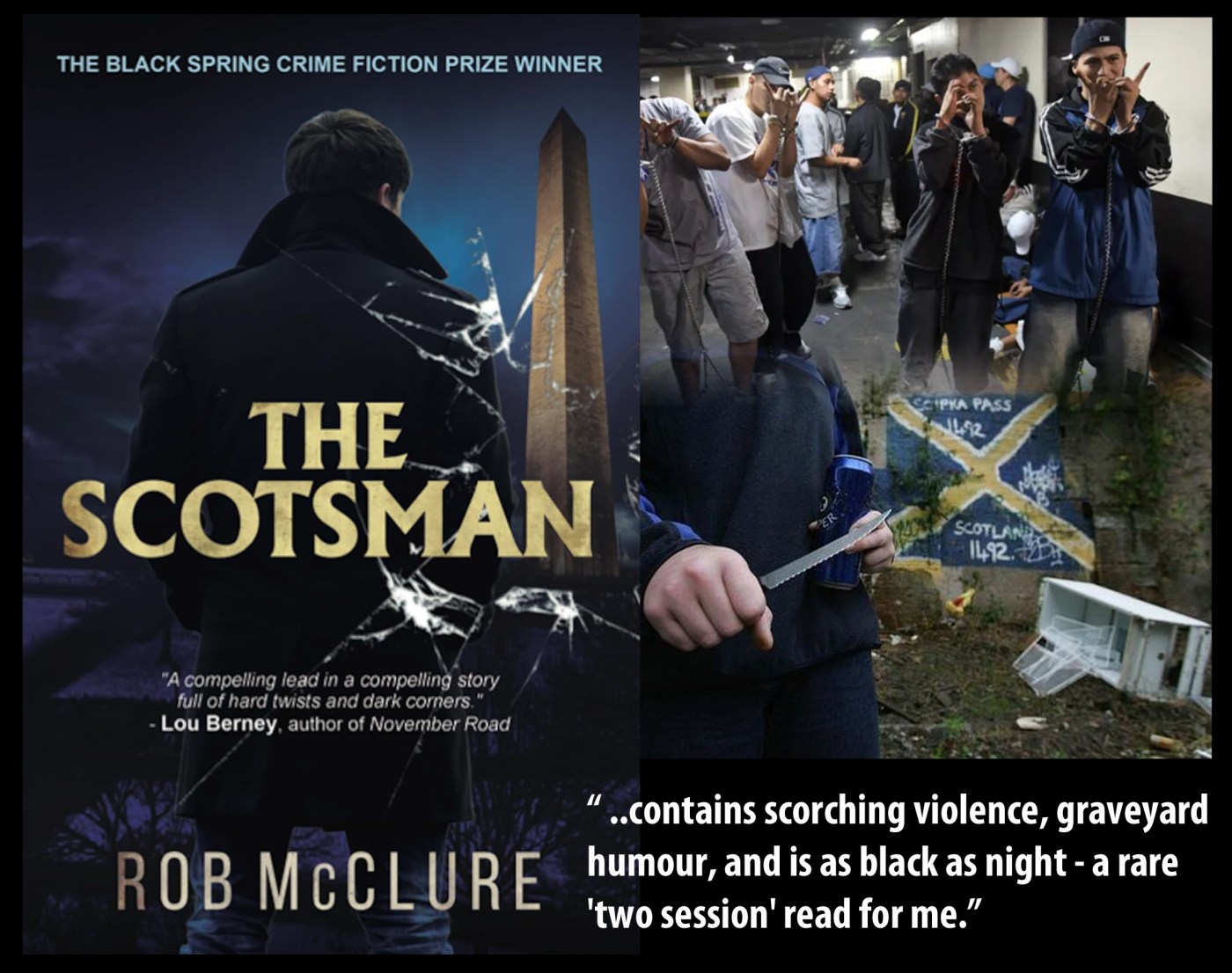
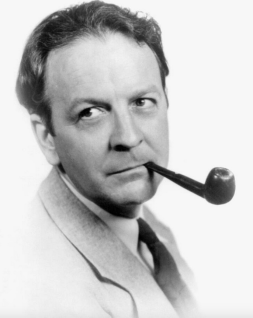
Screen Shot 2023-11-27 at 19.53.03The trope of a police officer investigating a crime “off patch” or in an unfamiliar mileu is not new, especially in film. At its corniest, we had John Wayne in Brannigan (1975) as the Chicago cop sent to London to help extradite a criminal, and in Coogan’s Bluff (1968), Clint Eastwood’s Arizona policeman, complete with Stetson, is sent to New York on another extradition mission. Black Rain (1989) has Michael Douglas locking horns with the Yakuza in Japan, and who can forget Liam Neeson’s unkindness towards Parisian Albanians in Taken (2018), but apart from 9 Dragons (2009), where Michael Connolly’s Harry Bosch goes to war with the Triads in Hong Kong, I can’t recall many crime novels in the same vein. Rob McClure (left) balances this out with his debut novel, The Scotsman, which was edited by Luca Veste.
Charles ‘Chic’ Cowan is a Glasgow cop, and his daughter, Catriona, was studying at an Washington DC university when she was shot dead on the Metro. CCTV footage shows that her assailants were two black men, one of whom later ends up dead as a result of feuding between drug gangs. The local police remain mystified as to who the other shooter was, and they are also baffled by an apparent lack of motive, and the fact that the shooting – at close range with a small calibre pistol – has all the hallmarks of a contract killing. Cowan travels to DC in an attempt to discover the truth.

Our man is a synthesis of every Scottish copper we have ever read about. He is undoubtedly intelligent, but abrasive in his speech and manner. He used to like a drink or six but is now ‘on the wagon’, and has a jaundiced view of humanity, hence a nice collection of one-line gags. He recalls a fracas he was involved in at a family wedding  in an insalubrious district of Glasgow:

“Easterhouse was the kind of place Ethiopia held rock concerts for.”

Cowan has long since separated from Catriona’s mother, and the more he investigates her life in the American capital, the more he realises how little he knew her. To start with, she was a lesbian, and it is when he discovers her relationship with a political journalist that he realises her murder is connected to something rotten in the state of American politics.

The closer he gets to the reason for his daughter’s murder, the more dangerous the men who are sent after him, but one by one, they come to rue the fact that the back streets of Glasgow make the sidewalks of Washington Highlands/Bellevue look like a Disney theme park by comparison. It is in places like Possilpark and Govan that Cowan learned every dirty trick in the book, and one involves a very inventive use of a piece of plywood, a razor blade, a length of duct tape and some knicker elastic. As for inducing a pursuer to ‘fall off’ a Metro platform thus making the acquaintance of the third rail, it is straight out of Cowan’s Glasgow playbook.

The Scotsman contains scorching violence, graveyard humour, and is as black as night – a rare ‘two session’ read for me. I don’t do star ratings, but if I did, it would be a five. I wasn’t fussed about the romantic interlude, but if it gives Cowan an excuse to return and cull a few more DC lowlife, then I’ll give his moments of passion a thumbs-up. The book is published by Black Spring and is available now.

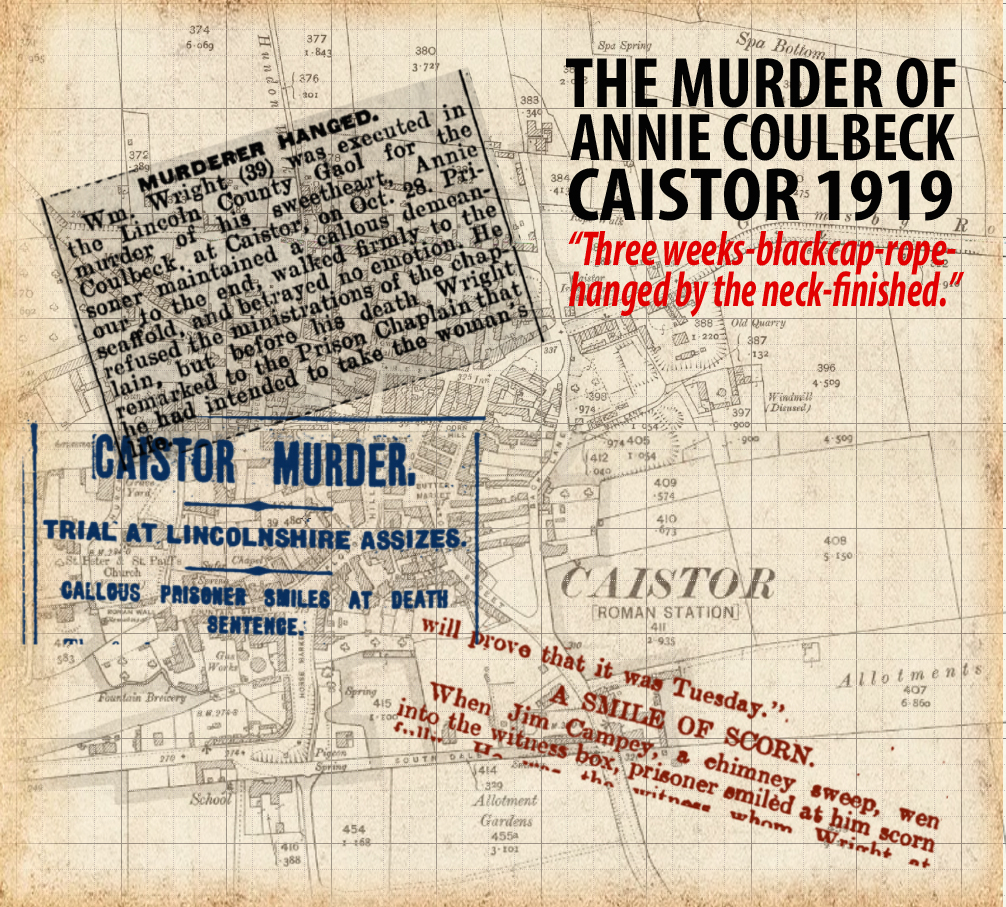
THREE WEEKS-BLACK CAP-ROPE-HANGED BY THE NECK-FINISHED . . . The murder of Annie Coulbeck, Caistor 1919 (2)

Annie Header

SO FAR: Caistor, North Lincolnshire, October 1919. William Wright (39), a former soldier, is now working in a sawmill in nearby Moortown. He has a reputation as a ne’er-do-well and sometime vagrant, with a long criminal record. He has been in a relationship with Annie Coulbeck, (34). She is carrying his child.

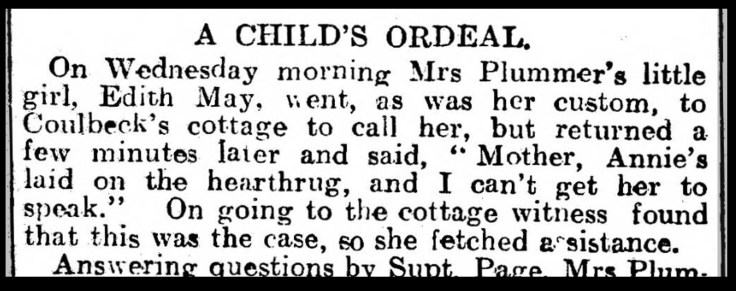
Annie, who lives in a cottage at Pigeon Spring on Horsemarket. has been working as a nanny, looking after the children of Mrs Plummer.  On the morning of Wednesday 29th October, Annie has not turned up for work, so Mrs Plummer sends one of her children to Annie’s cottage to see if she was unwell.

Child's ordeal

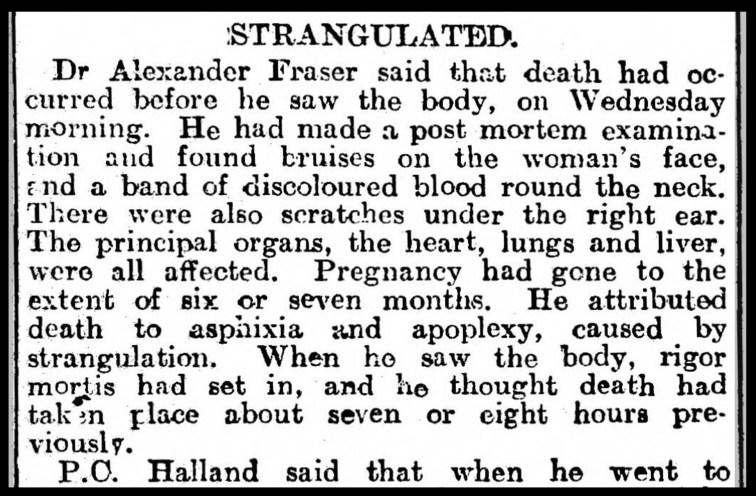
Annie Coulbeck had been strangled, and had been dead for some hours, and it goes without saying that her unborn child – some seven months in her womb – had shared its mother’s fate. At the coroner’s inquest, the doctor gave his report:

Strangulated

It was no secret that Annie Coulbeck and William Wright were lovers, and when police visited him at his home in South Dale, Caistor, his admission was astonishingly matter-of-fact:

“Last night, a little after 10 o’clock, I left the Talbot public house. I had a lot of drink and went down to Annie Coulbecks house. I asked her where she had got the brooch from which she was wearing. She said it was her mothers. I told her I did not think it was. I told her I thought it was one of her fancy men’s. She said, “I’m sure it is not, Bill.” I told her I would finish her if she did not tell me whose it was. I strangled her with my hands and left her dead. I put the lamp out and went home.”

Talbot

The Talbot in Caistor (above) is no longer a pub, but if its walls could talk, they might bear witness to a chilling conversation William Wright had with a fellow drinker, a local chimney sweep.

Strange Statement

The umbilical cord is often used as a metaphor for two things being inextricably joined, but it also has a presence in the British legal system, particularly in the case of murdered babies. Criminal history, particularly back in the day, is full of young women being tried for murder after they have killed an unwanted new-born baby. For it to be murder, it has to be established that the  infant had an independent existence, and it is clear that the child Annie Coulbeck was carrying had no such thing. However, in my book, William Wright was as guilty of murdering that child – his child –  as he was of killing its mother.

Screen Shot 2023-11-22 at 19.02.01

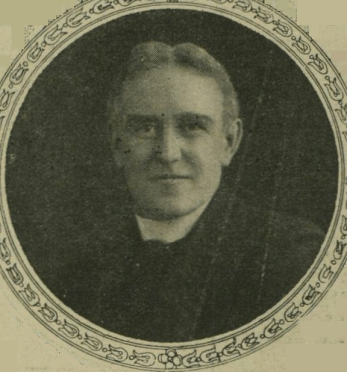
Wright, in his drunken estimation that it would take just three weeks from the death of Annie Coulbeck to his appointment on the gallows, was as ignorant of the legal system as he was of the way decent human beings should behave. The law took its rather ponderous course, and after the Coroner’s Inquest and then Magistrate Court, William Wright finally appeared at Lincoln Assizes, before Mr Justice Horridge (left) on Monday 2nd February 1920. It was a perfunctory affair. Wright’s defence lawyers, as they were bound to do, came up with the only possible plea – that Wright was insane. They cited his war experience, and the fact that members of his family had been committed to institutions. Neither judge nor jury were impressed and, as Wright had predicted, hunched over his beer in The Talbot, the judge donned the Black Cap. An appeal was lodged, but failed.

Appeal

Throughout the legal process, Wright had shown not one iota of remorse, nor did he betray any concern about what awaited him.

Black Cap
Screen Shot 2023-11-22 at 19.17.49

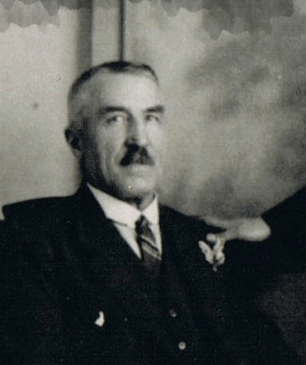
Wright was executed at Lincoln Castle on 10th March 1920. He had refused the ministrations of the prison chaplain, and the last face he would have focused on before the hood was placed over his head and he dropped to his death was the grim visage of executioner Thomas Pierrepoint (right), uncle of the more celebrated hangman Albert Pierrepoint, subject of the excellent film (2005) featuring Timothy Spall as the man who hanged, among others, Ruth Ellis and dozens of Nazi war criminals. The corpses of executed criminals at Lincoln Castle were interred in a little graveyard situated on the Lucy Tower. If ever a soul deserved to rot in hell, it is that of William Wright.

FOR MORE HISTORIC MURDERS IN LINCOLNSHIRE
CLICK THE IMAGE BELOW

Screen Shot 2023-11-25 at 20.25.19

THE SHEPHERD . . . A Christmas short story

SHEPHERD HEADER

The words ‘Walt Disney tie-in’ are seldom – if ever – uttered in the sepulchral corridors of Fully Booked Towers, but this looks intriguing. First published by Hutchinson in 1975, The Shepherd has become something of a minor classic. Disney have now made a short film, to be released on 1st December. The trailer is below.

The story? Simple and timeless. The ‘home for Christmas’ trope had been interpreted in many different ways over the years, but here we have a rather special take. It is Christmas Eve, 1957, and an RAF pilot is scheduled to fly home from his airbase in Germany to be with his family in England. In his Vampire jet fighter it should be an hour or so in the air, and then the welcome lights of the landing strip at Lakenheath. But mid-air, fog closes in and, inexplicably, his compass spins like a roulette wheel, and his radio dies. All alone in the freezing dark, the pilot begins to believe his simple flight home will end in disaster. Then, something impossible happens …..

Ghost stories should chill, and this certainly does, but it is also profoundly moving. The Shepherd has never been out of print, which is a huge tribute to Frederick Forsyth, one of our finest storytellers. This latest edition, with a foreword by the author, is published by Penguin and is out now.

THREE WEEKS-BLACK CAP-ROPE-HANGED BY THE NECK-FINISHED . . . The murder of Annie Coulbeck, Caistor 1919 (1)

Annie Header

There is an aphorism attributed to George Orwell which goes:

“We sleep safe in our beds because rough men stand ready in the night to visit violence on those who would do us harm.

It echoes Rudyard Kipling’s famous poem, ‘Tommy”, where he says:

“For it’s Tommy this, an’ Tommy that, an` Chuck him out, the brute! ”
But it’s ” Saviour of ‘is country ” when the guns begin to shoot”

In a nutshell, we want our soldiers to be savages when they face the enemy, but except them to revert to civilised and urbane when they walk our peaceful streets, far away from conflict.

This prelude is in no way an excuse for the  murder of a woman in the Lincolnshire village of Caistor in the autumn of 1919, but it points to the problems that some former soldiers have when they leave the world of government-endorsed killing, and walk again down peacetime streets.

William Wright was certainly not from an impoverished or brutal background. He was born in 1880, and the 1881 census shows that he was the youngest of three children to Charles Wright, a tailor, and his wife Jamima. He worked for his father for a while in his teens but it is recorded that he joined the army in 1898, and fought in the Boer War. Peacetime clearly didn’t suit him, as between 1907 to 1914 he received 32 convictions, mostly for theft, vagrancy and drunkenness.

Convictions

1914 came, and with it the chance to turn whatever demons plagued him in the direction of the Boche. His military record was to be no better than his civilian one, however, as In 1916 he was sentenced to death for striking his superior officer. The sentence was commuted to one of five years penal servitude and then further reduced to two years hard labour.

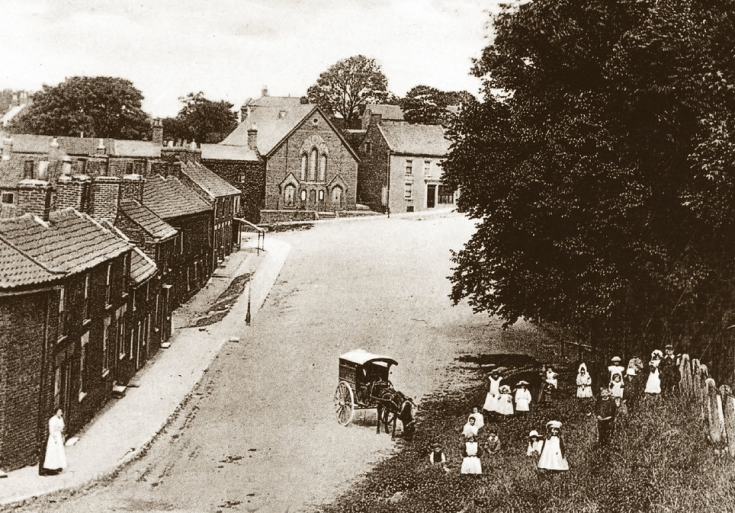
The army was clearly glad to be rid of Wright, and when he returned to Caistor in 1918, he struck up a relationship with Annie Coulbeck. We know relatively little of Annie. We know that she was 34 at the time of her death, was probably born in the nearby village of Stallingborough, and some sources suggest that she was simple minded. More pertinent to this story is that she had the misfortune to meet William Wright, and was pregnant with his child. In October 1919, her daily employment was to look after the children of a Mrs Plummer at her cottage near Pigeon Spring on Caistor’s Horsemarket. The picture below dates from 1908.

Horsemarket

This is an extract from a short video about the Horsemarket, and  is well worth watching, as it places Pigeon Spring on the photograph.

On the afternoon of 28th October 1919, William Wright came to visit Annie Coulbeck at Pigeon Spring. On the morning of the 29th, Annie Coulbeck had not arrived to look after the children, so Mrs Plumer sent one of her daughters to see if Annie had slept in. What the child found sent shock waves through the peaceful rural community.

TO FOLLOW
A DREADFUL DISCOVERY
AN INNOCENT BROOCH
A SMILING PRISONER
MORE WORK FOR MR PIERREPOINT

THE MURDER OF ROSA ARMSTRONG . . . Sutton in Ashfield 1924 (2)

ROSA HEADER

SO FAR: Sutton in Ashfield, Friday 27th June, 1924. Nine year-old Rosa Armstrong, after coming home from school for lunch never returned to her classroom. A shopkeeper sold her a bag of sweets during the afternoon, but now she is missing. Her frantic mother has been asking and searching, but with no luck. In the early hours of Saturday morning, a man approaches a policeman on duty in Mansfield Market Place, and confessed that he has killed Rosa. The man was Arthur Simms, who is married to Rosa’s older sister, Ethel.


Less than a mile from Rosa’s home on Alfreton Road, there used to stand a mission chapel, known as St Mark’s. It was nothing much to look at, been mostly constructed of corrugated tin. It disappeared in the 1970s when the road, the B6023 was altered. It stood at the top of Calladine Lane, also now totally changed. The short animation above shows its location. Arthur Simms gave chillingly accurate directions to the police:

“Go straight up Alfreton Road to St. Mark’s Church and then turn down the ash road leading to the side of St. Mark’s Church. Turn onto the first footpath to the left and she is under the hedge in the second field.”

What the police officers found was later recounted in court:

“The body was face downwards on the ground with the legs wide apart. A mohair bootlace had been tied round the girls neck; her left hand was grasping a paper bag containing sweets; in the right hand was a strand of grass, and marks were found on several parts of the body, including the nose, ear and thigh. The clothing was in a normal position, but a mohair bootlace was missing from one of the deceased’s shoes. The prosecution stated that it would be proved that the girl had no money or sweets when she left home. Around the place where the body was found, for a radius of about 5 yards, the grass had been trampled down, and eight yards away was a depression as if somebody had laying down.”

Rosa was buried on Tuesday Ist July, and the account of the occasion is still deeply poignant, nearly a century later.
Funeral

At this point, it is worth spending a moment to look at Arthur Simms. One of the problems with researching him and his history, is that while all the newspaper reports refer to him as “Simms” the only genealogical record I can find of him is under the name “Sims”. During his trial, the only possible defence was one of insanity, and it was stated that he had been badly treated as a prisoner of war, which led to mood swings and, perhaps, what we now know as PTSD. As I said earlier, I was sceptical of his father’s claim that had managed to serve in both India and France, and also managed to become a POW, when – in normal circumstances –  he could have seen only two years service, at best. However, diligent researchers on The Great War Forum helped me with the following information.

Simms went to France in late March, 1918. This coincided with the Kaiserslacht, the massive German offensive which threatened to turn the tide of the war. He was captured on 10th April, and was sent to a prison camp in Germany. When he was repatriated in late November, he was not discharged, but after two months at home, he transferred to The Border Regiment and was sent to India. There he stayed until September 1920 when, after some time at a barracks in Carlisle, he became fed up of waiting for his release, and simply discharged himself and came home. He married Ethel Mordan (née Armstrong) in December 1921.

Letter

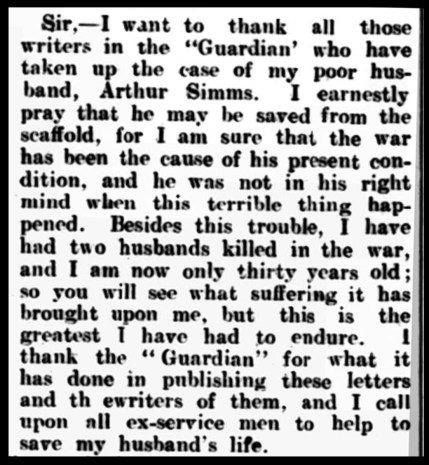
Inevitably, Arthur Simms was sent to Nottingham Assizes to be tried for murder, found guilty, and was sentenced to death. Despite appeals for clemency, such as the letter (left) written to the press by his wife, he was hanged in Bagthorpe Gaol, by Thomas Pierrepoint on 17th December 1924. The greatest mystery of this sorry affair is that there appeared to absolutely no motive for what Arthur Simms did. Rosa’s clothes were not disturbed in any way and her post mortem confirmed that there been no sexual activity evident. To use the euphemism of the press, she had not been “interfered with”. There was no evidence of animosity between the girl and her brother-in-law, family members later stating that they had been “on the best of terms.”

Looking back at this tragic affair we would do well to remember that apart from poor Rosa, there are other victims, perhaps none more so than her older sister Ethel. If it was the war that unhinged Arthur Simms, then by the end of 1924 the young woman had lost three husbands to that dreadful conflict.

The image of Rosa in the graphics is colourised and enhanced from a rather grainy contemporary newspaper photograph. It would be deeply ironic if it was the school photo that Rosa wanted sixpence for on the last afternoon of her life.

Click the image below to read other historical
true crime cases from around the country.

IPN

THE MURDER OF ROSA ARMSTRONG . . . Sutton in Ashfield 1924 (1)

ROSA HEADER

Rosa Armstrong was born in 1915, the daughter of Frederick Armstrong and his wife Maria. Her father died just three years later, but her mother remarried – to Edward Buttery – in 1920. June 1924 saw them living at 78 Alfreton Road, Sutton in Ashfield. Nine year-old Rosa attended the Huthwaite Road Council School, just ten minutes’ walk away along Douglas Road. Rosa’s older sister, Ethel (31), had not been lucky in her marriages. She had married William Parnham in August 1912, but on 18th June 1916, he died of wounds in France. Ethel married again, to Edward Mordan, a year later. An Edward Mordan is recorded as being killed in September 1918. At some point after the war, Ethel married again, to Arthur Simms, a miner, and in 1924 they were living in Phoenix Street, Sutton in Ashfield.

At this point, it is worth mentioning that Arthur Simms was reported as having served in the army – in both India and France – during the Great War, and that he had been taken prisoner by the Germans. He was born in 1899, so – unless he had lied about his age – the earliest he could have entered the war was 1917. Keep this in the back of your mind, because I will return to it later.

I am fairly ancient, and when I was at school, lunchtimes were long enough to allow children to go home for lunch. In the 1950s and 1960s, with just a few exceptions, I always walked or cycled home for lunch. Rosa Armstrong’s journey was less than a mile, and on Friday 27th June, she came home for lunch as usual, and as she prepared to go back to school, she asked her mother for sixpence to pay for her school photograph. Her mother, Maria, said that she would come to the school herself and pay for the photograph. Rosa never made it back to school for the afternoon’s lessons.

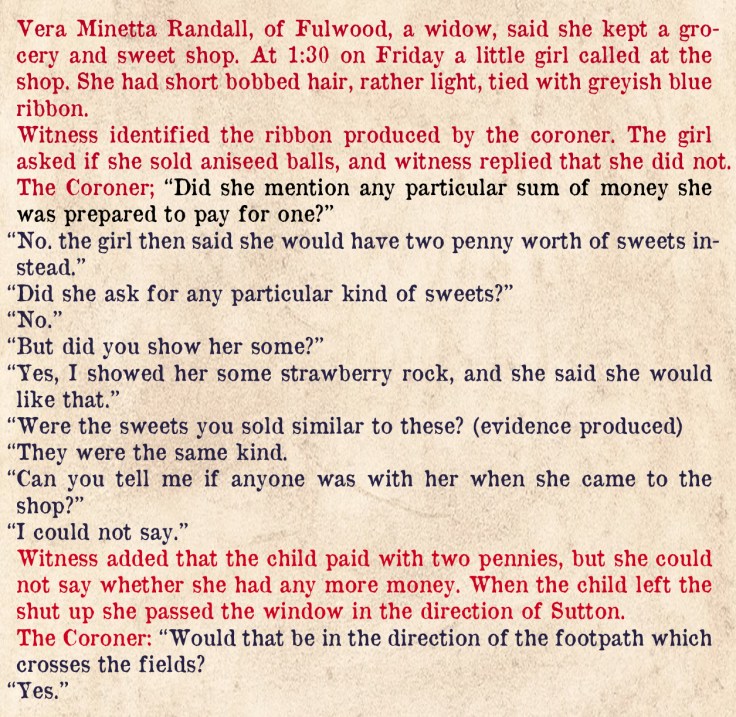
Fulwood no longer exists as a separate place, but back in the day it had its own identity as a small community south-west of Sutton and south of what is now the A38. In 1924, there was a sweet shop. Its owner was later to testify.

Sweets

When Rosa didn’t return home at the end of the afternoon, her mother was horrified to learn that Rosa hadn’t said “Yes, Sir” at afternoon registration. Deeply worried, she tried asking everywhere, even making it to the home of her daughter Ethel, but she drew blanks everywhere.

Police Constable Cheeseman was bored, tired and foot-sore, as he did his nocturnal rounds in Mansfield, four miles or so up the road from Rosa’s home. At 2.00 am, the early hours of 29th June, he was leaning against a wall in the Market Place, thinking about bed, supper, and sleep, when he was  startled to see a young man, apparently sober, making his way towards him. The newspapers later carried this report:

PC Cheeseman recounted the story of how Simms gave himself up to him in Mansfield Market Place in the early hours of the morning. As he was standing at the bottom of Stockwell Gate, he said he saw the prisoner approaching from the direction of Sutton The man came up to him and said,
“Policeman, I want to give myself up.” He asked what for and Simms replied,
“For murder. It’s my wife’s little sister at Sutton. I have done it at Sutton this afternoon.”
The constable took him to the police station and there said,
“Do you realise the seriousness of your statement?” Simms replied,
“Yes, I do.”
“When I next cautioned him that anything he said would be used as evidence against him,” continued PC Cheeseman. Simms said,
“You will find her under the hedge in the second field of mowing grass near Saint Marks Church Fulwood. I strangled her with my hands. I will put it on paper if you like.”

IN PART TWO

A HORRIFYING DISCOVERY
A FUNERAL
RETRIBUTION
AN UNSOLVED MYSTERY

CLASSICS REVISITED . . . The Big Sleep

tbs spine048 copy

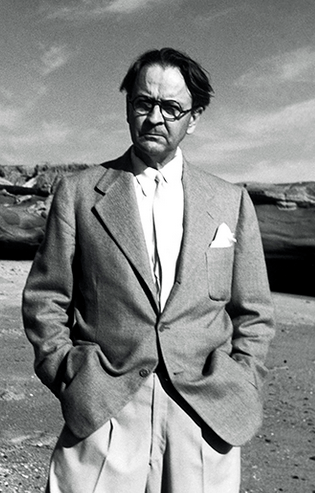
Screen Shot 2023-11-13 at 20.27.10The Big Sleep was published in 1939, but the iconic film version, directed by Howard Hawks, wasn’t released until 1946. Are the dates significant? There is an obvious conclusion, in terms of what took place in between, but I am not sure if it is the correct one. The novel introduced Philip Marlowe to the reading public and, my goodness, what an introduction. The second chapter, where Los Angeles PI Marlowe goes to meet the ailing General Sternwood who is worried about his errant daughters, contains astonishing prose. Sternwood sits, wheelchair-bound, in what we Brits call a greenhouse. Marlowe sweats as Sternwood tells him:
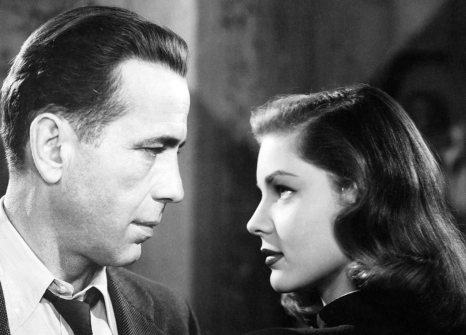
“I seem to exist largely on heat like a newborn spider, and the orchids are an excuse for the heat. Do you like orchids?”
“Not particularly.”
“They are nasty things. Their flesh is too much like the flesh of men. And their perfume has the rotten sweetness of a prostitute.”

The General can no longer drink alcohol, but he enjoys watching men who can:

“The old man licked his lips watching me, over and over again, drawing one lips slowly across the other with a funereal absorption, like an undertaker dry-washing his hands.”

“I used to like mine with champagne. The champagne as cold as Valley Forge and about a third of a glass of brandy beneath it.”

Sternwood has two daughters. The elder, Vivian, was married to a an ex-IRA bigshot called Rusty Reagan, a man much admired by his father-in-law, but he has disappeared. The younger girl, Carmen, has gone off the rails completely, and has been sucked into a world of drugs, vice and pornography.

Initially, Marlowe’s brief from the General is to find out what is going in with Carmen. He soon discovers that she is involved with a pornographer called Geiger. He goes to Geiger’s house, and sits in his car outside, the rain teeming down.

“As the darkness folded back on it and ate it up a thin tinkling scream cried out and lost itself among the rain drenched trees. I was out of the car and on my way before the echoes died. There was no fear in the scream. It had a sound of half pleasurable shock, an accent of drunkenness, overtone of pure idiocy. It was a nasty sound. It made me think of men in white and barred windows and hard narrow courts with leather wrist and ankle straps fastened to them.”

Forcing his way into the house, Marlowe finds an interrupted photoshoot:

“Neither of the two people in the room paid any attention to the way I came in, although only one of them was dead. She was wearing a pair of long Jade earrings. They were nice earrings and had probably cost couple of hundred dollars. She wasn’t wearing anything else.”

The drugged Carmen Sternwood had clearly been in the middle of a pornographic photo shoot and beside her is Geiger – shot dead. After taking Carmen back to the Sternwood mansion Marlowe returns to Geiger’s house, where he has left his car. He finds that Geiger’s body has gone and the crime scene has been interfered with. Wondering who has taken the corpse, he makes the celebrated comment:

“Dead men are heavier than broken hearts.”

Screen Shot 2023-11-13 at 20.28.07

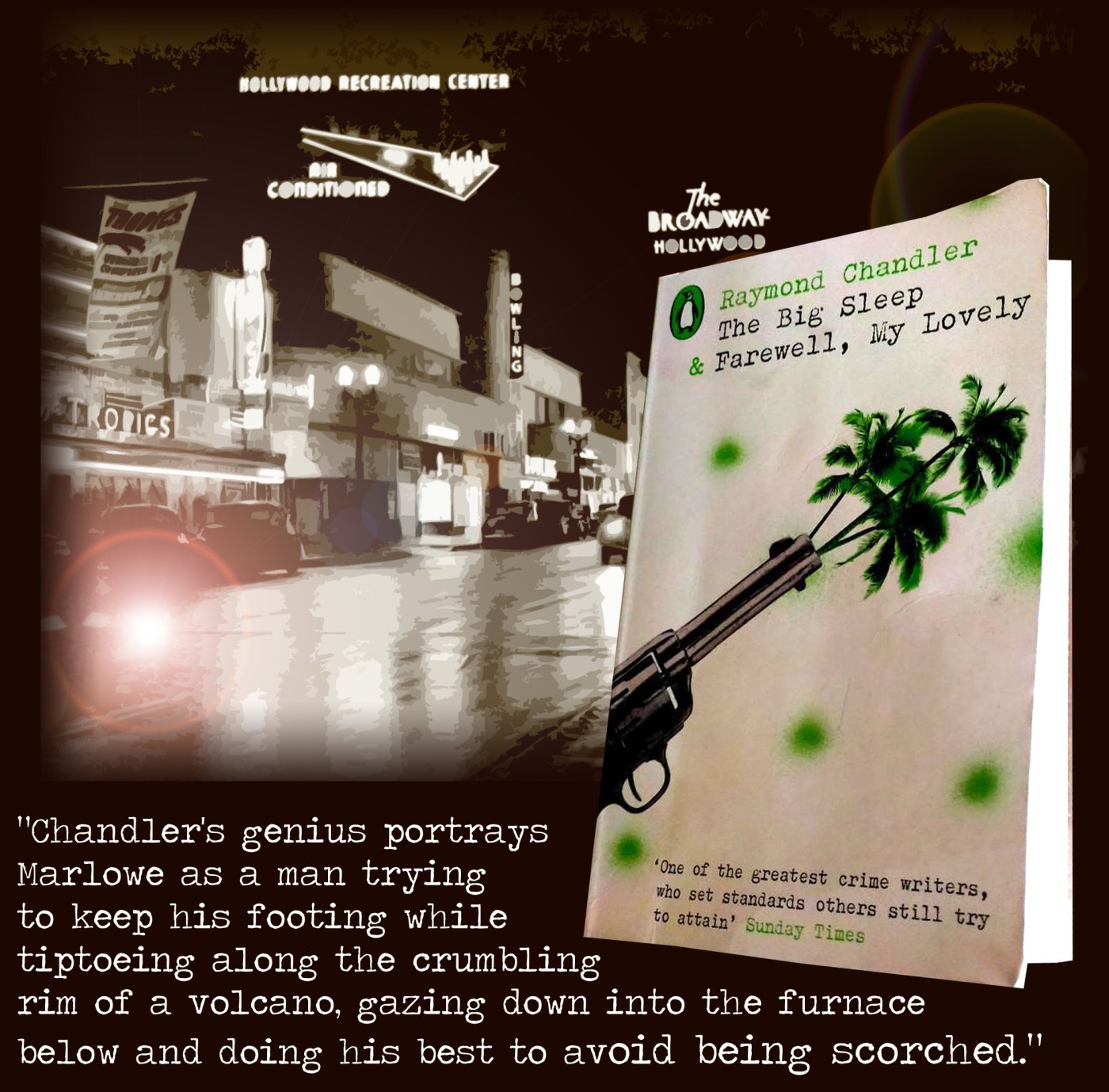
The plot then becomes something of a whirling dervish pirouetting in the California dust, sometimes moving so fast and in such unexpected directions that it is not easy to keep track of what is going on.  We meet Joe Brody, a small-time spiv who is trying to muscle in on Geiger’s pornography racket. He is shot dead by Geiger’s homosexual lover, and then Marlowe becomes aware of a much more sinister figure – gangster Eddie Mars, who is connected to Vivian Sternwood. This mad dance however is subsidiary to the poetry of Marlowe’s view of the dark world he inhabits. Chandler’s genius portrays Marlowe as a man trying to keep his footing while tiptoeing along the crumbling rim of a volcano, gazing down into the furnace below and doing his best to avoid being scorched.

In the end, as in all great novels it comes down to who we as readers care about. We don’t care too much for Carmen. We don’t care at all for the scattering of underworld figures who populate the book. We care about Vivian, who is damaged but perhaps redeemable. We care about the dying general still trying to protect his daughters and his legacy. Another cruel irony for the old man is the fate of Rusty Reagan, his corpse long since dumped in one of oil wells that have brought the family their immense wealth Above all, however, we care about Marlow and the bruises – mental and physical – he sustains while trying to do his job.

Screen Shot 2023-11-13 at 20.29.04The book began with an optimistic Marlowe:
“I was wearing my powder blue suit, with dark blue shirt, tie, and display handkerchief, black brogues, black wool socks with dark blue clocks on them. I was neat, clean, shaved and sober, and I didn’t care who knew it.”

It ends with him making a bitter deal with Vivian, that she will take Carmen as far away as possible from the moral cesspit she has been bathing in, and that the fate of Rusty Reagan will be kept from her father.

“Me, I was part of the nastiness now. Far more a part of it than Rusty Reagan was. But the old man didn’t have to be. He could lie quiet in his canopied bed, with his bloodless hands folded on the sheet, waiting. His heart was a brief, uncertain murmur. His thoughts were as grey as ashes. And in a little while  he too, like Rusty Reagan, would be sleeping the big sleep.”

The edition I read for this review was published by Penguin, and is part of their recent series of ‘Green Penguin’ crime classics. It is paired with Farewell My Lovely, and is available now.

MURDER ON THE CHRISTMAS EXPRESS . . . Between the covers

motce spine040 copy

Screen Shot 2023-11-03 at 18.54.48

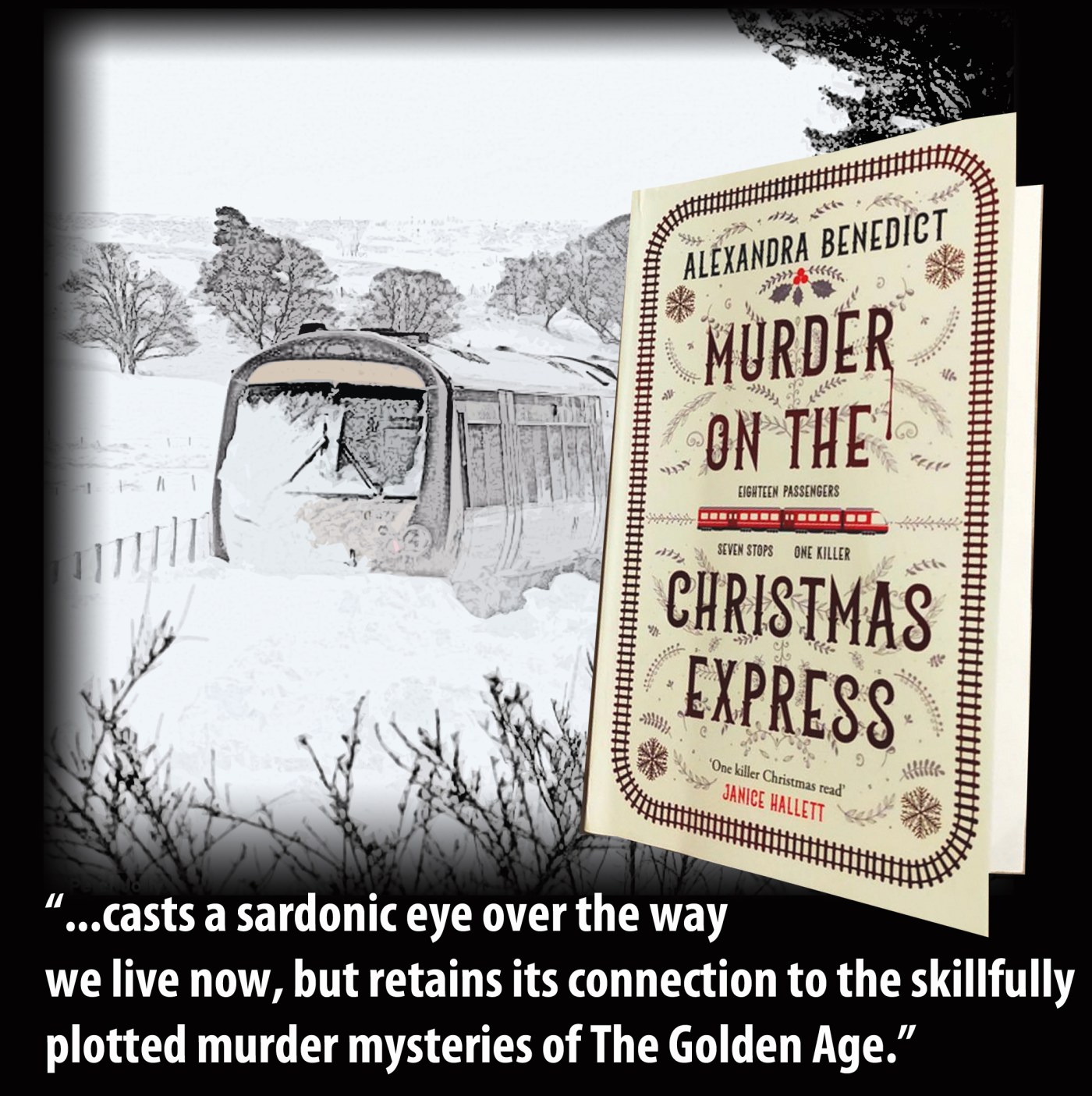
Alexandra Benedict (left) has confected a seasonal version of the traditional locked room mystery. Our locked room is actually a train, heading from Euston to Fort William just a few hours before the big day, but forced to stop in the middle of nowhere because of deep snow. Former Metropolitan Police copper Roz Parker is heading north on the train, not particularly for Christmas, but to be with her daughter who is about to give birth.

Her immediate fellow passengers are not people she would have chosen to be her traveling companions. There is Meg, a brittle, vacuous, Instagram-joined-at-birth, reality TV star and ‘influencer’, who live streams every moment of her life to her adoring followers. She was my odds on favourite to be bumped off, even before the Amazon publicity page for the book confirmed that it was she whose demise Roz would be investigating. Her boyfriend, Grant, is what they used to call ‘a nasty piece of work.’ By complete contrast we have Sally and Phil. Sally is stressed, jealous, and the mum-of-four, while husband Phil is a devoted dad and former teacher of Meg, the soon-to-be victim of the unknown killer.

Benedict sets out her list of suspects in the traditional way. Beck is a rather self-obsessed student and a passionate pub quizzer, while red parka-wearing Ember is an unhappy woman in her thirties with a dark past. A train steward, nicknamed ‘Beefy’, appears avuncular and honest, but it turns out he had a fixation with Meg – as did the mysterious Iain, who has no ticket for the the journey, therefore is keen not to be discovered by Beefy. He has gone one further than Beefy’s doe-eyed worship of Meg, and has stalked her to the extent of having a restraining order slapped on him. How about Craig, who Roz has taken a shine to? But he works for the Crown Prosecution Service so, surely, it can’t be him, can it?

The mechanics of ‘whodunnits’ are not particularly complex for writers, but for readers (who don’t cheat and skip to the last chapter) things can be be more complex. In this case, do we say that it couldn’t be Grant, because that would be too obvious? Or, do we think that the author is double bluffing us, and that it is the self-centred narcissist after all? It couldn’t be Phil, could it? Or did something happen back in the day when Meg was his pupil?

Needless to say, Roz Parker has to put aside her anxieties about her soon-to-be grandchild, and find out who killed Meg, a woman who may have been the most insubstantial of role-models, but was still a human being who deserves justice. Murder on the Christmas Express casts a sardonic eye over the way we live now, throwing in a conception-by-sperm donor for Roz’s daughter, and a sapiosexual love affair (look it up – I had to) while retaining its connection to the skillfully plotted murder mysteries of The Golden Age. For good measure, the author throws in some additional quiz attractions such as embedding the titles of Kate Bush songs in the narrative, and sprinkling some anagrams of her favourite poems and stories within the text. This entertaining novel is published by Simon and Schuster and is available now.


Blog at WordPress.com.

Up ↑