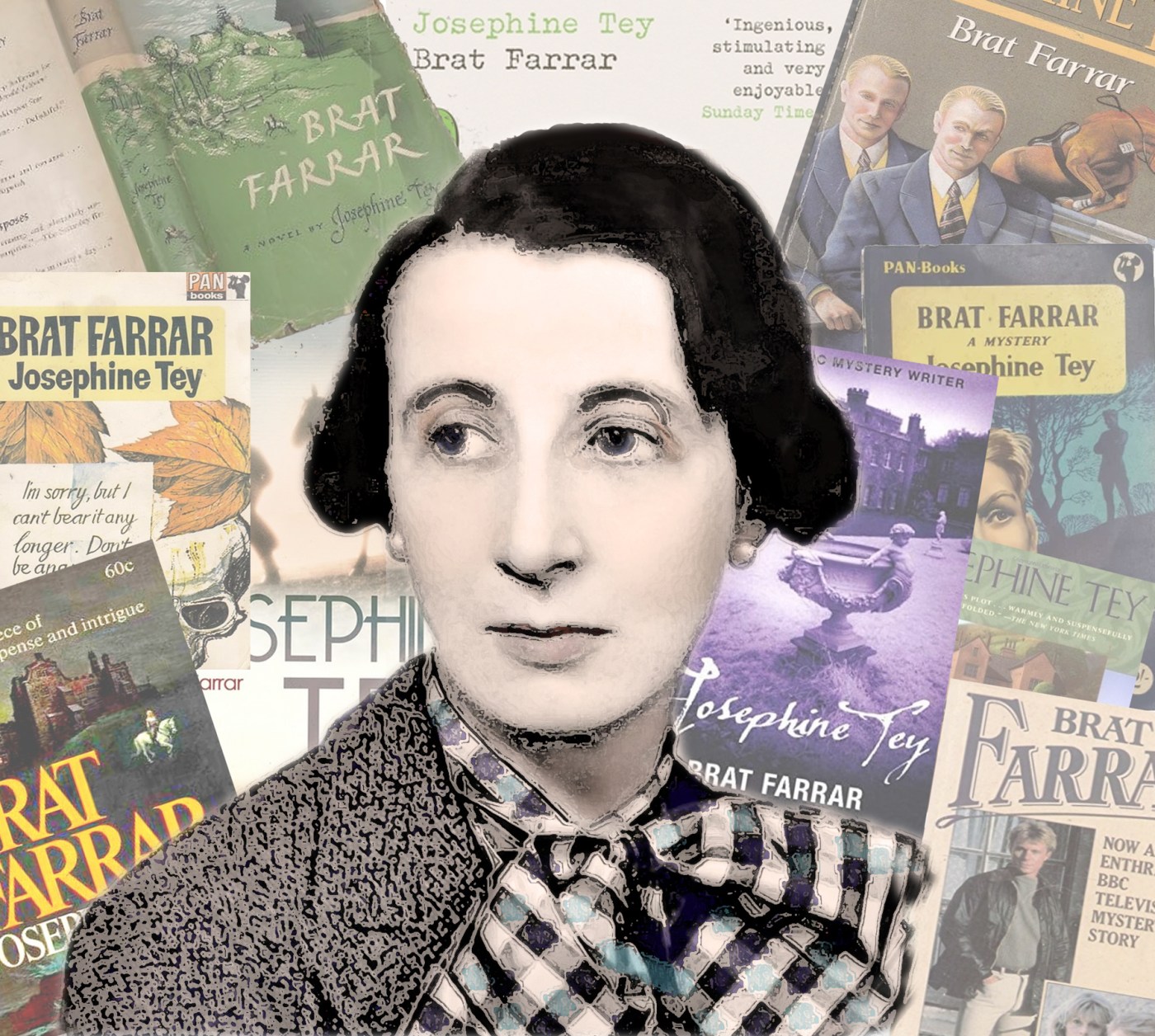

I imagine that anyone who calls themselves a crime fiction fan will have read Josephine Tey’s The Daughter of Time (1951) which, justifiably, regularly takes its place in the charts whenever anyone produces a list of the top crime novels ever written. I had vaguely heard of her earlier novel Brat Farrar (1949), but until I was sent a copy – by Penguin – as one of their reissued ‘Green’ classics, I had never got round to reading it. Within the first few ages I knew I was in for a treat, at least in terms of style and humour, when I read these lines:
“At this same table had eaten Ashbys who had died of fever in India, of wounds in the Crimea, of starvation in Queensland, of typhoid at the Cape, and of cirrhosis of the liver in the Straits settlements.”
“‘What became of cousin Walter?
‘Oh, he died.’
‘In an odour of sanctity?’
‘No. Carbolic. A workhouse ward, I think.'”
Rather like TDOT, the plot idea of Brat Farrar is very clever, if rather more complex. In the un-named English county where Tey sets the story, there are two neighbouring families, both formerly rather grand. In Clare House the Ledinghams “had been prodigal of their talents and their riches”. Now, the family has more or less destroyed itself and Clare is now a boarding school. The Ashbys still live at Latchetts. The male heir (the parents had been killed in an air crash) was Patrick, but he mysteriously disappeared, believed to have committed suicide by drowning, and now his marginally younger twin brother Simon stands to inherit the family fortunes when he comes of age. A member of the Ledingham family, a struggling actor called Alec Loding, has fortuitously spotted a young man – Brat Farrar – who is the living image of the late Patrick Ashby. He grooms him, and persuades him to assume Patrick’s persona, and reappear on the scene (with a plausible explanation for the false suicide) and claim the Ashby inheritance. Loding’s terms are simple:
“All I want is a cosy little weekly allowance for the rest of my life, so that I can thumb my nose at Equity, and management, and producers who say that I’m always late for rehearsal. And landladies.”
Yes, of course the plot is breathtaking in its implausibility, but that it its design – to make us gasp, and also entertain us with dazzling use of language and sharp social observation. It is also escapist in the best possible way, and for readers in the impoverished and dour times of post-war Britain, a glimpse of a different world. Perhaps a world that, even then, no longer existed, but a world away from austerity flavoured with NHS orange juice and dried milk.
 Brat Farrar is an ingenious invention. He is an orphan, and even his name is the result of administrative errors and poor spelling. He has been around the world trying to earn a living in such exotic locations as New Mexico, but has ended up in London, virtually penniless and becomes an easy mark for a chancer like Alec Loding. He is initially reluctant to take art in the scheme, but with Loding’s meticulous coaching – and his own uncanny resemblance to the late Patrick – he convinces the Ashbys that he is the real thing. But – and it is a very large ‘but’ – Brat senses that Simon Ashby has his doubts, and they soon reach a disturbing kind of equanimity. Each knows the truth about the other, but dare not say. The author’s solution to the conundrum is elegant, and the endgame is both gripping and has a sense of natural justice about it.
 Josephine Tey was one of the pseudonyms of Elizabeth MacKintosh (1896-1952) Her play, Richard of Bordeaux (written as Gordon Daviot) was celebrated in its day, and was produced by – and starred – John Gielgud. She never married, but a dear friend – perhaps an early romantic attachment – was killed on the Somme in 1916. She remained an enigma – even to friends who thought themselves close – throughout her life. Her funeral was reported thus:
“A small party of mourners, including Gielgud and the actress Dame Edith Evans, gathered at Streatham crematorium in South London on a cold, dreary day to say their farewells. “We talked to Gordon’s sister, whom we were all meeting for the first time,” *Caroline Ramsden recorded, “and she told us that Gordon had only come south from Scotland about a fortnight before, when she had stayed at her Club in Cavendish Square, on her way through London. What she did or thought about during that period was her own affair, never to be shared with anyone…. All her close friends were within easy reach, but she made no contacts—left no messages.”
*Writer, sculptor and racehorse owner, Caroline Ramsden was one of the oldest residents of London’s Primrose Hill ‘village’. Her abiding passions were horse racing and the theatre. Her memoirs encompass over 60 years of English social and cultural life, being a font of pleasure and information not only for racing and theatre enthusiasts, but for anyone who simply enjoys a glimpse of the past.
Brat Farrar is a wonderful book which simply does not date, despite the very different world in which we live. Tey’s prose is often sublime:
“She turned in at on the south porch of the church and found the great oak door still unlocked. The light of the sunset flooded the grey vault with warmth and the whole building held peace as a cup holds water.”
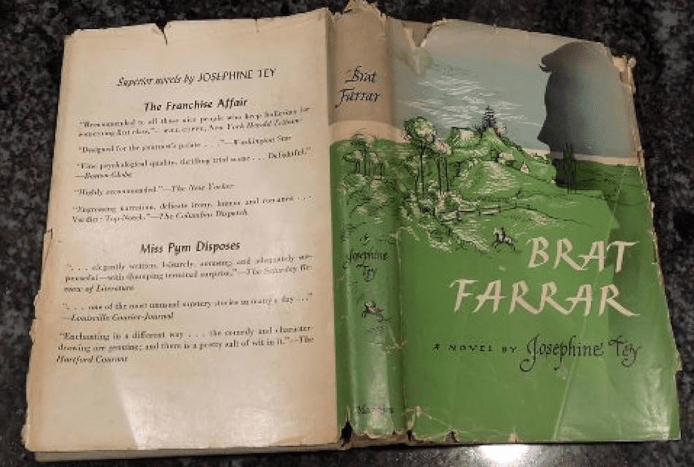
This edition is part of Penguin’s reissue of their ‘Green’ Modern Classics and is available now.


 fullybooked2017
Leave a comment