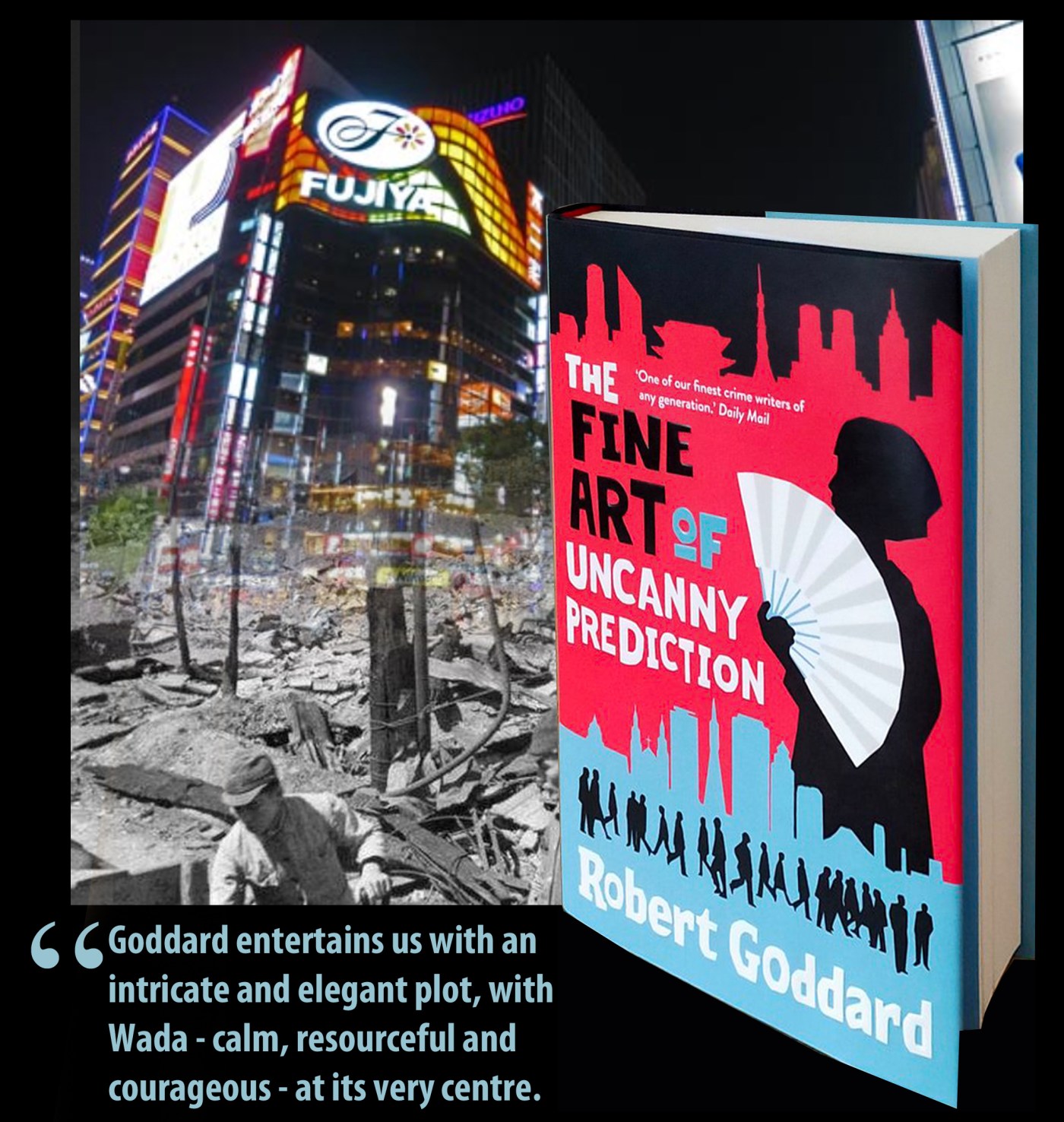

 I must confess to not having read anything by Robert Goddard (left) for a few years. Back in the day I enjoyed his James Maxted trilogy, which comprised The Ways of the World (2013), The Corners of the Globe (2014) and The Ends of The Earth (2015), which focused on a young former RAF pilot and his involvement in the political fallout in Europe after the Versailles Conference ended in 1920. I reviewed his standalone novel Panic Room in 2018 (click the link to read what I thought), and I quickly became immersed in his latest novel The Fine Art of Uncanny Prediction. Goddard introduced his unusual Tokyo private detective Umiko Wada in The Fine Art of Invisible Detection (2021). She returns in this novel, which is intricately plotted and rather complex at times. A widow, (her husband died as a result of the 1995 Tokyo Sarin Gas attack) she was once assistant to PI Kozuto Kodaka, but since his death she has shaped the business in her own way.
The strange title refers to a Japanese urban legend, which states that an unknown woman known as the Kobe Sensitive – predicted both the Kobe earthquake in 1995 and the tsunami which caused the Fukushima nuclear disaster 1n 2011. On both occasions she phoned the authorities, and on both occasions she was ignored, or so the story goes. The book spans over 70 years, but in three time frames – the immediate aftermath of Japan’s defeat in WW2, the 1990s and the present day. In the wreckage of 1945 Tokyo we meet Goro Rinzaki, the teenage factotum to the owner of an orphanage. After an accident in the ruins, Rinzaki allows his boss to die, but escapes with the a steel box which was locked in the orphanage’s safe, and it is Rinzaki who sits at the centre of Goddard’s narrative web like a malevolent spider. What the box contains is integral to the story.
We then switch to the present day where Wada is engaged by businessman Fumito Nagata who wants her to make contact with his estranged son Manjiro. The 1995 time frame begins with the late Kozuto Kodaka being hired by Terruki Jinno, millionaire chairman of Jinno Construction, to investigate the financial dealings of his recently deceased father – and founder of the company – Arinobu Jinno. If this all sounds complicated, that’s because it most certainly is, but it’s how Goddard pulls the disparate threads together that makes this such an intriguing read.
There is, almost inevitably, an American connection. Clyde Braxton was an American Army officer who was very much a ‘Mr Big’ during the post war occupation, and one of his remits was to monitor a reviving Japanese film industry. By ‘monitor’, I mean that exercised an absolute veto on the subject matter of new films. After leaving the army, he used his (probably ill-gotten) wealth to start a Californian winery, but when his family died in a catastrophic earthquake of he dedicated his time and money to the possibility of predicting future disasters, which is where his Japanese connections came good. One of the film-makers who prospered under his authority was none other than Goro Rinzaki. And Rinzaki believes he can offer Bryant the Kobe Sensitive.
As Wado searches for Manjiro Nagata she uncovers a conspiracy that puts her life in danger, as well as the lives of her friends and family. At every turn, both in Tokyo and California – where she goes to try to unravel the mystery – it seems that Goro Rinzaki has strings to pull and people on the inside of all major institutions – the press, the government and industry. We eventually learn what was in the steel box rescued from the ruins in 1945, but along the way Goddard entertains us with an intricate and elegant plot, with Wada – calm, resourceful and courageous – at its very centre. The book is published by Bantam and is available now.
https://www.amazon.co.uk/Fine-Art-Uncanny-Prediction-Between/dp/1787635104/ref=tmm_hrd_swatch_0?_encoding=UTF8&qid=1693469403&sr=8-1






 The title is, of course, police-speak for missing person, and this gritty novel shines an unforgiving light on the scourge of the County LInes drug trade in Britain. Put simply, the couriers are teenagers of school age up and down the land who deliver baggies of drugs to their customers. They are controlled by big city criminals who use the youngsters and their bikes, who know every little lane and ginnel of their home area to stay one step ahead of the police. Central to the story is the death of a policeman – shot by one of these youngsters – and the efforts of some of his colleagues to avenge his death. Watch my main page for a full review soon.
 This a very advanced look at a novel which will be available nearer Christmas time, although given the miserable summer we have been having, it might be more topical now. It’s December 1952, and a dead stranger has been found lodged up the chimney of Holly House in the remote town of Elderby. Is he a simple thief, or a would-be killer? Either way, he wasn’t on anyone’s Christmas wish list. Inspector Frank Grasby is ordered to investigate. The victim of some unfortunate misunderstandings, he hopes this case will help clear his name. But as is often the way for Grasby, things most certainly don’t go according to plan. Soon blizzards hit the North York Moors, cutting off the village from help, and the local doctor’s husband is found murdered. Grasby begins to realise that everyone in Elderby is hiding something – and if he can’t uncover the truth soon, the whole country will pay a dreadful price.
 This is the start of a new series from the Scottish author. In the small Highland village of Cronchie, a wealthy family are found brutally murdered in a satanic ritual and their heirloom, ‘the devil stone’, is the only thing stolen. The key suspects are known satanists – case closed? But when the investigating officer disappears after leaving the crime scene, DCI Christine Caplan is pulled in to investigate from Glasgow in a case that could restore her reputation. Caplan knows she is being punished for a minor misdemeanour when she is seconded to the Highlands, but ever the professional, she’s confident she can quickly solve the murders, and return home to her fractious family. But experience soon tells her that this is no open and shut case. She suspects the murder scene was staged, and with the heir to the family estate missing, there is something more at play than a mythical devil stone. As she closes in on the truth, it is suddenly her life, not her reputation that is danger! Will Caplan’s first Highland murder case be her last?
 This is the latest in the long-running Tempe Brennan series, and the redoubtable expert in human anthropology is playing away from her Montreal home turf – in the Caribbean paradise of the Turks and Caicos Islands – although there is a Canadian connection, in the shape of a badly chopped up body pulled out of the St Lawrence River. On the island holiday resort, Tempe has been induced to investigate the deaths of a number of young tourists, each of whom is missing a hand. Check my main page for the



 Catherine Ryan Howard shines an unforgiving light on the way in which the media treats the parents and family of women or children who have been abducted or murdered. Jennifer Gold was the youngest of the three missing women. She was conventionally beautiful, a scholar, high achiever and photogenic. Likewise her mother Margaret is polished, well groomed and an assured media performer. By contrast, Tana Meehan – the first woman to be abducted – was overweight and something of a wreck of a person, having left her husband to go home to live with her elderly and ill parents. Nicki O’Sullivan, or so it was reported, had been last seen staggering around on the pavement after drinking too much at a party.


 fullybooked2017