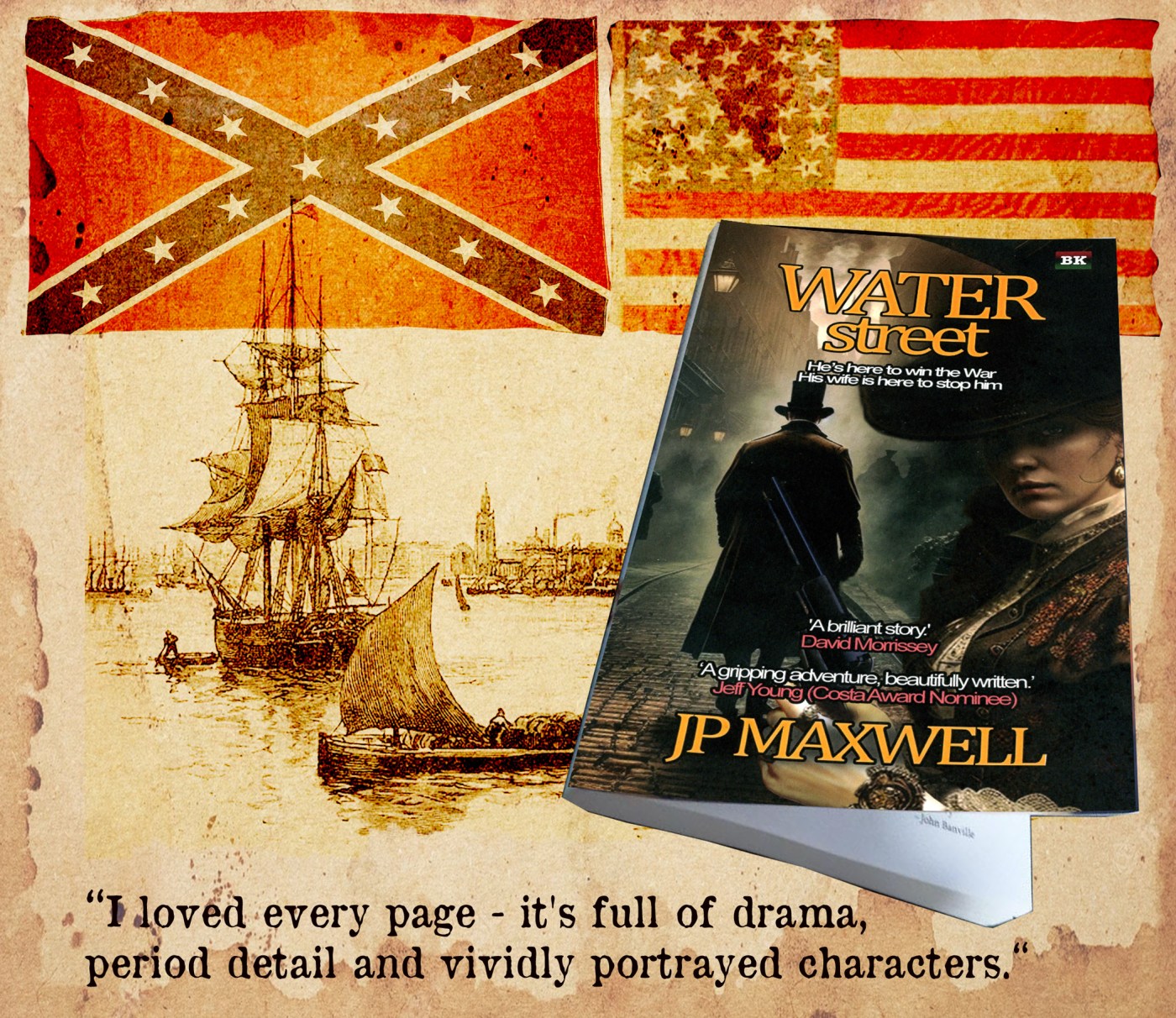

Britain’s relationships with both North and South during the American Civil War (1861-65) are something of a historical byway these days, but at the time, the conflict was a major issue in the port city of Liverpool. When the Union navy blockaded Charleston, Savannah, New Orleans and Mobile, it prevented shiploads of raw cotton from departing in the direction of Liverpool, thus dealing a crippling blow to the spinning and textile industries in and around Liverpool. The popular and political sentiment in the city became very much pro-Confederacy, and despite the national government remaining stoically neutral, shipyards on the River Mersey continued to build fighting ships – such as the Alabama – and sell them to the South.
Water Street is a highly entertaining novel set in the summer of 1863, and features murder and mayhem involving Union and Confederate spies trying to outwit each other and advance their respective causes with the British government. Author JP Maxwell centres his tale around two women – Harriet Dunwoody and her creole companion Conté Louverture. Harriet is married to a grotesque man called Banastre Xavier Dunwoody, an ardent and violent secessionist who plans to swing the support of Britain’s government – led by a seriously ill Lord Palmerston – behind the cause of Jefferson Davies and the Confederate States. Harriet is playing a very dangerous double game, along with Conté, as they conspire behind Dunwoody’s back to thwart local efforts to boost support for the Confederacy. In doing so, they enlist the aid of a rather ramshackle band of Irish nationalists, led by a thug called Royston Chubb.
Having thoroughly enjoyed the book (a quick read, just over 200 pages) I did want to step back and examine if – and to what extent – the characters in the book are based on real life historical figures. First, Palmerston. Although he was sick and elderly in 1863, there is no evidence that he was comatose and incapable of thought. The novel has Edward Seymour as First Lord of The Admiralty, and this he certainly was, but it seems his real life influence on Palmerston was nowhere as crucial as portrayed in the book. There was a Confederate agent in Liverpool called James Dunwoody Bulloch who did his very best to advance the Confederate cause during the war years, and he was certainly instrumental in pushing through deals with shipyards like Cammell Laird to build warships for the Confederacy, but he wasn’t the drunken gunslinger portrayed here.
One character who Maxwell doesn’t play fast and loose with is the official US Consulate to Liverpool – Thomas Haines Dudley. Dudley worked tirelessly for the Union cause, always being careful to stay within the constraints of diplomacy. The most curious real life character in the book is that of Major General Benjamin Butler. History has not been kind to him as either soldier, lawyer or politician, but there is no evidence (that I have seen) that he was running a ring of Union spies in the UK, nor that he visited Liverpool in 1863. In an edgy epilogue, Maxwell has Butler listening cynically to Lincoln’s famous speech at Gettysburg on 19th November 1863. He is joined by two characters called Surratt and Wilkes-Booth. If you know, you know!
To be fair, JP Maxwell has not claimed that Water Street is accurate historical fiction, and so my comments on real historical people can be ignored if you enjoy the book. The writing is very much ‘larger-than-life and, to borrow a sporting cliché, Maxwell leaves nothing in the dressing room. I loved every page – it’s full of drama, period detail and vividly portrayed characters. It was published on 1st July – a significant date, in the context of the story – by BK Books.


 fullybooked2017
July 10, 2023 at 10:10 am
Thanks for the blog tour support x
LikeLike