Search

fullybooked2017

Month

June 2023

VOICES OF THE DEAD . . . Between the covers

VOTD spine009 copy

Edinburgh physician Dr Will Raven returns for the fourth in the series set in Edinburgh in the middle years of the nineteenth century. Ambrose Parry is the husband and wife writing team of Chris Brookmyre and Dr Marisa Haetzman. For new readers, a brief ‘heads-up’ about the personal dynamics between the main characters might be useful. Raven is assistant to – and disciple of – Professor James Young Simpson, pioneer anaesthetist and the only real life character in the book. Sarah Fisher was once Simpson’s housekeeper and, briefly, Raven’s lover, but he has since married, as did she, but her husband is now dead. She has a burning ambition to become a doctor.

VOTD cast

When Raven is summoned to Surgeon’s Hall by his friend Henry Littlejohn he becomes caught up in a chain of events which range from the comically macabre through to the murderous. Wrapped in a blanket and  deposited in the bottom of a cupboard, a human foot has been discovered. The head of the College, the aloof and irascible Dr Archibald Christie has been informed. Anxious to avoid any whiff of scandal, and aware that Raven has something of a reputation as an amateur investigator, Christie orders Raven to discover the origin of the foot without alerting the police. Things spiral beyond Raven’s control, however, when other body parts are located. Along with the irascible detective James McLevy, all concerned initially make a wrong assumption about the person whose limbs seem to be randomly scattered around the city. Will Raven’s past is punctuated with several episodes that might be described as unfitting for a respectable physician, and one such – by way of an all-too-human ghost from the past – sets him back on his heels.

We are soon drawn into a fascinating parallel plot involving the  ‘science’ of mesmerism. Its creator, the German physician Franz Mesmer has been dead for over thirty years, but displays of what we now call hypnotism are still able to draw crowds. The flames of interest in mesmerism are being found by the activities of two people. One, Richard Kimble is more of a stage illusionist but the other, Doctor Harland Malham, seems to have better credentials, so much so that Sarah is extremely interested in what he is doing. Her interest is heightened because, when meeting her for the first time, he suggests that she has an aptitude for mesmerism and could possibly be taken on by him as a trainee. Raven of course is deeply sceptical, but is acutely aware of Sarah’s determination to succeed in the medical profession by one way or another. Is she being duped? And who is the mysterious local businessman, Mr Somerville, to whom Sarah has become attracted?

One of the key elements in this series – and this book is no exception – is the nature of the relationship between Raven and Sarah, now Raven is married. He already has one child, a small son, and another is on the way. He is devoted to his wife Eugenie, but there is always a frisson between him and Sarah and we wonder, as readers, where this will end.

It doesn’t take a critical genius to work out that Brookmyre is providing the plotting and textual nuances while Haetzman is providing the (sometimes grisly)medical details and sense of medical authenticity. This is certainly one literary partnership that works very well, and the world of 1850s Edinburgh is portrayed in vigorous detail, contrasting the often squalid lives of the poor with the very different world of the more advantaged. The bottom line is that this is a bloody good crime novel, full of twists and turns, convincing historical ambience and main characters we believe in. It is published by Canongate Books and is available now.

EVERYONE HERE IS LYING . . . Between the covers

EHIL HEADER

One of the most resilient tropes of the modern domestic psycho-thriller is the bland suburban community where something goes terribly, terribly wrong. This is bread-and-butter for Shari Lapena, and she introduces us to the manicured lawns and domestic harmony of Stanhope, a small  town where, at opposite ends of Connaught Street, live Dr. William Wooler and Nora Blanchard. They are both married, with children, but they have been having an affair. When Nora ends it, abruptly, at their regular tryst in a seedy motel, William drives home distraught, only to find his nine year-old daughter Avery in the house. She has been sent home from school after yet another outburst of disruptive behaviour. Avery is the very last person William wants to see, and they fight.

Avery Wooler is, frankly, a junior monster. She has all manner of letters after her name. Think of a syndrome, and she has it. She disrupts other little girls’ birthday parties because she can’t open the presents first. She drives her mum and dad to distraction and, in her father’s case – violence. On this afternoon. Avery greets her dad with her usual insouciance and he snaps, giving her a slap round the face. After making sure that no serious damage has been done, Wooler – his mind a turmoil of rejection and anger –  storms out of the house. Or does he?

When the rest of Wooler’s family – wife Erin and son Michael – arrive home, Avery is nowhere to be found. Eventually, the police are alerted, the panic button is hit, and a huge search ensues. The prescience of the book’s title becomes ever more apparent as – one house at a time – the families who live on Connaught Street are sucked into the mystery. The cops leading the hunt for Avery Wooler – officers Bledsoe and Gully – follow one false lead after another, not because they are particularly dim, but rather because they simply don’t have a physical trace of Avery. At the back of their minds is the awful truth that in child abduction cases, if the victim isn’t found alive within the first few hours, then it becomes a hunt for a body.

Shari Lapena describes in grim detail the psychological disintegration of the families involved, the Woolers and the Blanchards, but about two thirds of the way through she lets us know what actually happened to Avery so – in one sense – our suspense and stress are relieved, but our x-ray view of what is going on behind inside the walls of the houses on Connaught Street still allows for a few shocks. In my review of one of Shari Lapena’s earlier novels (click the link below) I used the term Anxiety Porn, and that’s what the Canadian novelist does really well.

BETWEEN THE COVERS . . . The End Of Her

Lapena’s speciality is describing how unfortunate events can tug away at domestic security like a loose thread being insistently pulled from a much-loved cardigan, with the result that the cosy garment disintegrates and becomes unwearable. Everyone Here Is Lying will be published on 6th July by Transworld Digital as a Kindle and Bantam in hardcover.

CLASSICS REVISITED . . . The Drowning Pool

TDP header

One of the abiding tropes of private eye fiction is that the book begins with a glamorous and mysterious woman knocking on the door of the PI’s office. Ross McDonald doesn’t disappoint.

“If you didn’t look at her face she was less than thirty, quick bodied and slim as a girl, her clothing drew attention to the fact: a tailored shark skin suit and high heels that tensed nylon-shadowed calves. But there was a pull of worry around her eyes and drawing at her mouth. The eyes were deep blue with a sort of double vision. They saw you clearly, took you in completely, and at the same time looked beyond you. They had years to look back on, and more things to see in the years that a girl’s eyes had. About thirty-five, I thought, and still in the running.”

Maude Slocum has been sent an anonymous letter which is demanding money with the threat of exposing her marital infidelity. After much sparring, because Maude is giving little away,  Lew Archer agrees to take the case.

The cast of characters, as in all good PI novels, is diverse: Maude Slocum is married to James Slocum, an amateur actor who is kept in funds by his mother Olivia, with whom he and his family live. Maude and James Slocum have a teenage daughter, Cathy, who is physically and mentally older than her years. Olivia Slocum owns a large plot of land in Quinto, the only place in the town which has not been brought up by an oil syndicate headed by Walter Kilbourne. Kilbourne, obese and devious has a wife, Mavis. Detective Frank Knudson is connected to the Slocum family. Pat Reavis is a tall good looking young man who is something of a Walter Mitty character.

When Olivia Slocum is found dead in her swimming pool, Archer is drawn into a web of lies and scheming which sideline his original quest for the author of the threatening letter.

More erudite critics than I have written about the comparison between Chandler’s Philip Marlowe and Lew Archer.  We need to remember that The Drowning Pool was published over a decade after the ground breaking The Big Sleep. For me, Macdonald takes the style and attitude of – let’s call him ‘the master’- and simply refines it while  never departing from the same bleak poetry that is unique to the sun scorched and wind blown California landscape.

“The water in the pool was so still it seemed solid, a polished surface reflecting the trees, the distant mountains and the sky. I looked up at the sky to the west, where the sun had dipped  behind the mountains. The clouds were writhing with red fire as if the sun had plunged in the invisible sea and set it flaming. Only the mountains stood out dark and firm against the conflagration of the sky.”

Archer has a sharp eye – and an even sharper tongue – for some of the characters he comes across.

“While I was eating a woman came through a door at the end of the bar. She was tall and big- boned, with more than flesh enough to cover her bones. The skirt of her cheap black suit was wrinkled where her hips and thighs bulged out. Her feet and ankles spilled over the tops of very tight black pumps. Her north end was decorated with a single grey fox, a double strand of imitation pearls approximately the same colour, and enough paint to preserve a battleship. Her chest was like a battleship’s prow, massive and sharp and uninviting. She gave me a long hard searchlight look, her heavy mouth held loose, all ready to smile. I took a bite of my sandwich and munched at her. The searchlights clicked off almost audibly.”

The title of the book is both literal and metaphorical. It is literal in the sense that Olivia Slocum is found dead in the family swimming pool, and later in the book Archer is subject to a kind of water torture from which he has great difficulty in escaping. But there is also the metaphorical sense that the frailties of many peoples lives are exposed,  and they are seen as perhaps basically decent people drowning in a moral swamp not entirely of their own making – the Aeschylean conundrum much loved by Shakespeare and Hardy.

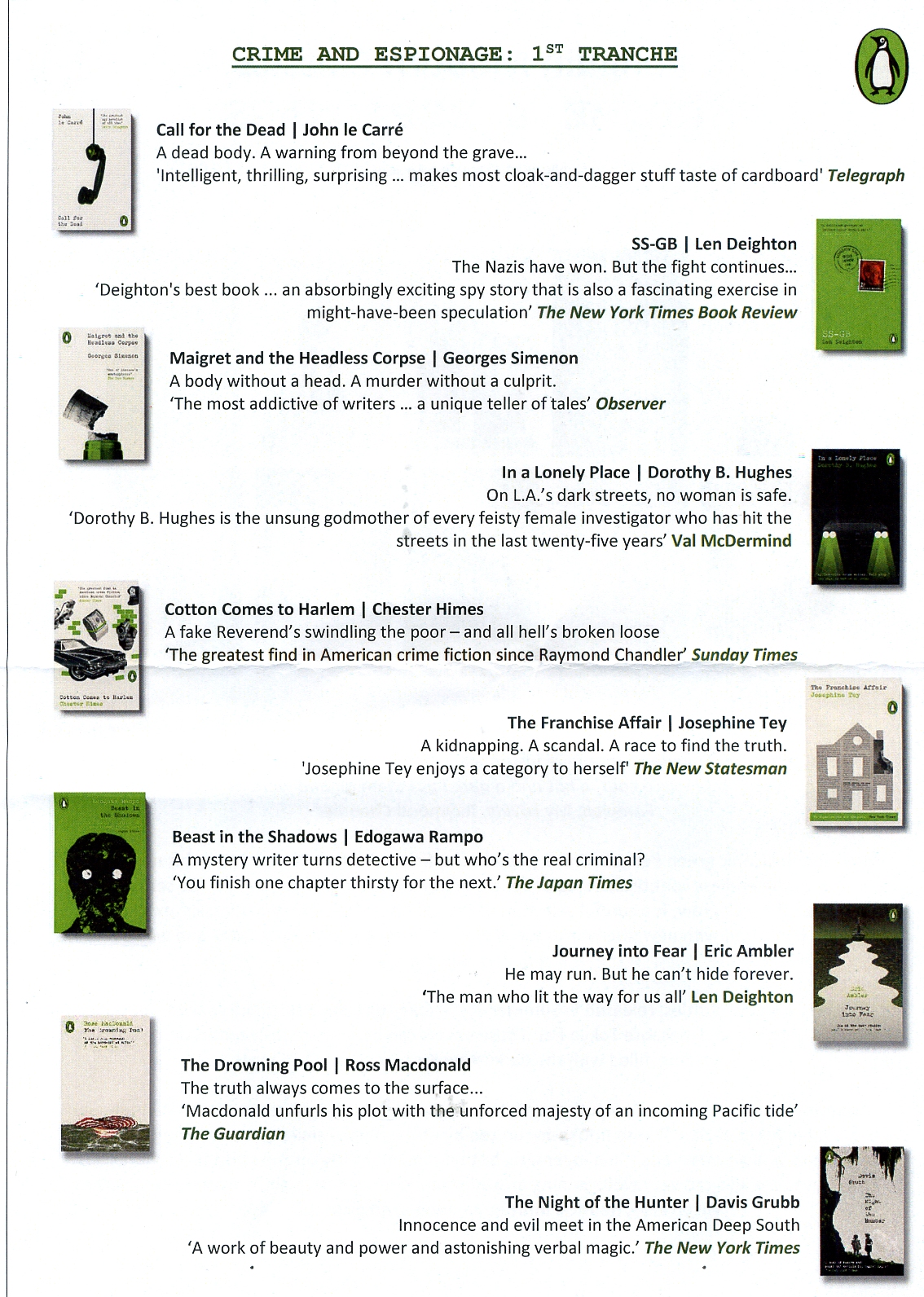
Blood feuds in California (at least the fictional California) seem only ever about two things. One, as in Chinatown is water, and the other – in this case –  is oil. Archer battles his way through the corruption and venality of rich men and women to reach a conclusion which is at least morally satisfying but, as ever, leaves him financially no better off. The Drowning Pool is full of pain, poetry and compassion, all of which are as vivid now as they were almost three quarters of a century ago when it was first published. This new edition of the novel, thankfully free from the malign attentions of Sensitivity Readers, will be published by Penguin on 13th July, as part of the first tranche of novels issued as an homage to the wonderful Green Penguins of yesteryear.

THE FASCINATION . . . Between the covers

Screen Shot 2023-06-08 at 19.51.27

Essie Fox takes us back to Victorian times with her novel The Fascination. It is the late summer of 1887. Keziah and Tilly Lovell are twins, but they are far from identical. At some point, Tilly simply stopped growing and, as she gets older, she is a woman in a child’s body. They escape from the brutish attentions of their drunken father, and are taken on by a showman called The Captain who senses a financial opportunity in the diminutive Tilly. She has the looks and voice of an angel, made all the more alluring by her tiny body.

Their paths cross that of Theo Seabrook. Cursed by being a (literal) bastard he is brought up by his aristocratic but malevolent grandfather, who eventually disinherits him. He finds work as assistant to Dr Eugene Summerwell – a former physician, but now another showman – who runs a ‘Museum of Anatomy’ in London. Despite its lofty title it is just another opportunity to make money out of punters who pay to marvel at preserved freaks of nature and medicine, mostly contained in glass bottles and cases.

The Fascination is described by the publicists as a ‘Gothic novel’. Church buffs will be aware of the architectural term, insofar as it applies to the three great periods of English medieval architecture – Early English, Decorated and Perpendicular – but what does it mean when applied to a novel? Although Wikipedia is frequently wrong, its definition of Gothic Fiction isn’t far off the mark:

Gothic fiction is characterized by an environment of fear, the threat of supernatural events, and the intrusion of the past upon the present. Gothic fiction is distinguished from other forms of scary or supernatural stories, such as fairy tales, by the specific theme of the present being haunted by the past.”

The anonymous author might have added:

A fascination with human deformity, ever-present reminders of death, physical beauty ruined by excess, the darkness of human imagination – and a general absence of normality.”

Away from the intriguing story – of which more in a moment – Essie Fox raises interesting questions about our age-old fascination with physical and mental differences in our fellow humans. I am old enough to remember traveling fairs in 1950s Britain, where people would still part with their hard-earned bobs and tanners to view The Bearded Lady, The Irish Midget or The Rat Woman. Most of these owed more to make-up than genuine deformity, but let’s not forget the 1932 American film (banned for many years) called Freaks. Directed and produced by Tod Browning. It was a melodrama set in a traveling circus. The basic plot was that a scheming female trapeze artist sets out to defraud a dwarf called Hans of a sizeable sum of money. In doing so, she invokes the wrath of Hans’s fellow ‘freaks’ – some of whom actually had severe physical deformities.

Screen Shot 2023-06-08 at 20.22.01

In these ‘enlightened’ days many enjoy a slightly more refined fascination with grotesques when they tune in to watch shows like Britain’s Got Talent and Love Island. Back in Victorian times, however, these pleasures were much more raw and face-to-face, and this is where Essie Fox places her characters. Few deviations from ‘the norm’ are excluded; in no particular order she offers us kidnap, prostitution, paedophilia, drug addiction, child abuse, grave robbing, pornography and debauchery.

FReaks
Under the skilful management of El Capitano, Tilly becomes a star of the London variety stage. It doesn’t hurt that she has a lovely singing voice, but the bottom line is that there is a sexual attraction, too. Essie Fox doesn’t lay this on with a trowel, but the fact is that Tilly is a nubile teenager, but one encased in the body of a nine year-old. It is this that brings her to the attention of Lord Seabrook, Theo’s syphilitic grandfather, and his scheming new wife. Tilly is kidnapped, and the intention is to use her as the central attraction at a Hellfire Club-style orgy in the crumbling mausoleum of Dornay Hall. After a daring rescue by El Capitano and his retinue of rather odd characters, Tilly’s virtue is saved, but not before several family skeletons are dangled in public view.

The Fascination is supercharged melodrama from start to finish and, on one level, gloriously over the top, but discerning readers will admire the many subtle counterpoints in the story, such as the intriguing relationship between Tilly and Keziah. The most telling twist only emerges in the final paragraph when the author reminds us that the proverbial ‘eye of the beholder’ is capable of powerful insight. This novel was published by Orenda Books on 22nd June.

TWO MEN IN BERLIN . . . Bernie Gunther and John Russell (part two)

Berlin Header

In part one of this feature I looked at the two fictional characters Bernie Gunther and John Russell and what happens in the novels, by Philip Kerr and David Downing, both series being rooted in Berlin. There, I dealt with the two series separately, and here I look at what divides them, and what common ground they share

In an imaginary world the two men might have met but, of course, they never did, despite Gunther being House Detective for the celebrated Adlon hotel (below), an establishment sometimes patronised by Russell.

Screen Shot 2023-06-02 at 20.36.09

Both men fought (for opposing sides) in the Great War and, in theory, coul have faced each other on opposite sides of No Man’s Land. Both have indelible memories of comrades being blown away by artillery and their tunics smeared with the brains of best mates. Both have an almost umbilical connection with Berlin, its parks and rivers, its tram and railway stations and its monumental architecture.

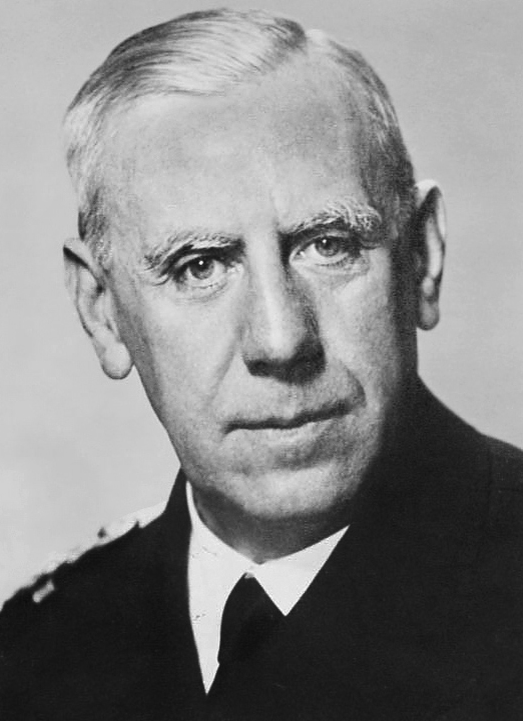
Screen Shot 2023-06-02 at 20.37.30Gunther is on nodding terms with such Nazi luminaries as Joseph Goebbels, Rheinhardt Heydrich and Arthur Nebe. In contrast, John Russell operates well below this elevated level of the Nazi heirarchy, although he references such monsters as Beria and Himmler, and does have face to face meetings with Wilhelm Canaris, head of the Abwehr (left).

John Russell is, largely, lucky in love. True, he has a failed marriage behind him but Paul, the son conceived and born when he was still married to Ilse, is a huge part of his life. He is also madly in reciprocated love with a prominent German actress, Effi Koenen. In the final novel, Masaryk Station, they are married. Effi is safe and well in Berlin – albeit in a Berlin being carved up between the Americans, the British, the Russians and the communist Germans who would go on to rule East Germany until the fall of the Berlin Wall. John and Effi have an adopted daughter Rosa, and Paul, who served as a teenager with the Wehrmacht, has survived the cataclysm of Hitler’s strategic blunders in the last two years of the war, and by 1948  he is living in London.

Screen Shot 2023-06-02 at 20.39.03Gunther, in contrast, has known nothing but trauma in family terms. His wife dies in tragic circumstance and then his girlfriend – whi s regnant with his child –  dies in one of the most infamous acts of WW2 – the sinking (by a Russian submarine) of the Wilhelm Gustloff in 1945. This account, detailed in The Other Side of Silence (2016) is, for me, the most compelling part of any of the Gunther novels:

The Wilhelm Gustloff was a cruise liner pressed into service as a military transport vessel, and in January 1945 it attempted to sail across the Baltic from Prussia. It was overloaded with some 10,000 personnel, mostly Germans fleeing the advance of the Red Army. The Soviet submarine S-13, captained by a maverick drunk and against orders sent three torpedoes into the side of the Wilhelm Gustloff. The ship sank killing 9,400, and is the worst maritime disaster in history.

Gunther is not a sexual predator, but beds women when they they present themselves, wherever and whenever. Russell remains resolutely faithful to Effi, but as she is an improbably beautiful film star with a healthy sexual appetite, we should not be placing the martyr’s crown on Russell’s head just yet, but he always has someone to fight for – Effi and Rosa, and his son Paul. By contrast Gunther is mostly only fighting for himself and his tarnished ideas of what is right and what is wrong. When he dies, he suspects that there will be few mourners as his coffin is laid in earth.

As far as Berlin is concerned, the two series run on parallel tracks. They share the final decadence of the Weimar years, the descent into Nazi rule, the devastation after the spring of 1945, and the finger-on-the-trigger tensions of the 1960s.

Russell’s geographical stamping grounds are tight: his domain is Europe – Prague, Triest, Belgrade, Danzig, occasionally London but – of course – always Berlin. Gunther goes where the job – or his pursuers – send him. In the novels, we see him operating all over the world – Argentina, Cuba, Greece, the South of France and Russia. Neither David Downing nor Philip Kerr waste time on political posturing, but both remind us that no known measurement – not even the thickness of the proverbial Rizla cigarette paper – separates the degeneration of Hitler and Stalin. This is never more prominent than in A Man Without Breath in which Gunther is sent by Goebbels to Smolensk. His task? To prove that it was the Russians who murdered thousands of Polish officers and flung their corpses into deep trenches. In the real world, it was not until the 1990s that Russia admitted its guilt.

Gunther is – first and last – a cop. He is physically imposing and familiar with violence. Russell is – at least in his day job – a freelance journalist, and avoids physical confrontation if he possibly can. Stylistically, the novels are also chalk and cheese. We share Gunther’s world through his own voice while we learn what John Russell is up to via the invisible third party. There is another important difference in the way the two series sit in what could be called a family tree of thrillers. Philip Kerr shapes his man more in the image of Philip Marlowe, albeit a Marlowe much more enthusiastic about using his fists (or any other available weapon). Gunther also echoes Marlowe’s bitter poetry, and talent for memorable descriptions. This is Bernie Gunther on Heidrich:

“Tall, skeletally thin, his long, pale face lacking expression, like some plaster of Paris death mask, and his Jack Frost fingers clamped behind his ramrod-straight back, Heydrich stared outside for a moment or two, saying nothing to either of us.”

David Downing portrays the world of espionage in a way familiar to readers of John Le Carré; this world is undeniably dangerous and fatal to those who make mistakes, but it it is less overtly dramatic, and – although more subtle – nonetheless deadly. John Russell is – in his heart – a socialist, but one who despairs of the direction taken by post 1945 communist regimes. Bernie Gunther is resolutely German and someone who has suffered grievously at the hands of the Russians, but a man who has gazed into the depths of evil plumbed by Hitler and his minions and realises that there are four combatants in his particular battle – the Germans, the Russians, the Anglo-Americans – and himself.

David Downing’s series ends with John Russell and Effi, like tens of thousands of other Berliners, becoming engulfed by the total Russian shut-down of land access to the city in 1948 – the act that precipitated the legendary Berlin Airlift. Philip Kerr’s premature death in 2018 means we shall never know if Bernie Gunther eventually enjoyed his retirement, but David Downing is – happily – still with us, and an eighth novel, Union Station, is due in 2024, and jumps forward to 1953, with Russell living in California.


THE GREEN PENGUIN RETURNS

PENGREEN HEADER

Great news for classic crime fans – the people at Penguin are giving us brand new editions of some of the greatest crime and espionage novels ever written, and all under the banner of that distinguished green penguin. Yes, I know most of us have read these books, maybe, as in my case, decades ago, but what a joy it will be to revisit them. The reissues begin on 13th July.

Pengreen001

Pengreen002

Pengreen003

Pengreen004

Pengreen005

Pengreen006

THE ROOM WITH EIGHT WINDOWS . . . Between the covers

8windows header

December 1930. Henry Johnstone, a former Detective Chief Inspector with the Metropolitan Police, has been forced to resign due to a debilitating injury. Now, he ekes out a solitary existence in a crumbling Brighton house, empty except for a large library assembled by the former owner, the late Sir Eamon Barry. Johnstone’s task – one given to him by a friend, concerned about his mental state – is to catalogue the thousands of books in the library. He is convinced he is being stalked, perhaps by someone linked to an old case. Then, he disappears. We know how – if not why – but his friends, among them his sister Cynthia and his former Sergeant Mickey Hitchens, are left with few clues, but one – left behind by Johnstone – suggests there is a link to a mysterious death and disappearance five years earlier.

When Johnstone is eventually found, he has been beaten within an inch of his life by a criminal gang, and is in no fit state to help the investigation into what seems to be a brutal and very well organised smuggling cartel. England’s south coast has been the backdrop for smuggling for centuries. I am reminded of the romantic lines of Kipling:

“If you wake at midnight, and hear a horse’s feet,
Don’t go drawing back the blind, or looking in the street,
Them that ask no questions isn’t told a lie. Watch the wall my darling while the Gentlemen go by.
Five and twenty ponies,
Trotting through the dark –
Brandy for the Parson, ‘Baccy for the Clerk.
Laces for a lady; letters for a spy,
And watch the wall my darling while the Gentlemen go by!”

These days, sadly, the smugglers don’t tend to deal in the traditional commodities of brandy and tobacco, but in the more profitable contraband of human lives. I would like to think that back in the day, the profiteers were not aided and abetted by the historical equivalent of the RNLI and the Border Force, but that is a debate for another day As Henry Johnstone slowly recovers his strength, Hitchens – and his slightly odd (but learning something new every day) Sergeant Tibbs – eventually get to the root of the mystery, but not before more lives are lost.

As is only right and proper in novels set in the 1930s, Jane A Adams makes us aware that most of her protagonists have a shared history – that of The Great War. Those over the age of 35 will have either fought in that conflict or lost husbands and sons: Younger people will have fathers they will never see again, with only a marble gravestone somewhere in France as a far-away reminder of what they have lost.

The period details in The Room With Eight Windows are impressive and convincing, as are the quirks and foibles of the main characters. This excellent and atmospheric thriller will be published by Severn House on 4th July.

TWO MEN IN BERLIN . . . Bernie Gunther and John Russell (part one)

Berlin Header

Bernie Gunther is the anti-hero of fourteen novels by the late Philip Kerr. Berlin cop, turned private investigator, sometime employee of Goebbels and Heydrich, and finally an international pariah, Gunther’s exploits span post Great War Germany to international intrigue in the 1950s. John Russell is an Anglo American journalist who begins the series of seven books by David Downing based in Germany. The books are all named after railway stations and span the years 1938 – 1948.

BERNIE GUNTHER

Screen Shot 2023-06-02 at 20.14.08Philip Kerr’s Berlin Noir series was published between 1989 and 1991, and introduced the world to Bernie Gunther. Strangely, it wasn’t until 2006 that the books March Violets, The Pale Criminal and A German Requiem were followed up with The One from the Other, and until his death the Edinburgh-born author brought us regular episodes from the life of his tough, resourceful and compassionate hero. The final novel in the series, Metropolis, was published in 2019 after Kerr’s death and, ironically, is set in the earliest part of Gunther’s career.

To begin with, Gunther has survived two world wars and seen death in all its forms. However, what makes the series fascinating is the challenge he faces, which is to keep his moral compass steady. Uniquely amongst fictional detectives, Bernie has to operate during the dark and savage days of the Third Reich.

Having returned from the trenches of The Great War, Gunther becomes a member of Kripo (Kriminalpolizei), the investigative branch of the Berlin police. During the turbulent years of the 1930s, he tries to steer an even and honest course between the rival political thuggery of the Nazis and the Communists, and when Hitler seizes power he eventually finds himself forced to join the SD (Sicherheistdienst), the intelligence division of the SS. Sent to Ukraine as part of an extermination group but having no stomach for this, he is shunted into the Wehrmacht on the Eastern Front, and is captured by the Russians. After the War, his ambiguous record makes him a person of interest to the Americans, the Russians and the leadership of the GDR, and he leads a dangerous existence among Nazi refugees in Cuba and South America.

Like John Lawton and George Macdonald Frazer, with their respective Freddie Troy and Flashman series, Kerr places fictional characters within real events and alongside celebrated or notorious historical figures. And, he manages to do so in a fascinating and totally plausible way. Assuming that Gunther was born in the mid-to-late 1890s, he can still be at work in the mid 1950s, albeit a heavier, slower and more breathless version of his former selfa latter day Ulysses.

“Made weak by time and fate, but strong in will to strive, to seek, to find and not to yield,” writes Kerr of his hero.
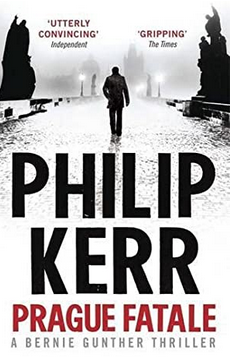
Screen Shot 2023-06-02 at 20.15.51The author’s style, particularly his use of dialogue, set him apart from most contemporary writers. His books were genuine literature, although I suspect written without literary pretension. In Prague Fatale,  he described Gunther meeting an American war correspondent in a Berlin blackout:

“His Old Spice and Virginia tobacco came ahead of him like a motorcycle outrider with a pennant on his mudguard. Solid footsteps bespoke sturdy wing-tip shoes that could have ferried him across the Delaware….his sweet and minty breath smelled of real toothpaste and testified to his having access to a dentist with teeth in his head who was still a decade off retirement.”

In his toughness, moral strength and cynical view of the world, Gunther is very much the heir of Philip Marlowe. His descriptions, sarcasm and one-line put-downs can be very funny. This is a line from A Quiet Flame, which came out in 2008:

“The isosceles of muscles between her chin and her collar-bone had stiffened, like something metallic. If I’d had a little wand I could have used it to tap out the part for triangle in the Bridal Chorus from Lohengrin.”
For more on Bernie Gunther, click the link below

https://fullybooked2017.com/tag/bernie-gunther/

JOHN RUSSELL

Russell is an English journalist with an American mother. Until 1927 he was a member of the Communist Party but, like many others, he fell out of love with the kind of socialism being espoused by Stalin and his acolytes. After serving with the British army in The Great War, he moved to Berlin, married Ilse, and they had a son – Paul. The marriage didn’t last.

Screen Shot 2023-06-02 at 20.17.47In terms of the actual time setting, Wedding Station (2021) gives us the earliest glimpse of John Russell.It is just months after Hitler’s rise to power, and Russell watches the Reichstag burn. Four weeks after Hitler’s accession, brownshirt mobs stalk the streets and the press prints what the Party tells it to.

In the first book (in publication terms) in the series, Zoo Station (2007) we are are introduced to Russell. It is 1939, Berlin, and Russell is an accredited American journalist, safe (for now) from the excesses of Hitler’s government. He has a glamorous girlfriend in Effie Koenen, who is a rising star in German cinema, but he still has a relatively civilised relationship with Ilse – and her new husband – and has regular access to Paul.

His communist background, American passport and fluency in both Russian and German make John Russell a unique target for the intelligence services of all the major powers and, almost like a serial bigamist he becomes wedded to the Sicherheitsdienst, the NKVD, the Abwehr, and the OSS. He plays each one off against the other, more or less successfully and, along with Effie and son Paul, survives the war, but finds ‘the peace’ post 1945 just as traumatic. In Masaryk Station (2013) set in 1948, Russell is told by a Soviet stooge that there is still a war, but that it is different:

“That war is over. It’s time you realised that another struggle – one every bit as crucial – is now underway.”
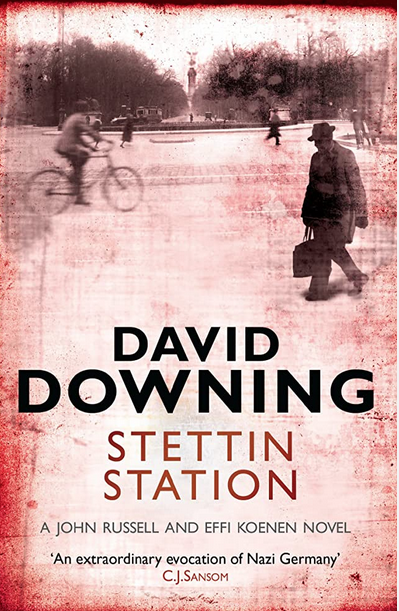
Screen Shot 2023-06-02 at 20.18.57One of the main anxieties in Russell’s complex life is his son Paul. As the boy reaches his teens he becomes – like millions of other German lads – a member of the Hitlerjugend, and this threatens to drive a wedge between father and so. In Stettin Station (2009) we are in November/December 1941, and a famed German air ace of WW1, Ernst Udet is dead. In fact, he shot himself, disillusioned with Luftwaffe chief Goering, and the general conduct of the war, but for the purposes of national solidarity the official story is that he died in a plane crash. As his elaborate funeral cortege passes their viewing point, Paul chides his father for not making the Seig Heil salute with enough reverence. Russell dreads the day when Paul is conscripted to the army and sent to fight on the Eastern Front.

John Russell’s contact with senior Nazi officials is limited, but he does occasionally come face to face with Wilhelm Canaris, the head of the Abwehr, the intelligence service of the German army. One of Russell’s many uneasy allegiances is to the Abwehr which, in fiction if not in fact, has been seen as the acceptable face of the Third Reich. This is perhaps born out by the fact that Canaris was executed for treason on 9th April 1945, in the dying days of Hitler’s regime.

Russell’s connection with Joseph Goebbels is more distant, and it is through Effi Koenen. She is probably the most ‘box office’ star of German cinema, and Goebbels – as propaganda minister – has absolute control over what films can be made, and what message they send out. As such, Effi is much sought after. Again in Stettin Station David Downing presents us with the bitter irony that Effi – pale, dark haired and sexually vibrant – is required to play a Jewish woman in a film with a vehemently anti-Jewish screenplay. For full reviews of Silesian Station and Wedding Station click the link below.

https://fullybooked2017.com/tag/david-downing/

IN PART TWO OF THIS FEATURE
I will examine the differences – and similarities between Bernie Gunther and John Russell.

TO DIE IN JUNE . . . Between the covers

TDIJ header

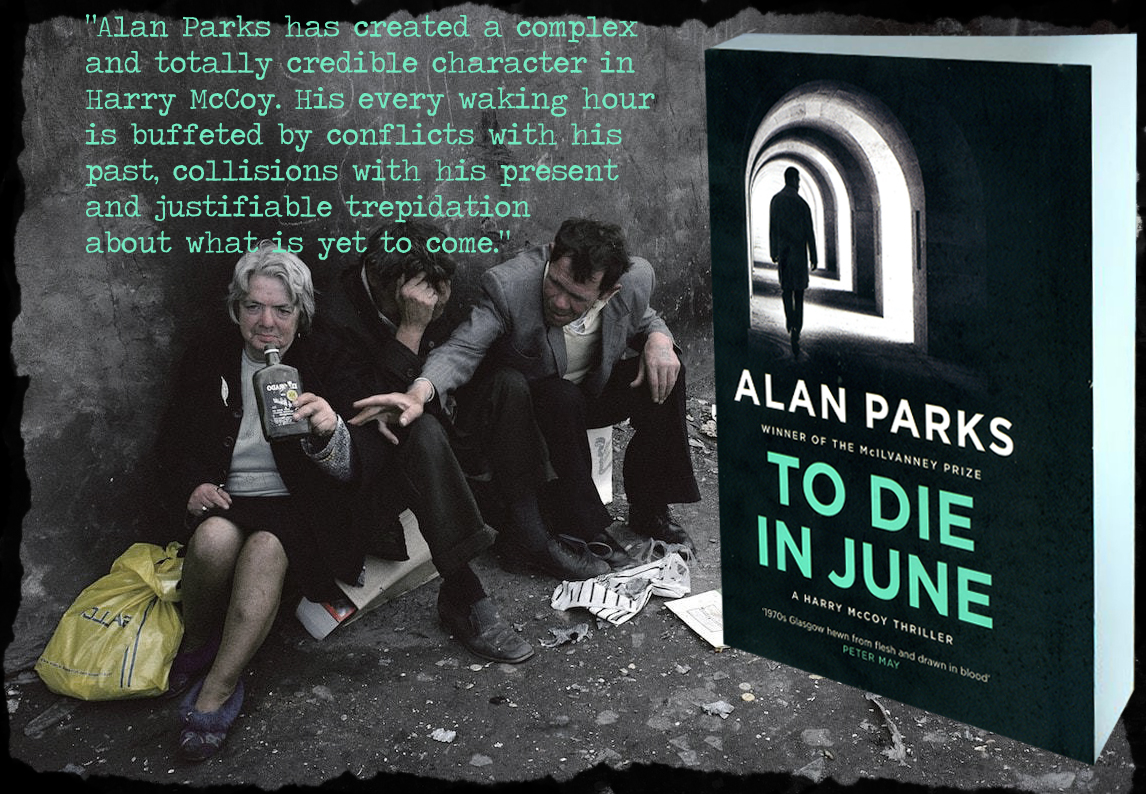
Screen Shot 2023-06-05 at 07.43.52Alan Parks (left) introduced us to Glasgow cop Harry McCoy in 2018 with Bloody January, and he has been resolutely working through the months with succeeding novels. Fictional Detective Inspectors in British crime fiction are many and varied. You would certainly need a fair sized village hall to seat them comfortably were they all to meet, so what about Harry McCoy? He has a fairly dark back-story. He was in and out of care institutions as a child. His mother is long dead, and his father – never the most consistent of parents – has now abandoned any sense of normality and is a homeless alcoholic. Through childhood connections – both were in care – he is connected to underworld boss Stevie Cooper. While not exactly in his pay, McCoy owes his old friend big-time, due to incidents in their shared past.

We are in the summer of 1975 so, in one sense this a historical novel, with many little period features that the author has to get right. No internet, computers or mobile phones, obviously, but early on in the story Parks sets the scene beautifully. McCoy has a celebrity girlfriend – a famous actress – and they are together at an showbiz awards function in the company of a young Billy Connolly, Stanley Baxter, Marie McDonald McLaughlin Lawrie (Google her) and Hamish Imlach. For those not versed in Scottish entertainers, Parks has Michael Aspel overseeing the evening.

McCoy has been transferred from his usual base to the insalubrious district of Possil, an area renowned for crime and deprivation. There is a purpose behind the move. McCoy’s boss, Chief Inspector Murray, believes that a group of detectives at the Possil station are corrupt, and he wants McCoy to infiltrate the cabal. Before McCoy can get close to the bent coppers, two urgent cases demand his attention. First, a vagrant is found dead, foaming at the mouth from having imbibed some kind of toxic drink. McCoy attends the scene, praying that the victim is not his dad. It isn’t, but the blasé dismissal of the case by the ‘experts’ as “just another alkie drank himself into an early grave” annoys him, and he senses something more sinister.

Then, a distraught woman presents herself at the station telling him that her young son has been abducted. Understandably, McCoy takes the woman at her word, and hits the panic button, with ensuing door-to-door, enquiries, blue lights flashing everywhere, and all leave cancelled. The woman then has some kind of fit and is hospitalised. When McCoy visits the home, and talks to the woman’s husband, the Reverend West, he is told that there is no son – never was – and that his wife has been  suffering with sever mental health issues for some years. West is the pastor at an obscure fundamentalist church, The Church of Christ’s Suffering.

When Mrs West throws herself to her death from a bridge, and more homeless men are found dead, McCoy hardly knows which way to turn. Added into the mix of his misery is that his old chum Stevie Cooper is about to initiate a turf war with a rival gangster, and expects McCoy to play his part. The plot twists this way and that, and there is a final hairpin bend which runs off the road anyone who is hoping for a warm and comfortable outcome to to this case for Harry McCoy.

lan Parks has created a complex and totally credible character in Harry McCoy. His every waking hour is buffeted by conflicts with his past, collisions with his present and justifiable trepidation about what is yet to come. To Die In June was published by Canongate on 25th May.

Blog at WordPress.com.

Up ↑