
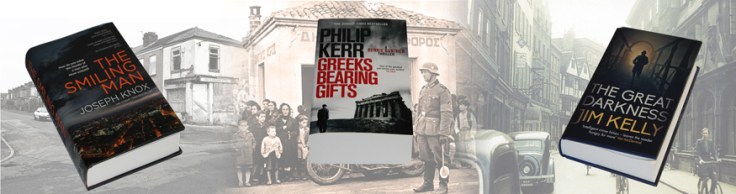
MOST BOOK REVIEWERS do not have the space to keep all the books they read and review. I’m no exception, despite living in a five bedroom property bought to house a missus and four sons. The four sons have now grown up and gone, but Mrs P is, happily, still in residence. Friends, giveaways and charity shops are the usual beneficiaries of the unwanted books, but there are some writers whose novels I will only be parted from after a brutal battle where I have, like John Cleese’s Black Knight, been dismembered. These books are usually dotted about throughout the year, and some only exist as a digital file on my Kindle, but to get three ‘keepers’ in one delivery is something special. Two of these writers could be called Elder Statesmen of the crime fiction world, but the third has established himself, in my eyes at least, after just one superb novel.
THE SMILING MAN by JOSEPH KNOX
 I met Joseph Knox (left) at a publisher’s showcase event in London, where he presented his debut novel, Sirens. I was hooked after hearing him read the opening paragraphs, and my initial impression was confirmed when I read the novel, featuring a conflicted young Manchester police officer, Aidan Waits. Knox talked about his work and influences in this interview, but now Aidan Waits makes a very welcome return. Once again, the city of Manchester looms as a malign and dystopian presence in The Smiling Man. In the crumbling and echoing emptiness of a former hotel, Waits finds a corpse whose killers have been so determined to render him anonymous that his teeth and fingertips have been replaced. In death, his face has assumed the rictus of a fatal smile. You can find out if – and how – Waits solves this crime on 8th March. The Smiling Man is published by Doubleday.
GREEKS BEARING GIFTS by PHILIP KERR
 Just as George MacDonald Fraser had his magnificent bounder Harry Flashman working his way through all the major political and military events of the the second half of the 19th century, so Philip Kerr (right) has positioned his wearily honest – but cynical – German cop Bernie Gunther in the 20th. We know Gunther fought in The Great War, but his service there is only, thus far, alluded to. We have seen him interact with most of the significant players in the decades spanning the rise of the Nazis through to their defeat and escape into post-war boltholes such as Argentina and Cuba. In the 13th book of this brilliant series, Gunther, joints creaking with advancing old age, is now working for an insurance company who want him to investigate a possible scam involving a sunken ship. His work takes him to Athens, where he discovers an unpleasantly familiar link to evil deeds committed under the baleful gaze of Adolf Hitler and his henchmen. Some of Bernie Gunther’s earlier exploits are covered here, while you can get hold of his latest case on 3rd April, courtesy of Quercus.
THE GREAT DARKNESS by JIM KELLY
Crime fiction readers are addicted to character series, and who can blame writers for feeding the fire. It is a matter of record that some very successful novelists have come to hate their creations, and have killed them off and started anew. Not all are successful – witness a certain Edinburgh physician – but Jim Kelly (below) has done the deed once, and now he is brave enough to do it again. His Peter Shaw books have matched his Philip Dryden novels for ingenuity, sense of place and history, and beautiful writing, but now he begins a third series, stepping back in time to the early days of World War Two. He has kept faith with his East Anglian setting, but we have moved sixteen miles down the road from Dryden’s cathedral city of Ely, to Cambridge where, in The Great Darkness, Detective Inspector Eden Brooke, struggling with the titular ban on night-time lights, discovers a gruesome killing o the banks of the gently flowing River Cam. The Great Darkness is published by Allison & Busby, and is out on 15th February. You can read more about Jim Kelly and his books here.



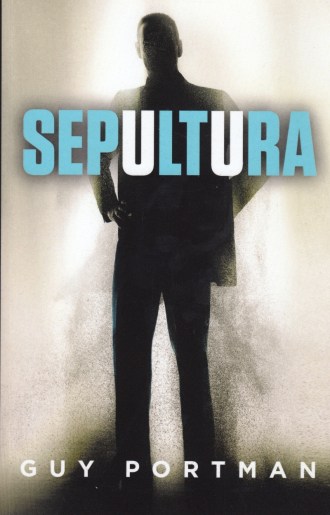 I must explain the apparent digression before you lose interest. Use your imagination. Conjure up a dreadful genetic experiment which breeds a being who, especially in his diarist’s style of first person narrative, shows very Pooteresque tendencies. But – and it is a ‘but’ the size of a third world country – the mad scientist has added Norman Bates and Hannibal Lecter into the mixing bowl, and then seasoned it with an eye-watering pinch of Patrick Bateman. What do you get? You get Dyson Devereux, Head of Cemeteries and Burials with Paleham Council.
 The trip to Italy temporarily removes Dyson from the cross-hairs of the local police, and also the relatives of the late lamented Jeremiah, who are out for vengeance. What follows is brilliantly inventive, murderous and breathtakingly funny. Guy Portman doesn’t reveal too much about himself, even on


 I became a firm fan of Robert Goddard (left) after reading and reviewing his excellent
  Robert Parker is one of CriFi’s ‘bright young things’. His debut novel,
  Some modern writers are so popular, so much read and so far down the road to becoming national treasures, that it almost seems like an affront to their status for (adopting Uriah Heep-like crouch and wringing hands) ‘umble reviewers to voice an opinion. Kirkcaldy’s First lady, Val McDermid, (left) is one such daunting figure. I have never had the pleasure of meeting Ms M, but she comes over on social media as being good- natured, endlessly patient and courteous to a fault. It goes without saying that she is a bloody fine writer and there can be few modern CriFi partnerships to match that of DCI Carol Jordan and Tony Hill. Now, heaven be praised, they return in paperback. Insidious Intent came out in Kindle and hardcover in summer 2017, but if you can hang on until the last week in February, you can get your paws on



 Amy Lloyd (right) makes sure that fans of Southern Noir who enjoy a tumbledown and gothicky old house in the Florida badlands are not disappointed. If you enjoy the odd sinister Sheriff, townsfolk who don’t hold grudges for much more than eighty years, and mentally disturbed teenagers in the body of a forty year-old man, you will not come away empty handed. But The Innocent Wife is much more subtle. As we follow the tortuous marriage of Sam and Dennis, we are reminded of the shocking consequences of ill-advised relationships forged on the flimsy anvil of whichever social media platform is currently in vogue. A chilling wind of truth blows through the narrative as we realise that the inch-thick perspex that separates prisoners from their visitors is a compelling metaphor for the separation which exists between people who only communicate via Facebook or Instagram.

 I had the pleasure of meeting Araminta Hall (left) recently at a publisher’s ‘do’ and so I was doubly delighted when a copy of Our Kind of Cruelty arrived at Fully Booked Towers. It is due to be published later this year, and it concerns a couple, Mike and Verity, whose relationship features a deadly game called the Crave. Mike describes the rules:
 I may as well continue the shameless name dropping and say that I was lucky enough to meet Tony Parsons (right) too, at the same Cornerstone event where I met Araminta Hall. He was full of fascinating background information about the mysterious and hidden world beneath The Old Bailey in London – the setting for an earlier DC Max Wolfe novel, The Hanging Club. Now, Max Wolfe returns with another London based case, but this time the stakes have ratcheted even higher. There is a very heated argument playing out on social media just now about what kind of city London has become, with acid attacks, knifings and terror threats becoming – some would say – commonplace. As topical as you like, Girl On Fire has terrorists using a drone to bring down an aircraft on a crowded London shopping centre, and in the ensuing chaos, Max Wolfe finds himself in clear and present danger. The book is
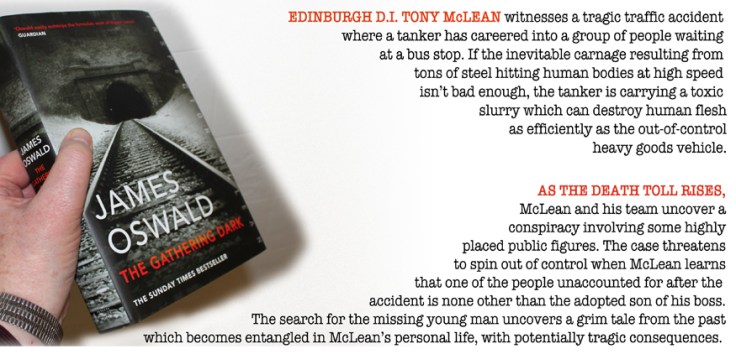


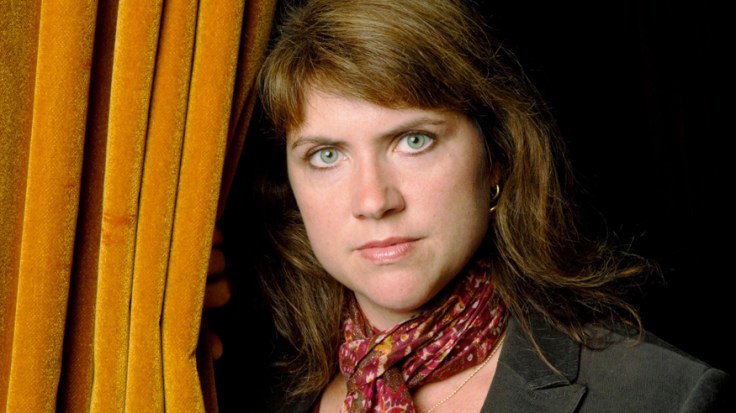
 We are taken to an autumnal Boston. Initially, Warren has nothing more on her mind than the consequences of giving in to the demands of her young son that they should adopt a dog. Her domestic reverie is rudely and violently interrupted when she is called to a house in the Brighton district of the city, where she is confronted by a scene of carnage. Householder Charlie Boyd is sitting on his sofa, as dead as a doornail. His girlfriend Juanita Baez is in the kitchen, shot as she was taking something from the cupboard. In the bedroom, even worse horrors await. Lola and Manny Baez, two of Juanita’s children, are clasped in a protective embrace, but just as dead as the adults.

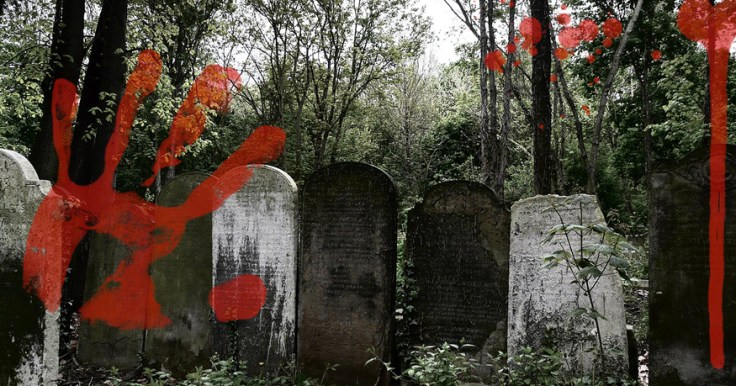
 Necropolis has a surreal plot involving, amongst other characters, an African drug dealer, a fugitive from the genocide of the 1990s Balkan wars – now working as a gravedigger – and a sadly deceased local resident for whom the undertakers have abandoned any pretence of good taste:
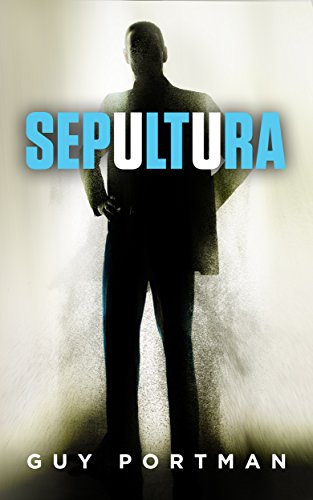 After a pause of three years, Dyson Devereux returns in Sepultura, to be published on 11th January. I have yet to get my hands on a copy, but it seems that Dyson has both a new job and a new son, but his cold rage and venomous disgust at his work colleagues and the world in general appears not to have abated one little bit. I can only guarantee that there will be death, cruelty, abrasive satire – and brilliant writing.


 fullybooked2017